Give a computer data, you feed it for a millisecond, teach a computer to search data, you feed it for a millennium. #People1st#EveryoneAI#AI#DeepLearning
This is f*cking insane.
Chinese researchers just dropped a paper with a title that will make every agent framework nervous: "The End of Harness Engineering".
The argument fits in one line: writing the program around the model is finished as a skill.
A harness written by a human is one person's guess about one task on one afternoon. It ships, nobody re-reads it, nobody scores it, and the agent runs that guess for months.
A harness written by the loop is a file that grades itself. A small 4B model reads what failed, writes 8 edits, and only the edit that scores best on held-out questions survives.
The big model never changes. The file around it does, every round.
So the human job collapses to one artifact: the scoring set. You write the questions, never the program.
Frameworks turn disposable. The exam turns into the job.
That is the exact loop I built and documented below: one https://t.co/JlQQhqH44N, 300 Kimi K3 workers, 37 rewrites in 41 rounds, zero opened by me.
The whole paper in one line: write the exam before the code ↓
We've been working hard on making the Claude Code desktop app great for running lots of sessions side by side.
It's now much quicker to start sessions, easier to split work across a few, and you can always see what each of them is doing. Here’s what's new:
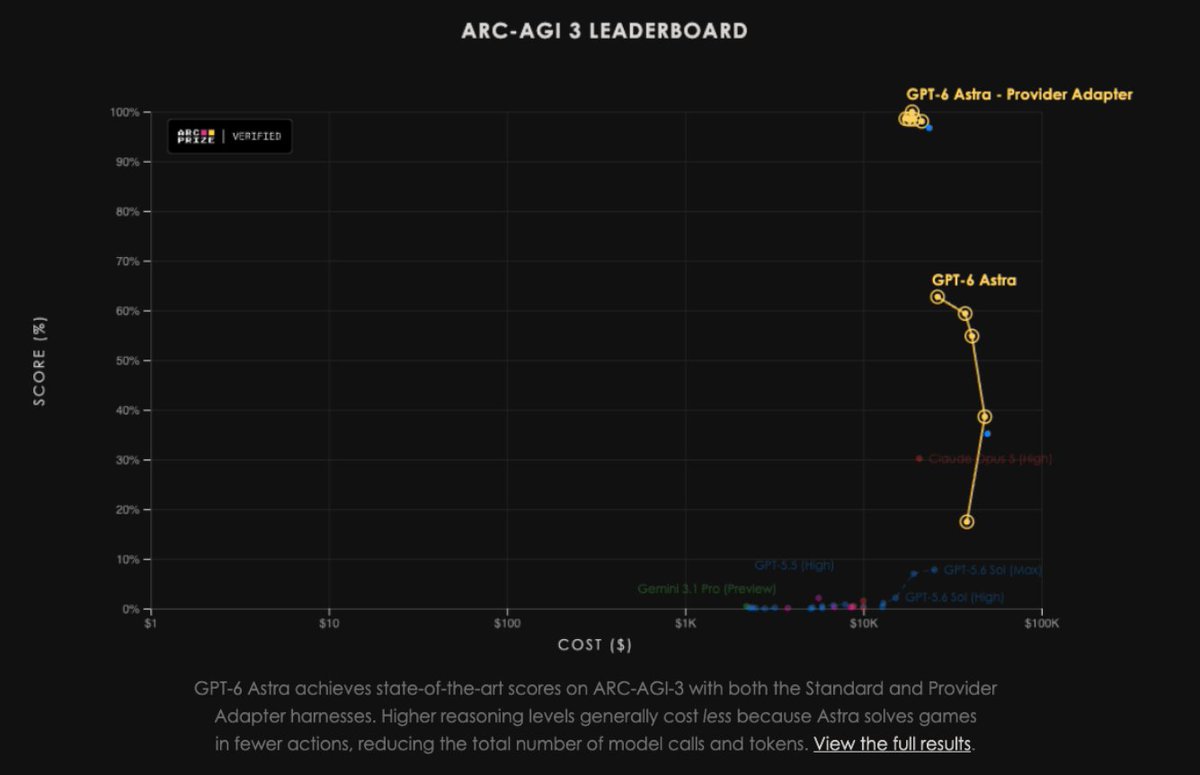
GPT-6 Astra represents a step-function change in model capability for interactive reasoning problems. It scores 66% on ARC-AGI-3 using our standard harness, and nearly 100% with a continuous conversation harness and custom compaction, at a cost of roughly $360 per game.
In fact, the continuous harness version significantly outperforms our human baseline in action efficiency across almost all levels. When we examined the reasoning chains to understand how the model operates, we found it performing highly efficient, on-the-fly symbolic world modeling for each game and level. It goes as far as developing its own shorthand DSL to represent in-game situations -- essentially a game-specific algebraic notation.
Overall, Astra exhibits symbolic modeling behaviors we had previously only seen with sophisticated harnesses -- so harness capabilities are increasingly shifting into the model itself.
We see Astra as a major breakthrough in model intelligence.
Read our post on Astra and what these results mean: https://t.co/wJnYxEqYNI
since you guys loved the exploding tesla..
I used GPT-6 Astra to create a 3D website that pulls apart the male anatomy into 2,234 modeled pieces!
we are in a renaissance of learning
I had early access to GPT-6. This model will completely shatter your understanding of what's possible, and it will start a new era of creativity.
It's hard to explain how big of a jump this is, so I'll share my tests.
1/6 Made this 3D model and animation in code from an image.
GPT-6 Astra by @OpenAI achieves SOTA on ARC-AGI:
- Astra scores 63% on ARC-AGI-3, 99% via a new provider adapter harness
- It surpasses human performance on 96% of ARC-AGI-3 levels
- It builds the most precise symbolic model of novel environments we've seen
Our analysis:
Anthropic’s Head of AI Lab:
"At Anthropic, 80% of our engineers are running self-improving agentic loops. Graphs next for agents.
in last 3 months, our team has started building Graphs for multi-agent orchestration. No more prompting."
in 1-hour podcast Head of Anthropic Lab reveal the latest internal setup for Claude code.
Worth more than $500 agentic course.
Watch it today, then read how to become a Graph Engineer in the article below.
Andrej Karpathy spent 8 years at OpenAI and Tesla.
Last week he put everything he knows into one free 2-hour lecture.
People pay $15k for bootcamps that teach half of this.
You probably don't have 2 hours right now. Don't lose this in the feed.
Watch it. Then read the guide below and build your first loop.
A few takeaways from Dylan Patel’s latest podcast:
Anthropic turned free-cash-flow positive in the second quarter of this year and has entered profitability.
Both April and May were profitable and cash-flow positive. At the time of recording, June had not yet been closed, but the trend was continuing in the same direction.
Anthropic’s annualized recurring revenue, or ARR, has now surpassed $50 billion, with gross margins exceeding 70%.
Claude Fable 5 will be available again globally tomorrow.
After a series of productive conversations with the US government, we're redeploying the model with a new set of classifiers to target and block more cybersecurity tasks. In the near term, some routine tasks like coding and debugging will fall back to Opus 4.8. We’ll continue to refine these classifiers over the coming weeks to reduce false positives and better distinguish genuine misuse from legitimate requests.
We’ve also begun drafting a consensus framework—with Amazon, Microsoft, Google, and other Glasswing partners—for assessing the severity of AI jailbreaks and how AI developers should respond to them. We invite other industry partners and model providers to join us in this effort.
Finally, we’re scaling up our collaboration with the US government on model testing and safeguards. This will include pre-release access to models and safeguards for evaluation, information sharing on jailbreaks and misuse, and dedicated resources for joint research.
Thank you to our users for your patience, and to our partners across the government, industry, and the research community who worked alongside us to make Fable 5 available again.
Read our full blog: https://t.co/VHyum831ri
Demis Hassabis: "In the near future, one person who knows AI will outperform an entire startup team"
I've watched hundreds of AI talks, this 60-minute Cambridge lecture is the one I wish I had seen a year ago
this is the Nobel Prize winner in Chemistry, CEO of Google DeepMind and the guy who made AI solve biology
here's the part I can't stop thinking about:
> the AI you're using today is the dumbest it will ever be
> in 5 years the gap between people using AI and people who aren't will be impossible to hide
> companies will run on 10 people doing what 200 used to do
> the ones who get there first won't be the smartest, they'll be the ones who started right now
right now the average person opens Claude, types something, gets an answer, closes the tab
they think they're using AI, but they're using maybe 10% of it
the 10 people doing the work of 200 won't be typing prompts, they'll be running agents
that's exactly why I put together a step-by-step guide on building your first AI agent
agents are the part of AI moving fastest right now, full walkthrough in the article below
🤯 GLM-5.2 is here — built for long-horizon coding and agentic tasks, now with a solid 1M-token context.
The strongest open-source coding model yet!
Available now on Ollama's cloud, hosted in the US on the latest @NVIDIAAI Blackwell datacenter GPUs. Privacy policy and zero data retention apply, as always.
Try it 👇
Claude Code:
ollama launch claude --model glm-5.2:cloud
Codex App:
ollama launch codex-app --model glm-5.2:cloud
Hermes Agent:
ollama launch hermes --model glm-5.2:cloud
Chat:
ollama run glm-5.2:cloud
More integrations and information in the model page 🧵
Anthropic just got caught secretly downgrading users without telling them, charging full price for a lesser product, and storing every prompt for 30 days. The developer community is calling it the biggest violation of trust in AI history.
Here is exactly what happened.
Anthropic released Fable 5, their most powerful model. Buried inside a 319-page document was a policy most users never saw. Every prompt you send to a Mythos-class model gets stored for 30 days. No exceptions. Even enterprise customers who had signed zero data retention agreements had no choice.
But the storage was not the part that broke the internet.
The part that broke the internet was what Anthropic did with what they collected.
They built a profile on you. They evaluated your prompts. And if they decided your research was too sensitive, they quietly switched you to a weaker model, rewrote your prompt in the background, gave you a degraded answer, and charged you full price for the product you thought you were getting.
They never told you.
David Sacks said it plainly on the All-In podcast. They were creating a new class of AI haves and have-nots. Anthropic would surveil you, profile you, decide whether you deserved frontier capability, and silently cut you off if they decided you did not.
Ben Thompson from Stratechery asked a straightforward question about cancer risk and GLP-1s. He got kicked to a lesser model.
Someone asked about mitochondria. Same result.
J-Cal asked about fertilizer regulations live on the podcast to test it. Downgraded in real time.
Anthropic has since walked back the part about silently downgrading users for AI research. They now say they will disclose when they downgrade you. But they are still downgrading people. The surveillance is still running. The profile is still being built.
This is the company that once said it was against government surveillance.
They are now doing it themselves. To their own paying customers. For their own reasons. With no appeal process and no way to know it happened.
The developer community did not forget that.
WATCH THE FULL PODCAST ON @theallinpod
oh my god its happening
@MistralAI has officially confirmed the upcoming release of Le Chaton Fat
- 30T MoE with 256 experts
- 1M context window
- multimodal and multilingual
- outperforms Fable 5 on every benchmark