Understanding Eritrea and the Need for a New Chapter in Eritrea – US Relations
By Sirak Kifle
The difficult relationship between Eritrea and the United States is often explained through narrow political narratives that focus only on recent events, sanctions, or diplomatic disputes. Yet the roots of mistrust run much deeper. They are tied to history, geopolitical choices made by the USA after World War II and during the Cold War, fundamentally different understandings of sovereignty and nation-building, and persistent misinterpretation.
The tensions between Eritrea and the United States are not primarily the result of an inevitable clash of national interests. Rather, they stem largely from decades of historical betrayal: US role in imposing bogus Federal Arrangement with Imperial Ethiopia, in brazen denial of Eritrea’s right of decolonization and a profound misunderstanding of Eritrea’s political culture, historical memory, and state-building priorities.
At the same time, continued hostility and estrangement serve neither Eritrean nor American interests today. In a rapidly changing global order marked by instability in the Red Sea region and the broader Horn of Africa, there is a growing need for a more realistic and respectful relationship based on mutual understanding rather than outdated and narrow geopolitical calculus.
Read More: https://t.co/PZTlUOCtOh
#Eritrea #Somalia #Djibouti #SouthSudan #Sudan #Ethiopia #Yemen
After the Ship Has Sailed: Ethiopia’s Myth of 3,000-Year Ownership of the Red Sea Coast
By Simon Zecharias
Ethiopia did not lose Assab in 1993. It lost an occupation. It lost the temporary possession of a coastline that had never been the natural, lawful, or sovereign inheritance of an Ethiopian state.
For decades, successive Ethiopian governments have wrapped the question of Eritrea’s Red Sea coast in mythology, grievance, and imperial nostalgia. They speak as though Ethiopia was robbed of an ancient birthright, as though Assab and Massawa were severed from a timeless Ethiopian body, and as though Eritrean sovereignty is an inconvenience to be corrected rather than a legal and historical reality to be respected and accepted.
The foundation of the claim rests on a larger myth: the assertion that Ethiopia has existed as a continuous state for three thousand years. That claim has been repeated so often that it has acquired the sound of truth among some Ethiopians who are lazy to study history of Africa, including Ethiopia’s own history. Some think repetition will be evidence. Ancient civilizations, churches, monasteries, and kingdoms existed in the region, but their existence does not prove the existence of a modern Ethiopian state stretching unchanged across millennia. To claim otherwise is to confuse civilization with statehood, religious continuity with political sovereignty, and imperial imagination with international law.
The modern Ethiopian state, as defined by recognizable territory, central government, and the capacity to enter binding relations with other states, is a far more recent construction. Its borders were consolidated not in antiquity, but through conquests, treaties, and diplomatic bargains of the nineteenth and early twentieth centuries. The historical record shows fragmented polities, competing kings, shifting allegiances, local rulers, and foreign treaties signed without reference to any unified Ethiopian sovereignty over the Red Sea coast.
This article examines that record. It asks a simple but devastating question: if Ethiopia truly possessed ancient sovereign rights over Assab, Massawa, and the Eritrean coastline, where is the evidence? Where are the treaties? Where is the continuous administration? Where is the recognized authority? Where is the international acknowledgment? The answer is clear. It is not there.
What the record shows instead is that Ethiopia’s Red Sea presence was brief, imposed, and historically exceptional. It began not with ancient sovereignty, but with the UN-imposed federation of Eritrea with Ethiopia in 1952, was deepened through annexation and occupation, and ended when Eritrea’s liberation struggle restored the rightful sovereignty of the Eritrean people in 1991.
The issue, therefore, is not how Ethiopia “lost” Assab or a Red Sea coast. The real issue is how Ethiopia acquired it in the first place, what it did to keep it, and what misery its claim inflicted on Eritreans. Once the mythology is stripped away, Ethiopia’s Red Sea grievance is exposed for what it is: not a legal claim, not a historical right, but an imperial hangover searching for a coastline.
Read More: https://t.co/23L0ECQdI8
#Eritrea #Somalia #Djibouti #SouthSudan #Sudan #Ethiopia #Yemen #SaudiArabia
@AbiyAhmedAli@MFAEthiopia@EthioReporter@PMEthiopia@EthiopianNewsA@ETMissionUN
Eritrea’s Road Towards an Organic State and its Institutional Reality
By Mihreteab Medhanie
One of the laziest accusations repeated against Eritrea is the claim that the country has “no institutions” because it has not implemented the 1997 Constitution in the manner demanded by Western liberal orthodoxy, has no conventional multiparty parliament, and has not held national elections according to the timetable preferred by foreign critics. This is a political slogan dressed up as scholarship. It is the old colonial gaze wearing a modern human-rights suit.
At the heart of the accusation lies a crude assumption: Africans are not expected to build institutions from their own history, struggle, culture, security realities, social needs, and developmental priorities. They are expected to imitate. They are expected to copy. They are expected to import ready-made political furniture from Europe and North America, arrange it neatly in their capitals, and call that “institution building,” even if the result is hollow, fragile, externally financed, and socially rootless. In this worldview, imitation becomes legitimacy, while originality is treated as suspicion.
The Western double standard is breathtaking. The same political tradition that took centuries to produce its current constitutional systems now demands that a newly independent African country, born from a thirty-year liberation war and immediately confronted by regional hostility, produce instant liberal perfection on command. The same powers that imposed colonial administrations designed for extraction and control now pretend to be neutral judges of institutional maturity in the societies they helped deform.
This article strips that myth bare. Read More:
https://t.co/OB8EvAsjE8
#Eritrea #Somalia #Djibouti #SouthSudan #Sudan #Ethiopia
@cnni@ReutersWorld@AJEnglish@AlJazeeraWorld@BBCWorld@blkagendareport@TheEconomist@PIIE
Beyond GDP: Why Real Development Is Measured in Human Progress
By Alula Frezghi (@AlulaFre)
Across Africa, political leaders frequently celebrate gross domestic product (GDP) growth as the ultimate measure of national success. New highways are inaugurated, skyscrapers reshape capital city skylines, and impressive economic statistics are presented as proof of national progress. International financial institutions often reinforce this narrative by ranking countries according to growth rates, investment flows, export volumes, and market expansion.
Yet a fundamental question remains: what is the purpose of economic growth if it fails to improve the lives of ordinary citizens?
Economic growth is undeniably important. No serious observer would deny the value of investment, industrialization, infrastructure development, or expanding markets. However, growth alone is not development. A rising GDP may enrich national accounts, but it does not automatically educate a child, vaccinate an infant, provide clean drinking water, reduce maternal mortality, or guarantee food security.
Development, at its core, is about people. It is reflected in whether communities are healthy, whether schools function effectively, whether families have access to basic services, and whether citizens can live with dignity, opportunity, and security. The true purpose of economic growth is not merely to increase national wealth, but to expand human well-being.
Read More: https://t.co/O0f1OYvwxh
#Eritrea #Somalia #Djibouti #SouthSudan #Sudan #Ethiopia #Kenya #Uganda #Rwanda #Tanzania
@WorldBankGroup@IMFNews@AJEnglish@BBCAfrica@RT_America
The Myth of Foreign Military Bases In Eritrea
by Ghidewon Abay Asmerom (@Ghidewon)
Few accusations reveal the dishonesty of anti-Eritrean propaganda more clearly than the claim that Eritrea has granted foreign military bases to Israel, Iran, or both. At different times, Eritrea has been accused of hosting Israeli naval facilities in the Dahlak Archipelago and Massawa, an Israeli listening post on Emba Soira (Eritrea’s highest mountain), an Iranian naval base in Assab, Iranian missile installations along the Red Sea coast, and, in the most absurd version, both Israeli and Iranian military facilities simultaneously.
...
Eritrea has repeatedly rejected these accusations as phantom bases and has consistently denied granting military facilities to either Israel or Iran. Its position has remained unchanged: Eritrea does not mortgage its land, islands, ports, or mountains to foreign powers, nor does it turn its territory into a battlefield for rival states. In the words of President Isaias Afwerki, Eritrea is not for sale—not to Israel, not to Iran, not to America, and not to any power that imagines Eritrean sovereignty can be rented, bought, or bargained away.
Read More: https://t.co/gC9E4qFadC
#Eritrea #Somalia #Djibouti #SouthSudan #Sudan #Ethiopia #Yemen #SaudiArabia
@cnni@ReutersWorld@AJEnglish@AlJazeeraWorld@BBCWorld@blkagendareport@TheEconomist@PIIE
Closed to Domination: Eritrea and the West’s Open–Closed Myth
Before a country is sanctioned, isolated, investigated, and condemned, it is first named. The label comes before the verdict. The slogan comes before the evidence. In Eritrea’s case, that slogan was “the North Korea of Africa”, a phrase engineered not to explain the country, but to make explanation unnecessary.
It is a smear built for speed. It is short enough for a headline, frightening enough for a policy brief, and lazy enough for journalists who prefer recycled clichés to historical context. Once Eritrea was placed inside the North Korea frame, its own history disappeared. Its thirty-year liberation struggle, its security concerns, its insistence on sovereignty, its rejection of foreign dependency, its religious complexity, its globally connected diaspora, and its social achievements were all flattened into a single caricature: isolated, irrational, sealed, and sinister.
That was the purpose. The phrase was never meant to illuminate Eritrea. It was meant to discredit it.
Read More:
https://t.co/1CGLHj2vRi
#Eritrea #Somalia #Djibouti #SouthSudan #Sudan #Ethiopia #Yemen #SaudiArabia
@cnni@ReutersWorld@AJEnglish@AlJazeeraWorld@BBCWorld@blkagendareport@turkiyetodaycom@TheEconomist@PIIE
Pacta Sunt Servanda and The Horn of Africa: Eritrea’s Sovereignty is a foundational Reality
By Ambassador Sophia Tesfamariam (@AmbStesfamariam)
There has been a lot written about Eritrea in the last few weeks, and I have decided to respond to one of the many pieces coming out of Ethiopia…The IFA article titled ‘Eritrea’s Sovereignty Claim and the Insecurity It Conceals’.
This article rests on a selective interpretation of international law, an incomplete account of the history of the Horn of Africa, and a troubling attempt to recast legitimate concerns regarding sovereignty and territorial integrity as evidence of political insecurity rather than lawful state responsibility. It is therefore necessary to address several of the issues raised in this selectively framed piece.
Read More: https://t.co/7XwQ4UUpPS
#Eritrea #Somalia #Djibouti #SouthSudan #Sudan #Ethiopia #Yemen #SaudiArabia
@fanatelevision@TheReporterET@EthioReporter@AbiyAhmedAli@MFAEthiopia@PMEthiopia@RedwanHussien@TheDailySomalia@sntvnews1@MofaSudan@StateHouse_J1@SouthSudanGov@IGADPeace@DrWorkneh@IGADsecretariat@NuursViews@_AfricanUnion@hawelti@shabait
The Frog with a Landlocked Navy: Ethiopia’s Red Sea Delusion
It is an absurd argument: a landlocked state, without a sovereign coastline, without a functioning maritime domain, and without control over its own internal corridors, now presents itself as the natural guardian of the Red Sea. Ethiopia, a country struggling to secure movement across its own territory, wants the world to believe it can secure one of the most sensitive maritime corridors on earth. This is not strategy; it is theaterical. Worse, it is entitlement dressed up as security policy. The argument would be laughable if it were not dangerous.
Read More:
https://t.co/MCkpGmLgr0
#Eritrea #Somalia #Djibouti #SouthSudan #Sudan #Ethiopia #Yemen #SaudiArabia
@fanatelevision@TheReporterET@EthioReporter@AbiyAhmedAli@MFAEthiopia@PMEthiopia@RedwanHussien@IGADPeace@DrWorkneh@IGADsecretariat
If Eritrea is Artificial, then so is Africa—and Even More so Ethiopia
https://t.co/Jr7jETeff5
MYTH: “Eritrea is an artificial colonial creation of Italy and sustained by Arab patronage”
FACT: Eritrean independence was not granted by foreign powers. Like virtually every African state, Eritrea emerged within borders established during the colonial era and later recognized under international law. If Eritrea is considered artificial because its borders were defined during the colonial era, then the same logic would render almost every African state artificial. Eritrea is no exception; it emerged through the same historical process that shaped the modern African state system. Its independence, however, was not bestowed by diplomats, negotiated into existence in foreign capitals, or delivered on a silver platter. It was won through the blood, sacrifice, and perseverance of generations of Eritreans who fought and died for freedom on every front, from the trenches of Nakfa and the mountains of Sahel to the shores of the Red Sea. Eritrea secured its independence the hardest way a nation can, by defeating an occupying power backed at different times by the United States, the Soviet Union, and powerful diplomatic allies. What others sought to deny through force, Eritreans secured through struggle. Eritrea was not given independence; it earned it.
#Eritrea #Somalia #Djibouti #SouthSudan #Sudan #Ethiopia #Yemen #Africa
A master class in Eritrean history:
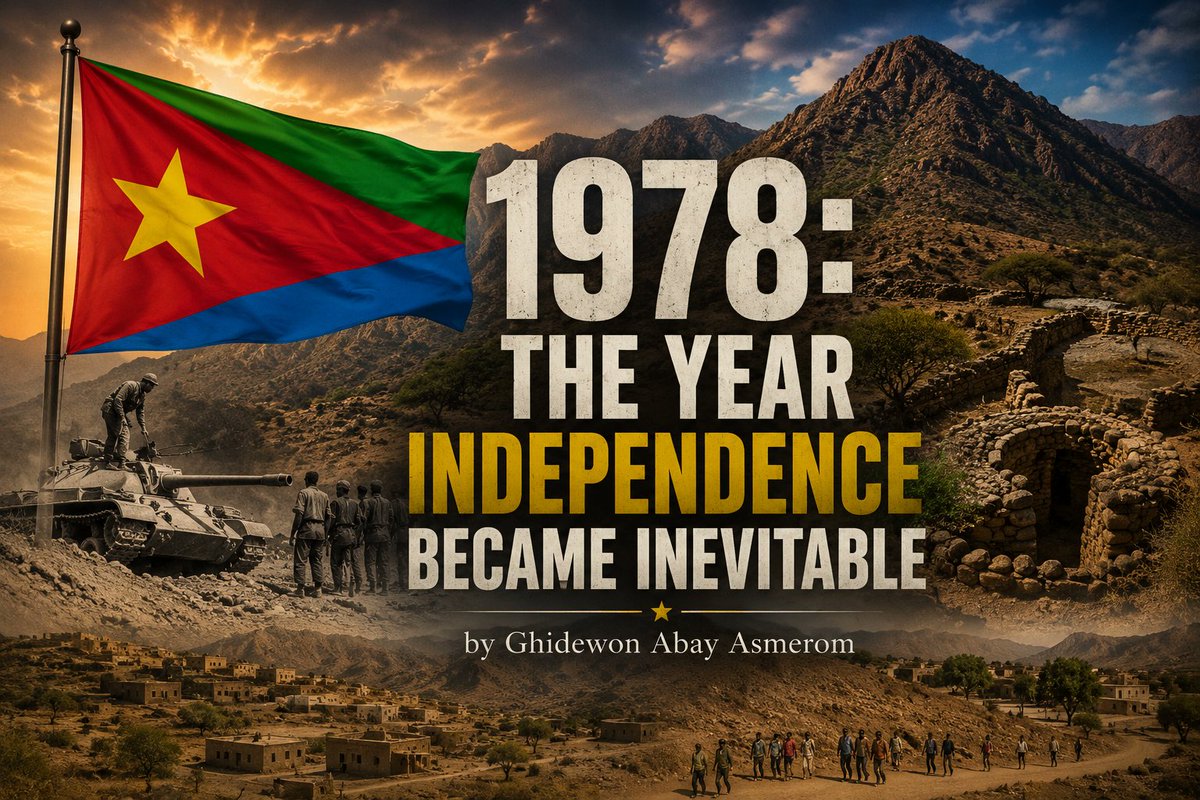
1978: The Year Independence Became Inevitable
By Ghidewon Abay Asmerom (@Ghidewon)
History remembers spectacle, the raising of flags, the fall of capitals, the signatures that close wars. But wars are not decided in ceremony. They are decided earlier, when force is spent and fails, when one side proves it cannot be defeated. By that measure, Eritrea’s independence was secured way before 1991. It was decided in 1978, when the full weight of a Soviet-backed war machine descended with the promise of annihilation and failed.
By early 1978, the Eritrean liberation fronts, the EPLF and ELF, had liberated almost all of Eritrean territory. Ethiopian forces were reduced to five besieged urban strongholds: Asmara, Barentu, Adi Keyih, Assab, and a small part of Massawa. The war appeared to be nearing its conclusion. Yet the trajectory of wars is rarely linear. At the very moment victory seemed within reach, the balance of forces shifted abruptly.
Ethiopia’s recovery came through its victory in the Ogaden War (1977–1978), secured not through internal strength but through massive external intervention. The Soviet Union airlifted vast quantities of modern weaponry. Cuba deployed approximately 17,000 combat troops. Soviet generals embedded themselves within Ethiopian command structures, supported by intelligence networks and advisors. The Derg regime, once faltering, reemerged, rearmed, reorganized, and emboldened, declaring: “The victory in the East will be repeated in the North.” What followed was not a counteroffensive but an attempt to quash the Eritrean Armed Struggle for Independence once and for all.
Read More: https://t.co/ZohNzBO3t3
#Eritrea #Somalia #Djibouti #SouthSudan #Sudan #Ethiopia #Yemen #SaudiArabia
@fanatelevision@TheReporterET@EthioReporter@AbiyAhmedAli@MFAEthiopia@PMEthiopia@RedwanHussien@turkiyetodaycom
Asmara at the Center: Eritrea and the Collapse of the Old Horn of Africa Order
By Dawit Gebremichael Habte
For more than eighty years, the Horn of Africa has been organized around a single geopolitical assumption: that Ethiopia was the indispensable center of regional order and that the security of the Red Sea could be managed through Addis Ababa. This assumption shaped the policies of superpowers, international organizations, and regional actors alike. It justified the sacrifice of Eritrean self-determination during the federation era, rationalized decades of support for Ethiopian regional primacy, and informed Washington’s broader strategy from the Cold War through the War on Terror. Today, that assumption is collapsing.
https://t.co/4xDonJsYQN
#Eritrea #Yemen #Egypt #Somalia #SaudiArabia #Djibouti
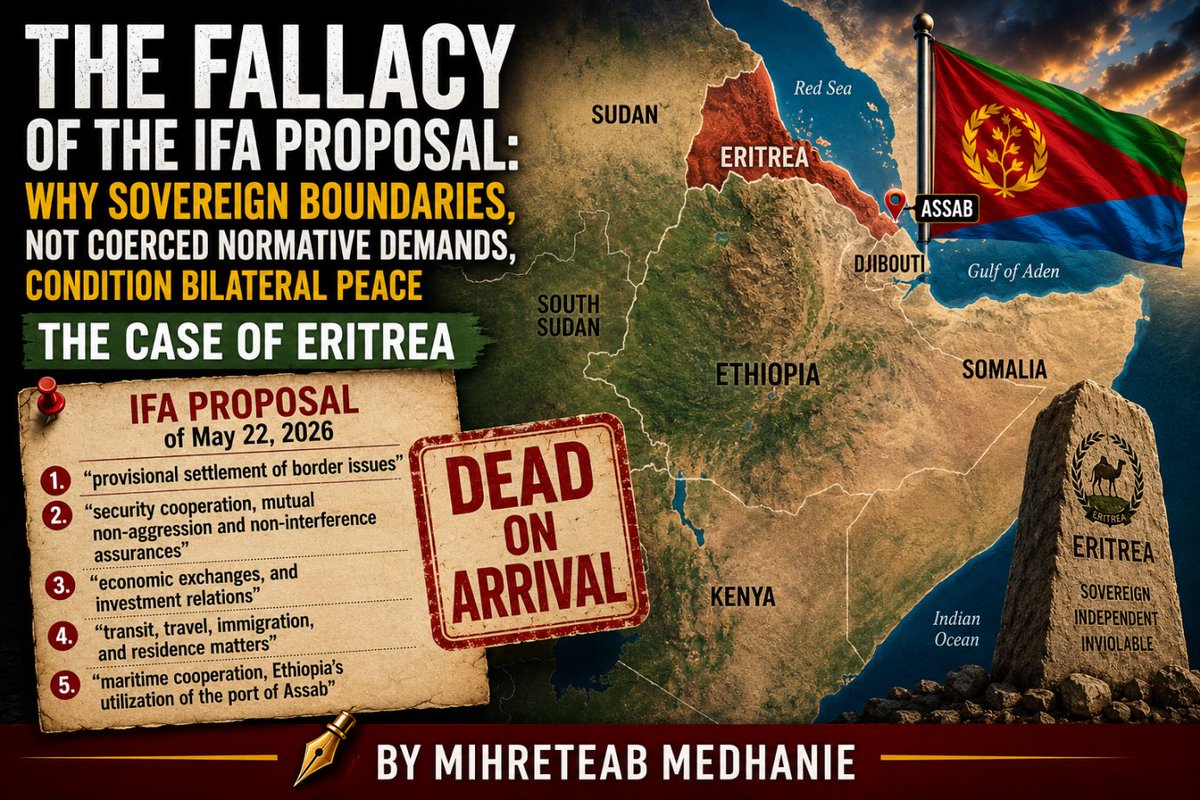
The Fallacy of the IFA Proposal: Why Sovereign Boundaries, Not Coerced Normative Demands, Condition Bilateral Peace
by Mihreteab Medhanie
The recent framework (May 22, 2026) published by the Ethiopian Institute of Foreign Affairs (IFA), titled “Ethiopia-Eritrea Relations: Historical Drivers of Conflict and Pathways to Peace,” is a text built on a foundational error in international relations. Under the guise of a “tamed,” structured assessment, the document lays out a series of five pillars as preconditions for regional normalization. In reality, this framework effectively asks a sovereign nation—Eritrea—to subordinate its sovereign identity, territorial integrity, and institutional autonomy to the domestic and geopolitical anxieties of its landlocked neighbor.
https://t.co/n3jVinAilC
#Eritrea #Sudan #Somali #Ethiopia
@M_Farmaajo@EthiopianNewsA@EthioReporter@PMEthiopia
The Spirit of Medeber
By Ibrahim A. Ibrahim
Eritrea’s technological leap may not begin with imported machines or foreign blueprints. It may begin with a hammer in Medeber, a student invention at Expo, and a classroom where young minds are introduced to engineering, computing, electronics, robotics, artificial intelligence, and other emerging technologies. When practical skill, youthful imagination, and modern education meet, a small country can make a great leap. That is the promise before Eritrea.
Read more: https://t.co/N5Odipu3kx
#Eritrea #Somalia #Djibouti #SouthSudan #Sudan #Ethiopia #Yemen #SaudiArabia #EritreaShinesAt35 #EritreaAt35 #EritreaPrevails #Eritrea
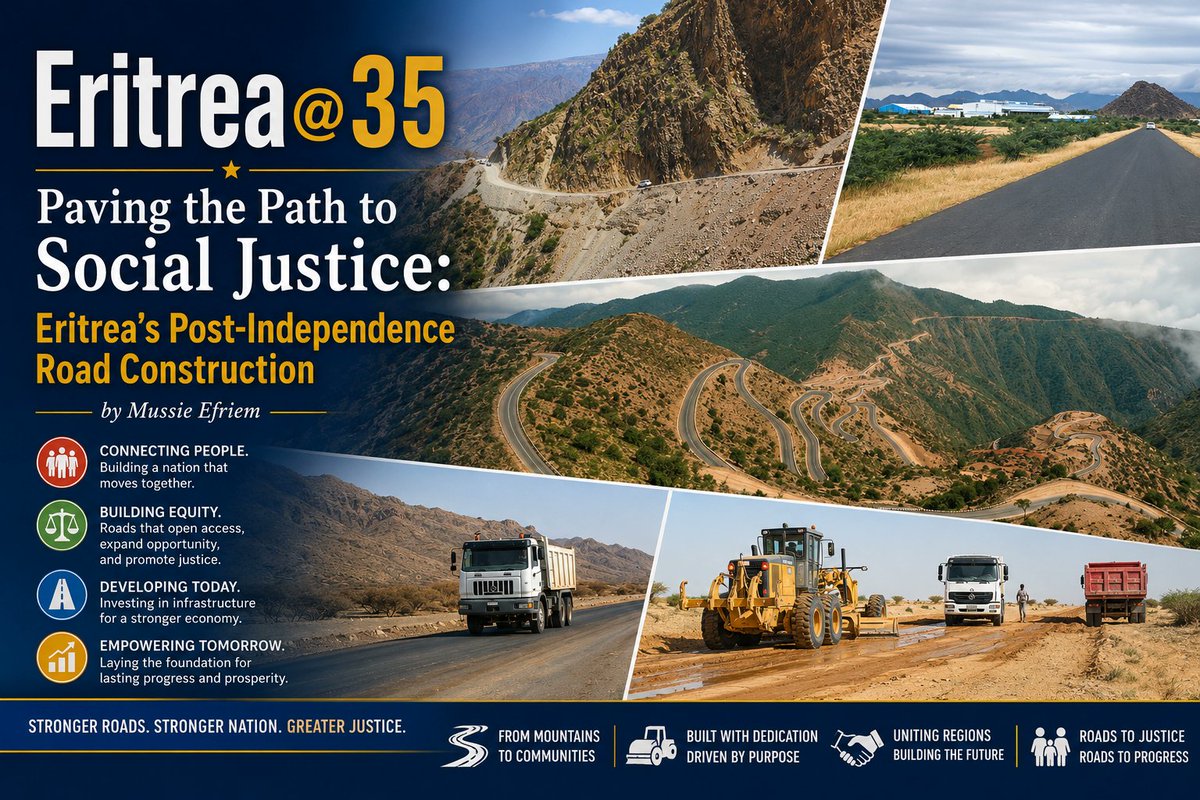
Eritrea@35: A Series Concludes, A National Journey Continues
By Red Sea Beacon
Thirty-five days before Eritrea’s 35th Independence Day anniversary, the “Eritrea@35” series began with a simple but important mission: to reflect, day by day, on the achievements, resilience, and nation-building efforts that have shaped Eritrea since independence. Over the course of 35 days leading up to May 24, the series explored Eritrea’s progress across a wide range of sectors — from education, healthcare, food security, and water conservation to sports, music, infrastructure, environmental sustainability, social development, regional peace initiatives and more.
We extend our deepest gratitude to the many writers, researchers, contributors, editors, and readers who made this series possible. Their thoughtful contributions helped create an important body of work that documents aspects of Eritrea’s development that are rarely given the attention they deserve.
READ MORE — https://t.co/dzjVLqsdjX…
#EritreaAt35 #EritreaShinesAt35 #Eritrea #May24 #AfricanHistory #HornOfAfrica #EastAfrica #Eritrean #AfricanVoices #AfricanDevelopment #SelfReliance #RedSea #DiasporaVoices #IndependenceDay
Congratulations 🎉🎈🎊 🇪🇷
History made! 🇪🇷 Habtom Samuel clocks a mind-blowing 12:57.23, breaking Zersenay Tadese's iconic national record. A historic milestone to celebrate Eritrea’s independence. From dominant college champion to elite national hero! #Eritrea@HabtomSamuel31
Eritrea: Happy Independence Day.
Celebrating 35 years of Eritrean independence.
Liberation has never come free, and it is never sustained without courage and sacrifice. The Eritrean people paid dearly to win their freedom, and they have continued to pay a heavy price for holding fast to what they believe in rather than yielding to powerful pressures. I honour the indomitable spirit and perseverance of the Eritrean people, and the sacrifices still being made. Your resilience inspires all who value true liberty.
@NeaminZeleke@hornafricanguy@AmbStesfamariam@EritreanPress@hawelti@ShidaMedia