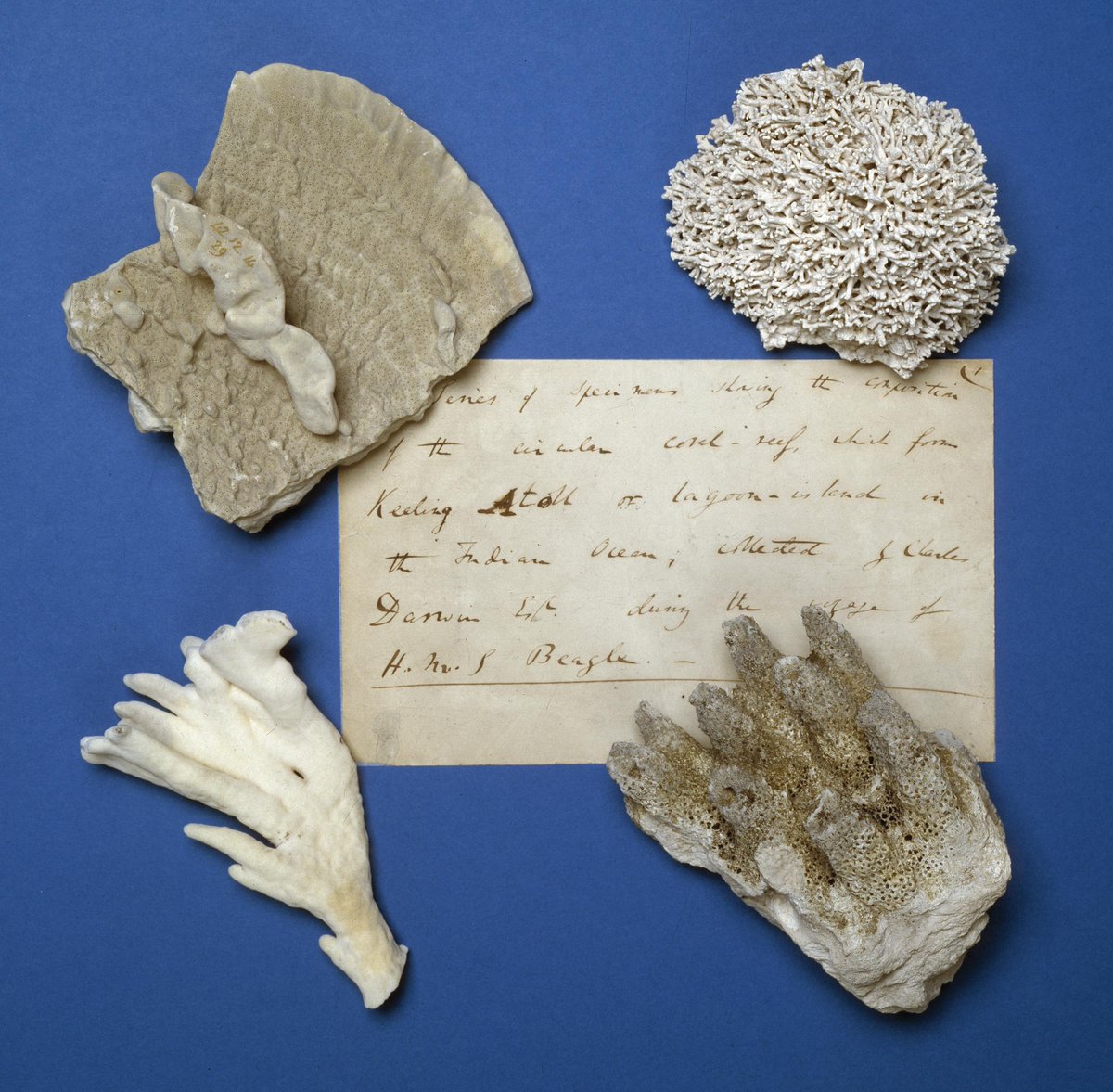
"We may thus ... gain some insight into the great system by which the surface of this globe has been broken up, and the land and water interchanged." (Darwin)
Their forms are reminiscent of the Home Office's 'hostile environment' stuff, and the language of their comms is neoliberal, micro-management corporate jargon. Who *are* these people? They're harming UCL's own brand, and ought to be given the push.
Beware the company called #Guidant who have been hassling UCL staff and occasional guest lecturers like me with a lengthy and totally OTT 'vetting' (their word) process which also even includes an online interview. I refused them point blank and told them why
It always amazes me that online book retailers are absolutely hopeless, at best inconsistent, about giving the dates and editions of books. They seem to have no idea that this is important.
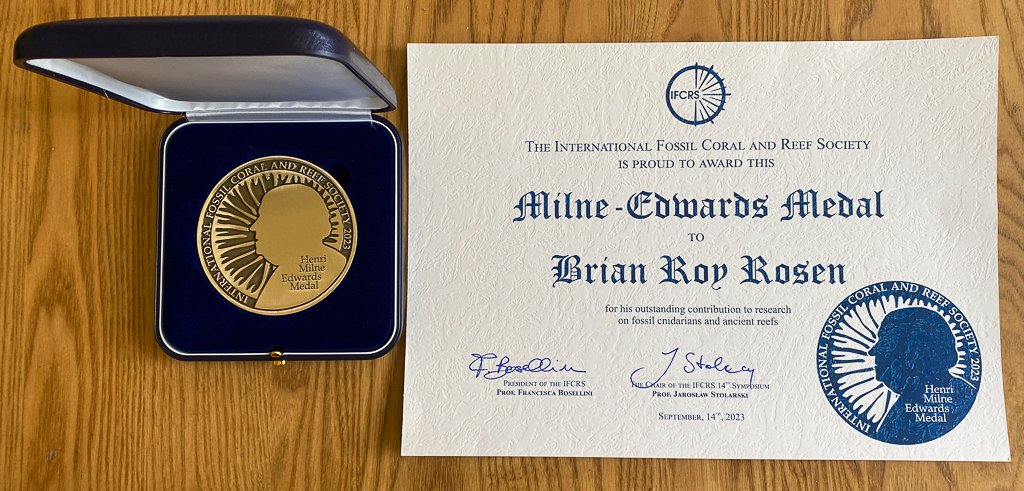
Last week at the 14th quadriennial meeting of the International Fossil Coral and Reef Society, I was awarded the Henri Milne Edwards Medal for 'outstanding contributions to research on fossil cnidarians and ancient reefs'.
Unfortunately, we recently learnt that Dunedin can no longer go forward with new books, and are currently looking for another publisher to take over their publishing operation. Or perhaps we'll just have to find another publisher ourselves. 🙄
Yesterday we submitted all our material for our 'geological guide to the southern Pennines' to Dunedin Press. Lots of good stuff about the Derbyshire carbonate platform and Millstone Grit deltas including a 'geobike' ride on the Monsal Trail.
@BryozoanNhm@Dales_Starman@fossiliam@NadWGab@FossilBonanza So far so good, but one also needs a focused view to see the structure inside those tubes (corallites). Rod-like structure in the middle = probably Siphonodendron. Tiny cobweb-like structure = Lonsdaleia. No structure in the middle = probably Diphyphyllum.
@holly_bourneYA 'Dictionary of Nursery Rhymes' (Iona & Peter Opie) says that HD says in 'Alice Through the Looking Glass, "It's very provoking to be called an egg." So Lewis Carroll answers the riddle. But the twist is that his name means somebody squat and short, like eggs.
Butts Quarry https://t.co/JiHjhYGt6F via @UKGE It's a disgrace that this quarry - one of the best in Derbs for fossils and minerals - has now been made off-limits by its owners. It should be a SSSI. Whatever happened to geoconservation?
At 10.5 m across and 400yrs old, this means this coral (Porites) grew 26mm/yr but this seems far too fast for Porites. Typical extension growth of Porites is c 9mm/yr, in which case this coral may be a lot older (c 1200 yrs). https://t.co/LnJdx4H7pw
Last week I read two of my geopoems to the Geological Society of London's Geopoetry online event, a thoughtful and interesting all day event recorded in real time on YouTube: https://t.co/AMi2sDHBnZ
@geolsoc Just had two poems accepted for the GeolSoc of London's GeoPoetry event this autumn. Would have been held in Edinburgh. Shame it will have to be a video event instead.
https://t.co/Jts6GEA01a It's a common fallacy that older understanding of difficult scientific subjects (like what extinct organisms looked like) is often referred to as 'mistakes' whereas people were simply doing their best with the means and evidence that were available to them
... and I meant to say that we have fossil reef corals in the @NHM_London Earth Sciences coral collections to prove it! In fact our corals show that the latitudinal range of reef corals extended and retreated many times in Earth's history as climates changed.
CO2 in Earth's atmosphere nearing levels of 15m years ago https://t.co/nT9vkt1JF8 And at that time reef corals extended their latitude range by ≈3.5˚S and ≈10˚N beyond their usual range.
@DrAnnaPease My guess is https://t.co/mVzKzbTrPu as it's similar size to yours and typical of the Med region, (probably like the grapes). Nasty but not usually serious. Our then 5 yo found one when we were staying in Italy and called us, telling us to come and see the lobster in the yard.
fraid have only just found out that #HeroesMW is for coronavirus frontline worker-heroes not as I first thought when I tweeted earlier, for our Museum-related heroes - odd? Most current frontline workers are not working in Museums. But thanks hugely to all of them, anyway.
#HeroesMW NHM has unique important little didactic collection of #Darwin's coral reef specimens from Cocos (Keeling) Atoll in the Indian Ocean, collected in 1835 during 'his other Beagle voyage' studying reefs, i.e. not much to do with natural selection or the Galapagos