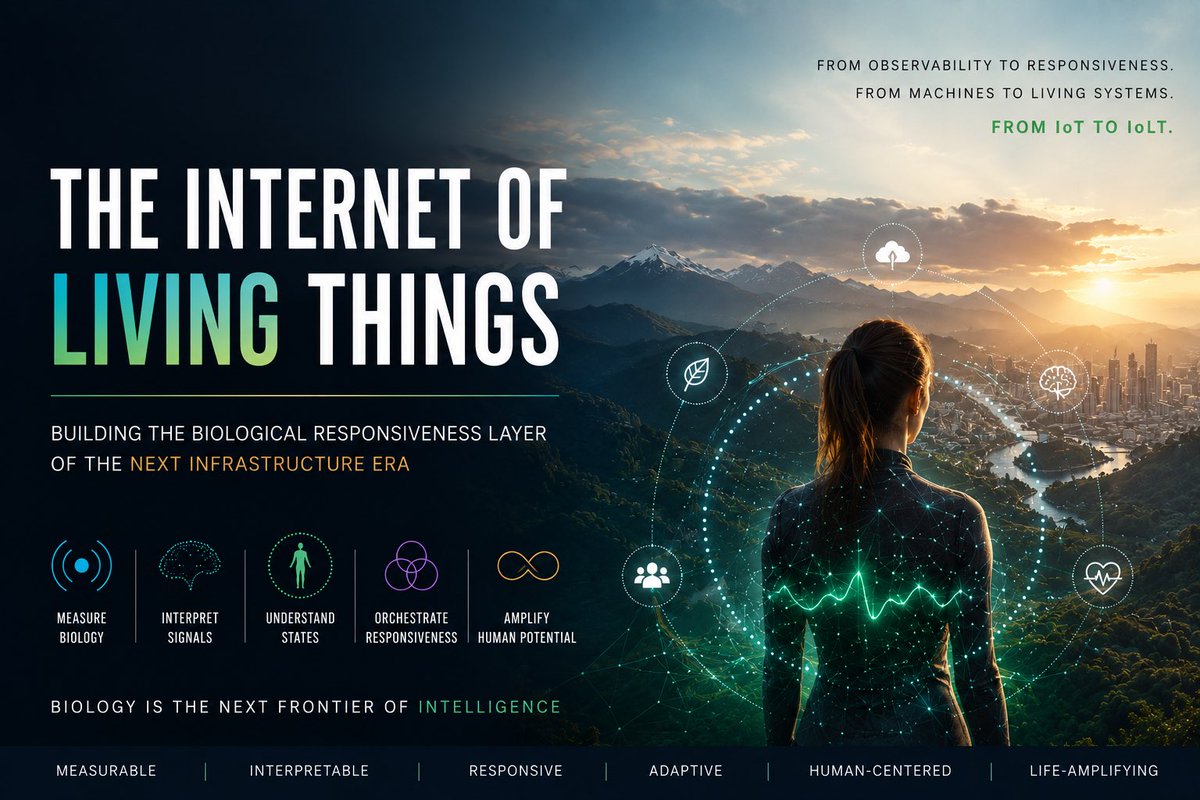
I’ve been thinking a lot about the next layer after the Internet of Things.
For the past two decades, we connected machines: sensors, devices, factories, cars, homes.
We called it the Internet of Things. But if you zoom out, IoT was never really about “things”, it was about something deeper: observability.
The ability to turn previously invisible systems into measurable systems.
A machine that could suddenly tell you when it was overheating; a supply chain that became visible; infrastructure that became responsive.
But biology introduces a different problem entirely: living systems are not machines, they adapt, compensate, oscillate.
The same biological signal can mean radically different things depending on context.
A rise in heart rate variability might signal recovery in one moment, stress in another. Fatigue, emotion, cognitive load, adaptation. Biology is dynamic.
And dynamic systems cannot be interpreted with static logic.
That is why I increasingly believe we are moving toward something adjacent to IoT: IoLT — the Internet of Living Things.
Not as a replacement, as a new layer.
If IoT connected machines, IoLT connects biological systems. Not merely through sensing, but through responsiveness.
That distinction matters because the future will not be won by whoever collects the most biological signals—we already generate enormous amounts of biological data.
The harder problem is interpretation, coherence, responsiveness.
Historically, every major infrastructure transition follows a familiar pattern: first comes instrumentation, then observability, then orchestration.
We are still early in biological instrumentation. Wearables, EEG, sleep signals, metabolic signals, behavioural data, fragmented systems, fragmented meaning.
The more difficult question is no longer: Can biology become measurable?
That transition is already underway.
The more important question is: What infrastructure layer turns fragmented biological signals into coherent responsiveness?
My sense is that this next chapter will require something fundamentally different than traditional IoT architectures.
Not just connected things, connected living systems. Not just telemetry, Biological responsiveness.
The Internet of Things changed how machines communicate.
The Internet of Living Things may change how humans and systems learn to adapt together.
🟦 #FHRA #IoT #IoLT #Biological #Responsiveness #Infrastructure
While this is great and much appreciated, Would love richer deployment notifications in Coolify 🙏
Right now we get “A new version is available.” It’d be great if native notifications could include:
→ Semantic version (vX.X.X)
→ Deployed commit SHA
→ Commit message(s) included in the deployment
→ Branch/environment
→ Deployment logs link
Ideally with customizable notification templates/variables, while keeping the whole CI/CD + Resend flow native to Coolify.
Would make deployment emails genuinely useful as release records. 🚀
For years, cybersecurity was primarily about protecting infrastructure.
Networks, servers, applications, databases, endpoints…
The assumption was simple: protect the system and you protect the organization.
Increasingly, that assumption appears incomplete because attackers are no longer attacking systems first.
They are attacking identities.
Not who you are, the digital representation of who you are.
Permissions, credentials, trust relationships, access paths, behavioral footprints—the invisible layer that determines what a system believes about you.
And that realization has been quietly reshaping cybersecurity.
The most valuable asset is no longer necessarily the server, or the application, or the database, it is the trust model connecting them.
What fascinates me is how far beyond cybersecurity this observation extends: healthcare, artificial intelligence, digital identity, human-computer interaction.
Everywhere we look, systems are becoming increasingly dependent on representations rather than realities, profiles rather than people, records rather than relationships, models rather than humans. And the more dependent we become on these representations, the more important a question becomes: Who controls them?
Because a compromised representation can be almost as powerful as compromising the underlying system itself.
The challenge becomes even more profound when the system being represented is not a company or an employee, but a human being.
Their biology, their cognition, their behavior, their responsiveness.
The future will not simply require better security, it will require new architectures of sovereignty. Architectures where individuals maintain meaningful control over the representations generated about them.
Not because privacy is fashionable, because trust becomes impossible without it.
The strongest systems of the next decade will not be those that collect the most information, they will be the ones that minimize unnecessary exposure while preserving utility.
The next frontier of security may not be protecting infrastructure, it may be protecting the digital representations that infrastructure increasingly relies upon. 🟦 #FHRA #CyberSecurity #DigitalIdentity #Infrastructure #ArtificialIntelligence #Trust #Privacy #SystemsThinking #BiologicalResponsiveness
One of the most fascinating differences between digital systems and human systems appears during investigations.
Digital forensics starts with evidence whereas human investigations often start with people. That distinction sounds small, it isn’t.
A compromised server does not experience shock. A log file does not suffer trauma. A database does not reinterpret reality after a stressful event.
Evidence remains where it was generated, humans do not.
The challenge is that many investigative frameworks were built around the assumption that memory functions like storage, it doesn’t.
Memory is reconstruction, not replay.
Two honest individuals can witness the same event and remember it differently. Not because one is lying, because biology is not a recording device: attention shifts, perception filters, emotional states influence encoding, stress influences retrieval, trauma influences interpretation.
The event remains constant while the internal representation evolves.
Digital evidence behaves differently: logs, packets, timestamps, access records, telemetry, metadata… These systems preserve traces without requiring interpretation at the moment of creation.
The interpretation occurs later.
Which is why modern investigations increasingly depend on the convergence of both worlds.
Digital systems tell us what happened, human systems help explain why—neither is sufficient alone.
Too much reliance on human testimony creates ambiguity; too much reliance on digital evidence creates context blindness.
I believe the strongest investigations emerge when both forms of evidence reinforce one another, and I suspect the same principle extends far beyond law enforcement: healthcare, insurance, risk management, human resources, security.
Everywhere we encounter the same challenge: separating the signal from the interpretation.
Computers preserve events, humans preserve experiences.
The future belongs to systems capable of understanding both. 🟦
#DigitalForensics
#CyberSecurity
#Investigations
#HumanBehavior
#Neuroscience
#SignalProcessing
#SystemsThinking
#BiologicalResponsiveness
For a significant part of my career, I was required to undergo various forms of polygraphic testing as part of admission and security clearance processes.
At the time, I accepted it as normal. Looking back, I find the underlying assumption fascinating because the more I learned about systems, biology, and signal interpretation, the more obvious a fundamental limitation became: traditional polygraphs do not detect deception, they detect physiological responses.
Heart rate, blood pressure, respiration, skin conductance… In other words, they do not measure the event itself.
They measure secondary signals that may or may not be associated with the event.
The assumption is straightforward: deception creates stress → stress creates physiological changes → physiological changes become measurable.
The challenge is equally straightforward. Human biology is not standardized.
An innocent person may experience extreme stress.
A trained individual may learn to regulate responses.
Some personalities process emotion differently.
Some individuals simply do not react according to the statistical norms upon which the model was built.
The problem is not that the signal is wrong, the problem is that the interpretation layer is incomplete—and I increasingly believe this observation extends far beyond polygraphs.
Many of our systems operate through proxies.
We measure what is easy to observe and infer what is difficult to observe.
Engagement becomes a proxy for attention.
Productivity becomes a proxy for contribution.
Activity becomes a proxy for progress.
Stress becomes a proxy for deception.
Sometimes those assumptions work, sometimes they fail spectacularly.
The future of human-centered systems may depend on moving beyond indirect approximations and toward a richer understanding of responsiveness itself.
Not isolated signals, not static measurements: patterns, context, adaptation, relationships between signals over time.
Because biology rarely reveals itself through a single metric, it reveals itself through dynamics.
The most interesting question may not be whether a signal is true, it may be whether we are measuring the right thing in the first place. 🟦
#FHRA #SignalProcessing #Biological #Responsiveness #Infrastructure
Humanity has never had more information.
More notifications, more inputs, more recommendations, more dashboards, more decisions, more noise.
Yet, despite having access to more intelligence than ever before, many people feel increasingly overwhelmed, because humans were never designed to process infinite complexity.
Attention has limits. Energy has limits. Cognitive bandwidth has limits. And when everything competes for attention: clarity suffers, stress compounds, focus fragments, decision fatigue grows.
This raises an important question: What if the next generation of technology helped reduce cognitive burden, instead of increasing it?
Not more dashboards, better signals.
Not more noise, better meaning.
Not more complexity, better timing.
The future of human-centered systems may not belong to technologies demanding more attention. It may increasingly belong to technologies capable of quietly helping humans navigate complexity with less friction.
Less overload, more clarity.
At Future Human Resonance Architecture (FHRA), this is one of the long-term shifts we find deeply compelling.
Because the next frontier may not simply be intelligent systems, it may be: systems that help humans think and feel better inside an increasingly complex world.
The conversation is only beginning.
#HumanCenteredAI #Neurotechnology #HealthTech #DeepTech #MentalWellness #ArtificialIntelligence #FHRA
Most companies hire PR when they need visibility.
The strongest organizations think about reputation much earlier. Not as promotion, as architecture.
A new category does not emerge because it is technically correct, it emerges because enough people eventually share the same language to describe it.
History is full of technologies that arrived before the narrative capable of carrying them.
The challenge is rarely invention, the challenge is actually translation. Translating complexity into understanding; translating signals into trust; translating scientific possibility into institutional legitimacy.
At Future Human Resonance Architecture (FHRA), we spend most of our time thinking about Biological Responsiveness Infrastructure.
The science. The systems. The infrastructure. The trust layer. The governance layer. The human implications.
But increasingly, another realization is becoming clear: building the future and explaining the future are not the same discipline.
Both matter, and both require craftsmanship.
As we continue expanding our international ecosystem, we are beginning conversations with a select number of reputation architects, strategic communications leaders, public affairs specialists, scientific communicators, and long-horizon narrative builders across multiple regions.
Not to manufacture attention, to help build understanding.
The future of human responsiveness will require collaboration across science, healthcare, technology, industry, regulation, education, ethics and society.
No single institution can carry that conversation alone.
If your work focuses on translating complex systems into public understanding, shaping institutional narratives, building trust across industries, or helping new categories find their place in the world, I would genuinely enjoy the conversation.
The strongest reputations are rarely built through visibility alone, they are built through coherence.
And coherence compounds.
Some organizations build products. Some build companies.
The most important ones eventually become responsible for helping society understand what is changing, and why it matters. 🟦
#FHRA #StrategicCommunications #PublicRelations #ScienceCommunication #DigitalHealth #Biotechnology #ResearchTranslation #PublicAffairs #Trust #GlobalHealth #Innovation
One of the most expensive mistakes I see across teams, startups, and even large organizations is confusing a Definition of Done with a Definition of Success.
A Definition of Done is relatively easy.
The feature shipped.
The milestone delivered.
The project completed.
The report submitted.
The box checked.
But reality does not care whether something is finished. Reality cares whether something mattered.
That is a different question entirely.
A product can be delivered and still fail.
A strategy can be executed and still miss the point.
A roadmap can be completed and create no meaningful change.
Done measures completion. Success measures consequence.
The distinction sounds obvious. Yet, many systems are optimized around output rather than outcome.
We celebrate activity. We measure delivery. We track completion. And then wonder why progress feels disconnected from impact.
Over time, I have become increasingly convinced that the strongest organizations define success before they define done.
Because once success is clear, priorities change.
Decisions change. Trade-offs become visible. Noise disappears.
The goal is no longer to finish the work, the goal is to create the condition the work was meant to achieve.
The same principle applies far beyond business.
In learning, in health, in relationships, obviously, in personal growth.
Being finished and being successful are not the same thing.
One is an event, the other is a state change.
A Definition of Done tells you when to stop working.
A Definition of Success tells you why you started in the first place. 🟦
#DoD #DoS #Education #Management
One of the first responsibilities I was given after joining my first high-scale senior role was helping triage incoming candidates.
The hiring framework surprised me.
The instructions were simple:
Autodidacts first. Military second. University third. Everyone else after.
At first, it felt counterintuitive. After all, universities exist to educate, and many of the brightest people I know came through traditional academic paths.
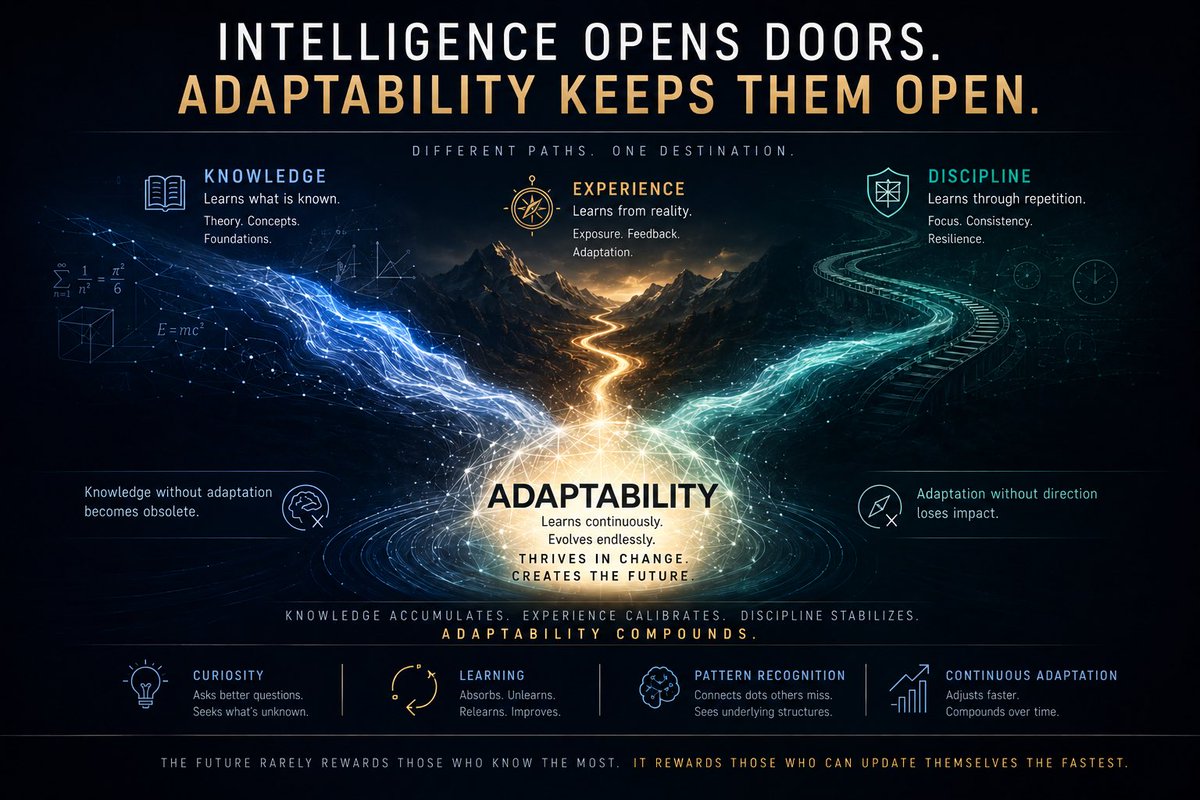
But over time, I realized the ranking had very little to do with intelligence: it was about adaptation.
Autodidacts had already demonstrated something difficult to teach: the ability to identify a gap, learn independently, navigate uncertainty, and build competence without waiting for permission.
Military backgrounds often brought something equally valuable: discipline, execution under pressure, accountability, and the ability to operate inside complex systems where failure carries consequences.
Universities, at their best, provided rigorous foundations, structured thinking, and deep expertise.
All three paths created value, but they produced different operating characteristics. And in fast-moving environments, operating characteristics often matter more than credentials.
The interesting lesson was not about education, it was about responsiveness.
The people who consistently outperformed were rarely the ones who knew the most on day one.
They were the ones who adapted the fastest when reality changed. Looking back, I think this extends far beyond hiring.
Many institutions are designed around knowledge acquisition.
Reality rewards adaptation. Knowledge remains essential.
But knowledge alone is static, the world is not.
The strongest individuals are often those capable of continuously updating themselves without losing coherence.
Learning. Unlearning. Relearning. Repeat
Perhaps the most valuable skill is not intelligence, it is the capacity to remain adaptive in a world that refuses to stand still. 🟦
#Education #AdaptiveThinking #SelfAwareness #FHRA
Modern technology is becoming increasingly good at prediction.
What we may click, what we may buy, what we may watch, what we may search.
Prediction has become powerful.
But when technology begins interacting with humans more deeply with cognition, biology, behavior, and context, an important question emerges: is prediction enough?
Because humans are not probabilities, we are dynamic systems.
The same person can behave differently depending on:
→ fatigue
→ stress
→ recovery
→ cognitive state
→ environment
→ timing
Prediction may estimate behavior, understanding may explain it, and that difference matters.
Especially when systems increasingly move closer to human biology.
The future of human-centered technology may not simply belong to systems that predict outcomes.
It may increasingly belong to systems capable of understanding: why something is happening — not only what might happen next.
Not only probability, meaning.
Not only prediction, context.
Not only intelligence, understanding.
At Future Human Resonance Architecture (FHRA), this is one of the long-term shifts that deeply interests us, because when technology interacts with humans: understanding may matter more than prediction.
The conversation is only beginning.
#HumanCenteredAI #ArtificialIntelligence #Neurotechnology #DeepTech #HealthTech #SignalProcessing #FHRA
The technologies that shape civilization rarely remain visible for long.
Electricity transformed modern life, yet we rarely think about the grid.
Cloud transformed computing, yet most people never think about servers.
GPS transformed movement, yet few people think about satellites.
The most important infrastructure often disappears into everyday life.
Not because it matters less, because it works. Quietly, reliably, seamlessly.
Human-centered technology may evolve in similar ways.
Today, biological intelligence still feels fragmented.
Disconnected devices.
Disconnected signals.
Disconnected systems.
But over time, the most valuable technologies may not be the ones demanding more attention.
They may increasingly be the ones that quietly help humans navigate complexity without friction. Without overload. Without demanding constant effort.
The future may not belong to systems that feel louder, it may belong to systems that feel: natural, invisible, aligned, human.
Because the best infrastructure rarely asks to be noticed, it simply helps the world work better.
At Future Human Resonance Architecture (FHRA), this is one of the long-term shifts we find deeply compelling.
The conversation is only beginning.
#DeepTech #Infrastructure #Neurotechnology #HealthTech #HumanCenteredAI #ArtificialIntelligence #BioIntelligence #FHRA
@CardilloSamuel When creating a new category, educating includes format, which must be institutional by design.
I try to avoid the laidback jargon and the casual slang, but I still want to keep personal tone and rythm.
Being tied legally is a pain, I’m figuring my way through it ;)
For years, software architecture debates have revolved around a familiar question: Monolith or microservices?
The discussion usually focuses on engineering.
Deployment speed, scalability, maintenance, fault isolation.
All important, but I increasingly think the deeper lesson sits elsewhere.
Nature rarely builds monoliths. The human body is not a single system. The brain does not perform the role of the immune system. The immune system does not perform the role of the cardiovascular system. The endocrine system does not replace the nervous system.
Each component specializes, each evolves, each adapts, each remains autonomous.
Yet somehow, the entire organism maintains coherence. That balance is what makes complex life possible.
As systems grow, complexity becomes unavoidable.
The question is no longer how to eliminate complexity. The question becomes how to organize it.
Monolithic architectures often excel during early stages. They create speed, focus, simplicity.
A single source of truth.
But as systems mature, every new dependency increases the cost of change.
Every modification propagates further.
Every failure affects more surface area.
Every decision becomes increasingly coupled to decisions made years before.
Over time, responsiveness declines.
Not because the system lacks intelligence, because it lacks adaptability.
Microservice architectures are often misunderstood as a scaling strategy.
I see them differently.
They are an adaptation strategy.
A way to preserve local responsiveness while maintaining global coherence, and that distinction matters.
Because the future will not be built by isolated systems, it will be built by interconnected systems continuously adapting to one another.
This is one of the reasons we think deeply about infrastructure at Future Human Resonance Architecture (FHRA).
Biological responsiveness cannot emerge from rigid architectures alone.
Human biology is dynamic, contextual, continuously changing. The infrastructure interacting with it must be capable of the same property.
Not merely processing information but adapting to it.
The strongest systems are rarely the largest. They are the ones capable of evolving without losing coherence.. Scale creates complexity.
Responsiveness determines whether complexity becomes evolution or entropy..
🟦 #SystemsThinking #Monolithic #Microservices #Architecture #Engineering #Infrastructure