i just generated an image in the style of a Monet painting using AI
please describe, in as much detail as possible, what makes this inferior to a real Monet painting
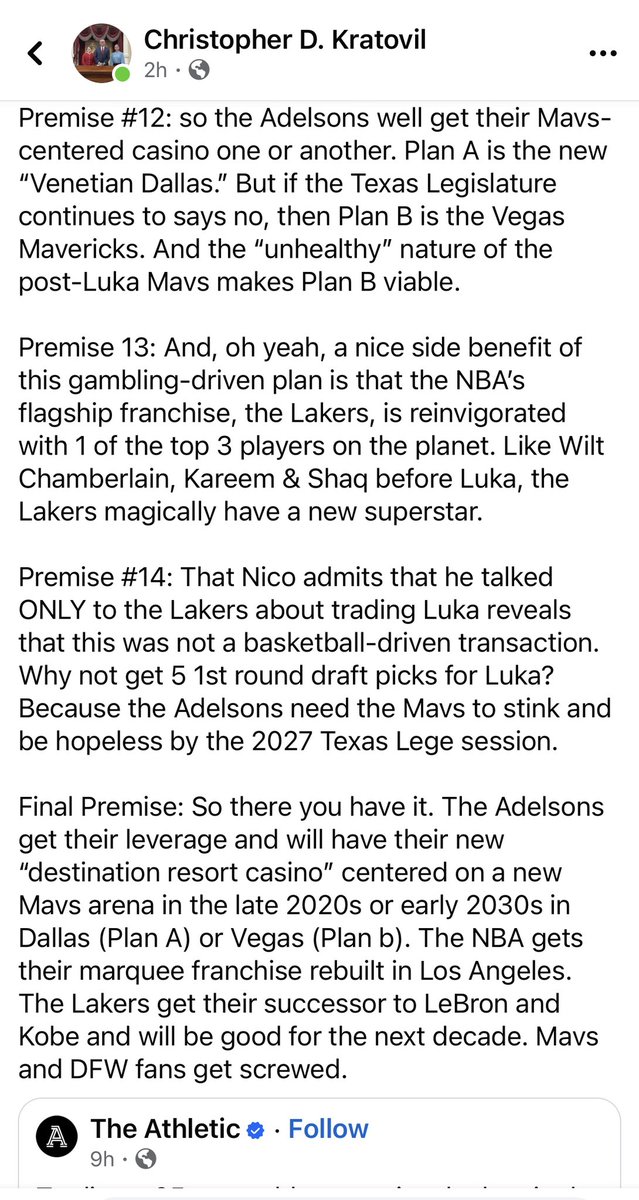
Sharing this A+ analysis on the Luka trade by the always insightful @chris_kratovil
Makes a ton of sense to me from the #txlege angle - esp considering Lite Patrick likely done next Session.
Good stuff. Read it 👇🏼
#txlege#MFFL
Tim Legler on the Luka trade:
“Not only would Mark Cuban not have done the deal, Mark Cuban would’ve fired a person who suggested it on the spot… Because he’d be certain that person has to be doing something in terms of narcotics…”
(via @ALLCITY_NBA)
🪄Rookie of the Year
🪄5x All-Star
🪄5x All-NBA First Team
🪄WCF MVP
🪄23-24 Scoring champion
Your impact on this team & this city will never be forgotten, 77. Mavs family for life. Thank you for the magic.
Hvala, Luka 💙 #MFFL
Until tonight, my most shocking moment of covering the Mavericks was Dec. 26, 1996, when acting GM Frank Zaccanelli pulled me aside in a Reunion Arena hallway and said he was about to trade 23-year-old Jason Kidd.
Tonight was at least five times more shocking.
That's because this dude doesn't know what education is.
He speaks of growing wheat, herding sheep, riding a horse, and so on, but in the era of these skills, this was the kind of education given to slaves.
Only a slave, a person who was owned as property, and used as a machine for a task, could be expected to do one task for his whole life.
A gentleman, or even a freeman of the lower classes, was not a machine for labor, but a person who could be expected to act in his own interests, and thus would need to do many different things throughout his life, depending on what served his goals at the time.
And he would need to be able to independently learn these tasks, rather than needing to be taught them in childhood.
Therefore if a boy was to formally educated, that might include some of gentleman's skills (riding, fighting with a sword, the management of finances), but his education was centered around what education really meant:
A fundamental grounding in how to live and thrive as an independent and free-willed person.
Thus, he was taught the seven liberal arts of classical antiquity:
- Arithmetic
- Geometry
- Music
- Astronomy
- Grammar
- Logic
- Rhetoric
These were not trade skills in the sense that they did not enable the performance of any particular trade or task, but that wasn't the point.
The point was that they taught the young gentleman how to think and learn.
By contrast, modern government schools were founded to train clerks and factory workers at public expense... a servant class with the specific skills necessary to be useful workers, but not the general education to be independent or question their betters?
Have you noticed which two of these arts are utterly absent from a modern government-school "education"?
That's right, logic and rhetoric. Logic is how to arrive at true conclusions from known facts. Rhetoric is how to persuade.
A servant educated in logic might notice that the things he is being told are false. A servant educated in rhetoric might notice the techniques that are being used to persuade him to act in the rulers' interests instead of his own.
If you conceive of your children's education as training in career skills, whether that be growing rice or programming a computer, you are preparing them to be slaves, not free men.
If you properly prepare them to be free men, what skills will be lucrative or useful twenty years from now is irrelevant, because they will be prepared to learn them.
In my opinion, the seven liberal arts of the modern world are:
- Logic: how to derive truth from known facts
- Statistics: how to understand the implications of data
- Rhetoric: how to persuade, and spot persuasion tactics
- Research: how to gather information on an unknown subject
- (Practical) Psychology: how to discern and understand the true motives of others
- Investment: how to manage and grow existing assets
- Agency: how to make decisions about what course to pursue, and proactively take action to pursue it.
Notice that you didn't learn any of these things in school, even if you went to a so-called "liberal arts" college. Instead, they taught you things about mitochondria and calculus and symbolism in Jon Steinbeck novels where a boy has a dog, and the dog dies.
That's because liberal arts, whether you define them as I have, or slightly differently, are the arts of the master, the arts that make one a master, and therefore not be taught in a school for slaves.
Worry less about which "career skills" AI will take over, and more about whether you are training to be, and training your kids to be, high-agency, perceptive, self-motivated people who can navigate an unknowable future with an adaptable mind.
This is one of my favorite movie scenes of all time...
No I didn't rush the f*cking field, I wasn't there...I was in a bar having a drink with my future wife.
That's why I'm not talking right now about some girl I saw at a bar 20 years ago. How I always regretted not going over and talking to her.
I don't regret the 18 years I was married to Nancy, I don't regret the 6 years I had to give up counseling when she got sick, and I don't regret the last years when she got really sick.
And I sure as hell don't regret missing a damn game. That's regret.
This is a harsh reality of life:
You always romanticize the ROAD NOT TAKEN.
The antidote is to spend more time appreciating the beauty of the road you did take.
Lack of appreciation is where your happiness goes to die.
Make sure you’re recognizing the tiny moments of joy, the tiny beauties, and the peace in your current path.
Find joy in the present path, work daily to make it the best one you can imagine.