@arindube Interesting! The relatively modest change wrt a common inflation benchmark is in line with the idea that a higher exposure to price changes pushes workers to take (costly) actions on the labor market. I find some empirical evidence for that in my JMP:
https://t.co/9k7MMNNFQI
Interesting thread by @pogourinchas on widening global imbalances. In a paper with @jan_mazza, we argue that a major, often overlooked driver of imbalances is income inequality. 🧵on our paper "Domestic Inequality and Global Imbalances" 1/
Want focused feedback on your PhD research?
Submit your work to the Second PhD Workshop 2026, hosted by the European University Institute (Department of Economics).
Submission Deadline: 31 March 2026
Read more here: https://t.co/SvPWvUUuId
@timdesilva@alexolegimas@adridefax Similarly to Menaka Hampole’s JMP, we also find that relying less on student loans increases long-term earnings, while not affecting short-term earnings significantly.
The most recent working paper version is here:
https://t.co/Kbyd0nxrCO
@timdesilva@alexolegimas@adridefax We find that relative to not having to pay back any loans, students on income-contingent plans do not choose fields with a different variance in earnings, but do opt for majors with lower dropout risk. I.e., uncertainty about degree completion is another relevant margin.
🚨 Updated working paper
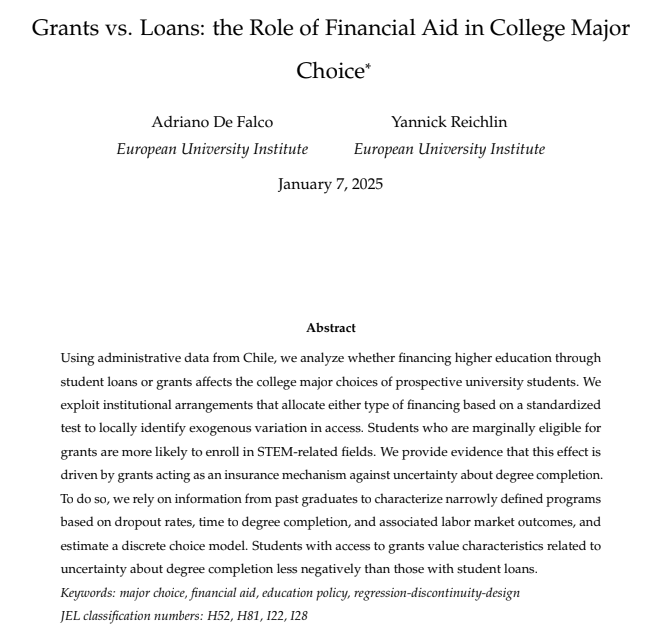
Ever wondered how financial aid—grants vs. loans—impacts students' college major choices? In a thoroughly revised version of our paper, @adridefax and I provide answers using rich administrative data from Chile.
Here is a short summary:
6/ Policy takeaway: even if unintended, financial aid shapes college major choices and not only the “extensive” margin of university enrollment. Aid that mitigates risks tied to degree completion (like grants) has the potential to steer students toward high-return fields.