ISGF is hosting a two-days intensive in-person training on "Advanced Metering Infrastructure (AMI)" from 16 to 17 July 2026 | 10:30 AM to 06:00 PM
🔗 Read Details: https://t.co/wCzPRKPAt6
Register Now: https://t.co/JXGBG63Tju
@rejipillai | @suri_reena
Join us at the 10th Distribution Utility Meet - #DUM26, the premier annual conference of power distribution utilities planned on 27 – 28 October 2026 in Jaipur, Rajasthan
Visit: https://t.co/AD3eER4521
@rejipillai | @suri_reena | @PFIndiaOrg | @bsesdelhi
ISGF is hosting a two-days intensive in-person training on "Advanced Metering Infrastructure (AMI)" from 16 to 17 July 2026 | 10:30 AM to 06:00 PM
🔗 Read Details: https://t.co/wCzPRKPAt6
Register Now: https://t.co/JXGBG63Tju
@rejipillai | @suri_reena
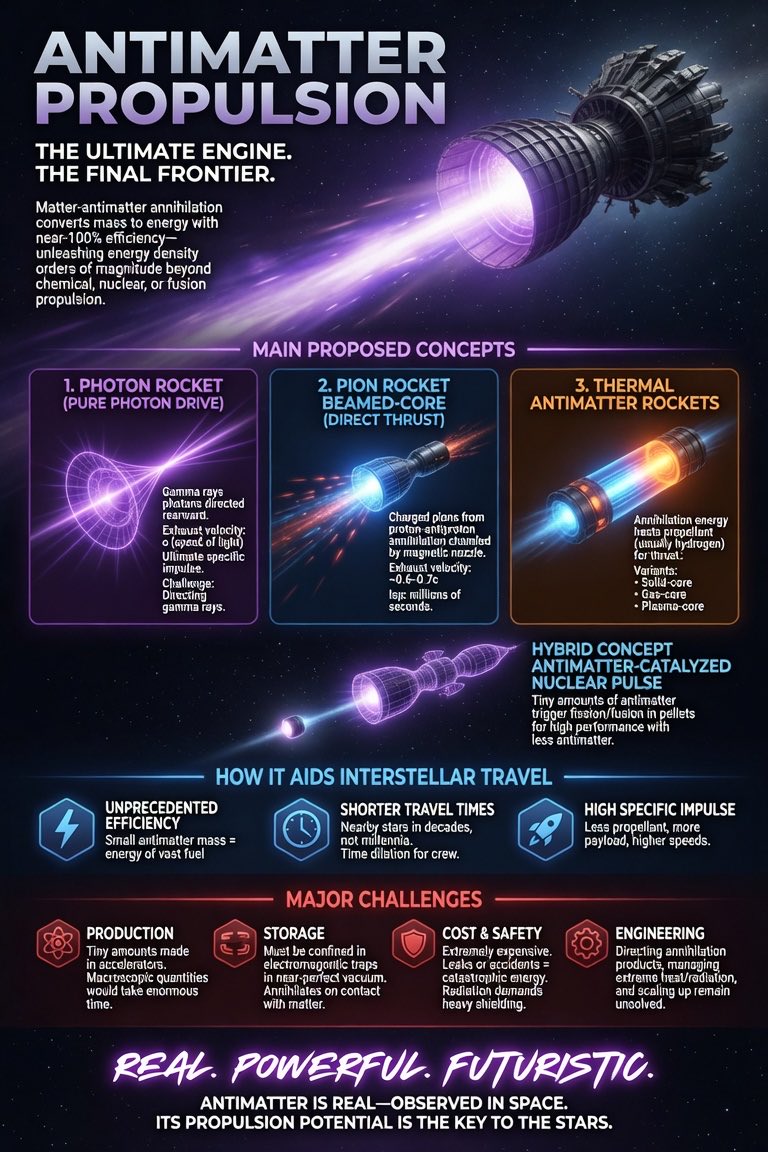
ANTIMATTER PROPULSION SYSTEMS
Antimatter propulsion uses the enormous energy from matter-antimatter annihilation to generate thrust. Because annihilation converts mass directly into energy at near-100% efficiency, these systems offer extremely high specific impulse (a measure of efficiency) and energy density—orders of magnitude better than chemical rockets, nuclear thermal rockets, or even fusion concepts.
Main Proposed Concepts
1. Photon Rocket (Pure Photon Drive)
Annihilation produces gamma rays/photons directed rearward. In theory, photons have the highest possible exhaust velocity (the speed of light), giving the ultimate specific impulse. Practical challenges include directing gamma rays.
2. Pion Rocket / Beamed-Core (Direct Thrust)
Antiproton + proton annihilation produces charged pions. These are channeled and directed by strong magnetic fields (a “magnetic nozzle”). This provides both high thrust and very high exhaust velocity (around 0.6–0.7 times the speed of light). Specific impulse can reach millions of seconds.
3. Thermal Antimatter Rockets
Annihilation energy heats a conventional propellant (usually hydrogen). The hot gas is expelled through a nozzle. Variants include:
• Solid-core: Annihilation heats a refractory metal block; propellant flows through channels.
• Gas-core / Plasma-core: Higher temperatures and efficiencies using magnetic confinement.
Hybrid concepts (antimatter-catalyzed nuclear pulse propulsion) use tiny amounts of antimatter to trigger fission or fusion in pellets, reducing the antimatter needed while still delivering high performance.
How It Aids Interstellar Travel
• Unprecedented efficiency: Small amounts of antimatter + matter could provide energy equivalent to vast quantities of conventional fuel. This enables spacecraft to reach significant fractions of the speed of light.
• Shorter travel times: Nearby stars could be reached in decades instead of tens of thousands of years. Relativistic time dilation would shorten the subjective trip for the crew.
• High specific impulse means less propellant mass is needed overall, allowing more payload or higher final speeds.
Major Challenges
• Production: Only tiny amounts are produced in particle accelerators. Current rates would take enormous time to make macroscopic quantities.
• Storage: Antimatter annihilates instantly on contact with matter. It must be held in electromagnetic traps in near-perfect vacuum.
• Cost and safety: Extremely expensive to produce. Any leak or accident would release catastrophic energy. Radiation requires heavy shielding.
• Engineering: Directing annihilation products efficiently, managing extreme heat/radiation, and scaling up remain unsolved.
In summary, antimatter is real and already observed in space. Its cosmic asymmetry explains why the universe exists as it does. For propulsion, it represents the theoretical pinnacle of rocket efficiency—potentially enabling practical interstellar travel—but production, storage, and engineering hurdles mean it remains a futuristic concept.
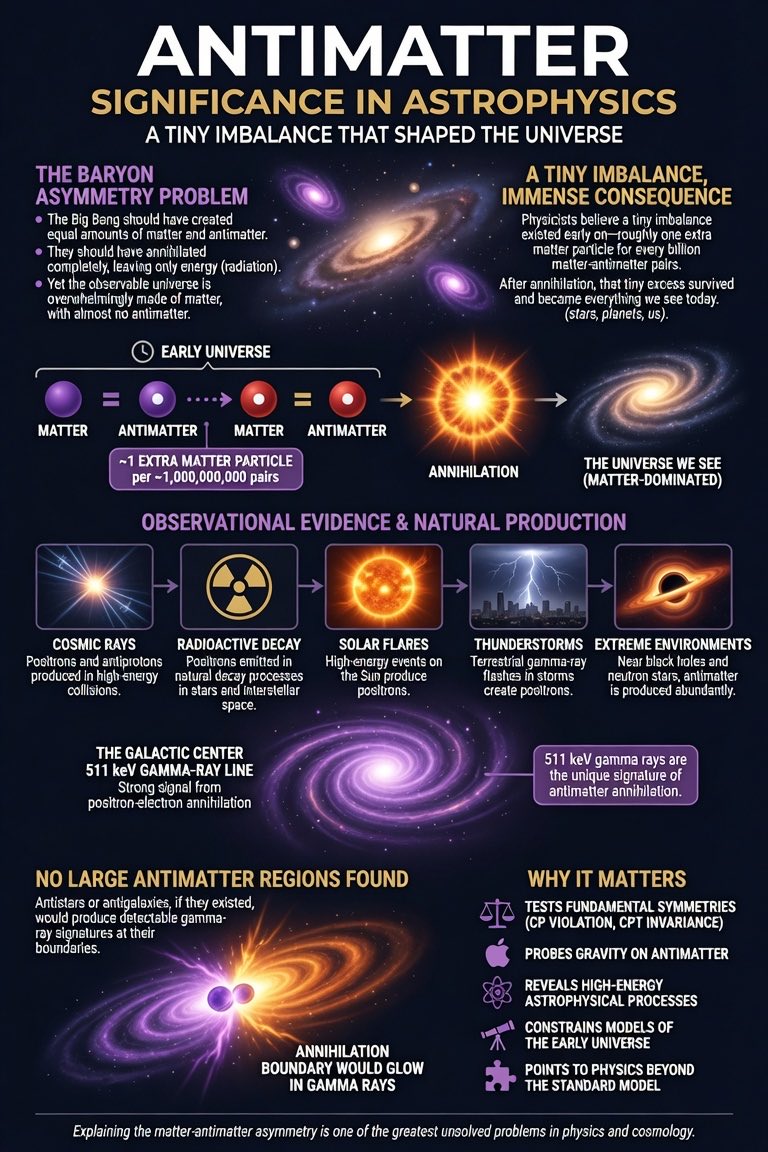
SIGNIFICANCE OF ANTIMATTER IN ASTROPHYSICS
Antimatter plays a central role in our understanding of the universe’s origin and structure, primarily through the baryon asymmetry problem (also called the matter-antimatter asymmetry):
• The Big Bang should have created equal amounts of matter and antimatter.
• They should have annihilated completely, leaving only energy (radiation).
• Yet the observable universe is overwhelmingly made of matter, with almost no antimatter.
Physicists believe a tiny imbalance existed early on—roughly one extra matter particle for every billion matter-antimatter pairs. After annihilation, that tiny excess survived and became everything we see today (stars, planets, us). Explaining this asymmetry (via processes like CP violation in the weak force) is one of the biggest unsolved problems in physics and cosmology.
Observational evidence and natural production:
• Positrons are routinely produced in cosmic-ray interactions, radioactive decay, solar flares, thunderstorms, and near black holes/neutron stars.
• The galactic center shows a strong gamma-ray signal from positron-electron annihilation.
• Antiprotons and positrons appear in cosmic rays.
• No large antimatter regions (antistars or antigalaxies) have been found; their boundaries would produce detectable gamma-ray signatures from annihilation.
Antimatter thus helps test fundamental symmetries, gravity on antimatter, and high-energy astrophysical processes. It also constrains models of the early universe and possible physics beyond the Standard Model.
@elonmusk Yes, and thankfully antimatter is becoming easier to work with:
Scientists Just Mixed Matter and Antimatter (It Didn't Explode)
https://t.co/8ISTQCyONZ
@Rejipillai, President, ISGF will be sharing his thoughts on "Role of Energy Efficient Buildings for Low Carbon Buildings" at the upcoming webinar on "Technology Innovations in the Buildings Sector" on 5th June 2026 | 15:00 PM – 16:30 PM (IST)
🔗 https://t.co/NyrW12CRc6
@rejipillai, President, ISGF will present on the topic "Scaling Living Energy: Addressing Energy Poverty Through Data and AI" as part of Session 4.3 on Digitalization and AI Accelerating Discovery and Optimal Processing of Important Clean Energy Inputs at the @ACEF_Forum
Register Now for the Open Dialogue on "Technology Innovations in the Buildings Sector" organised by @GGGIindia & ISGF under the Asia Low Carbon Buildings Transition (ALCBT) Project with the HCL ClimaForce Fund, on 05 June 2026
🔗 https://t.co/NyrW12CRc6
@rejipillai
Register Now for the Open Dialogue on "Technology Innovations in the Buildings Sector" organised by @GGGIindia & ISGF under the Asia Low Carbon Buildings Transition (ALCBT) Project with the HCL ClimaForce Fund, on 05 June 2026
🔗 https://t.co/NyrW12CRc6
@rejipillai
At the session “From Policy Design to Building Infrastructure: Grid Resilience and Energy Security” convened by @cdri_world and Energiva Ventures, speakers highlighted:
⚡ Strong institutions, governance, & local capacity
⚡ Shared ownership & co-developed solutions
⚡ Risk-informed planning & climate-proofing
⚡ Regional integration & knowledge sharing
⚡ Innovative financing for resilience
⚡ Technology, finance & capacity building together
🔌 Power systems are the backbone of economies. #CDRI is committed to advancing multi-hazard #resilience across #energy infrastructure.
#resilientinfrastructure
@NehaK861@rejipillai@Chylo360@ramrajn
GFN focused on:
🔹 Mobilising investment for low-carbon buildings and sustainable cooling
🔹 Enhancing financial sector engagement
🔹 Supporting business development and project preparation
🔹 Increasing private sector participation
🔗https://t.co/V8XeqzDGl4
@rejipillai, President, ISGF will be speaking at IREDonline 2026 an international conference on Battery Energy Storage Plants in Power Systems Markets, Technologies and Regulation ...(1/2)
📅 22–23 June 2026 | Online Register to attend: https://t.co/9DIgJZS2pw
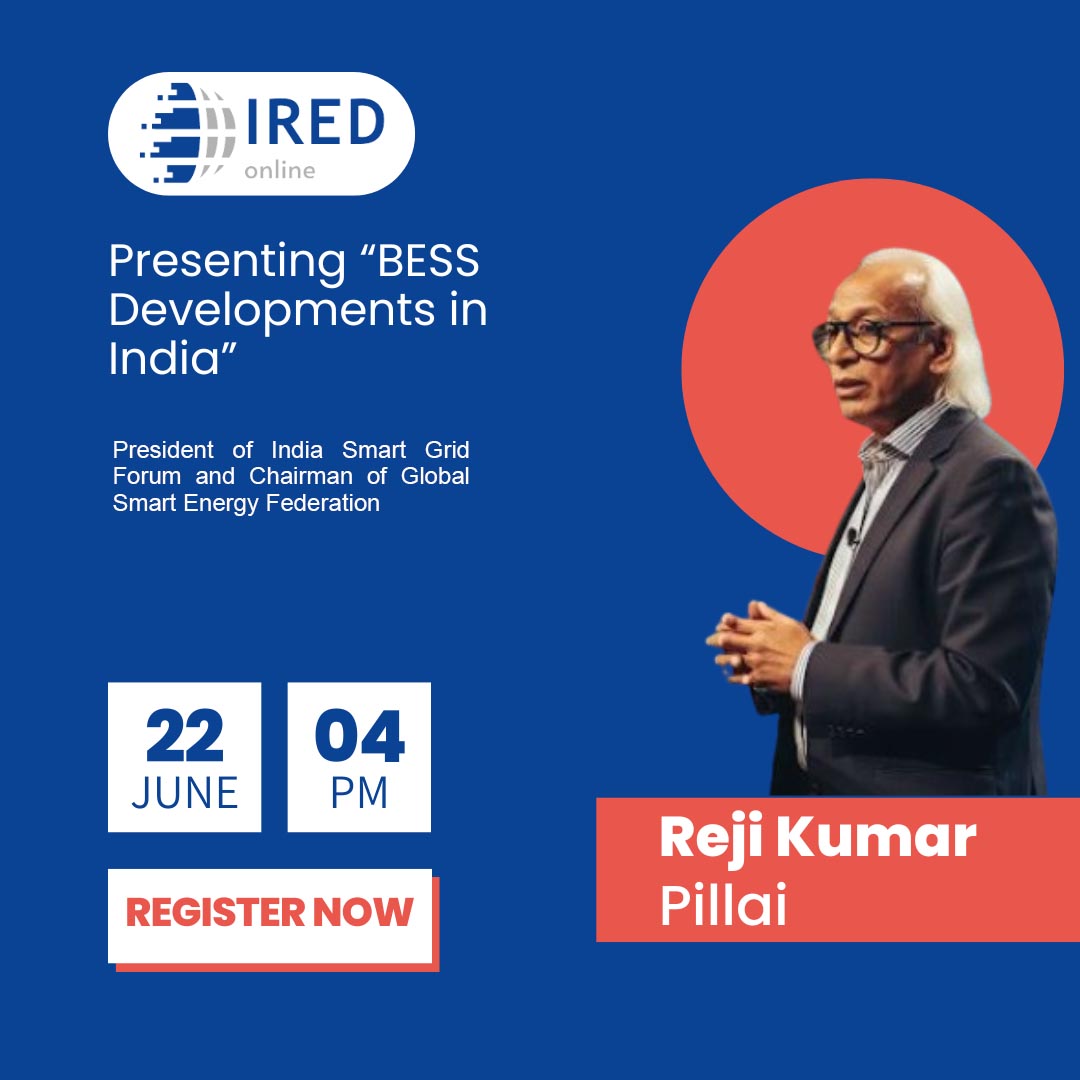
Reji Kumar Pillai, President, @IndiaSmartGridF & Chairman, Global Smart Energy Federation, will speak at IREDonline 2026 on “BESS Developments in India” on 22 June 2026 at 16:00 CEST.
Register to attend: https://t.co/wa70nghZNj
The India Smart Grid Forum (ISGF) is pleased to announce that the day-long training workshop has been finalized for 21 May 2026 in New Delhi.
Limited seats available.
Register today - https://t.co/wCzPRKPAt6
@rejipillai | @suri_reena
The India Smart Grid Forum (ISGF) is pleased to announce that the day-long training workshop has been finalized for 21 May 2026 in New Delhi.
Limited seats available.
Register today - https://t.co/wCzPRKPAt6
@rejipillai | @suri_reena