Most people are opinionated. They think they know the answers to everything. But in reality, their opinions are fueled not by true confidence—but by ego and insecurity. Ironically, this often makes them appear very confident on the surface.
But here’s the truth: most people are not successful because they lack the most important ingredient of growth—humility. They don’t have the willingness to admit they might be wrong or the openness to learn from someone better.
Ask yourself these questions:
If you’re so smart, why aren’t you rich?
Why haven’t you invented something that changes people’s lives?
Why don’t people follow you, respect you, or look to you for guidance?
Why aren’t you happy, fulfilled, or living with purpose?
Why haven’t you achieved something truly great?
Why don't you have the most amazing life?
The answer is simple: you’re not that smart. And until you admit that, you’ll never become that smart. Your mind is already full. Your cup is overflowingwith little room for new knowledge. You’re uncoachable.
The first step to becoming great is to admit that you suck.
The second step is to believe that you could be great.
The third step is to find somebody who is great and willing to teach you.
The fourth step is to shut your mouth—and listen.
That’s the formula. Everything else comes after.
My greatest personal strength and the secret to my success is my willingness to truly be a lifelong student and to never stop seeking the truth from those who know more than me. I love learning, and I never want to be someone who doesn't need to learn.
Read everybody. Learn every nuance of trading from everywhere.
But once that learning phase is done, and you understand both the center and the corners of trading… start understanding what actually suits you.
Maybe that 5% stop loss is not for you.
Maybe breakout trading is not your game.
Maybe you are the kind of trader who only wants 3R profit.
After all the learning is done, the search for your own personal trading style should begin.
That’s when real confidence comes.
And eventually, that’s where the big money is made.
Because the best traders are not the ones who copy others perfectly,
they are the ones who understand themselves the best.
THE LESSON I LEARNED THE HARD WAY — AS A TRADER WHO FACED ALL OF THIS
1. Fighting a Bear Market
I once tried to be the hero who buys when the whole market bleeds.
The market didn’t care about my confidence — it crushed me.
Lesson: When the tide is going out, even strong swimmers drown.
2. Buying a Weak Group
I picked a “strong” stock inside a dying sector.
The group dragged it down like a sinking ship.
Lesson: A stock rarely wins when its whole family is losing.
3. Entering Below the 30‑Week MA
I convinced myself the stock was “cheap.”
It kept getting cheaper.
Lesson: Below the 30‑week MA is where hope lives — not trends.
4. Ignoring a Declining MA
Price was above the MA, so I thought it was safe.
But the slope was negative — and the slope told the truth.
Lesson: A declining MA is a warning, not a suggestion.
5. Chasing Too Late
I bought far above the ideal entry because it “looked strong.”
It pulled back immediately and punished my FOMO.
Lesson: If you’re late, the market will remind you.
6. Breakout With Weak Volume
I bought a breakout with no volume behind it.
It failed fast — and I exited faster.
Lesson: Breakouts without volume are just candles pretending to be leaders.
7. Ignoring Relative Strength
I bought a laggard hoping it would “catch up.”
It didn’t.
Lesson: Leaders lead. Laggards lag. Simple.
8. Buying Under Heavy Resistance
I entered right below a wall of overhead supply.
Every bounce got sold into.
Lesson: You don’t run into a ceiling and expect to fly.
9. Trying to Catch the Bottom
I tried to guess the bottom because the price “looked cheap.”
It kept falling — and I learned why they call it a falling knife.
Lesson: Bargains in Stage 4 are traps. Breakouts are truth.
THE REAL TAKEAWAY
Every mistake on that list?
I lived it.
I paid for it.
And that’s why I respect the rules now — not because they look smart,
but because breaking them is expensive.
My Experience With the 50‑Day Moving Average
When I first discovered the 50‑day moving average, I thought it was just another technical line. But over time, it became my compass — the quiet signal that told me when to stay in and when to step aside.
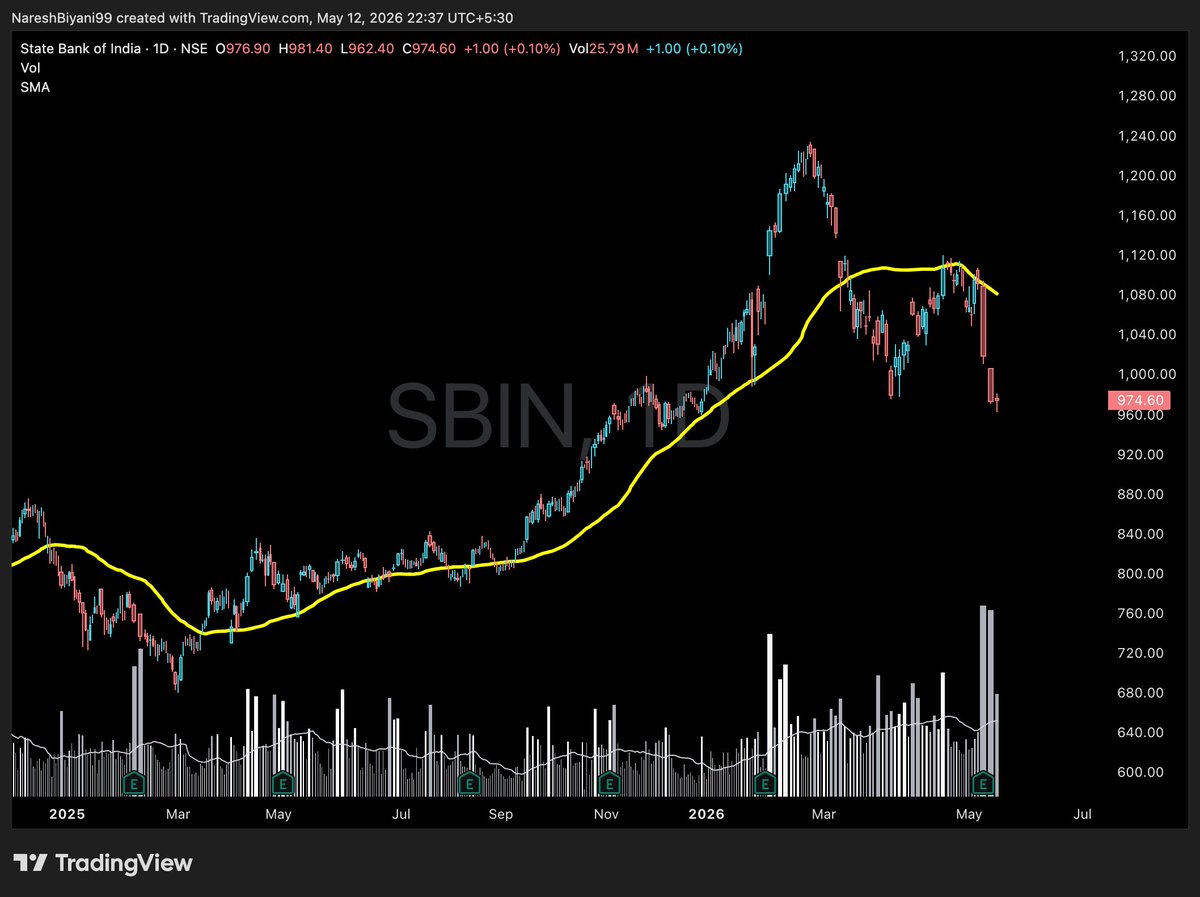
I learned that a strong stock lives above its 10‑week line. Every time it bounced off that level, it was like watching confidence return to the chart. But when it broke below — especially on heavy volume — that was the market whispering, “Get out now.”
I remember adding to positions only when the price respected that line. If the moving average was trending up, I felt aligned with strength. If it flattened or dipped, I knew hesitation was creeping in — and hesitation kills momentum.
The biggest lesson? Support turns into resistance once the trend breaks. I’ve seen it happen again and again: what once held the stock up becomes the ceiling that traps it. That realization changed how I manage every trade.
Now, the 50‑day and 10‑week lines aren’t just indicators to me — they’re psychological checkpoints. They remind me that discipline isn’t about prediction; it’s about protection.
We have built a trading journal for Indian traders.
No bloat. No Excel hell. Just your trades, your charts, and your edge, backed by analytics that actually tell you something.
Introducing StockyMind Journal 🧵
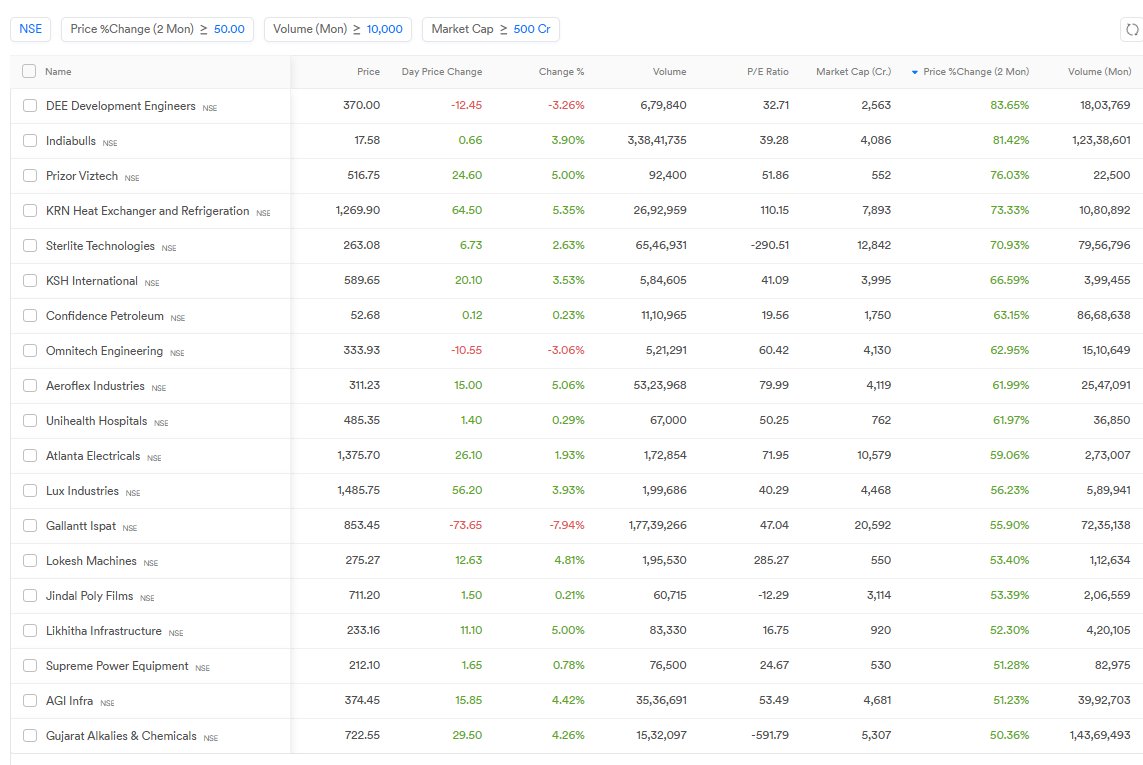
50% gainers in two months
There are 19 names which have gained more than 50% in the last two months, the highest count we’ve seen in the past year. I review 50% gainers biweekly to identify names I may have missed and, more importantly, the entries that could have been taken. This helps train the mental eye.
Below are the names that were tradable over the past month from the list (annotated charts with low risk and hindsight entries attached):
- DEEDEV
- KRN
- STLTECH
- KSHINTL
- OMNI
- AEROFLEX
- ATLANTA
- GALLANTT
- GUJALKALI
Some of these are hindsight observations, but the objective is to identify entries that could have been taken in real time. Using the bar by bar replay feature to simulate these entries is one of the most effective feedback loops for improving the ability to spot such setups in the future.
Today’s market strength was textbook. This is exactly what markets do during corrections when they get stretched to oversold levels. As I said just recently, "some of the biggest rallies occur during bear markets and corrections." Today was a perfect example.
Traders rushed in after headlines hit that Iran’s president signaled a willingness to end the conflict with the U.S. The Dow exploded higher by 1,125 points. But let’s not confuse cause and effect. The news may have been the trigger, but the market was already set up for a rally. It was oversold and primed. Now comes the part where discipline matters.
We ignore the first few days of a rally attempt. That’s potential noise. What matters is whether the market can follow through and whether leadership begins to emerge and proper setups develop.
Technically, this is a classic snapback: Indexes that broke below the 200-day are rallying back toward it, while Indexes that held the 200-day are bouncing off it. That’s typical countertrend behavior until proven otherwise.
Expect volatility to remain elevated. That’s not where low-risk money is made, but it's certainly where the risk is. Your job during corrections is simple: identify the stocks showing the best relative strength and the tightest price action. Those are your future leaders when the market finally turns.
On the macro side, nothing has been resolved. Higher crude prices are still a problem. Yesterday’s rally did nothing to materially bring down oil. The bigger issue is still in play and the jury still out. Oil at these levels feeds inflation, pressures growth, and gives the Fed a reason to stay on hold longer. Yields stay elevated in that environment.
To cut through all the noise, I look to the market itself, which has a much better track record of telling us the truth than the politicians, the analysts, the news, and the gurus.
The four steps of the bottoming process are:
1. Oversold – The difference between an ordinary pullback and an oversold condition starts with price, but it does not end there. Poor breadth and and a lack of volume confirmed follow through describe a one-sided market, and one not to trust.
2. Rally – Inevitably, the market bounces from its oversold condition. A high-quality rally is broad-based. A low-quality rally is defined by short covering and driven primarily by the stocks that have declined the most. Again, the character of the rally is important to distinguish. So far, we simply don't have enough data to make a confident determination, so patience is the watch word while we wait.
3. Retest – After the rally, there is almost always a retest. The popular averages approach, and in some cases breach, their oversold lows. The key to a successful retest is less selling pressure, such as fewer stocks below their moving averages, fewer stocks, sectors, and markets making new lows, less total volume, and less downside volume. If the retest fails, the process reverts and we generally start looking for divergences during lower lows. In the event of unexpected news, it is possible for the market to recover in a "V" fashion with no retest. In that case, we look at breadth confirmation and participation.
4. Breadth thrusts – In the final phase, not only do benchmark indices rally sharply with few pullbacks, but they do so with an extremely high percentage of stocks, sectors, and markets participating, or what technical analysts call breadth thrusts. In rare cases, the market has skipped step 3. With strong enough breadth, retests are not necessary. The Covid bottom is an example of a pretty powerful V-shaped recovery.
Bottom line:
This was an oversold rally, sparked by headlines—but not defined by them, and certainly not confirmation of a reliable bottom.
Now we watch:
--Quality of follow-through
--Emergence of leadership
--Market internals and model health
If the rally lacks quality, if economic pressure builds, or if leading stocks begin to deteriorate, then this remains what it likely is—a rally within a correction.
Stay objective. Let the market prove itself. If you are going to trade, do so incrementally.
https://t.co/JXzFFTmMtn
Trading Roadmap: 5 Levels System
This is what I wish someone gave me 9 years ago when I started trading.
In this article I'll share:
• The 5 Key Trader Levels
• Your current level and how to get to the next
+ A free custom AI
Enjoy:
https://t.co/Q1ZuYtbOUh
Where will markets go?
All said and done.. nobody knows.
Most people don’t trade the market.
They trade the illusion of prediction.
But the real battle isn't prediction.
It’s discipline.. and that’s hard.
Even if you predict right,
it doesn’t mean you’ll trade it right.
For trading, You don’t need to know what will happen to succeed.
You need to be prepared.
Preparation is a process.
And.. that’s the real edge.
Stop endlessly learning from losses 🧵
The "game of probability" involves an attitude of accepting randomness, adopted by "those who have already completed their learning", in order to bring reproducibility to that learning.
🧵1/5