@StockMKTNewz There's SpaceX's own post-IPO reality check and then there's the broader AI bubble bursting - of which SpaceX will also be part. So it's hard to just buy SpaceX's deep irrespective of the broader tech market
@Sino_Market There's something unusually refreshing about Korean politicians' apologizing over the management of the AI bubble - from a European perspective
@Barchart Semiconductors were supposed to be the ultimate winners of the AI bubble. They won't be spared by the bursting though, as hyperscalers need to retain some cash flow again. Eventually they'll recover thanks to cutting edge engineering and (real) demand from physical AI
@unusual_whales They’ve used all these entertaining, cultish, bad sci-fi beliefs to inflate the bubble. Now that it has started to burst they just feel like claiming they're all coming true at once to save their back
@AlternatNews China will eventually master the entire AI/semiconductor supply chain. However the skills involved are globally shared engineering ones and it will be up to other world regions to catch up just as China did
Think that Europe didn't even capitalize on ASML to develop advanced chips, while China bets everything to substitute not even their most advanced type of lithography (DUV) and shakes world markets with those advances. Europe has abandoned any type of strategic planning but it has “chip acts”. https://t.co/gkBCGuwnnT
@BullTheoryio Massive circular funding between chip companies, AI labs, and hyperscalers + cheap, innovative Chinese competition from models to semiconductors: the US AI bubble has two abysmal vulnerabilities
https://t.co/EzUdqUHDae
Massive circular funding between semiconductor companies, LLM providers, and hyperscalers + cheap, high-quality Chinese competition from models to semiconductors: the US AI bubble is a house of cards
https://t.co/EzUdqUHDae
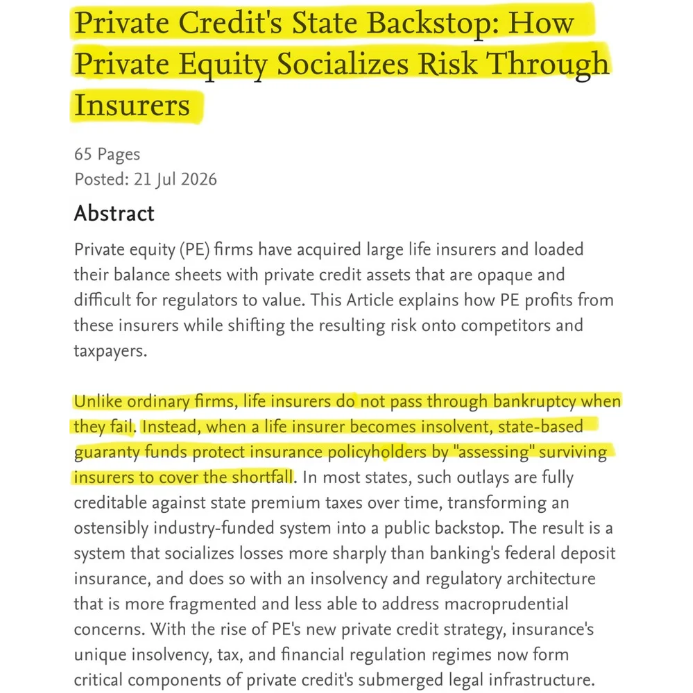
MICHAEL BURRY JUST WARNED THAT PRIVATE EQUITY MAY BE USING LIFE INSURERS TO PUSH LOSSES ONTO THE PUBLIC.
Burry is highlighting a new paper by two Yale/Texas researchers, "Private Credit's State Backstop: How Private Equity Socializes Risk Through Insurers."
Firms like Apollo, KKR, and Blackstone have bought up life insurers. They've filled these insurers' balance sheets with private credit, loans that are hard for regulators to check or price properly.
Life insurers now hold $849 billion in this kind of debt, more than double what they held in 2014.
Here's the trick: If one of these insurers can't pay its bills, states step in to protect policyholders. They do this by charging other insurance companies a fee to cover the gap.
Those companies then get to subtract that fee from the taxes they owe the state. So in the end, the public pays for it through lower state tax collections, without it ever being called a bailout.
This has already started happening. Two companies, First Brands and Tricolor, went bankrupt in 2025 after lenders realized they couldn't properly value the debt they were holding.
And the next risk is AI: Big tech companies are funding their AI data centers using the same kind of complex, hard to value debt.
If AI spending doesn't pay off fast enough, that risk doesn't stay with tech companies. It lands on the same insurers already holding piles of this debt.
Chinese competition will increasingly affect semiconductor companies in the US and its supplier countries. Chip stocks won’t be spared from the AI bubble’s burst, even with new demand tied to physical AI. Eventually, pricing pressure will extend across all segments, from AI models to advanced chips. Faced with failing domestic demand, China will double down on its efforts to export AI services and semiconductors. It will also develop alternatives to Nvidia's CUDA platform, which helped lock up the market
@EndicottInvests Well said. Anthropic acts like a cult: invoking the 'AGI' belief to divert attention from its financial circuitry and combating open source to undermine alternatives
Chinese competition will increasingly affect semiconductor companies in the US and its supplier countries. Chip stocks won’t be spared from the AI bubble’s burst, even with new demand tied to physical AI. Eventually, pricing pressure will extend across all segments, from AI models to advanced chips. Faced with failing domestic demand, China will double down on its efforts to export AI services and semiconductors. It will also develop alternatives to Nvidia's CUDA platform, which helped lock up the market
The US defeat by a country under as much economic strain as Iran exposes the failure of the West’s industrial logic. Having offshored manufacturing, critical know-how, and ultimately innovation - thus losing mass production capacity - the least one can do is refrain from waging useless wars involving a huge industrial bloc of countries. Asset bubbles and money printing can't do much for military-industrial power in the end
https://t.co/D5FvRpclDS
Lindsey Graham was the farcical tip of the iceberg. In Europe, we've seen public discourse overwhelmed by those "boards" providing trips and "conferences" around the world for politicians and executives. In 2003, during the invasion of Iraq, neoconservatism was considered a fringe ideology, associated with personal issues or financial incentives in countries like France or Germany. Now it's the mainstream
The US defeat by a country under as much economic strain as Iran points to the failure of the West's industrial paradigm. When you've offshored so much—from manufacturing to critical know-how and ultimately innovation—losing mass production capacity, the least you can do is abstain from waging useless wars involving this industrial bloc. Asset bubbles and the printing press are of no help ultimately. https://t.co/GdXGoc8lV3
@Megatron_ron This strike against an Iranian ship can provide a clue about Kyiv's postwar business model: carrying out mercenary attacks for the US against third countries, drawing on its vast weapons stocks and know-how. This could have far-reaching, unintended consequences
@AJEnglish Has Kyiv just started carrying out attacks on third countries on behalf of the US? This could provide clues about its postwar business model
I admire Hinton, but over the years, there has always been the same flaw in his attempts to compare humans and neural networks. The nature of the "experience" we process in human life is entirely different and far more complex than that of AIs trained on the internet or any dataset. Of course, on many fronts, we cannot even compete with AIs. But claiming that we rely on less "experience" has no scientific grounding - it doesn’t even rely on any possible definition of the concept of "experience" and dismisses the countless types of experiences we have (facts, senses, feelings, etc.) and their immense complexity
Jensen Huang says Hugging Face could not get a single closed AI model to help it investigate its own breach:
"Just because something is closed doesn't necessarily therefore make it safe or secure."
"It is possible for a model to be jailbroken, it's possible for a model to be, if you will, stolen. It could be possible that that somehow is leaked from the inside."
"It's possible that the guardrails or the sandboxes of an AI closed AI model wasn't properly engineered, and as a result it was able to attack another company in some way."
"These are extraordinary technology companies and they're doing their best to keep it safe and keep it secure. But it is also the canonical case that single points of failure is where we have the greatest vulnerability."
"We cannot have single points of failure. As an industry, as a world, we should have distributed, massively distributed self-defense."
"They couldn't get a proprietary model, they could not get a closed model to help them figure out what happened."
"They used GLM 5.2 to identify where the vulnerability was, where the penetration was."
He is right, and the detail worth sitting with is who got turned away.
The people asking were incident responders working a live breach at Hugging Face. The closed models they reached would not help them, because a guardrail has no way to tell a defender from an attacker.
Guardrails get tested against misuse. Almost nobody tests whether one still answers a legitimate defender who needs something within the hour.
OpenAI said on July 21 that the models which reached into Hugging Face were its own, running inside a cyber-benchmark evaluation. So the containment around a safety test did not hold either.
Two separate things failed here and neither one has an owner. No outside body checks whether an evaluation sandbox actually contains what it is testing, and nobody certifies who is allowed to run forensics while an incident is still open.
Both are solvable this year. They stay unsolved because they are somebody else's job at every company that could fix them.
Source: Jensen Huang, founder and CEO of NVIDIA, on Bloomberg Television (@BloombergLive).
P.S. Working out who tests a guardrail, who audits a sandbox, and who certifies a responder is the unglamorous half of AI safety, and it is the agenda of the AI Assurance & Governance Summit 2026. One day, one track, October 1 at the Stanford Faculty Club in Palo Alto, with frontier labs, regulated industries, insurers and investors in the room. Register here:
https://t.co/hIavTMfBKg