Technology network for licensed banks and regulated financial institutions, bringing regulated stablecoins into bank workflows for cross-border payments.
Kigali, see you this week. 🇷🇼
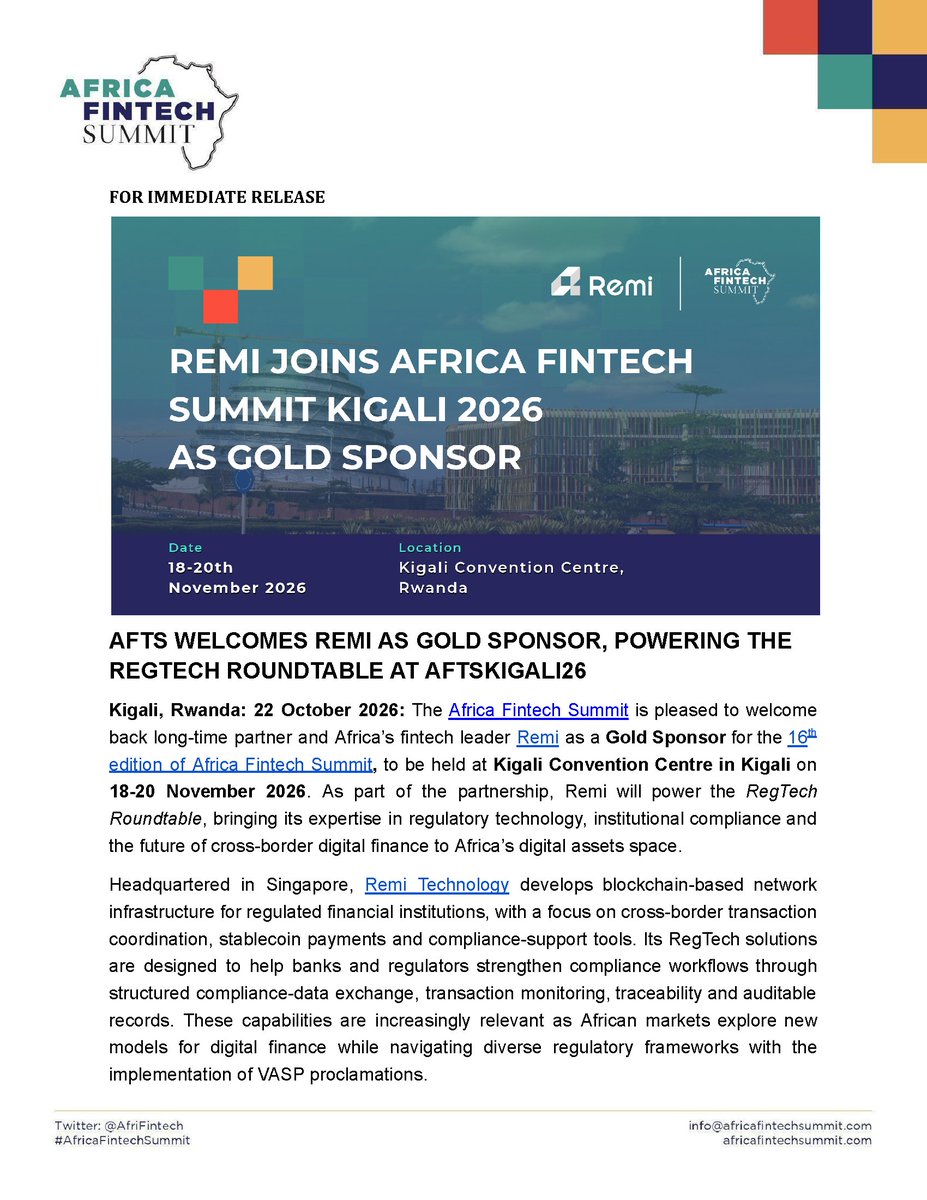
Remi is joining Africa Fintech Summit as a Gold Sponsor, 18–20 November at Kigali Convention Centre.
Steven Marshall, our Chief Business Officer – Emerging Markets, and Ryan Hu, our Head of Business Partnership, will be there.
On 19 November, Steven will speak at two sessions:
• 10:20–10:35 — Remi keynote, Main Auditorium
• 11:00–12:00 — Remi RegTech Roundtable, AD11
All times are local to Kigali.
If you work at a bank or licensed financial institution and are exploring digital assets, come say hello. Tell us what you’re working on, and let’s talk about where Remi can help.
DM us to arrange a time.
@AfriFintech #AFTSKIGALI26
Heading to Singapore FinTech Festival next week? So are we. 👋
The Remi team will be at Singapore EXPO on 18–20 November.
We work with banks and licensed financial institutions on bringing stablecoins into existing banking systems. If that’s on your agenda too, let’s get a coffee and compare notes.
DM us to arrange a time.
#SFF2026
A bank’s IT team has enough on its plate. Connecting to Remi doesn’t mean replacing its core banking system.
Remi Core is the software that connects the bank’s existing systems to our network. The bank can run it on premises or in a cloud environment it controls, with Remi providing application support.
Or it can choose a dedicated service managed by Remi, covering deployment, maintenance, monitoring and technical operations within an agreed scope. Who manages the service and where it is hosted can be decided separately, based on the bank’s technical and regulatory requirements.
Either way, the bank keeps its own ledger and approval systems. It still handles customer compliance, approves payments, prepares the funds and makes account entries.
#BankingTechnology #PaymentInfrastructure
Instant payments are convenient. Scammers think so too.
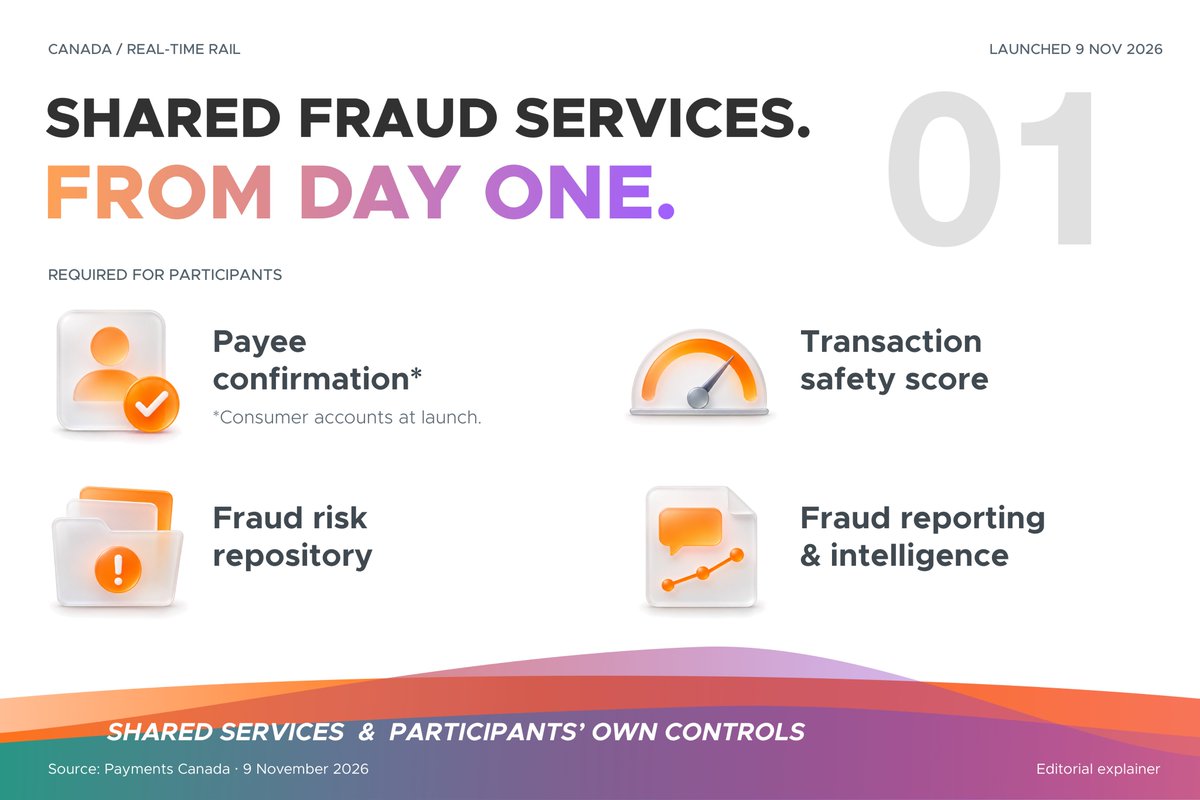
Canada launched its new Real-Time Rail on 9 November, with something worth a closer look: participating institutions have to use a shared set of fraud services from day one.
That includes checking the identity of a recipient’s account before sending money, and giving banks a fraud-risk score before they authorise a payment. Payee confirmation initially covers consumer accounts.
Banks still run their own fraud checks. These shared services work alongside them.
We like the decision to make this part of joining the system. A bank connecting to faster payments should get help spotting suspicious transactions from the start. If something looks wrong, you want the warning before you’ve sent the money.
https://t.co/WMtWuGDIzu
#InstantPayments #FraudPrevention
The payment screen is still spinning. Do you press “Pay” again?
An AI helping a finance team make payments can run into the same uncertainty. It may retry because it hasn't received a confirmation, even though the first payment has already gone through.
Deutsche Bank and Ant Digital Technologies flag this risk in their white paper on AI agents in institutional payments.
The system needs to recognise when the same payment instruction is submitted again and avoid processing it twice. When the result is unclear, checking whether a payment went through and making another payment are two very different actions.
Remi's design includes checks to help prevent the same instruction from being processed more than once. As banks explore AI, protections like this deserve as much attention as what the agent can do.
Let AI save the finance team some work. Don't leave them chasing a supplier for money that was paid twice.
https://t.co/PLntiM8aDc
#AI #Payments
Banks are exploring blockchain to make cross-border payments faster and easier. Making that work also means deciding how customer information moves between institutions, and who is allowed to see it.
Recording a payment on a public blockchain doesn’t mean publishing the customer’s ID number alongside it. Think of a public blockchain as an online ledger that other people can inspect.
Suppose a company is paying a supplier overseas. The receiving bank may need the sender’s name or company name and account details to check who the money is coming from. Those details need to reach the bank securely so it can handle the payment.
Remi’s design gives sensitive customer information a separate route. It travels through encrypted channels to banks and other institutions authorised to receive it. The information itself stays out of the public blockchain record.
The receiving bank can still get the details it needs. Someone looking up the blockchain transaction doesn’t automatically get access to the customer file as well.
A better way to pay shouldn’t come at the cost of the customer’s privacy.
https://t.co/pElTGJyhvw
#Banking #DataPrivacy
A company may need to pay a bill on Saturday, even if it can’t get money out of an investment fund until Monday.
That means keeping cash ready in advance. Sensible, of course—but it also means some money stops earning an investment return earlier than it otherwise might.
In a pilot announced on 30 October, Uber used HSBC tokenized deposits to buy tokenized money market funds. The pilot also demonstrated the ability to liquidate part of those holdings over a weekend.
That gives banks something practical to build on: more flexibility for businesses to decide how much cash to keep ready, and how much can remain invested until it is needed.
This was a pilot. The next test is making that flexibility a reliable part of everyday cash management.
https://t.co/6iUz8pGyPe
#Tokenization #Banking
Some connections don’t need an API. 👋
🇭🇰 Remi at Hong Kong FinTech Week earlier this week.
We spend plenty of time getting bank systems to talk to each other.
At the conference, getting connected was a little simpler: say hello, have a chat, take a selfie. No integration guide required. 😄
#HKFinTechWeek
Steven Marshall, our Chief Business Officer – Emerging Markets, will be a keynote speaker at Africa Fintech Summit in Kigali, 18–20 November.
Heading to Kigali too? Let’s talk. 🇷🇼
#AFTSKIGALI26
Bringing emerging markets expertise and regulatory intelligence to the #AFTSKIGALI26 stage, we're welcoming Steven Marshall as a Keynote Speaker!
As Chief Business Officer – Emerging Markets at @RemiTechnology, Steven brings extensive experience in emerging markets banking and a deep understanding of the challenges financial institutions face in accessing timely regulatory information.
He is also the Founder and CEO of CircALERT, a data technology company leveraging AI to capture, categorize, and distribute central bank updates across emerging markets, helping address critical information gaps in financial markets.
We look forward to hearing Steven's perspectives on regulatory intelligence, emerging markets, and the future of financial innovation in Africa.
📅 18–20 November 2026
📍 Kigali Convention Centre, Rwanda
🎟️ Register: https://t.co/97Ob8G2VPS
#AFTSKIGALI26 #AfricaFintech #RegTech #FinancialInnovation #EmergingMarkets
An instant payment can arrive in seconds. Getting it back after a mistake takes more than an “undo” button.
On U.S. networks such as RTP and FedNow, completed payments cannot simply be cancelled. The sending bank can ask the receiving bank to return the money. The receiving bank reviews the request and responds; returning the funds is a separate payment step. Sending the request does not reverse the original payment.
The U.S. Faster Payments Council walks through this in its 23 October guide to the messages banks exchange around instant payments.
For a bank launching an instant payment service, this belongs in the launch plan: agree who contacts the other bank, who reviews a return request and who keeps the customer informed. Those jobs should already be assigned when the first mistaken payment happens.
Customers get a “send” button. The bank needs a plan for the “I sent it to the wrong account” call.
https://t.co/CKr0V4E3Bi
#InstantPayments #Banking
When a bank needs to put up securities as collateral, “you'll have to wait” is not a welcome answer.
Making those assets easier to move is one aim of DTCC's Tokenization Service, launched on 28 October. The securities remain held at its subsidiary DTC. Eligible users can convert the corresponding rights into blockchain-based tokens, hold and transfer them through registered digital wallets, and convert them back into traditional form.
DTCC says the existing rights and investor protections are preserved. For a dividend-paying share, for example, tokenizing the entitlement does not mean giving up the right to those dividends.
That is the kind of progress we want to see: less waiting when an asset is needed, while holders keep the rights that come with it. It gives banks a concrete reason to consider the technology.
https://t.co/NU5Y063WnM
#Tokenization #Banking
Cregis has just announced its partnership with Remi. A token, by itself, is only one part of the story.
A bank still needs the banking foundation, a way to connect with other institutions, and secure controls around the assets. Cregis, Bison Bank and Remi each bring a different piece: digital asset security and management, a regulated banking environment, and institutional connectivity.
The point of this partnership is making those pieces work together in real cross-border operations.
We’re pleased to announce our partnership with @RemiTechnology to support the development of a digital asset network connecting regulated financial institutions.
Remi connects participating institutions and supports transaction information exchange and compliance coordination. Its strategic partnership with Bison Bank in Portugal provides the banking foundation and regulated operating environment for the network.
Cregis provides the underlying digital asset security and management infrastructure, helping participating institutions manage assets within their existing access control, risk management and governance frameworks.
Through the partnership, we aim to help banks, payment service providers and Forex brokers conduct cross-border digital asset transactions more efficiently, with infrastructure suited to their regulatory requirements and day-to-day operations.
Learn more 👉 https://t.co/NEmOhhw6T6
#Cregis #RemiTechnology #DigitalAssets #FinancialInfrastructure
Fastest isn’t always the right route.
A cross-border payment can move through ACH, a wire, a card network or a real-time rail. Each one changes the trade-off between speed, cost, liquidity, working capital and compliance. The hard part for a bank is choosing the route that fits the transaction—without making the customer or the operations team manage a maze of separate systems.
A new BAFT recap makes the point clearly: no single rail can meet every client need. The future is less about picking one winner and more about making different rails work together under the bank’s existing controls.
That is the practical question we care about at Remi: can new payment infrastructure fit into a bank’s existing operating model, so the bank gains new options without losing visibility over the transaction?
https://t.co/4KJSvbzKbV
#CrossBorderPayments #Bankin
The stablecoin rule is out. The argument isn't over.
On 24 October, the Bank Policy Institute (BPI), a US banking group, criticised the final stablecoin rule from the Office of the Comptroller of the Currency (OCC). The dispute centres on how to judge whether reward arrangements involving an issuer and a third party get around the ban on paying interest for holding payment stablecoins. BPI wants more transparency about the case-by-case review process and how its outcomes will be disclosed.
We agree with the call for transparency. A bank preparing a new service has to set product terms, review contracts, build systems and explain the service to customers. Knowing which factors a regulator will consider helps it spot problems and make changes while the product is still being designed.
The OCC could retain case-by-case review while publishing anonymised examples explaining which arrangements breach the interest ban, and why. That would give the next institution something concrete to work from—and a clearer understanding of where a particular arrangement crosses the line.
https://t.co/swKdsaS0K7
#Stablecoins #Banking
See you in Kigali 🇷🇼
Remi is joining Africa Fintech Summit on 18–20 November as a Gold Sponsor and supporting the RegTech Roundtable.
We’re looking forward to talking with banks, regulators and fintech teams about making cross-border finance work better—including how institutions can exchange the information they need for compliance.
#AFTSKIGALI26
@RemiTechnology returns as a Gold Sponsor for #AFTSKIGALI26, powering the RegTech Roundtable.
Join conversations on compliance, digital assets, and cross-border finance.
🎟️ Use code REM15 for 15% off registration.
#AfricaFintech#RegTech
🛫Las Vegas → Houston🛬. A busy week for Remi. 👋
This week, our team joined Money20/20 USA and BAFT’s Regional Bank Conference.
Stablecoins can make a transfer faster. For a bank, though, there are still systems to run, compliance obligations to meet and customers to serve.
Remi connects existing banking systems with regulated stablecoin infrastructure, helping banks and licensed financial institutions add cross-border capabilities without starting from scratch.
Thanks to everyone who made time to meet the team. It was good to connect in person.
#Money2020 #BAFT
Buying a Treasury investment with stablecoins is different from earning interest just for holding those coins.
The US Office of the Comptroller of the Currency (OCC) published its final GENIUS Act stablecoin rule on 21 October. For covered issuers, one restriction remains: they cannot pay interest or yield solely because a customer holds, uses or retains a payment stablecoin.
An issuer promising “buy our coin and earn interest just by holding it” is describing the kind of payment the ban covers. Paying another company to deliver that prohibited interest does not get the issuer around the rule.
A customer using stablecoins to buy a separate short-term Treasury investment is buying an investment product. Think of buying a bond fund with dollars: the customer earns a return on the investment, not simply because dollars are sitting in an account. Paying with stablecoins does not, by itself, turn an investment return into interest on a stablecoin balance.
Calling something an “investment product” does not automatically make it compliant, either. If an issuer is still paying prohibited interest for holding a stablecoin, relabelling that payment “investment income” can still breach the ban.
Banks and licensed financial institutions should make the distinction clear: whether the customer holds stablecoins or has bought an investment, where the return comes from, and how to sell or redeem the investment when the money is needed.
The rule takes effect on 18 January 2027.
https://t.co/zR7vbsxZ0B
#Stablecoins #Banking