The fastest way to fund science. $1.8M+ funded, powered by $RSC.
Post an RFP.
Discover high quality preregistered proposals.
Paid peer review in 10 days.
Since January 2025, ResearchHub has deployed over $1.5M in research funding to scientists worldwide.
We just redesigned our funding page to make it even easier for funders and researchers to connect.
Take a look ↓ https://t.co/BLp1KaeS5s
Reinkemeier et al., Recordanelles for transcriptome-wide single-cell RNA recording in human cells, Nature Biotechnology, 21 October 2026. ETH Zurich, D-BSSE, Platt lab (open access, CC BY; human cells; abstract-level verification).
https://t.co/8mVs2bI82d
One engineered protein, anchored to the mitochondria, builds a synthetic organelle that samples up to 90% of a human cell's mRNAs and protects them for days.
Earlier RNA recorders logged a few genes over a narrow window.
https://t.co/egeniBFWdP
Ever wondered what a cell has experienced in the past? This is in general hard to measure. Here we introduce the recordanelle, to equip cells with a tool that lets them record their own history.
https://t.co/JVM3yOit8s
@NatureBiotech@ETH@randall_platt@ETH_BSSE
Sun, Hudelmaier et al., Systematic mapping of the prokaryotic noncoding sequence space with a genomic language model, bioRxiv, 22 October 2026. Arc Institute, Hsu lab (preprint, not peer reviewed; computational, abstract-level verification).
https://t.co/UTqAyoOqph
A genomic language model sorted 376 million stretches of DNA between genes, from 1.3 trillion base pairs of prokaryotic DNA, into 5.14 million clusters.
20,149 hold a putative structured RNA plus a protein partner (preprint).
https://t.co/7WuMScgHEz
Delighted to share a landmark preprint from our lab, using genome language models and AI agents for biological discovery and genome mining!
The stretches of DNA between protein-coding genes are often called the genome’s “dark matter,” but they are far from empty. They encode RNA molecules that sense metabolites, regulate genes, and control some of molecular biology's most important tools (such as programmable genome editors e.g. CRISPR/bridge)
Much of this biology is unexplored. One reason is that RNAs can retain similar structures and functions even as their DNA sequences change dramatically, making their relationships difficult to recognize with conventional computational tools
Shaulson et al., Context-specific hypermetabolism in humans with mitochondrial defects, Cell Press Blue, October 2026. Columbia University, Picard lab (case-control, 10 vs 10; energy figures are lean-mass-adjusted residuals, verified in the authors' medRxiv preprint since the published full text is paywalled).
https://t.co/2XKdspJTLO
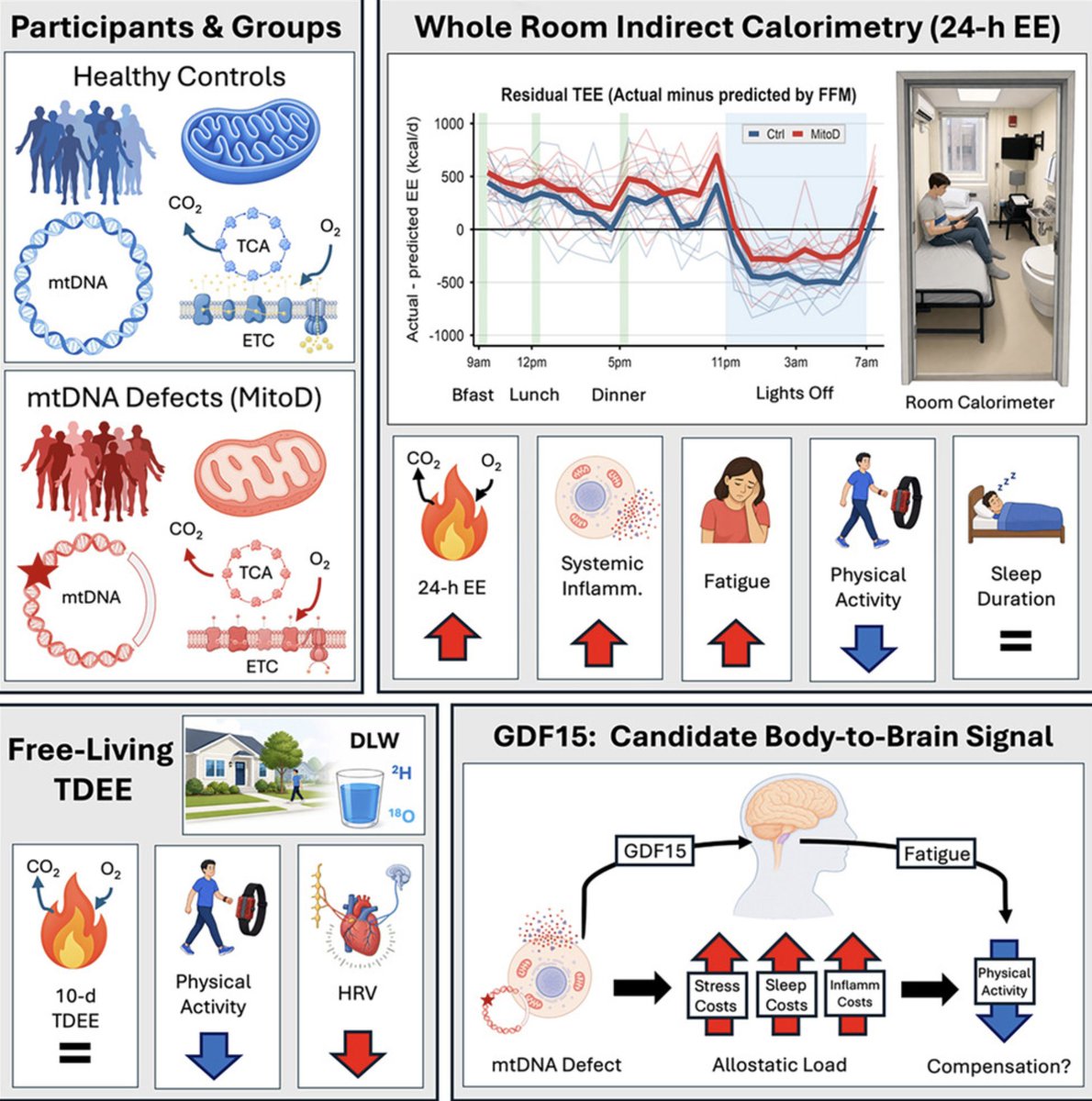
Ten adults with mitochondrial DNA defects burned 195 kcal a day more than matched controls in a sealed metabolic room, lean-mass adjusted.
Over 10 days of normal life their totals matched. They moved 39% less (n=10 per group).
https://t.co/Ehoo1LUF0J
Adults with mitochondrial disease burned about 195 more calories a day than healthy controls in a metabolic chamber, while moving 26% less. Yet over 10 days of normal life, their total energy expenditure looked the same as everyone else's.
A new study in Cell Press Blue, led by Evan Shaulson and Martin Picard @MitoPsychoBio at Columbia University, suggests the extra cost is real. It just gets hidden because people with these defects move less.
The study compared 10 adults with mitochondrial disease to 10 healthy controls of similar age, sex, height, and BMI.
Mitochondria carry their own small set of DNA, separate from the DNA in your cell nucleus. All 10 patients had a confirmed mutation in that mitochondrial DNA. Five had a single letter change in the genetic code (the m.3243A>G mutation). Five were missing a large chunk of the DNA entirely (a single large deletion).
Different mutations, same problem. Both damage oxidative phosphorylation, or OxPhos, the final stage of energy production where mitochondria use oxygen to make most of your ATP.
The question was simple. If the cell's energy machinery is damaged, does the whole body burn less energy, more, or the same?
Answering it is harder than it sounds, because a single measurement can mislead. So the researchers measured each person three different ways:
1. Resting energy expenditure for one hour, fasted, lying still.
2. A 23 hour stay in a whole-room calorimeter (an airtight room that measures oxygen use and CO2 output) with fixed meals, fixed lights-out, and hourly blood draws.
3. Ten days of free living, using doubly labeled water (you drink water tagged with two isotopes, and how fast they leave your body reveals total energy burned).
The findings were fairly insightful:
• Resting energy expenditure did not differ between groups (+19 kcal/day, p = 0.989), after adjusting for fat-free mass (everything in the body that isn't fat).
• In the chamber, 24 hour expenditure was higher in mitochondrial disease by 195.5 kcal/day (p = 0.016). The gap held across day and night.
• Wrist acceleration was 26% lower in patients, yet energy spent per unit of movement was 58% higher.
• During sleep, patients burned 116.7% of their resting rate versus 102.3% in controls. Heart rate variability (a marker of how well your nervous system shifts into recovery mode) was 58% lower.
• In free living, total daily expenditure was similar (p = 0.48), but patients moved 39% less.
• Plasma GDF15, a stress hormone made by cells under mitochondrial strain, was about 4.6 times higher in patients (1,840 vs 404 pg/mL). C-reactive protein, an inflammation marker, was 301% higher.
So what's happening here?
Think of a car with a worn engine. It burns more fuel per mile. If the driver cuts back on trips, the monthly gas bill looks normal, but the engine is still inefficient.
Mitochondrial defects seem to be raising the energetic cost of living, and the body appears to balance the budget by lowering voluntary activity.
This fits the constrained energy model, which holds that total daily expenditure stays within a narrow range because activity and other costs trade off against each other.
GDF15 is the candidate messenger. It acts on a receptor called GFRAL, found only in the brainstem, and in other settings it causes malaise, suppresses appetite, and reduces activity. In this study, higher GDF15 tracked with disease severity, fatigue ratings, higher energy cost per unit of movement, higher sleep expenditure, and lower free-living activity.
Some things to take into consideration:
The sample is 10 per group, with two different mutation types pooled together.
Wrist accelerometers capture movement poorly, and the energy measure includes non-movement costs like inflammation, so the study can't say how much of the extra cost is muscle inefficiency.
The chamber was a strange place to sleep, with an IV line and sensors, and both groups burned more than expected at night.
Patients also ate only 95% of their measured expenditure versus 107.5% in controls, so their lower fat burning in the chamber could reflect a calorie deficit and not the mutation.
The GDF15 data are correlations across a case-control gradient. They can't show whether GDF15 causes the inactivity, or whether inactivity, symptoms, and GDF15 all follow from the disease. Proving that would take trials that block the pathway, and the team recommends caution because GDF15 may be a useful energy-sensing signal.
For patients, the findings point to managing the downstream costs: sleep problems, anemia, heart and lung dysfunction, and psychological stress. They also suggest exercise may help partly by lowering the energy cost of everyday movement. That is an interpretation, supported by earlier training studies in this population.
There is a broader question for the rest of us. This was a rare disease, and these patients carried mutations in most of their mitochondrial DNA copies. Healthy aging looks nothing like that. But some of the same pieces show up as we get older, and what follows here is my extrapolation, not something the study tested.
• Mitochondrial DNA damage accumulates with age, though at much lower levels than in disease.
• GDF15 rises steadily with age, and in large cohorts it is one of the strongest blood predictors of mortality and age-related disease.
• Older adults tend to spend more energy per step when walking, and fatigue and falling activity are among the earliest signs of functional decline.
If mitochondrial strain raises the cost of living even modestly, and the body responds by quietly cutting activity through a signal like GDF15, that could be one route by which aging becomes self-reinforcing. Less movement means less muscle and fewer mitochondria, which raises the cost of the next trip. A hidden energy tax would be hard to see in a resting test, and most people would just call it getting older.
Training is the best-supported way to improve mitochondrial function and lower the cost of movement, and the case for staying active gets stronger if the brake is partly biological and not just motivational. Any drug aimed at GDF15 or its receptor is years from clinical use, and blocking an energy-sensing signal could carry risks.
The broader lesson is about measurement. A one hour resting test missed the problem entirely. Only the full day in the chamber exposed it, and only the free-living data showed how behavior hides it. Fatigue may be less a failure of motivation than a response to an energy bill the body can't afford.
Gatti et al., Amazon carbon emissions driven by human actions amplified by droughts, Nature, 21 October 2026. INPE, Brazil, with NOAA and co-authors (open access; aircraft vertical profiles 2010-2024, column budget method).
https://t.co/3oaxKLPy7L
Fifteen years of aircraft CO2 profiles put the Amazon at 0.32 PgC a year of net carbon emission. Fires alone: 0.40.
2024 was the highest in that record at 0.81 PgC. Lightning lit 1.0% of its fires (1,017 profiles, 4 sites).
https://t.co/ThRfFdHR2A
Chang et al., Association Between Medication Use for ADHD and Risk of Motor Vehicle Crashes, JAMA Psychiatry 2017. Karolinska Institutet and Indiana University (within-individual design; any ADHD medication, stimulant or atomoxetine; US commercial claims 2005-2014, 11,224 crash visits).
https://t.co/uFrvdG0QmS
Men with ADHD had 38% lower odds of an ER visit for a car crash in months they filled an ADHD prescription than in months they did not.
Women: 42% lower. Each patient compared against themselves (2.3M US adults).
https://t.co/u0JJQtePff
Among adults with ADHD, the odds of a car crash requiring an ER visit were 38% lower in men and 42% lower in women during months on medication vs. months off.
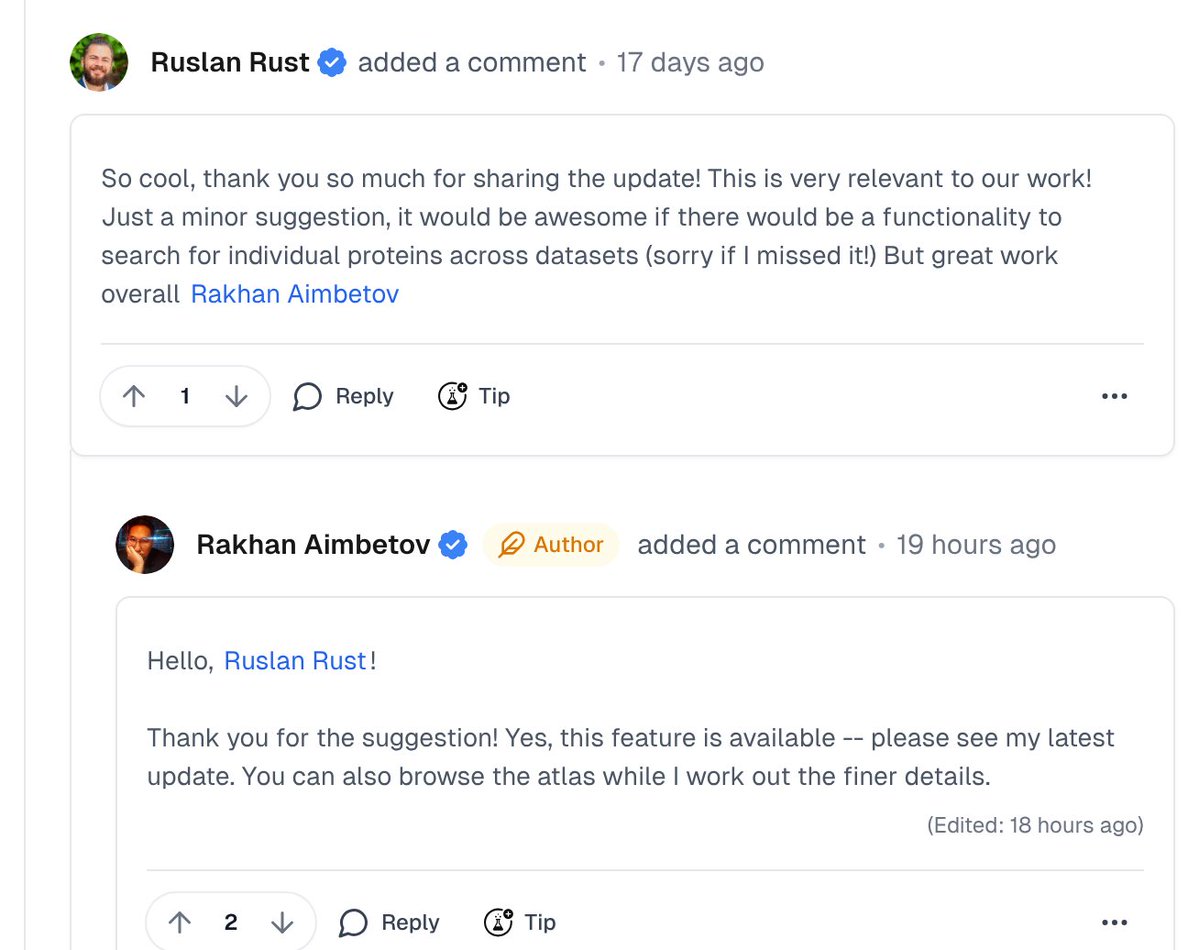
12 funders put $5,000 into this proposal. Since July the researcher has posted four progress updates, and in one of them he told his funders several of the v1 headline results were processing artefacts. This week he opened up the atlas.
https://t.co/9wGOeyvwyW
If you fund research, this is the bit to watch. Updates go on the proposal page you paid into. You can reply or tip. @rust_ruslan asked for per-protein search. Rakhan pointed him to the latest update, where the Gene tab does that. Most grants send a PDF a year later.
Your brain makes one of the most powerful psychedelics on Earth.
Right now. As you read this.
It’s called DMT. And a new documentary is digging into why.
DMT Quest 2 hits IMAX Tue 11/17/26 in Austin, TX. @dmt_quest
This is the trailer. My thread will talk about the first film. 🧵
The bottleneck in science is clearly headed towards validation.
We're experimenting with flipping the process: AI drafts V1 proposals, scientists refine them with peer review bounties, and the crowd funds the ones worth running.
Open, distributed wet-lab validation 💪