Humbled and deeply honored to be awarded the 2025 Walter Huber Research Prize by @ASCETweets ! Walking in the footsteps of past awardees, many of whom I've long admired and learned from, is truly humbling.
https://t.co/9Qj9jcmfpt
Recent paper from our lab led by @liujiafu15 presents FloodDamageCast, the first of its kind ML model for near-real-time flood damage nowcasting of structures at fine resolutions (500m x 500m)! The model combines data augmentation (CTGAN) & LightGBM to tackle imbalanced datasets and predict property damage at scale for rapid damage assessment (nowcasting) to inform response and recovery efforts.
🚀Excited to share our latest work from @ResilienceTAMU!
🌊FloodDamageCast: A damage nowcasting model that combines CTGAN for data augmentation with LightGBM, pinpointing high-damage areas often missed by baseline models.
https://t.co/Tro2fhFYit
#MachineLearning#UrbanResilience
📢New preprint from our lab led by @liujiafu15 and @chiawei_hsu reveals the network dynamics of business recovery which unfold via diffusion on pre-disaster visitation network. Key findings: (1) the presence of a diffusion process influencing recovery across the business network; (2) variations in how different business types depend on others for recovery; (3) identification of recovery multiplier businesses that accelerate regional recovery; and (4) differences in recovery multipliers across high- and low-income areas.
https://t.co/FsJRGyyTA1
📢The latest paper from our lab led by @natcoleman27 in collab w @Claireleepp & wonderful @tinacomes presents the research landscape of a decade of research focusing on integrating equity into infrastructure resilience assessment! We unpack various dimension of analysis and explore important directions for future research for this growing area of inquiry in the resilience literature!
https://t.co/MmAwnFvrK4
📢Excited to share our latest preprint led by @natcoleman27 in collab w @Chenyue__Liu in which we dissected societal recovery at the finest scale ever examined based on evaluating fluctuations in lifestyle activities of millions of anonimozed users in two major hurricanes! The results unveil heterogeneity in societal recovery even for individuals living in the same spatial area!
https://t.co/ODLfcQhk3g
📢Recent paper from our lab in collab w @FarahmandHaamed@XavierEspinet@KaiyinTamu presents a new framework for assessing the resilience of road networks, especially in regions with limited data. Our approach considers agency, user, and environmental costs and supports benefit-cost analysis, integrating climate projections for smarter investments. Our case study in Haiti, part of the World Bank's Resilient Urban Transport and Accessibility Project (RUTAP), showcases how this framework can offer quantitative insights for better decision-making to enhance road network resilience in the Global South!
https://t.co/47NBYMrwaW
📢 Recent paper from our lab led by @Chenyue__Liu unveils the determinants of health risk disparity in cities using graph machine learning. This AI-based approach provides novel insights for evaluating intertwined features that shape health disparities for inter- and intra-city analysis to inform integrated urban design strategies promoting urban health. #UrbanAI
https://t.co/eTqc12QTk8
📢The latest preprint from our lab led by @ViolaYuHsuanHo presents our Elev-Vision-SAM model for enhancing automated estimation of the lowest floor elevation of buildings by integrating vision language and foundation models on street view imagery. #AI#ResilienceTech
https://t.co/YHRcR480Tk
We are thrilled to publish this study by @Junwei__Ma & @Mostafavi_Ali, highlighting how coastline and metropolitan counties in the US show large spatial inequality of property flood risk linked to urban density and growth, economy, and racial and income segregation.
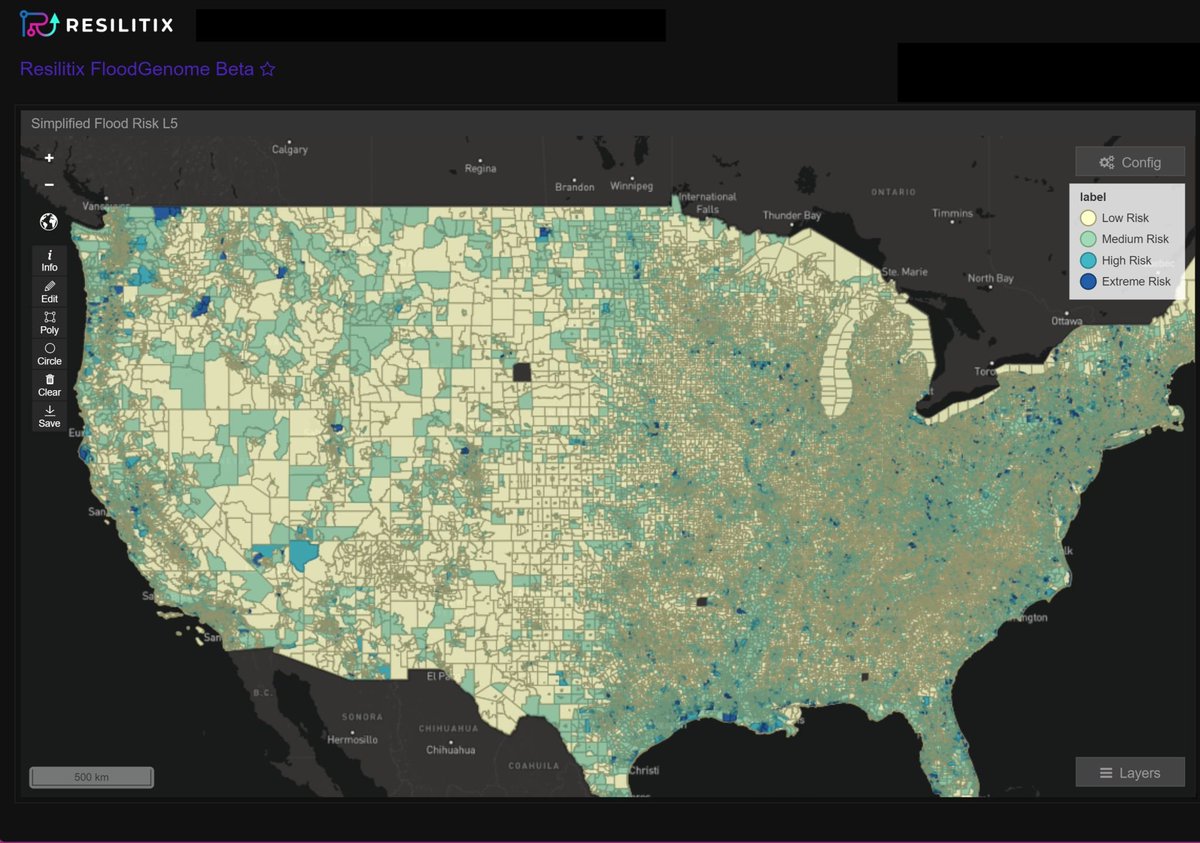
📢The latest preprint from our lab led by @Chenyue__Liu presents our #FloodGenome model (interpretable ML model) which reveals universal features that shape property flood risk predisposition in cities! The model also enables classifying property flood risk profile of communitis at fine resolutions to complement flood maps to inform flood mitigation and risk reduction efforts!
We have implemented #FloodGenome model for the entire U.S. through #Resilitix and the data product is available for access for free to public and community-based organizations. To request access, contact: [email protected]
https://t.co/2zv6r57Q72
📢 The latest paper from our lab co-led by @khilRajput@JackyZhewei_LIU@Chenyue__Liu published in Nature Cities examined population life activity flood exposure to provide a human-centric approach to flood risk analysis. We used millions high-rsolution location based data to quantify population dwell time in flood prone places. By focusing on the effect of daily human activities in flood-prone areas, this approach offers a better understanding of flood impacts on daily activities and socioeconomic factors. #NSF_Funded @TAMUCVEN
@TAMUEngineering
https://t.co/EtsM7kvjmU
New paper from our lab unveils how human mobility networks in 20 U.S. cities affect urban heat exposures, identifying "urban heat traps" where populations frequently move between high-heat areas. Insights like these are crucial for designing healthier, more sustainable cities.
https://t.co/RZMuSID61J
So excited to share our latest preprint led by @KaiyinTamu in which we present a deep learning-driven community resilience rating model based on intertwined socio-technical systems features. #AI#Resilience#NSF_Funded https://t.co/bZo8BoSBdU
Excited to share our new paper led by @liujiafu15 in which we characterize disaster recovery as a network diffusion process. The findings have EJ implications: the recovery network spillover effects are stronger in disadvantaged communities👇 #NSF_Funded
https://t.co/76fQINEL5x
The latest paper from our lab led by @chiawei_hsu examined the sensitivity of human mobility network analyses results to the data sources! The findings reveal that human mobility properties obtained from different dataset may not be generalizable due to representativeness issues!
A new preprint led by @libo0901 reveal #Resilience curve archetypes & their fundamental properties in power infrastructure using unsupervised #MachineLearning. Findings explain distinct resilience behaviors of triangular vs trapezoidal archetypes.
https://t.co/Ia6FJGeRkv
New paper from our lab led by @chiawei_hsu reveals different resilience characteristics in human mobility networks at microscopic vs. Substructure vs macroscopic scales! #NSF_Funded
https://t.co/Fct5JFzw2M
Our latest preprint led by @ViolaYuHsuanHo presents ML4EJ: an interpretable machine learning model for decoding the role of urban features in shaping disparities in environmental hazard exposures!
https://t.co/hlG90vZ3Do