All your prediction markets & tools in one place with charting, mentions data, sports odds, contract filters, risk analytics & more! Not investment advice.
We're excited to roll out our latest feature, Resolve Elections! We want this to be your 2026 US midterm election prediction markets hub! A thread🧵on all the new features: https://t.co/LS3ltrBHNR
@Kalshi Stop on by our elections center to monitor flows, see which contracts are moving, where there is disagreement between exchanges, make turnout assumptions with our projection model, and much more! https://t.co/aEMmIlIgqw
We're excited to roll out our latest feature, Resolve Elections! We want this to be your 2026 US midterm election prediction markets hub! A thread🧵on all the new features: https://t.co/LS3ltrBHNR
@EventualNews@JonHusted We just published the latest piece in our midterm analysis series, this time on Ohio. Feedback welcomed!
https://t.co/F12ORHQb8W
OHIO SENATE: Next up in our midterm analysis series is the special election for the Ohio senate seat vacated by Vice President Vance in January of 2025. Governor DeWine appointed then GOP Lieutenant Governor Jon Husted to replace Vance. This race intrigues us for several reasons, most notably because Sherrod Brown, the Democratic challenger, was a three term senator from Ohio already, making him a household name in the state.
Background: In the modern political era, Ohio has been seen as a "bellwether" state, even having earned the phrase "As Ohio goes, so goes the nation" in political science circles. However, following President Trump's first term victory in 2016, Ohio has looked fairly ruby red, having voted for Trump decisively three times in a row in presidential elections. That being said, Sherrod Brown managed to do something that had seemed to be impossible in the Trump era: he won reelection as a democrat in 2018 for a third senate term, at 53.5-46.5. He was part of a trifecta of Democratic senators winning in "Trump" states that year along with Montana's Jon Tester and West Virginia's Joe Manchin.
Fast forward to 2024, and Brown is up for reelection and loses in what was by all accounts a tough year for Democrats. However, Brown vastly outperforms Harris, losing to GOP's Bernie Moreno by 3.5, 46.5 to 50 where Harris lost the state by roughly 11 points. Brown's outperformance in a red wave year is the first signal to us that he has the potential to reclaim his seat in 2026 if the "blue wave" does, in fact, materialize. Brown outperformed Harris in all 88 Ohio counties, and some counties even voted for Trump and Brown, such as Lorain (West of Cleveland).
What is difficult to measure is whether certain states have become more partisan in the last few cycles, Ohio included. For example, we'd be hard-pressed to imagine a Democrat - including Joe Manchin - winning a statewide office in West Virginia in 2026. Is Ohio the same? We'd argue that it's partisan shift is a bit less ossified than in these other "Trump" states, in part due to the ticket splitting Sherrod Brown experienced in 2024, even if he came up short.
So, what are the polls saying? As of this writing, the @RCPolitics average of polls has Brown up by 3.1. In 2024, Brown underperformed the polls by 1.9. In 2018, while no final average was given, he also underperformed his polls by between 3 to 10 points, depending on cutoff time. This time around, just as with our first analysis on Texas, there is far more polling being conducted which does give us more confidence in the figure being reported. However, with polling errors in recent history landing on the wrong side for Brown, we need to take this into account. Trump not being on the ballot this iteration may also be a benefit to Brown.
Energy: then, there is the diesel angle. Unlike our first two states in our analytics, Texas & Maine, Ohio is far more tied to agriculture, which relies heavily on diesel and fertilizer. Rising prices due to the Iran war have weighed on midwestern farmers and agricultural economies. As of this writing, a gallon of diesel fuel in Ohio costs about $6.24, almost double the final price in 2024 of $3.47 (NBC). This alone may be enough to swing it in Brown's favor.
The elephant in the room: the GOP gubernatorial candidate, Vivek Ramaswamy, has recently come under fire for an ad attacking his Democratic opponent that even members of his own party have distanced themselves from. There could be a backlash not only to Ramaswamy, but also to down ballot Republicans such as Husted.
Data centers: This has become a hot button issue in Ohio where public sentiment has turned negative towards the buildout of data centers. Brown has been framing Husted as having been "pro data center". The @ezraklein podcast recently had a good episode on Trump voter focus groups where this has been a consistent issue that Brown is hammering Husted on. Given the heightened anxiety around this topic, if this has staying power, it could be a drag on Husted, especially given how pro data center President Trump has been.
Conclusion: We think this one goes to Brown. A combination of high diesel prices, household name recognition, a populist message, poor GOP approval ratings, Trump not being on the ballot, and a GOP gubernatorial candidate that has mismanaged his campaign messaging all make for a positive environment for any Democrat running statewide in Ohio. However, this is still a Trump +11 state, so this is by far not a foregone conclusion. The past polling errors against Brown combined with the slim lead he currently holds in the polls means this is well within the margin of error. At ~70c, the price for a Brown victory also feels a bit rich here. We do not currently hold a position. We will be watching - but not chasing - a YES Brown position. As always, these views are our own and do not constitute a recommendation to buy, sell, or trade any contract.
https://t.co/oW9xDPOeXW
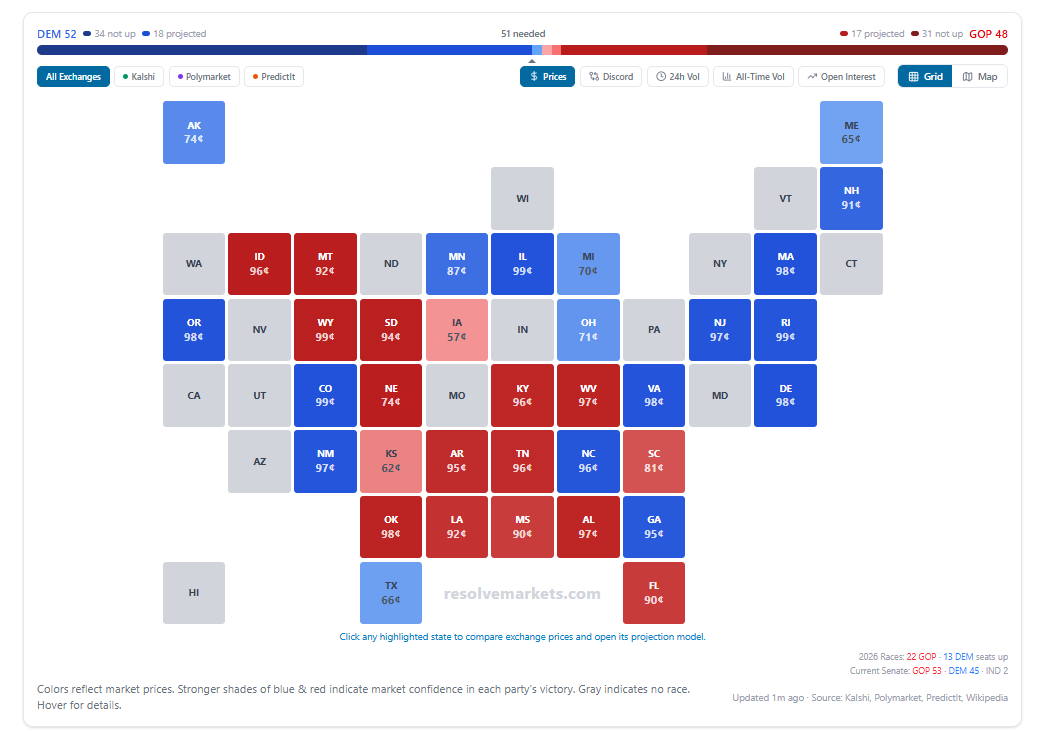
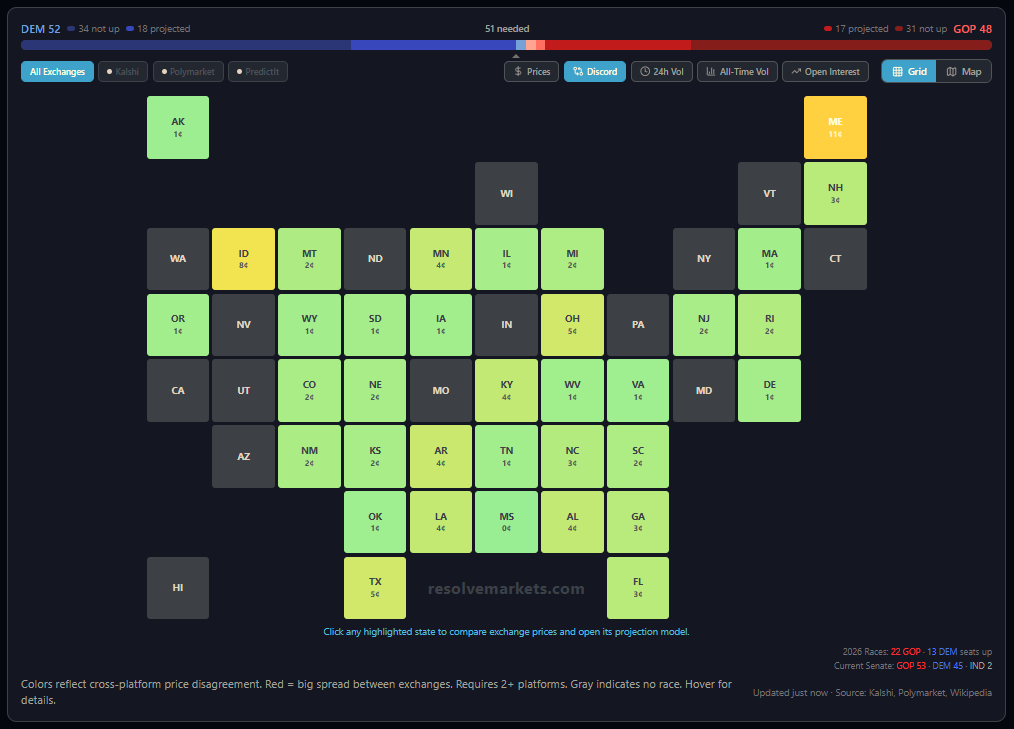
@TheStalwart Joe of potential interest to you in the final 10 days of election season is our aggregated senate election prediction market contract map w/ prices from multiple exchanges for each race (including TX). Prices now indicate 52-48 Dem control.
https://t.co/F18MA1bLu2
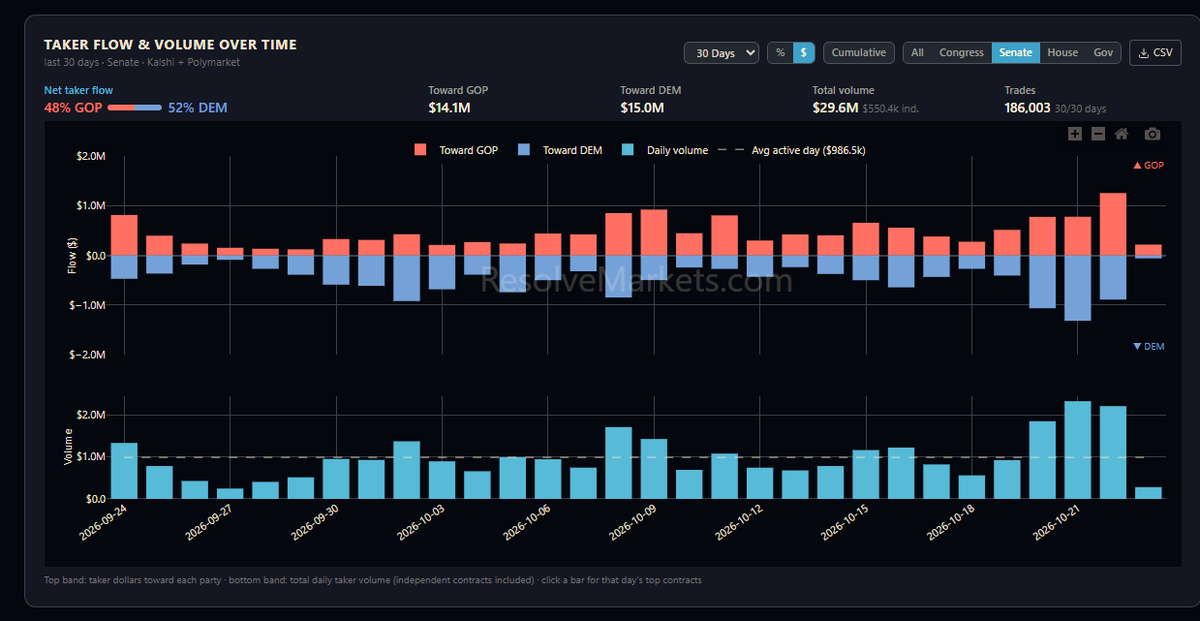
Aggregate volume on midterm senate election contracts finally starting to perk up a bit here. Will be interesting to see in the final ten days what the flows look like.
https://t.co/LS3ltrBHNR
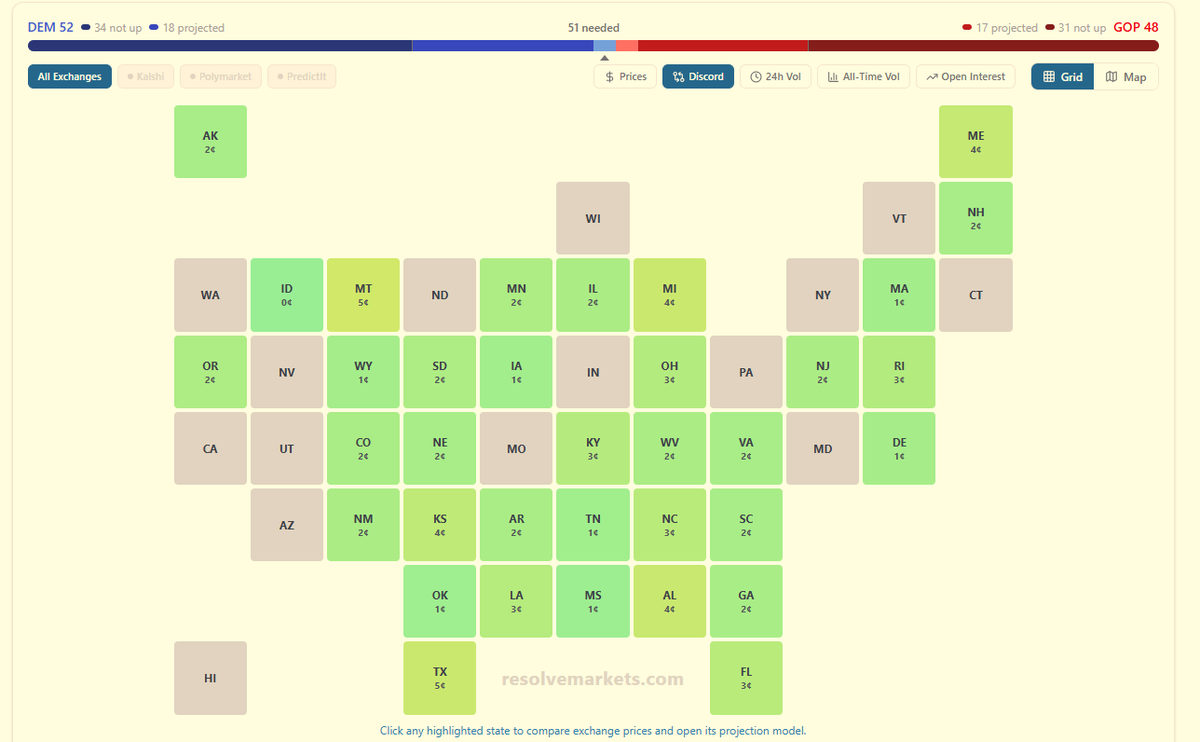
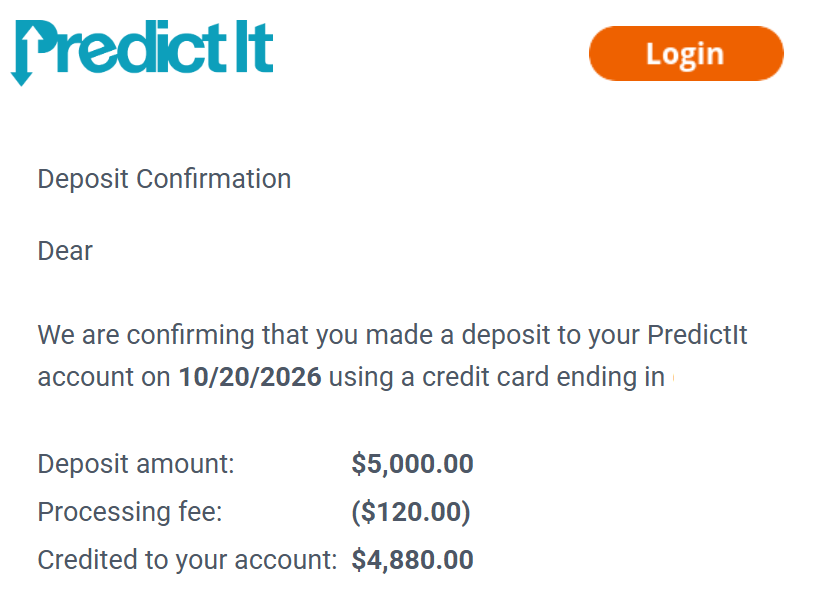
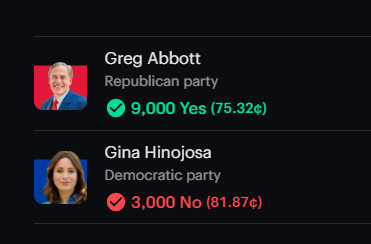
Not all prediction market exchanges are in agreement about senate prices. See the differences using our Senate map. We just scooped up shares of NO Paxton on @PredictIt at 62c while the @Kalshi price was 68c. (Not a recommendation to trade).
https://t.co/F18MA1cjjA
TWO WEEKS TO GO: Our aggregated senate price map across three prediction market exchanges has Democrats priced to control 52 seats.
https://t.co/F18MA1bLu2