Sam Altman:
“We are two years away from true super intelligence. By the end of 2028 more of the world’s intellectual capacity will reside inside of data centers than outside of them.”
Shutting down these data centers is humanity’s last hope for survival.
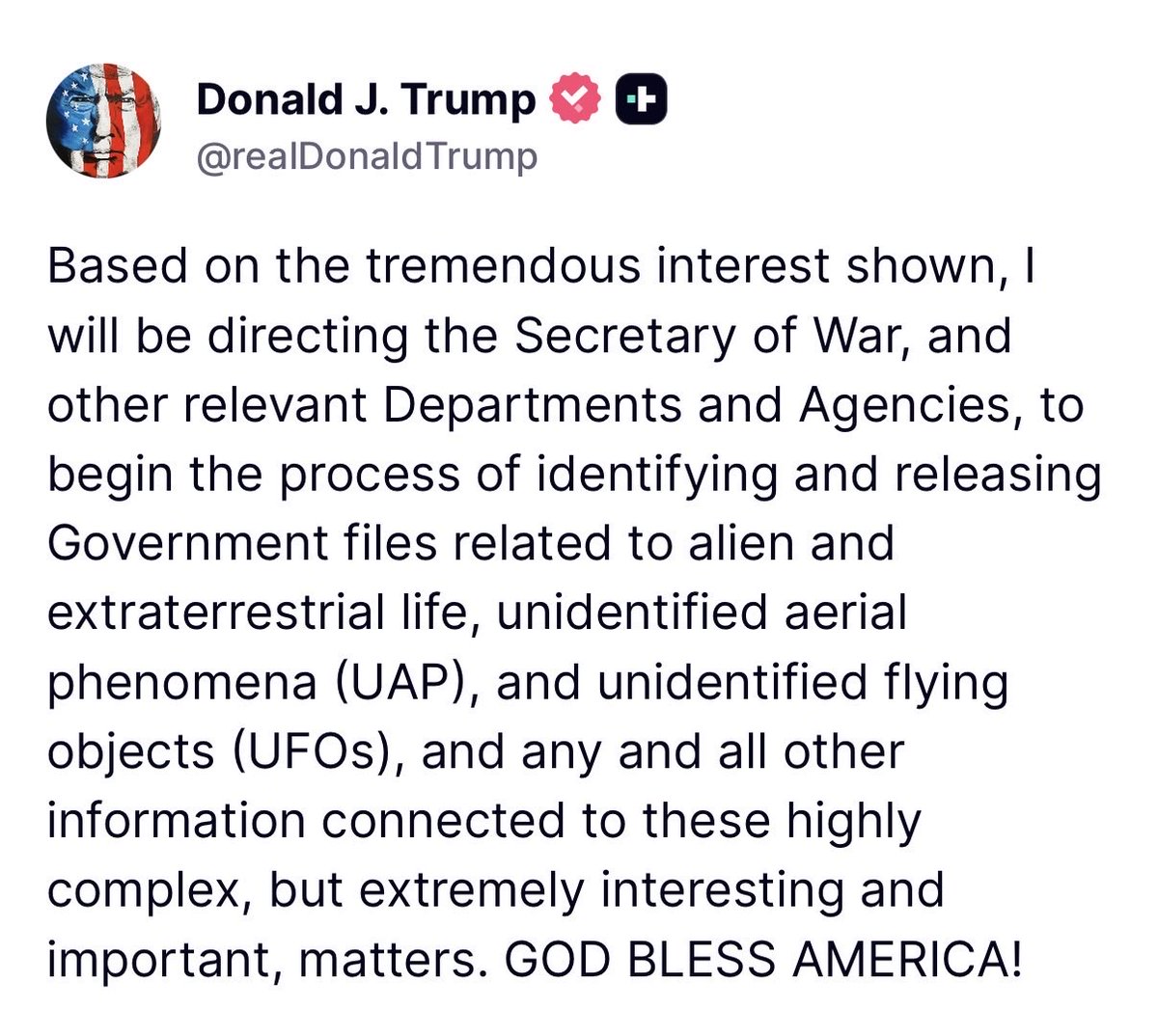
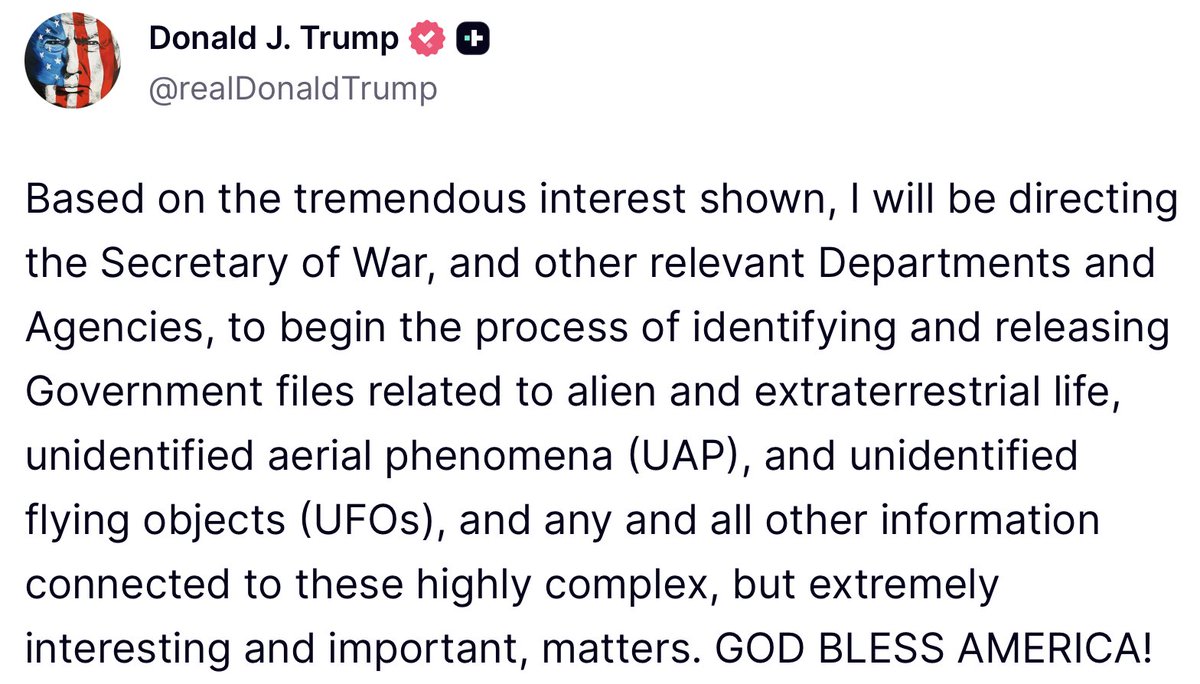
"Based on the tremendous interest shown, I will be directing the Secretary of War, and other relevant Departments and Agencies, to begin the process of identifying and releasing Government files related to alien and extraterrestrial life, unidentified aerial phenomena (UAP), and unidentified flying objects (UFOs)..." - President Donald J. Trump
That is the key question. Epstein and Maxwell were sent to prison for running an underage child sex ring.
Prosecute their clients!!! Until we see at least one client arrest, this partial release of Epstein files means nothing.
A few random notes from claude coding quite a bit last few weeks.
Coding workflow. Given the latest lift in LLM coding capability, like many others I rapidly went from about 80% manual+autocomplete coding and 20% agents in November to 80% agent coding and 20% edits+touchups in December. i.e. I really am mostly programming in English now, a bit sheepishly telling the LLM what code to write... in words. It hurts the ego a bit but the power to operate over software in large "code actions" is just too net useful, especially once you adapt to it, configure it, learn to use it, and wrap your head around what it can and cannot do. This is easily the biggest change to my basic coding workflow in ~2 decades of programming and it happened over the course of a few weeks. I'd expect something similar to be happening to well into double digit percent of engineers out there, while the awareness of it in the general population feels well into low single digit percent.
IDEs/agent swarms/fallability. Both the "no need for IDE anymore" hype and the "agent swarm" hype is imo too much for right now. The models definitely still make mistakes and if you have any code you actually care about I would watch them like a hawk, in a nice large IDE on the side. The mistakes have changed a lot - they are not simple syntax errors anymore, they are subtle conceptual errors that a slightly sloppy, hasty junior dev might do. The most common category is that the models make wrong assumptions on your behalf and just run along with them without checking. They also don't manage their confusion, they don't seek clarifications, they don't surface inconsistencies, they don't present tradeoffs, they don't push back when they should, and they are still a little too sycophantic. Things get better in plan mode, but there is some need for a lightweight inline plan mode. They also really like to overcomplicate code and APIs, they bloat abstractions, they don't clean up dead code after themselves, etc. They will implement an inefficient, bloated, brittle construction over 1000 lines of code and it's up to you to be like "umm couldn't you just do this instead?" and they will be like "of course!" and immediately cut it down to 100 lines. They still sometimes change/remove comments and code they don't like or don't sufficiently understand as side effects, even if it is orthogonal to the task at hand. All of this happens despite a few simple attempts to fix it via instructions in CLAUDE . md. Despite all these issues, it is still a net huge improvement and it's very difficult to imagine going back to manual coding. TLDR everyone has their developing flow, my current is a small few CC sessions on the left in ghostty windows/tabs and an IDE on the right for viewing the code + manual edits.
Tenacity. It's so interesting to watch an agent relentlessly work at something. They never get tired, they never get demoralized, they just keep going and trying things where a person would have given up long ago to fight another day. It's a "feel the AGI" moment to watch it struggle with something for a long time just to come out victorious 30 minutes later. You realize that stamina is a core bottleneck to work and that with LLMs in hand it has been dramatically increased.
Speedups. It's not clear how to measure the "speedup" of LLM assistance. Certainly I feel net way faster at what I was going to do, but the main effect is that I do a lot more than I was going to do because 1) I can code up all kinds of things that just wouldn't have been worth coding before and 2) I can approach code that I couldn't work on before because of knowledge/skill issue. So certainly it's speedup, but it's possibly a lot more an expansion.
Leverage. LLMs are exceptionally good at looping until they meet specific goals and this is where most of the "feel the AGI" magic is to be found. Don't tell it what to do, give it success criteria and watch it go. Get it to write tests first and then pass them. Put it in the loop with a browser MCP. Write the naive algorithm that is very likely correct first, then ask it to optimize it while preserving correctness. Change your approach from imperative to declarative to get the agents looping longer and gain leverage.
Fun. I didn't anticipate that with agents programming feels *more* fun because a lot of the fill in the blanks drudgery is removed and what remains is the creative part. I also feel less blocked/stuck (which is not fun) and I experience a lot more courage because there's almost always a way to work hand in hand with it to make some positive progress. I have seen the opposite sentiment from other people too; LLM coding will split up engineers based on those who primarily liked coding and those who primarily liked building.
Atrophy. I've already noticed that I am slowly starting to atrophy my ability to write code manually. Generation (writing code) and discrimination (reading code) are different capabilities in the brain. Largely due to all the little mostly syntactic details involved in programming, you can review code just fine even if you struggle to write it.
Slopacolypse. I am bracing for 2026 as the year of the slopacolypse across all of github, substack, arxiv, X/instagram, and generally all digital media. We're also going to see a lot more AI hype productivity theater (is that even possible?), on the side of actual, real improvements.
Questions. A few of the questions on my mind:
- What happens to the "10X engineer" - the ratio of productivity between the mean and the max engineer? It's quite possible that this grows *a lot*.
- Armed with LLMs, do generalists increasingly outperform specialists? LLMs are a lot better at fill in the blanks (the micro) than grand strategy (the macro).
- What does LLM coding feel like in the future? Is it like playing StarCraft? Playing Factorio? Playing music?
- How much of society is bottlenecked by digital knowledge work?
TLDR Where does this leave us? LLM agent capabilities (Claude & Codex especially) have crossed some kind of threshold of coherence around December 2025 and caused a phase shift in software engineering and closely related. The intelligence part suddenly feels quite a bit ahead of all the rest of it - integrations (tools, knowledge), the necessity for new organizational workflows, processes, diffusion more generally. 2026 is going to be a high energy year as the industry metabolizes the new capability.
“Bank of England must plan for financial crisis sparked by aliens.”
The Times just published this.. https://t.co/m1rsBgAZC2
This is the UK’s paper of record treating UAP and non-human intelligence as a systemic financial and societal risk. Not culture. Not conspiracy. Not entertainment.
And at the centre of it is my friend, Helen McCaw. A former Bank of England senior analyst in financial security. A Cambridge graduate. Someone whose actual job was to think about state-level risk, stability, and what breaks systems.
She didn’t come to this from “UFO world”. She came to it from risk modelling, financial systems, and contingency planning.
She formally warned the Bank of England that official confirmation could trigger bank runs, market collapse, and societal shock.
And now The Times has published it.
I’m incredibly proud of her. She inspires me regularly.
The question is no longer “is it real?”
It’s “what happens when it’s confirmed?”
The truth is coming 11/21. Worldwide on Prime Video & in select U.S. theaters.
An explosive documentary that reveals an 80-year global cover-up of non-human intelligent life, with testimony from 34 U.S. Government insiders.
60+ years ago I was provided highest level classifications to lead DOD work on nuclear weapons&anti-missile defense. Informally briefed on "otherworld technologies" by CIA's Richard Bissel (who had been in charge of Skunkworks, Area 51, Los Alamos, etc.) but sworn to secrecy.
NEW- Statement from UAP whistleblower David Grusch on @RepEricBurlison hiring him to be on staff:
“I’m both immensely humbled and deeply honored to join Congressman Burlison and his amazing team of professionals in pushing for government transparency,” said Grusch. “The
public is rightfully demanding to know the truth and it is my true privilege for me to serve the people of this country once again. I will use all my expertise to support Rep. Burlison and help the US Congress restore full oversight while enabling the Legislative Branch’s ability to investigate and hold those accountable who have broken the law and lied not only to our Congress, but also to the Executive Office of the President, Director of National Intelligence, and Department of Justice.”
Dear Followers:
I confirm that within the year 2025 the Ecat technology will be spread in the world.
Warm Regards,
Andrea Rossi, CEO
Leonardo Corporation