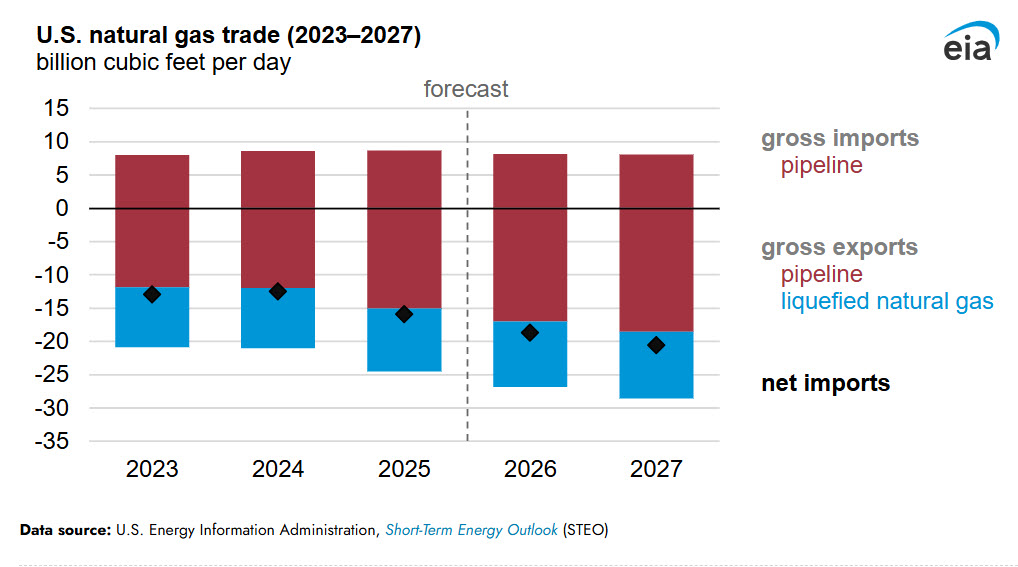
For the short term, we forecast through 2027:
🔹 U.S. LNG exports ⬆️
🔹 U.S. natural gas pipeline exports ⬆️
🔹 U.S. natural gas net exports ⬆️
https://t.co/vPPDuj8Kb1
#TodayInEnergy#ShortTermEnergyOutlook
Energy Transfer Launches Natural Gas Deliveries to Oracle Data Center: Energy Transfer LP (ET) has begun deliveries of natural gas to Oracle Corp.’s massive Texas data center, marking the start of what the firm bets could be a rippling wave of demand for… https://t.co/WcKaVwfNla
We need data centers in space
Former Google CEO Eric Schmidt:
“We’re running out of electricity. I testified in congress we need 92 gigawatts more power, the average nuclear power plant is 1.5 gigawatts, you see the problem”
A research team at TU Wien has uncovered something astonishing: quantum entanglement the mysterious bond connecting particles across space doesn’t form instantly. Instead, it takes about 232 attoseconds (a quintillionth of a second) to fully emerge. Using advanced computer simulations of atoms hit by laser pulses, scientists observed that entanglement develops gradually as one electron escapes and another shifts energy levels, slowly weaving their quantum link through time.
This finding challenges decades of assumptions that entanglement happens outside of time itself. It reveals that even the universe’s fastest phenomena have measurable stages a kind of “quantum heartbeat.”
Researchers now aim to confirm the results experimentally, a daunting task at speeds where light barely crosses a human hair’s width. Cracking these fleeting moments could reshape quantum computing, encryption, and communication, showing that even instant mysteries unfold with rhythm and order.
Sources: NASA, Scientific American, Physical Review Letters
Kasuruban is one of five oil and gas blocks that were advertised by @MEMD_Uganda in the second licensing round. The other blocks were Avivi, Omuka, Ngaji and Turaco.
A licensing round is a call for expression of interest to invest in a country’s resources.
In Uganda, @MEMD_Uganda is responsible for licensing investors in the oil and gas sub-sector.
Visit the link below for more details👇
https://t.co/s6jf9sawDm
#KasurubanProject
The US gas pipeline story is evolving.
Between 2010 and 2025, the US gas market almost doubled while prices nearly halved. Pipeline development was the unsung hero connecting low-cost resources to markets. Now we're seeing a fundamental shift: demand pull from LNG exporters and power companies is driving new pipeline investment, moving away from the traditional producer-led model.
What are some of the key trends reshaping the landscape?
🔹 Our Lens platform is currently tracking US$50 billion in tracked projects that would add 8,800 miles of new pipeline capacity
🔹 LNG developers funding upstream pipeline extensions
🔹 Data centers are creating massive new gas demand for power generation
🔹 Utilities are investing in pipeline projects for supply security
This shift will impact stakeholders across the entire energy value chain, including those who don't think they have direct gas market exposure.
Want the full analysis? Our report explores these trends in detail with supporting data and key project insights. https://t.co/2DQZdZzYEH
#Gas #PowerDemand #LNG #DataCenters https://t.co/lzXftHXVIT
Western Haynesville is emerging as a high-productivity gas source as U.S. LNG and data-center demand booms. Output hit 500 MMcfd in 2025, but $30–35M well costs mean breakevens above $4 Henry Hub. Can operators cut costs? #natgas#LNG#Haynesville
https://t.co/FqOVA0RhZR
Arch Manning becomes the first SEC QB with a passing TD, rushing TD, and a receiving TD in THE SAME GAME since Dak Prescott in 2014 🤯
Texas blows out Arkansas 52-37 😤
Russia’s Ryazan oil refinery, one of the largest in the nation, has been completely shut down by Ukraine’s drone offensive.
Per Reuters, all refining activity has been suspended and is not expected to resume until next month.
Mapped: U.S. oil production by state in 2024, led by Texas and New Mexico with a combined output of 7.7 million barrels/day. https://t.co/aaFnHN6RLf via @visualcap
At 427.9 million bbl, US crude oil inventories are about 4% below the 5-year average for this time of year
EIA: US crude inventories up 4.1 million bbl https://t.co/CHSCHmQBA0
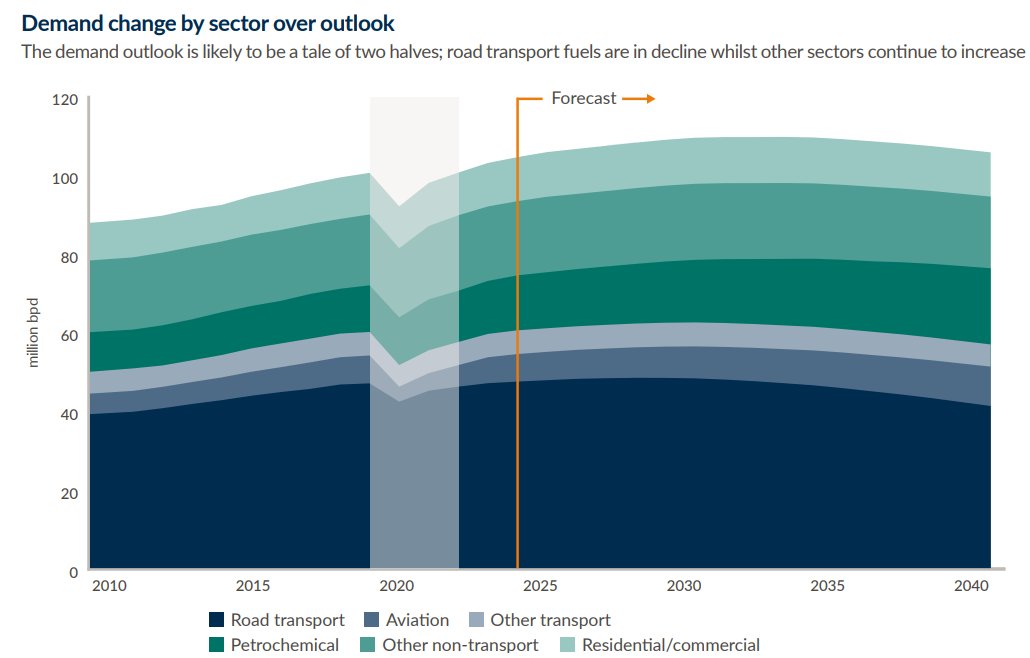
Vitols view of oil demand to 2040. Given 2024 is ~105mb/d this most likely includes ~3mb/d biofuel. They note a 5yr delay in EV adoption targets could lift demand 2-3mb/d by 2040. Source: https://t.co/KIdGgZ2eWc