Platforms are finally recognizing that people don’t want to consume AI slop. A growing number of sites and apps now have tools and policies to flag, label, and ban AI-generated content. via @WIRED https://t.co/wmnTC3EiXU
The newly introduced Stealth Bot Prohibition Act would prevent AI stealth crawlers from hiding their identities and illicitly scraping web content. via @adexchanger
https://t.co/RSLTb9lRZT
"The future of AI should and will not be defined by who has the best model or the cheapest compute. It will hinge upon access to the highest-quality data, and whether that data is lawful, licensed, accurate, original, and kept current." via @DCNorg
https://t.co/dq2IqhUEe1
Publishers are under attack from Big Tech. Tech giants are taking their content without payment, draining the creators of quality content of the resources they need to inform & connect their communities. Tell Congress to Protect Journalism from Big Tech. https://t.co/NIAxzdwKEH
Digiday spoke with Cloudflare CEO Matthew Prince a few days after he met with the U.K. regulator on why he believes Google will inevitably have to split its AI and search crawler. https://t.co/yQFO8MPS5a
How do people use generative AI in their daily lives? And how do they use it for news?
These are two of the questions we explore in a new report, based on fresh survey data from 🇦🇷🇩🇰🇫🇷🇯🇵🇬🇧🇺🇸
🔗 Full report
https://t.co/S06rg5KeQY
🧵 Key findings in thread
"The RSL Standard supports a variety of licensing models, including free ones. Site owners can ask AI companies to pay a subscription or assign a pay-per-crawl fee through the RSL Standard, which companies must pay each time an AI bot crawls the website." https://t.co/HU2lPhkVA6
"If something — let’s say trustworthiness — becomes really scarce, then it becomes very valuable."
Subscriber retention and daily visits increased after readers were confronted with AI-generated images. https://t.co/hHnguTsd0h
"Though tech companies have been helping themselves w/impunity to articles, books, recipes & endless other nuggets of information to build their models, many are simultaneously crafting licensing deals, particularly w/established publishers" @adamlashinsky https://t.co/eYsqTQQhQR
"When AI Overviews is present, publishers witness a drop of 47.5% in clickthrough rate on desktop, and 37.7% on mobile." @pressgazette
https://t.co/SEaXEmHQbT
"AI companies admit these unfair and un-American tactics are fundamental to their businesses, but they refuse to pay because it’s cheaper to steal." @nypost https://t.co/w3cgik52ih
"Although news publishers and other websites can implement blockers to prevent various AI bots from scraping their content, TollBit found that more than 26 million AI scrapes bypassed those blockers in March alone." @washintonpost https://t.co/ZhveLYDXC2
Big Tech companies are stealing content from creators to fuel AI. America’s creative industries are part of what make this country great, and stealing their work is un-American and wrong. Tell Washington today to make Big Tech companies pay for the content they take. https://t.co/9AUIYpZbwj
"If AI companies’ theft drives creators out of business, everyone ends up worse off." - Danielle Coffey, @newsalliance President & CEO https://t.co/Df505JvmLx
The global AI market is expected to reach trillions of dollars by 2030. But the original content creators and publishers whose work fuels AI products are being left behind. They deserve compensation for their work – and you deserve high quality, diverse content. Together, we can hold Big Tech accountable and demand responsible AI. Join us: https://t.co/dFBuLERjvu
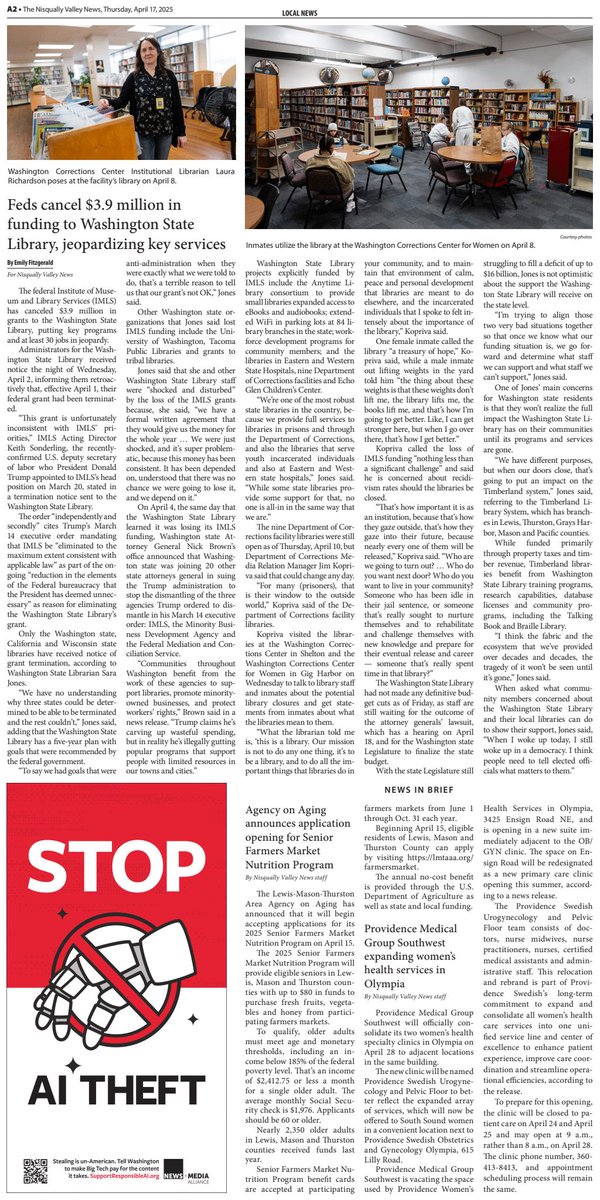
As a reminder, writers, artists, journalists, and publishers are the creative minds behind the content that AI programs generate – but they're not being compensated for their work. Thanks @NisquallyNews for joining us in the fight for a future of responsible AI.
Learn more: https://t.co/dFBuLERjvu