Founder of Pari Passu, research firm that provides all-encompassing coverage of the most consequential restructuring transactions. Join our free email list!
Introducing Flint, @Recursive_SI’s first model: a fast local coding model built with our automated research system, the Eureka Machine.
• Best-in-class fast local coding
• Up to 2x faster than comparable models: 125+ tokens/sec on a MacBook Pro, 150+ on RTX Spark
• Built from scratch in under 4 months
Private, unmetered intelligence on your own machine. Open weights available now on @huggingface, run it locally on your favorite framework or try it for free on @opencode or @pidotdev.
I hear a lot of pushback from SMBs saying they don’t need AI because their industry has high moats.
To me, that’s like saying we won’t make a website or use the internet because we have a high moat.
Sure, that moat might give you some runway, but it won’t adapt; you’ll eventually fall behind.
And once you’re behind, you’ll never recover as the gap is only getting larger.
The definition of the NYC problem:
- Mid-30s with a $4mm net worth
- Net worth only increasing by $300–400k/year
- Will only retire with a low eight-figure net worth
I hear a lot of pushback from SMBs saying they don’t need AI because their industry has high moats.
To me, that’s like saying we won’t make a website or use the internet because we have a high moat.
Sure, that moat might give you some runway, but it won’t adapt; you’ll eventually fall behind.
And once you’re behind, you’ll never recover as the gap is only getting larger.
Today Monaco is launching Agent Matrix.
Monaco unleashes countless agents working together, goal seeking, with one outcome in mind: accelerate revenue growth.
If you don’t have an army of agents working 24/7 to accelerate revenue growth, you’re living in the past.
Apply for early access now.
In September 2021, Clearlake Capital acquired Springs Window Fashions for approximately $3.4bn or almost 11x EBITDA
The deal was done in the middle of a zero-interest-rate environment and strong discretionary consumer spending, when many people had the time and cash to spend during COVID.
In this case specifically, people were stuck at home during lockdowns, which encouraged many to update and renew major home design components, a dynamic called “nesting purchases”.
However, inflation and rapid rate hikes pushed up costs while freezing the housing market, so existing home sales and remodeling activity dried up and consumers pulled back on big-ticket home spending. Revenue declined through 2024, margins compressed, and the business started burning cash. By late 2024, SWF had run through most of its liquidity and needed a transaction to keep operating.
The company completed an LME in 2024 that addressed liquidity and extended maturities; however, ongoing housing market pressures prolonged distress, and we expect a second transaction within the next 12 months.
On Friday, we will dive into the company history, business overview, break down the first LME, and understand where we are today, subscribe now to get in your inbox on Friday
Yet another software refi to test the market
TLs trading at 99
Let's see if KKR needs to give up docs
See below our coverage of other software stressed A&Es
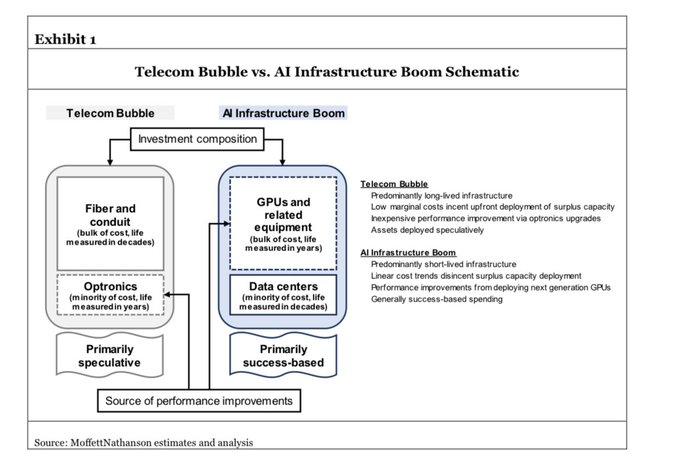
The graphic below is something everyone should understand
1) In the AI Capex cycle, the majority of the infrastructure is short-lived vs. long-lived for Telecom cycle
2) In the AI Capex cycle, the costs are linear vs. high upfront and low at the margin for the Telecom cycle (making a bubble easier to form)
3) In the AI Capex cycle, spending tends to be more success-based than in the Telecom cycle
If you are confused about what this technology is, that makes two of us.
After spending some time, this is how I think about it.
When you ask an AI a question, two things happen:
1) Understanding your question. This is like a researcher reading your request and figuring out what you need. It takes a lot of raw thinking power, and standard AI chips (GPUs) are great at this part.
2) Writing the answer, one word at a time. For each word, the researcher has to run back to the shelves to look something up before writing it. They aren’t slow at thinking here. They’re slow because they keep waiting on the trip to the shelves. That trip is the “memory” part.
Positron’s chips are built to make those trips much quicker, so answers come out faster. Standard chips rely on a particular kind of fast memory that’s currently in short supply, and @positron_ai ’s design doesn’t depend on it.
@general_compute’s idea is to use both kinds of chips: the thinking-focused ones for understanding your question, and the shelf-focused ones for writing the answer. Then they sell the whole thing to companies as one service.
This matters most for AI agents, which are programs that make dozens of AI requests in a row to finish a single job. If each request is a little slow, the delays stack up, like a chain of errands where every stop takes a bit too long and the whole trip drags.
Our heterogeneous cloud just got better. We're announcing a cluster scale deployment of @positron_ai as our next partner.
We believe demand for fast inference will outstrip supply for the next decade. Our bet on Positron is another step towards getting fast inference for opensource models into builders' hands.
Hardware goes live Q1 2027.
Thanks to @mitesh711, @trsohmers and the whole Positron team! We're excited for this partnership.
LFG!
Simple representation of myself trying to get differentiated information
> You send an email asking for some experts
> You go back and forth to find someone that works and a time
> You speak for 60 min
> Most of them are useful, and you really get value out of 15min
> 1 call = $1,000+ = just a few core insights
> Scale over 50 names, multiple calls for names, and you see why pods create dedicated teams
Qualitate is trying makes easier and change the equation. One centralized repository with thousands of expert calls on the core insights that matter.
How painful is it to switch? Will you switch? And why?
We just raised $25M from Insight Partners to replace Gartner, McKinsey, and GLG.
RIP the Quadrant, the 80-page consulting deck, and the $2000 expert network call.
Our revenue run-rate is up 10x+ this year.
100+ investment firms and enterprises use Qualitate to inform decisions with firsthand evidence.
Here's how:
https://t.co/0KKmWR07Ik
All of the robotics companies are purely focused on performance, but they forget that trust and perception matter just as much.
I would never want a scary humanoid in my bedroom, no matter how good it is.
This company actually considers the experience of living with a robot, and I am convinced this will be much more appealing to consumers.