"Most Indians retire poor, not for lack of income but lack of math" | Practical retirement planning for Indians backed by real scenarios + a weekly letter ↓
Retirement Planning Case Study #2
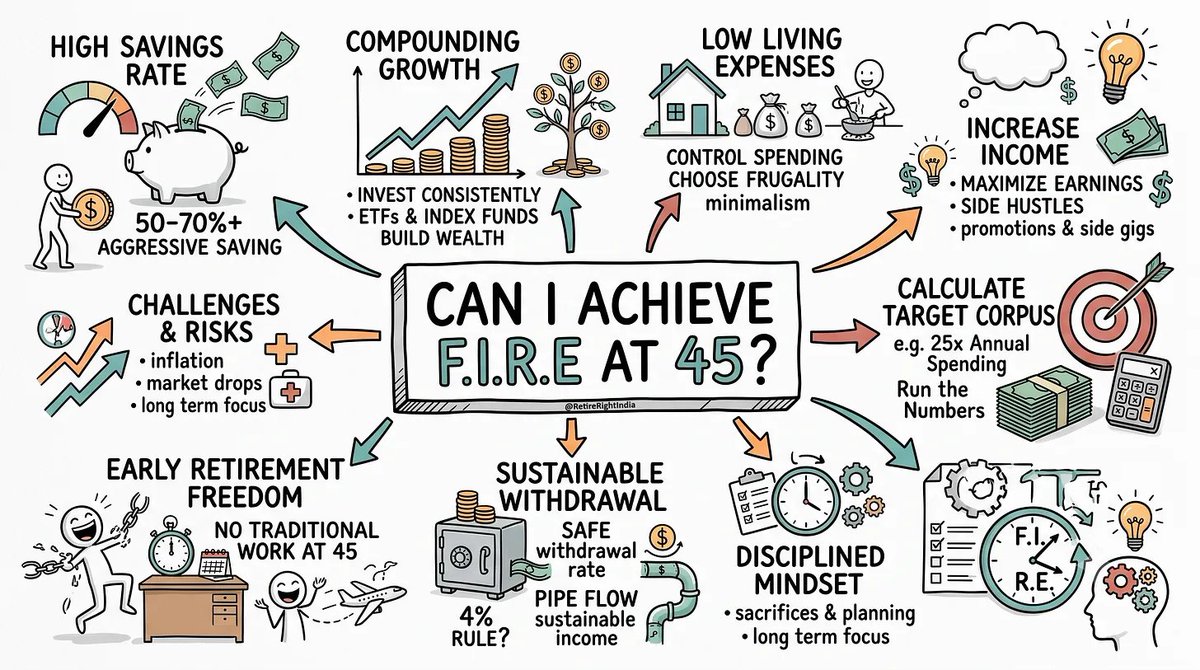
🧐 Can an IT professional retire at 45 with ₹X Cr?
One of our clients asked us exactly that.
Instead of relying on a thumb rule like "25x expenses", we built a detailed financial plan to stress test whether work could truly become optional.
Here's the case study 👇
SWP is such a beautiful tool for retirees. ❤️
Imagine someone invested ₹1 Cr in 2012 and started withdrawing ₹75,000 every month from the portfolio. That's ₹9L a year withdrawn consistently for 14 years totalling to ₹1.26 Cr.
Still ₹2.5 Cr sitting in the portfolio today
Surprisingly, a simple 33% allocation across Equity, Debt & Gold has won the 10-year return race in 6 out of 10 years.
Sometimes diversification doesn't just reduce risk.
It can actually win the race. 🏃♂️
The boring portfolio might not look exciting every year, but that's exactly the point.
A friend's manager recently bought a house.
On the outside, everyone congratulated him for achieving the milestone 🏠
Very few in his inner circle knew that he had to empty his entire ₹1 Cr savings, accumulated over 12 years to fund it.
He then took another ₹30L loan for interiors and miscellaneous expenses.
Now that he has possession, he is more worried about a job loss than ever.
He has almost no savings left, his wife is looking for a job, and the EMI isn't going anywhere.
The house gave him an asset worth crores, but took away his financial safety net.
Maybe he could have bought a cheaper house, kept 12 to 18 months of expenses aside, and done the interiors gradually.
A house should give you security, not make you scared of losing your next salary.
Would you have done anything differently?
@gurjota Gurjot, really really happy for you.
As an investor, what kind of an investor did you find yourself to be all this while? Like 50% MF and 50% direct or something else
@paresh_pisipati Agree 2Cr is a good corpus for 50k monthly expenses considering no lumpsum needs.
Would still add a 50L contingency fund on top of this as buffer.
Hence 2.5Cr
@BaluGorade SWP is only as good as the market condition.
The moment market falls even by 10%, it can eat 2-4 years of your retirement easily. Add 1 or 2 liquid buckets and create a mix income approach.
@InvestorOfJAMMU Agree yet, if you have managed to reach 2Cr then better avoid loan at this stage. Taking a loan will only give anxiety.
Keep renting and be flexible unless owning a home is actually one of your goals and not a society inflicted goal on you.
@IndiaNewGen The more you earn the more anxiety one has. We have multiple clients who earn more than 3L per month in hand at family level and are still unable to afford a home they like or scared of the retirement number when goal planning sessions are scheduled.
Most of the folks working in IT constantly nag 😩 about their salary ( 75% of our client base )
Harldy anyone wants to talk about where is the money leaking.
One such client approached us whose monthly combined take home income was ₹4L/month and they were only doing an SIP of ₹50k/month for all the goals.
🎯 They were targetting a corpus of 8Cr in next 20 years.
Out of ₹3.5L monthly outflow, only ₹1.2L were mandatory expenses.
This gives us a good buffer of ₹2.3L to play around.
So instead of ✂️ the power supply all-together we agreed to meet mid-way and reduce it by 50% to begin with and cap it at ₹1.15 L.
✅️ Key focus, next 6 months is to build an emergency liquid fund ( payments will be done via credit cards which will later by paid using this fund )
✅️ Post 6 months are over, we will start diverting these to their individual SIP linked to specific goals like retirement, house and kids education.
The plan started to make sense after we made this small yet proactive change.
☑️ To add a corpus buffer, they agreed to add a step-up layer if and when salary increases every year.
Keeping a manual check on your expenses always helps in identifying and correcting the trend early and hence let you take the benefit of compounding.
So stop crying about your salary and start recording expenses. 🤞
Market crashes are getting boring. 👀
At least that's what the charts since 2007 seem to suggest.
FY08: -61%
FY11: -27%
FY15: -25%
FY20: -40%
FY22: -16%
FY26: -17%
The interesting part? Every time, the market eventually recovered and in each of these cases, the recovery happened within the next year.
So rather than trying to predict the bottom, here's how I think about a ₹50L opportunity fund can help:
🟢 25% deployed at -10%
🟢 25% at -20%
🟢 25% at -30%
🟢 25% at -40%
If we ever see a -50% fall, I'd personally be willing to liquidate some of my debt allocation, including EPF to deploy further.
The objective isn't to catch the bottom.
It's to make sure I still have cash when everyone else is running out of it.
Market corrections are not a bug in equity investing. They're the sale 🛒
A client in his early 60s owns a ₹8 crore family business and around ₹4 crore worth of real estate. His two children are 31 and 34, both doing well in their careers.
He told me, “I want to retire now and let them take over. I have built enough for the family.”
So I asked him a slightly uncomfortable question:
“Are you retiring because you are ready to retire, or because you think your children are ready to take over?”
He admitted he still enjoys working.
The business still gives him ₹40L to 50L a year.
And his children aren't particularly interested in running it.
They have spent the last decade building careers of their own.
This is something I see quite often in Indian families.
Parents spend 30 years building an asset and then feel they need to hand it over to the next generation simply because they have reached retirement age.
But inheritance doesn't have to mean succession.
Your child can inherit the business without running it/ They can inherit the property without managing it/ They can inherit the money without needing it today.
The bigger mistake is changing your own life today because you are worried about what your children will need 20 years from now.
So his plan changed.
He decided to keep working as long as he enjoyed it, gradually move ownership to the children, and let them decide what they actually wanted to do with the assets.
Generational wealth should give the next generation choices, not create obligations for the previous one.
📥 [email protected]
@BasuNivesh Why not both as per risk appetite? Personally, I am inclined towards SIP while mom takes care of PPF.
At the end its all about the risk appetite.
A friend finally got the promotion he had been chasing for years.
It pushed him into the ₹50L CTC bracket. 🎯
But now he isn't sure if he actually wanted the promotion.
Can you guess why?
Most retirees I've met don't regret spending too much money.
They regret the things they can no longer do because age caught up.
A few lakhs saved today may not mean much 20 years later.
But the trip you postponed, the hobby you never pursued or the time you didn't spend with family may not come back.
Sacrifice a little bit of the number. Gain a lifetime of experiences...
As a 65 y/o boomer, I have some advice.
If there are special experiences that you want to have, go have them.
Obviously make sure you can afford them and you are properly planning for retirement.
It may get difficult to do what you want when you’re older. Kids, career, and eventually age will get in the way.
Don’t always wait until you have more $$$, now may be the best time.
I know I have a limited time left for travel, so we will go many places while we’re still able to do so. I don’t want to regret waiting until it’s too late.
You won’t get your lifetime back, so use it well, while you can.
Find a good balance between enjoying life and funding retirement.
Hitting your first ₹1 Crore is life changing.
I still remember when we crossed ours.
We were aggressively allocated with 80% plus in 📈, and we got to experience a strong bull market.
Someone said it perfectly, you sometimes need just one bull market to change your life.
Since then, the corpus has grown multiple times.
But the biggest change isn't the number anymore.
It genuinely feels like we have one more person 👨💻 working alongside us.
Except this employee doesn't ask for a salary. It just quietly works, earns and compounds.