📖 Nearly 3 years after the publication of Causal Analysis (@mitpress), I'd like to highlight the lecture slides accompanying the book. Available here as PDF and editable TeX files, together with datasets & code in R, Python, & Stata: https://t.co/5Zah7NVoH9
i should write an article on what economists do when we don't have the data we need, meaning the exercises we do because it's good practice or because reviewers will ask. this after we already considered changing the question :)
something like "problem -> exercise":
1. the variable exists but you can't observe it -> sensitivity analysis (Oster, Rosenbaum)
2. it exists somewhere, just not in your data -> proxies, external calibration
3. part of the sample is missing, not at random -> Lee bounds, Horowitz-Manski, selection models
4. you have it, but badly measured -> EIV corrections, reliability ratios, Monte Carlo
5. you measure quantity but need quality/prices -> hedonics, residual inference from identities
6. the counterfactual doesn't exist (lol) -> the design builds it, placebos audit it, honest DiD prices its failure
7. the original inputs are lost/proprietary -> GOOD LUCK (jk: partial reconstruction, scenario grids, email the authors!!)
8. the data is at the wrong level -> ecological-inference bounds, shift-share
9. the definitions changed -> cry, then crosswalks, bridge tables, splicing
10. too few observations -> randomization inference, synthetic control placebos, shrinkage
11. datasets you can't link -> probabilistic linkage, two-sample IV, mismatch bounds
12. suppressed/top-coded on purpose -> interval regression, Pareto-tail imputation
13. the phenomenon is newer than the data -> nowcasting, triangulate unofficial sources
14. the data describes the wrong population -> reweight, bound the unobservables (Andrews–Oster)
15. your variable answers a nearby question, not yours (patents =/= innovation) -> convergent validation, or change the estimand
16. one unit's treatment leaks onto others -> exposure mappings, spillover-radius sensitivity
and it's all really just four moves:
BOUND IT: give up the point, report the honest set
STRESS IT: how wrong must the assumption be to kill the result?
REBUILD IT: buy the point back with structure and side data
SIMULATE IT: build the missing world, watch your estimator in it
So much this:
"Why the smartest people in the room keep missing that intelligence is often not the main bottleneck in the real world"
Institutions, laws, and regulations matter. Politics matter (ask Dario and Sam!).
Kids: Study social science.
Blau argues that Skinner's "mythology of coherence" can obscure racist coherence in canonical political theory. Bringing Skinner into dialogue with Bernasconi and Mills, he proposes the "mythologies of inclusion" and "historicism" to guide interpretation.
https://t.co/SBGawcfhQQ
To be rich without a 4 year college degree usually involves being a small business owner. In this article, we do one of the most in-depth surveys of the political preferences of small business owner and why they lean right: https://t.co/NqyO2xCDFZ
Everybody wants to think critically and creatively, but nobody wants build their knowledge base!
Reasoning, creativity, etc., involve combining elements of a knowledge base.
You can't think with knowledge you don't have. You can't cook with ingredients you don't have.
Conservatives are not well represented in academia because conservatism is, for the most part, the ideology of the incurious. Abortion is bad because the Bible said so. Immigrants are bad because Fox News said so. Capitalism is good because Reagan said so
There's a really good article about this called "Why Johnny Can't Dissent" which basically argues that any dissident or countercultural movement gets commodified and absorbed to serve capitalism
https://t.co/4BjyTQI8pZ
Do LLMs think like us?
The answer is NO.
I’m glad to see Psychology Today covering our paper on the epistemological fault lines between human intelligence and large language models.
We identify seven:
Grounding fault: We begin with the world; LLMs begin with encoded inputs.
Parsing fault: We recognize objects, faces, and situations; they segment inputs into tokens.
Experience fault: We remember lived episodes and navigate through intuitive physics and psychology; they extract statistical regularities from data.
Motivation fault: We are driven by emotions, desires, and goals; they perform numerical transformations.
Causality fault: We search for causes; they primarily learn correlations.
Metacognitive fault: We can recognize that we do not know and suspend judgment; they are built to produce an answer.
Value fault: We judge through values and anticipated consequences; they generate outputs through learned patterns and externally defined objectives.
But beneath these seven faults lies an even deeper divide:
We are alive. LLMs are not.
A biological neuron must continuously maintain itself, preserve its boundaries, regulate exchanges, and repair damage. An artificial neuron does none of this. It is a mathematical operation.
This biological difference creates a fundamental cognitive difference.
Human intelligence is teleological: our goals arise, at least partly, from within a vulnerable organism that must survive, act, and live with consequences.
Artificial intelligence is ateleological: it can pursue objectives, but it does not generate or care about them. Its goals are assigned from outside.
Still, many people assume that, because we can produce similar language, our minds must work in similar ways.
This is a bias.
I use the term LLMorphism to describe this bias: mistaking believing that we think like LLMs.
Similar language does not imply a similar mind.
*
Relevant references in the first reply
Using Swedish political elites experiment, Dawson shows that fairness cues increase politicians' willingness to report misconduct within their parties, while loyalty cues do not. Party inaction is the strongest trigger of external whistleblowing.
https://t.co/FQh1dE22Y7
Harteveld et al use a nine-country survey experiment to test consequences of affective polarization. Depolarization reduced avoidance and discrimination and strengthened democratic norms in some countries, but its effects were strongly context-dependent.
https://t.co/OwdIyGceWP
Good research design doesn't start with data collection.
It starts with a series of decisions.
Your philosophy shapes your approach.
Your approach guides your strategy.
Your strategy determines your methods.
Your methods produce your data.
The Research Onion reminds us that every layer of a study should align with the one before it.
Strong research is built from the outside in.
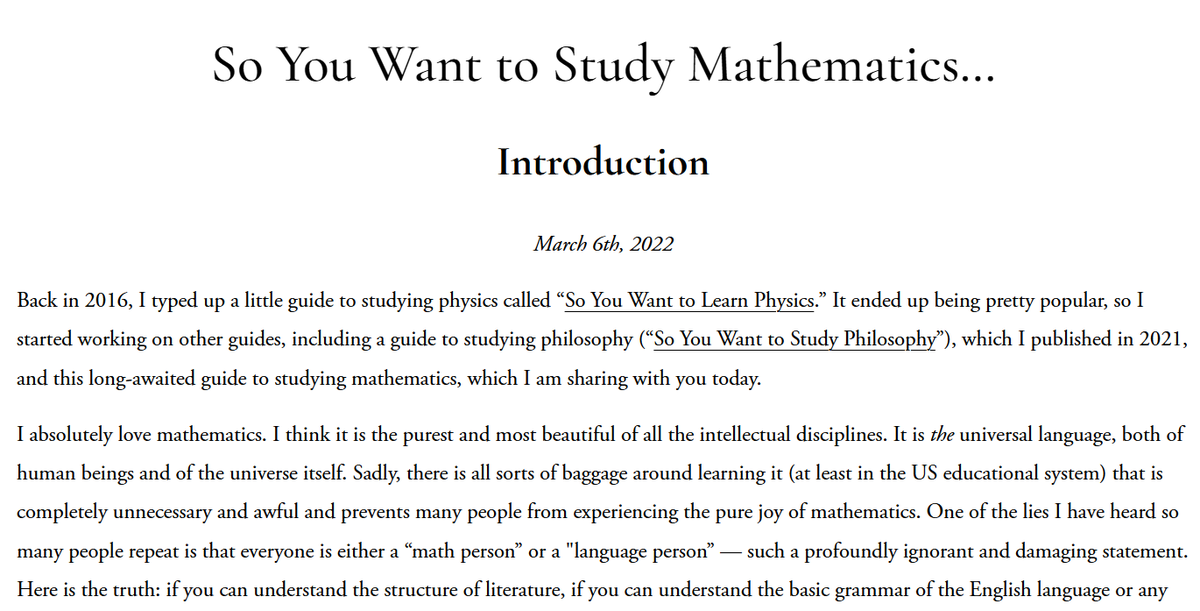
found an absolutely beautiful guide, by Susan Rigetti, on how one can get started with studying math.
the recommended books are great! i have some issues with the order (discrete maths might be a better start than calculus), but if you're looking for a roadmap, here it is!