We built an NFL draft analytics platform from scratch and it's finally live at https://t.co/FyyzpIRFnq!
Most draft boards are built around consensus. Where is this guy mocked? What round does the industry think he goes? We don't use any of that. Our model doesn't care where you're projected. It evaluates prospects against what actually correlates with NFL success at each position, then matches them to the teams where they'd fit best.
The foundation is a proprietary Draft Value Score model. Position-specific weights across four pillars (measurables, athletic testing, production stats, and PFF grades), tuned through correlation analysis against 6,498 historical NFL careers dating back to 2005. Every position group has its own weight structure because what predicts success for a quarterback is completely different from what predicts success for an offensive lineman.
On top of that, every prospect gets an archetype classification based on their trait profile, historical comps through percentile-based weighted Euclidean distance matching, a confidence-adjusted grade (A+ to F), and a risk label.
Then there's the team side. We built a 6-layer pipeline that constructs roster profiles for all 32 NFL teams, identifies trait gaps weighted by scheme, and produces fit scores for all 19,488 prospect-team combinations. Scheme classification uses empirical clusters derived from actual playcalling data, not assumptions about what a coach "probably" runs.
Some of our grades diverge hard from consensus but we consider that a feature not a bug. When your model is anchored to historical outcomes instead of draft position, the board looks different. Go see for yourself now!
Sleeper Series RB: Jonah Coleman
This one isn't quite as much of a hot take, but our model has Coleman as the clear cut RB2 behind Jeremiyah Love. For Running Backs the most predictive stats for NFL success come from PFF and Production scores, and Coleman has a strong profile for both pillars.
His PFF pillar score is 89.4 out of 100. Here's how he stacks up against the 2026 class in some key areas:
- PFF Rush Grade: 99th Percentile. This is PFF's per-snap evaluation of his rushing execution. Not volume, not system, not offensive line. How well he runs on a play-by-play basis.
- Rush Avoided Tackles: 96th Percentile. At 5'8" 220lbs this is the bowling ball effect that a lot of people have talked about with him. The data confirms defenders struggle to bring him down on first contact.
- Rec Route Grade (96th Percentile), Rec Avoided Tackles (94th Percentile), Targets (92nd Percentile). This is where Coleman might surprise a lot of people at the next level. If you look at his bowling ball frame you might not expect it, but he is truly a weapon out of the backfield in the receiving game, which is one of our most predictive skill sets for RB success in the NFL.
- Elusive Rating: 84th Percentile. Not elite but well above average
- Breakaway %: 67th Percentile. This is his weakest area, he probably isn't going to be a long home-run hitter, but his overall profile shows a lot of promise to be a consistent chain-moving force.
His overall Production pillar is also strong at 94.4 out of 100:
- Rec Yds/G and Rec TD/G are both in the high 80s to 90s percentile-wise, reinforcing his PFF receiving grades.
- Rush TD/G is at 99th Percentile. He has a nose for the end zone.
- Total PPA also at 99th Percentile. This is a measure of total points a player added through their individual plays across their college career.
His trait profile earned him the Bellcow archetype, which requires spiking in Workhorse Ability and either/both of Gap/Power Fit and Receiving Ability:
- Workhorse Ability: 92.2
- Gap/Power Fit: 87.5
- Receiving Ability: 87.4
- Zone Scheme Fit: 81.9
- Explosiveness: 74.0
Four of five traits hit above 80, with three above 87. The only hole is Explosiveness at 74, but even that isn't an awful mark.
Final Thoughts: Jonah Coleman is a well balanced runner and receiver of the ball out of the backfield. Our model rewards him for the traits that historically predict RB success at the next level: receiving ability, tackle-breaking, and efficient rushing execution. He is elite at all three. The one thing slightly lacking is his breakaway speed, but all the other tools he brings to the table more than make up for it. Don't be surprised if he finds himself in an every-down role sooner rather than later!
@Giantsnation122@SharpFootball I’m not sure you want to see it 🫣 BUT Malachi fields has true elite upside and Hood was our 2nd best man press corner so not a complete waste of a draft
@Schultz_Report Love the Caldwell fit with the Chiefs, if the guy puts it all together with Mahomes throwing him the ball? Could be scary for the league
Sleeper Series WR: Jeff Caldwell (https://t.co/SMWwnoxqdQ)
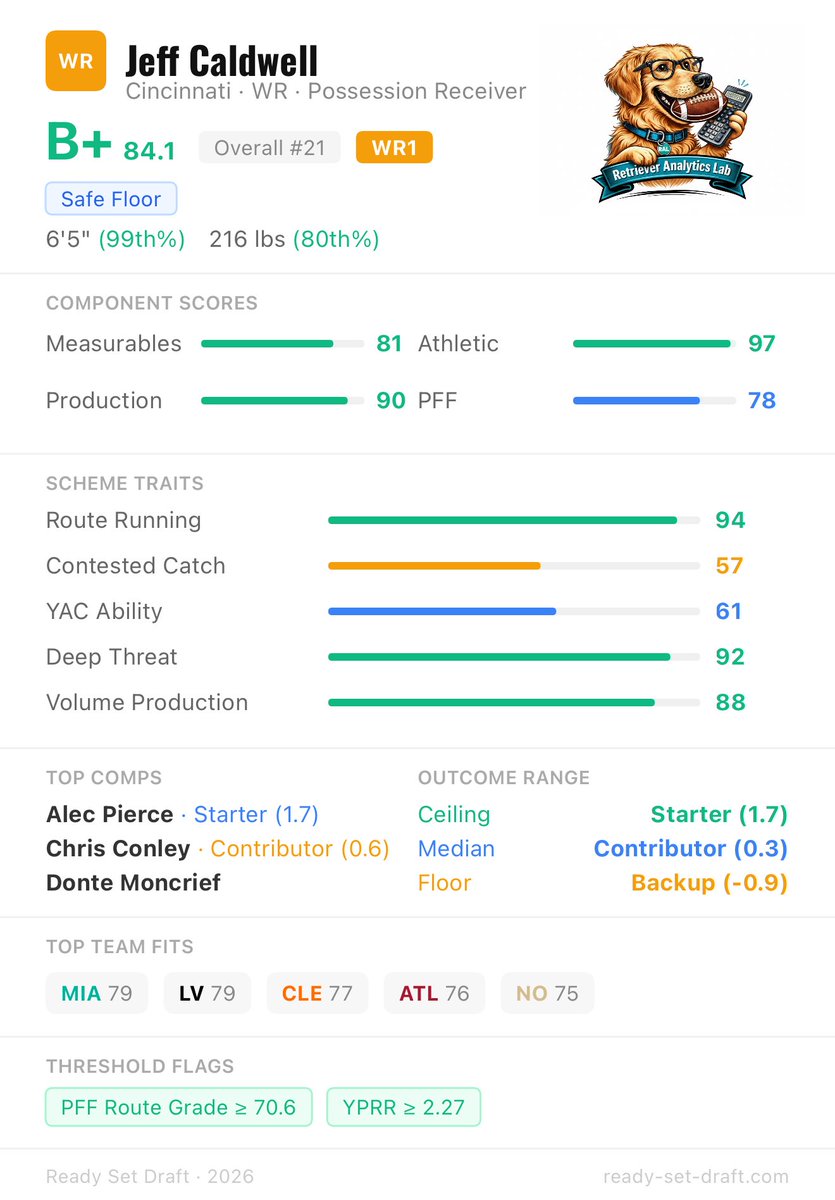
Caldwell is probably the most complete profile in our WR class, and the only wide receiver in our top 25 with a Safe Floor risk label. He's our WR1 at #21 overall with a B+ grade (84.1). Most boards have him as a day 3 developmental prospect, but our model sees a much more complete picture.
What makes Caldwell unique is that he scores well across all four pillars. Most WR prospects in this class are strong in one or two areas. Caldwell shows up everywhere.
Starting with the physical profile. At 6'5" 216 lbs, his height is 99th percentile and his weight is 80th percentile among all drafted WRs since 2005. He has prototypical outside receiver size. Then at the combine he ran a 4.31 forty (96th percentile), jumped a 42" vertical (98th percentile), and hit 134" on the broad jump (96th percentile). His athletic testing score is 96.5 out of 100. That size-speed combination is historically rare. His RAS score of 10.00 ranked 2nd out of 4,190 WRs tested since 1987, behind only Calvin Johnson.
Caldwell contributes meaningfully across all 4 model weight pillars (PFF, Production, Athletic Testing, Measurables). His PFF Pillar score is 77.7 out of 100:
- PFF Route Grade: 98th percentile. Despite the scouting narrative that his route tree is limited, PFF grades his route running execution near the top of the class.
- Avoided Tackles: 95th percentile. At his size, that elusiveness after the catch is a rare combination.
- YPRR (Yards Per Route Run): 89th percentile. Efficient when targeted.
- Wide Rate: 88th percentile. He lines up outside, which is where his size and speed do the most damage.
- Targets: 82nd percentile. He earned looks.
- Contested Catch Rate: 36th percentile. This one is surprising for a 6'5" receiver. He will likely need to work on attacking the ball in the air more at the next level.
- YAC/Rec: 31st percentile. Despite the tackle-breaking ability, his yards after catch per reception is below average. This might be a function of his deep route-heavy role (deep catches naturally have less YAC opportunity).
- Drop Rate: 36th percentile. This is the most concerning aspect of his profile. If he doesn't clean up the concentration drops he will not be trusted to stay on the field and receive consistent targets in the NFL.
His production pillar is 89.8 out of 100:
- Rec TD/G: 94th percentile. He finds the end zone consistently. Six touchdowns at Cincinnati after 22 at Lindenwood.
- Total PPA: 94th percentile.
- Dominator Rating: 86th percentile. He commanded a significant share of his team's receiving production.
- Rec Yds/G: 81st percentile. Solid but not elite volume.
His trait profile is what really tells the story:
- Route Running: 93.8
- Deep Threat: 92.0
- Volume Production: 87.8
- YAC Ability: 61.3
- Contested Catch: 57.1
Route Running and Deep Threat are both above 90, which is elite. Volume Production is strong. But YAC and Contested Catch are both below average, which is why he gets the Possession Receiver archetype instead of something flashier. The model sees a guy who wins by running crisp routes and using his speed to separate deep, not by breaking tackles or winning 50/50 balls. That's a specific skill set, but it's still a valuable one and if he blossoms in the other areas with his athletic profile whew watch out!
(Caldwell 1/2)
#NFLdraft
Sleeper Series DB: Cole Wisniewski (https://t.co/vV3hg023Zf)
Wisniewski is our DB3 but most boards have him as a mid-to-late day 3 pick or UDFA.
His backstory is part of what makes this interesting. He was a 2-star recruit who started his career as a linebacker at North Dakota State. He moved to safety before the 2023 season and immediately broke out with 8 interceptions and 13 passes defensed to earn FCS All-American honors. A foot injury wiped out his 2024 season, and he transferred to Texas Tech for 2025 where he became a key piece of one of the best defenses in the country.
For DBs, our model leans heavily on PFF grades because traditional defensive counting stats (interceptions, PBUs) are noisy and heavily situation-dependent. Our correlation analysis shows PFF's per-snap grading is a much more reliable signal for defensive back evaluation, and Wisniewski's PFF profile is dominant.
His PFF pillar score is 95.2 out of 100. Within the 2026 class:
- Overall Def Grade: 99.2nd percentile. He's one of the highest-graded defensive players in the entire prospect class.
- Run Def Grade: 99.8th percentile. This is the linebacker background showing up. He is elite against the run.
- Man Coverage Grade: 99.8th percentile. When he's in man coverage, he's one of the best in the class.
- Pass Rush Grade: 98th percentile. His blitzing ability from the safety position is a real weapon.
- Coverage Grade (overall): 98th percentile.
- Stops: 98th percentile. He makes plays at the point of attack.
- Zone Coverage Grade: 89th percentile. This is his weakest coverage number. The man coverage is elite, the zone coverage is good but not dominant.
- Missed Tackle Rate: 61st percentile. Above average but not elite. For a former linebacker that's a slight concern, though the overall tackling production (92nd percentile Tackles/G) more than compensates.
His production pillar is only 56.9 out of 100, and this is where the traditional stats don't tell the full story. His INT/G is 0th percentile at Texas Tech (zero interceptions in 2025). But he did have 8 interceptions at NDSU in 2023. The ball production disappeared when he moved to the Big 12, but PFF still graded him as one of the best defensive players in the country. The model de-weights production for DBs because interceptions are one of the noisiest stats in football. The PFF grades capture the actual quality of his coverage on every snap, not just the plays where the ball happened to come his way.
His trait profile earned him the Box Safety archetype:
- Run Support: 89.7
- Man Coverage: 82.0
- Zone Coverage: 55.9
- Ball Production: 52.6
- Athleticism: 49.4
The Run Support score of 89.7 is near-elite and it's his defining trait. The Man Coverage at 82 gives him versatility beyond just being a box defender. Zone Coverage is below average from his 2025 numbers and a clear growth area to focus on. Athleticism trait is limited by incomplete combine data (only 2 drills completed).
His overall comps: Xavier McKinney (Starter+), Marcus Maye (Starter), Marcus Epps (Contributor), Tarvarius Moore (Bust), Thomas Graham (Bust). His ceiling is 2.94 DVS, which is McKinney territory. His risk label is Boom or Bust because the outcome range is wide. The model sees a player who could be a legitimate starting safety or could wash out, depending on whether the zone coverage develops and whether the ball production returns at the NFL level.
Final thoughts: Wisniewski's PFF profile is one of the strongest in the entire 2026 DB class. His run defense and man coverage grades are near-perfect. The former linebacker instincts give him a skill set that most safeties in this class can't match near the line of scrimmage. If a team needs a physical, box-oriented safety who can also hold up in man coverage while also being versatile enough to effectively rush the passer, he's one of the best values in this draft.
#Nfldraft
Sleeper Series RB: Jonah Coleman
This one isn't quite as much of a hot take, but our model has Coleman as the clear cut RB2 behind Jeremiyah Love. For Running Backs the most predictive stats for NFL success come from PFF and Production scores, and Coleman has a strong profile for both pillars.
His PFF pillar score is 89.4 out of 100. Here's how he stacks up against the 2026 class in some key areas:
- PFF Rush Grade: 99th Percentile. This is PFF's per-snap evaluation of his rushing execution. Not volume, not system, not offensive line. How well he runs on a play-by-play basis.
- Rush Avoided Tackles: 96th Percentile. At 5'8" 220lbs this is the bowling ball effect that a lot of people have talked about with him. The data confirms defenders struggle to bring him down on first contact.
- Rec Route Grade (96th Percentile), Rec Avoided Tackles (94th Percentile), Targets (92nd Percentile). This is where Coleman might surprise a lot of people at the next level. If you look at his bowling ball frame you might not expect it, but he is truly a weapon out of the backfield in the receiving game, which is one of our most predictive skill sets for RB success in the NFL.
- Elusive Rating: 84th Percentile. Not elite but well above average
- Breakaway %: 67th Percentile. This is his weakest area, he probably isn't going to be a long home-run hitter, but his overall profile shows a lot of promise to be a consistent chain-moving force.
His overall Production pillar is also strong at 94.4 out of 100:
- Rec Yds/G and Rec TD/G are both in the high 80s to 90s percentile-wise, reinforcing his PFF receiving grades.
- Rush TD/G is at 99th Percentile. He has a nose for the end zone.
- Total PPA also at 99th Percentile. This is a measure of total points a player added through their individual plays across their college career.
His trait profile earned him the Bellcow archetype, which requires spiking in Workhorse Ability and either/both of Gap/Power Fit and Receiving Ability:
- Workhorse Ability: 92.2
- Gap/Power Fit: 87.5
- Receiving Ability: 87.4
- Zone Scheme Fit: 81.9
- Explosiveness: 74.0
Four of five traits hit above 80, with three above 87. The only hole is Explosiveness at 74, but even that isn't an awful mark.
Final Thoughts: Jonah Coleman is a well balanced runner and receiver of the ball out of the backfield. Our model rewards him for the traits that historically predict RB success at the next level: receiving ability, tackle-breaking, and efficient rushing execution. He is elite at all three. The one thing slightly lacking is his breakaway speed, but all the other tools he brings to the table more than make up for it. Don't be surprised if he finds himself in an every-down role sooner rather than later!