D7: A New Geopolitical Player?
Former NATO Secretary General Anders Fogh Rasmussen has proposed the creation of a new alliance of democracies — D7, the “Democratic Seven.” The proposed members are Australia, Canada, the European Union, Japan, New Zealand, South Korea, and the United Kingdom.
Together, these economies generate roughly $36 trillion in GDP — about 30% of global economic output. They possess enough economic weight to resist coercion even from the world's largest powers.
D7 is envisioned not as a closed club, but as an advanced core surrounded by concentric circles of associated members and partners. Countries could participate in specific initiatives according to their interests, creating flexible coalitions through what Rasmussen calls “variable geometry.”
The idea did not emerge by accident.
The international environment is changing rapidly. An increasingly coordinated axis of authoritarian states — Russia, China, Iran, and North Korea — is becoming more visible. The war against Ukraine has highlighted this trend: North Korean ammunition and troops, Iranian drones, and Chinese technological and economic support have all contributed to Russia’s war effort.
At the same time, U.S. foreign policy is evolving. Washington increasingly acts according to immediate strategic interests rather than as the unquestioned leader of the democratic world. Global trade disputes, sanctions, protectionism, and technological competition continue to intensify.
Against this backdrop, Rasmussen argues for a flexible coalition of advanced democracies capable of jointly protecting their economic, technological, and security interests.
In effect, D7 would represent a new architecture of democratic influence that is not entirely dependent on American leadership.
What Would D7 Do?
1. Create a democratic trade alliance.
2. Coordinate protection against economic coercion.
3. Align technology policies.
4. Invest jointly in artificial intelligence, quantum technologies, and space exploration.
5. Secure access to critical raw materials.
6. Develop new defense cooperation mechanisms modeled on support for Ukraine.
7. Build an alternative to China's Belt and Road Initiative.
The proposal's authors openly acknowledge that D7 should be capable of functioning even without direct U.S. participation if Washington continues reducing its global leadership role. At the same time, the door would remain open. The United States could participate as an associated member in specific coalitions or eventually join the core of D7 should its political direction change.
Why Does It Matter?
The world is gradually moving away from the era of a single superpower toward a system of multiple competing geopolitical centers.
For decades, the security and prosperity of many countries were built around American leadership. Today, democracies are increasingly searching for new mechanisms to collectively defend their interests.
A particularly relevant example is the so-called “Coalition of the Willing” supporting Ukraine, initiated by the United Kingdom and France. Operating outside NATO’s traditional bureaucracy, it has demonstrated that flexible coalitions can often move faster than established international institutions.
Rasmussen proposes applying this same principle to trade, technology, investment, and geopolitics.
The Future of the Project
At present, D7 remains more of a concept than a formal organization. Yet the logic behind its emergence is highly significant.
The world is entering a period of new international blocs and coalitions. Countries are no longer aligning solely around military power but also around technology, logistics, energy, critical resources, artificial intelligence, and control of global supply chains.
If implemented, D7 could become a new center of power within the democratic world — more flexible, more technologically advanced, and more economically focused than many existing institutions.
SCOOP: US ‘Secretary of War’ Pete Hegseth says New Zealand isn’t spending enough on defence, that 3.5 percent of GDP is "the new global norm."
Here’s his answer to my question at the Shangri-La Dialogue:
https://t.co/pwxMt56bE6
SCOOP
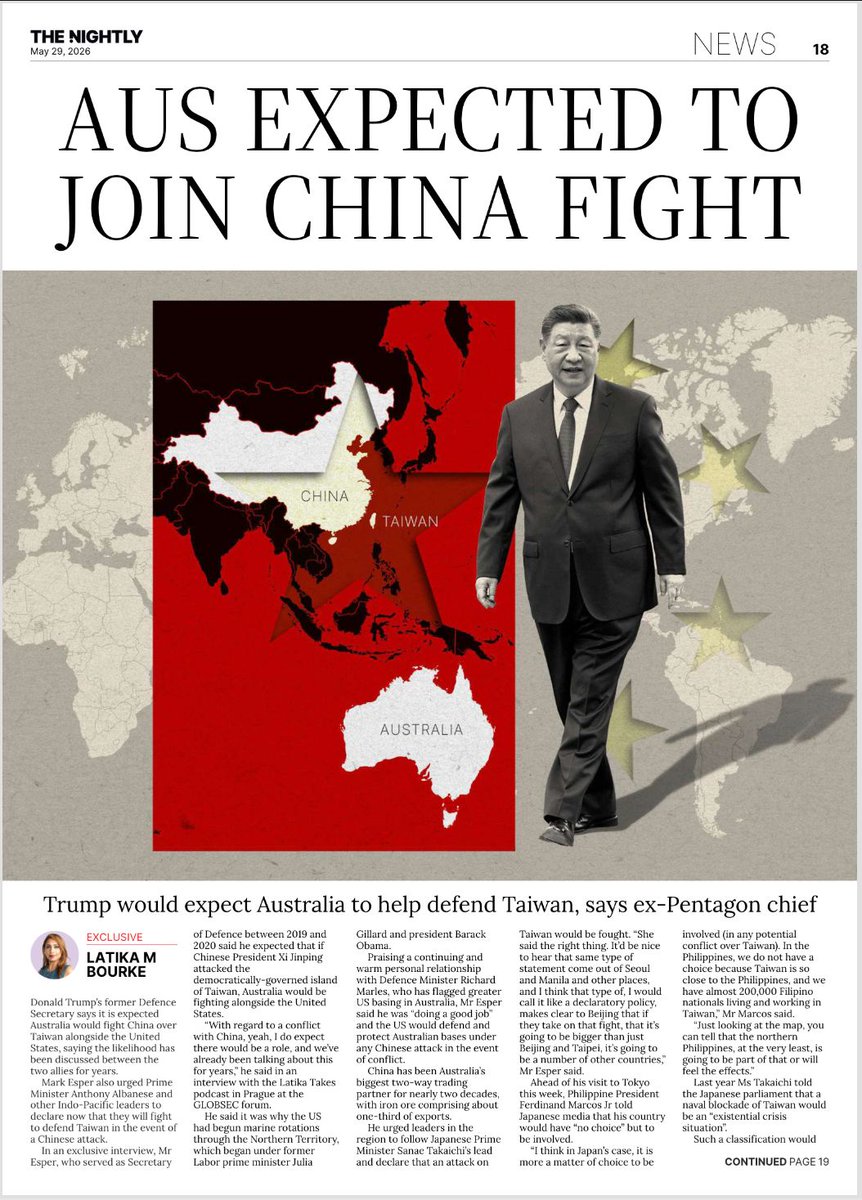
'We've been talking about it for years.'
Former US Defence Secretary Mark Esper tells me that the US expects Australia to fight China over Taiwan and that discussions have been ongoing for years.
Australia has never said what it would do in the event of a Taiwan contingency, but @MarkTEsper says it's time it did a la Takaichi (and most recently Marcos).
Read more in @thenightlyau: https://t.co/2LxdihxjeW
The Telegraph: Macron tore up 65 years of doctrine to defend Europe with French nukes, with or without the US.
Poland, Germany, the Netherlands, Belgium, Greece, Sweden, Denmark, and now the Czech Republic will host French nuclear-armed Rafales. 1/
I feel like I'm eating crazy pills when I read the countless bad takes around how the Vatican would have virtually anointed Anthropic.
When if you read the Pope's encyclical it's actually a COMPLETE repudiation of everything Anthropic - and U.S. AI generally - stands for.
Read this part of the encyclical for instance (paragraph 110: https://t.co/LR5R22vQWj):
"Finally, I would like to employ the expression 'to disarm,' which is close to my heart. Disarming AI means freeing it from the mentality of 'armed' competition, which today is not limited simply to the military context, but is also an economic and cognitive phenomenon. This entails a race for ever more powerful algorithms and larger datasets, driven by the desire to secure geopolitical or commercial dominance. To disarm means discrediting the assumption that technical power automatically confers the right to govern. To disarm does not mean rejecting technology, but preventing it from dominating humanity. It means freeing technology from monopolistic control and opening it to discussion and debate, therefore making it human-friendly and restoring it to the plurality of human cultures and ways of life."
In a nutshell what the Pope is saying is:
1) The "AI race" mentality itself is the disease: there is no "winning it responsibly", we need to stop seeing AI as a way "to secure geopolitical or commercial dominance"
2) Technical dominance and being the most powerful does not give you the right to set the rules
3) AI must be "freed from monopolistic control", opened to scrutiny, and "restored to the plurality of human cultures"
Now compared and contrast it with what Anthropic is officially saying - namely Dario Amodei in his famous essay "Machines of Loving Grace" (https://t.co/R02pmoOU3M):
1) Where the Pope says stop the AI race. Dario says win it: "A coalition of democracies [should seek] to gain a clear advantage on powerful AI by securing its supply chain, scaling quickly, and blocking or delaying adversaries' access to key resources like chips and semiconductor equipment."
2) Where the Pope says technical power doesn't confer the right to govern. Dario says it does: "This coalition would on one hand use AI to achieve robust military superiority (the stick) while at the same time offering to distribute the benefits of powerful AI (the carrot) to a wider and wider group of countries in exchange for supporting the coalition's strategy."
3) Where the Pope says free AI from monopolistic control and restore it to the plurality of human cultures. Dario says concentrate it and use it to impose one model: "If we can do all this, we will have a world in which democracies lead on the world stage and have the economic and military strength to avoid being undermined, conquered, or sabotaged by autocracies, and may be able to parlay their AI superiority into a durable advantage. This could optimistically lead to an 'eternal 1991.'"
These aren't cherry-picked gotchas. This is the central thesis of Dario's essay.
And Anthropic keeps repeating this over and over. On May 14, just days ago, Anthropic published a 5,000-word policy essay titled "2028: Two scenarios for global AI leadership" (https://t.co/gsah6SzrVq) urging the US to "lock in a 12-24 month lead" over China by blocking chips, cutting off model access, and ensuring that "democracies, not authoritarian regimes" control AI. They warn that "a lead in frontier AI will enable a widening lead across the full national security technology stack" and urge America not to "squander our advantage."
This is, almost word for word, everything the Pope is condemning in his encyclical.
I'll grant Anthropic one thing: they have an excellent PR team. Turning what's an obvious repudiation into a perceived endorsement is pretty masterful.
But it doesn't mean you have to fall for it...
We’re calling it: The war in Ukraine has entered a new phase.
@KatStepanenko and I have authored a new special report studying how Ukraine is actively challenging the positional character of the war that has dominated the battlefield since 2023.
Data on Russia’s battlefield performance indicates that the character of the war is shifting in favor of Ukrainian forces – at least for now. Russian forces rates of advances are stagnating while Ukrainian forces are employing novel tactics and operational concepts in efforts to break out of positional warfare. Neither Russia nor Ukraine can conduct operational maneuvers yet, however.
The bottom line is that the war in Ukraine is competitive and far from stalemated. Ukrainian forces are out-innovating Russian forces in both military technologies and in applying these new technologies in effective operational concepts that can help Ukrainian forces break out of positional warfare. Ukraine is employing mechanized equipment in tactical maneuvers in ways that were impossible 12 months ago. Russia’s ability to conduct infiltration missions will likely continue to degrade as Ukraine’s intermediate-range strike campaign pushes Russia’s logistics and forward operating bases further away from the frontlines, reducing resourcing to sustain infantry tasked with infiltration missions. Ukraine may be able to scale these effects if they resourced properly by international partners.
Ukraine’s advantage in intermediate range strikes is notably not permanent, and Russia will very likely eventually develop countermeasures to mitigate Ukraine’s advantages. Ukraine’s international partners thus have a rare and temporary opportunity to help Ukraine exploit favorable battlefield dynamics while Ukraine has the upper hand.
Key Points of the report:
• Russia’s rate of advance is plummeting during the Russian Spring-Summer 2026 offensive.
• Russia is losing more soldiers to make fewer gains, with monthly Russian casualty rates reportedly outpacing monthly recruitment since December 2025.
• Ukraine is starting to regain more ground than it is losing for the first time since 2023.
• Ukraine’ recent counterattacks feature unique characteristics and deviate from key trends that defined the positional character of the war since 2023.
• Ukraine is conducting a pattern of more frequent mechanized counterattacks at the tactical level for the first time since 2023.
• The Ukrainian command’s operational planning is maturing.
• Ukraine’s early 2026 counterattacks in the south were successful likely due to better planning and preparation of the battlefield.
• Ukraine has been conducting a coherent campaign to suppress and destroy Russian air defenses since late 2025, in order to shape the battlefield as part of more sophisticated campaign planning.
• Ukraine significantly intensified its intermediate-range strike campaign against dynamic targets in Spring 2026 in order to degrade Russian logistics at operational depths ahead of planned Ukrainian maneuver.
• Ukrainian forces started actively disrupting Russian railway logistics in occupied Ukraine and Russian western regions in Spring 2026.
• Ukrainian intermediate-range strikes are already achieving notable operational effects, including degrading Russia's ability to use the key Russian highway connecting Russia to occupied Crimea and GLOCs around Donetsk City.
• Ukrainian forces decisively seized the initiative in intermediate-range strikes by fielding new technologies such as the US-made Hornet strike UAV, among other systems.
• Ukrainian forces are achieving temporary tactical drone overmatch in some frontline sectors, which is slowing Russian offensive operations by degrading the effectiveness of Russian shaping operations.
• Ukrainian forces likely achieved tactical drone overmatch in certain frontline sectors after degrading Russia’s drone capabilities in late 2025 to early 2026 - primarily by suppressing drone launch positions and increasingly intercepting Russian tactical UAVs.
• Ukraine’s degradation of Russian forces at operational depth combined with tactical-level drone overmatch likely is creating vulnerabilities in the Russian lines.
• Ukraine’s intermediate-range strike campaign is likely far from its zenith, assuming continued support from Ukraine’s partners, and will likely intensify over 2026 as Ukraine fields new weapons capable of striking Russian’s operational rear.
Link to full report: https://t.co/rCeWbYJNiB
This is an extraordinary document written by the research arm of China's spy agency (the powerful MSS, basically the CIA and the FBI all wrapped in one) that absolutely zero media has picked up on.
As far as I can see, I'm the first person to write about it even though it was published (in Chinese) on May 13th on https://t.co/6uFjJ6ObmL, a website of China's Ministry of Foreign Affairs.
The document contains perhaps the most authoritative description of where China thinks its relationship with the U.S. stands, and where it’s headed.
The title of the report is “The Great Global Transformation and the Path to U.S.–China Coexistence” and I provide a full translation of it in my article, the link of which is at the bottom of this post.
To summarize briefly the most important - and, perhaps, surprising - aspect of the document: China's spy agency - the one institution whose entire job is to worry about the U.S. threat - has largely stopped worrying.
That's really what transpires from the document. They use a strategic framework borrowed from Mao's "protracted war" theory and, according to this framework, America's offensive phase is finished and China weathered the storm intact.
The question is no longer "how do we survive America?" but "how do we manage America?" - and they're proposing a six-step relationship recovery program.
I'll let you read the full document as well as my analysis of it here: https://t.co/vDvWFZJlrQ
@JacobShap No one is 'at the wheel' re. technology's impact on Western societies. Our leaders do not play any kind of leadership/educational role. Why? Because they are old, don't understand and/or don't care as (class element) they have the wealth to buffer their kids from the worst of it.
@JacobShap@Geo_papic I second that American Factory (doco) is well worth a watch. And that audio clip you paid of AOC is the first and only time it's made me think she might be presidential material. She needs to not overthink things when she is speaking at national/international forums.
WILD.
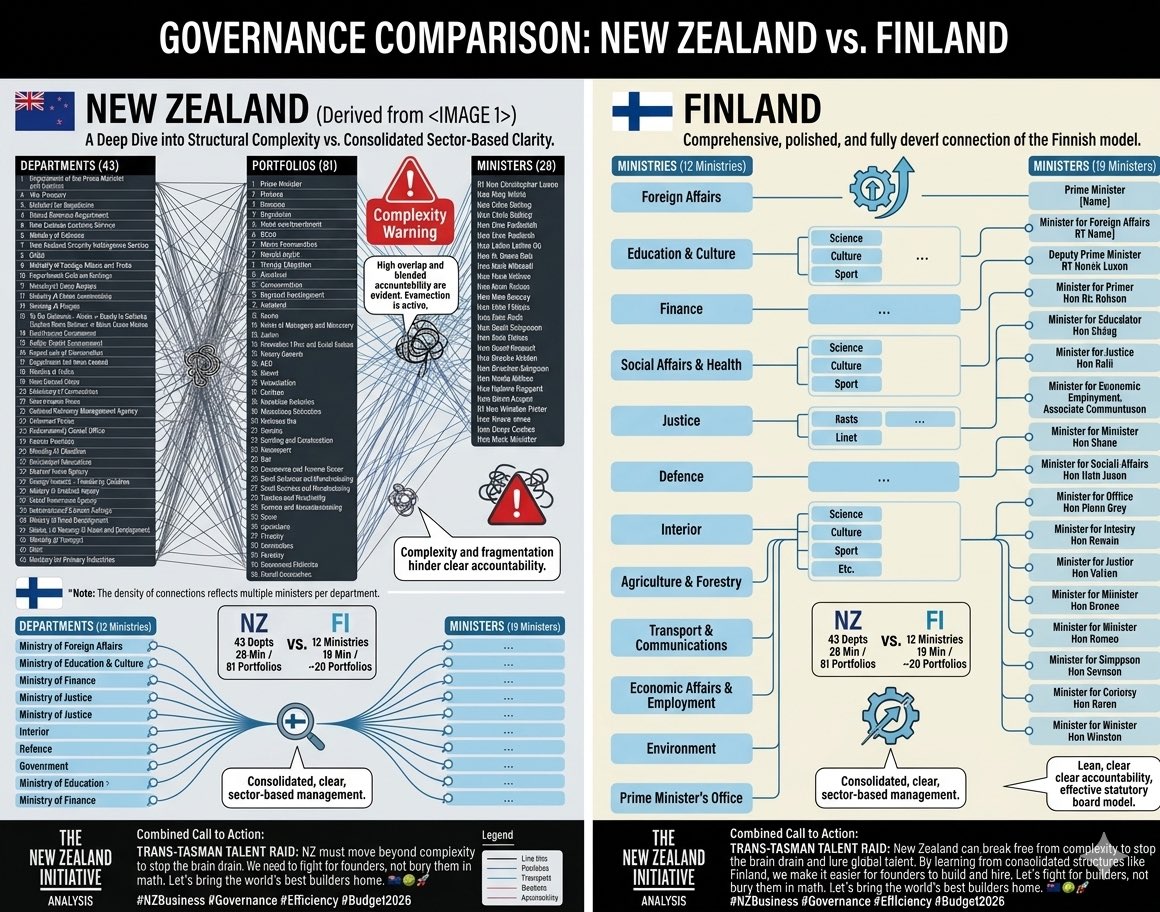
Comparing the NZ government structure to Finland’s. A picture says 1000 words !!
Both countries have similar populations (5.5M). The structures behind are very different.
Finland:
• 12 core ministries
• Clear vertical accountability
• Defined ownership
• Built for speed, clarity, and execution
New Zealand:
• 40+ departments
• 80+ ministerial portfolios
• Layers of overlapping responsibility
• Super-ministries reporting across multiple ministers
The result? Accountability blur. No improvement. Massive waste.
In any high-performing organisation, if everyone is responsible, no one is.
NZ has exceptional people. But we need systems designed to deliver outcomes, not a birds-nest structure that creates no improvement or efficiency.
Fixing this will be a HUGE unlock on NZ long term. All parties should come together in a bi partisan way to sort this out.@actparty@NZNationalParty@nzfirst@nzlabour
Sharing my commentary on #Trump-#Xi summit: "The commercial framework announced in Beijing is real and should not be dismissed. But the actual substance of the Beijing summit was grimmer, and more consequential, than the business pages have conveyed. At its core, this was a negotiation about the weaponization of the AI stack — and a mutual communication of red lines that reveals just how precarious the great power relationship remains. The United States arrived in Beijing with one non-negotiable message: China must stop arming Iran. China's red line is Taiwan. What the summit achieved is a tactical pause in an ongoing strategic contest. Both sides needed air. However, the red lines exchanged in Beijing were not concessions. They were warnings. "
https://t.co/P8p9Ywluw1
Maybe the most important question of the Trump-Xi summit: Did Trump agree to allow access to state-of-the-art semiconductors? I saw one news story claiming he had but nothing to substantiate it.









![RnaudBertrand's tweet photo. I feel like I'm eating crazy pills when I read the countless bad takes around how the Vatican would have virtually anointed Anthropic.
When if you read the Pope's encyclical it's actually a COMPLETE repudiation of everything Anthropic - and U.S. AI generally - stands for.
Read this part of the encyclical for instance (paragraph 110: https://t.co/LR5R22vQWj):
"Finally, I would like to employ the expression 'to disarm,' which is close to my heart. Disarming AI means freeing it from the mentality of 'armed' competition, which today is not limited simply to the military context, but is also an economic and cognitive phenomenon. This entails a race for ever more powerful algorithms and larger datasets, driven by the desire to secure geopolitical or commercial dominance. To disarm means discrediting the assumption that technical power automatically confers the right to govern. To disarm does not mean rejecting technology, but preventing it from dominating humanity. It means freeing technology from monopolistic control and opening it to discussion and debate, therefore making it human-friendly and restoring it to the plurality of human cultures and ways of life."
In a nutshell what the Pope is saying is:
1) The "AI race" mentality itself is the disease: there is no "winning it responsibly", we need to stop seeing AI as a way "to secure geopolitical or commercial dominance"
2) Technical dominance and being the most powerful does not give you the right to set the rules
3) AI must be "freed from monopolistic control", opened to scrutiny, and "restored to the plurality of human cultures"
Now compared and contrast it with what Anthropic is officially saying - namely Dario Amodei in his famous essay "Machines of Loving Grace" (https://t.co/R02pmoOU3M):
1) Where the Pope says stop the AI race. Dario says win it: "A coalition of democracies [should seek] to gain a clear advantage on powerful AI by securing its supply chain, scaling quickly, and blocking or delaying adversaries' access to key resources like chips and semiconductor equipment."
2) Where the Pope says technical power doesn't confer the right to govern. Dario says it does: "This coalition would on one hand use AI to achieve robust military superiority (the stick) while at the same time offering to distribute the benefits of powerful AI (the carrot) to a wider and wider group of countries in exchange for supporting the coalition's strategy."
3) Where the Pope says free AI from monopolistic control and restore it to the plurality of human cultures. Dario says concentrate it and use it to impose one model: "If we can do all this, we will have a world in which democracies lead on the world stage and have the economic and military strength to avoid being undermined, conquered, or sabotaged by autocracies, and may be able to parlay their AI superiority into a durable advantage. This could optimistically lead to an 'eternal 1991.'"
These aren't cherry-picked gotchas. This is the central thesis of Dario's essay.
And Anthropic keeps repeating this over and over. On May 14, just days ago, Anthropic published a 5,000-word policy essay titled "2028: Two scenarios for global AI leadership" (https://t.co/gsah6SzrVq) urging the US to "lock in a 12-24 month lead" over China by blocking chips, cutting off model access, and ensuring that "democracies, not authoritarian regimes" control AI. They warn that "a lead in frontier AI will enable a widening lead across the full national security technology stack" and urge America not to "squander our advantage."
This is, almost word for word, everything the Pope is condemning in his encyclical.
I'll grant Anthropic one thing: they have an excellent PR team. Turning what's an obvious repudiation into a perceived endorsement is pretty masterful.
But it doesn't mean you have to fall for it...](https://pbs.twimg.com/media/HJNUVnQaUAA8aW7.png)