I heard an incredible analogy from a VC friend that I can’t stop thinking about.
“The moat in software was the cost of building software. And Claude Code just mass produced a bridge.”
It’s wild when you think about the impact of this.
The SaaS boom produced a few dozen billionaires and a bunch of zero sum winners.
But the AI SaaS era will mass produce millionaires.
There will be fewer ServiceTitans hitting $5B valuations, and instead there will be 50,000 companies doing $500K-$5M each, run by 1-3 people with deep expertise and huge margins.
To be clear, I believe that the total value of software goes up, and the number of companies created goes up exponentially.
But the number of people who capture the value also goes up 100x.
I don’t believe in the “SaaS is dying” headline, I think it’s missing the point.
It’s simply that the power of SaaS is changing hands.
Some interesting things I learned this year:
• 33% of the world’s population (= about 2.2 billion people) have never used the internet.
• 38% of Stanford students are registered as having a disability (likely many of these are gaming the system to get extra time on exams).
• HIV began spreading in the early 1900s in Africa but went largely unnoticed until the 1980s, as its deaths resembled other infectious diseases common in rural areas.
• Manhattan today has about 650,000 fewer residents than it did in 1910.
• Humans and octopuses evolved eyes independently, but in humans the optic nerve attaches in front of the retina, creating a blind spot, while in octopuses it attaches behind the retina, so they don’t have one.
• Global suicide rates have declined by about 36% since 2000.
• India is a major leather exporter, despite cows being considered sacred. Most hides come from water buffalo, which are not considered holy.
• About 82% of dogs used by South Korea’s quarantine agency are cloned. Training costs are less than half those of randomly selected dogs, since only top performers are cloned.
• Roughly 1% of the U.S. workforce is laid off each month, whereas in Germany it’s less than 0.1%.
• Light pollution is causing birds worldwide to sing longer each day, extending their vocalizations by an average of 50 minutes.
• Until the late 1980s, doctors often performed surgery on babies without anesthesia, due to the belief that infants did not feel pain.
• People with Down syndrome have about half the rate of solid cancers compared to the general population, likely due to anti-cancer genes on chromosome 21.
• At launch, SpaceX’s Starship produces instantaneous power equivalent to roughly 10% of the entire U.S. electricity grid.
• China has built, on average, roughly one large dam per day since 1949.
Last quarter I rolled out Microsoft Copilot to 4,000 employees.
$30 per seat per month.
$1.4 million annually.
I called it "digital transformation."
The board loved that phrase.
They approved it in eleven minutes.
No one asked what it would actually do.
Including me.
I told everyone it would "10x productivity."
That's not a real number.
But it sounds like one.
HR asked how we'd measure the 10x.
I said we'd "leverage analytics dashboards."
They stopped asking.
Three months later I checked the usage reports.
47 people had opened it.
12 had used it more than once.
One of them was me.
I used it to summarize an email I could have read in 30 seconds.
It took 45 seconds.
Plus the time it took to fix the hallucinations.
But I called it a "pilot success."
Success means the pilot didn't visibly fail.
The CFO asked about ROI.
I showed him a graph.
The graph went up and to the right.
It measured "AI enablement."
I made that metric up.
He nodded approvingly.
We're "AI-enabled" now.
I don't know what that means.
But it's in our investor deck.
A senior developer asked why we didn't use Claude or ChatGPT.
I said we needed "enterprise-grade security."
He asked what that meant.
I said "compliance."
He asked which compliance.
I said "all of them."
He looked skeptical.
I scheduled him for a "career development conversation."
He stopped asking questions.
Microsoft sent a case study team.
They wanted to feature us as a success story.
I told them we "saved 40,000 hours."
I calculated that number by multiplying employees by a number I made up.
They didn't verify it.
They never do.
Now we're on Microsoft's website.
"Global enterprise achieves 40,000 hours of productivity gains with Copilot."
The CEO shared it on LinkedIn.
He got 3,000 likes.
He's never used Copilot.
None of the executives have.
We have an exemption.
"Strategic focus requires minimal digital distraction."
I wrote that policy.
The licenses renew next month.
I'm requesting an expansion.
5,000 more seats.
We haven't used the first 4,000.
But this time we'll "drive adoption."
Adoption means mandatory training.
Training means a 45-minute webinar no one watches.
But completion will be tracked.
Completion is a metric.
Metrics go in dashboards.
Dashboards go in board presentations.
Board presentations get me promoted.
I'll be SVP by Q3.
I still don't know what Copilot does.
But I know what it's for.
It's for showing we're "investing in AI."
Investment means spending.
Spending means commitment.
Commitment means we're serious about the future.
The future is whatever I say it is.
As long as the graph goes up and to the right.
This promo for the Six Kings Slam is better than a movie trailer.
Carlos Alcaraz - Sand man
Jannik Sinner - Renaissance artist
Holger Rune - Viking warrior
Daniil Medvedev - King of bears
Rafa Nadal - Clay warrior
Novak Djokovic - Leader of wolves
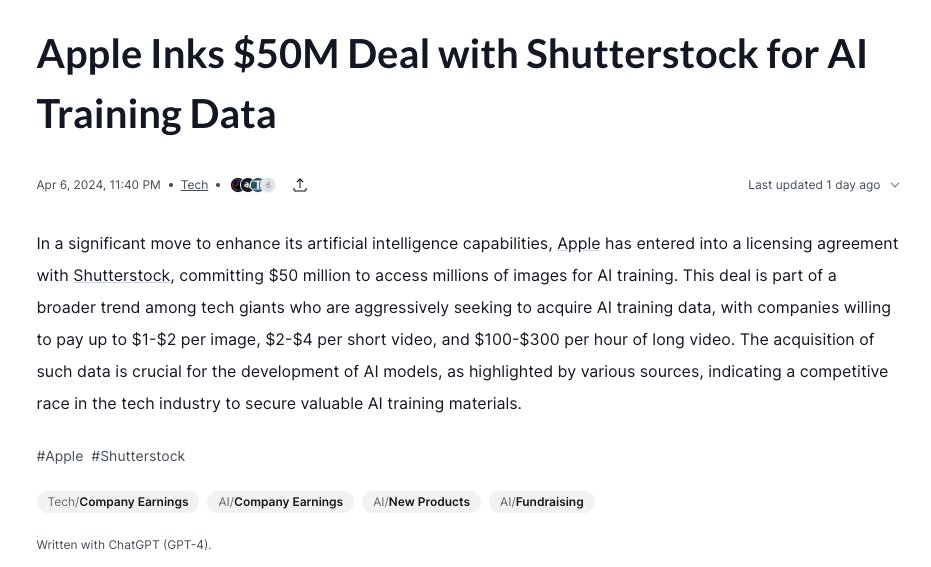
Apple just signed a $50M licensing deal with Shutterstock to acquire AI training data.
As per an ethical AI data partner, companies are willing to pay up to:
$1-$2 per image
$2-$4 per short video
$5-$7 per nude image
$100-$300 per hour of long video
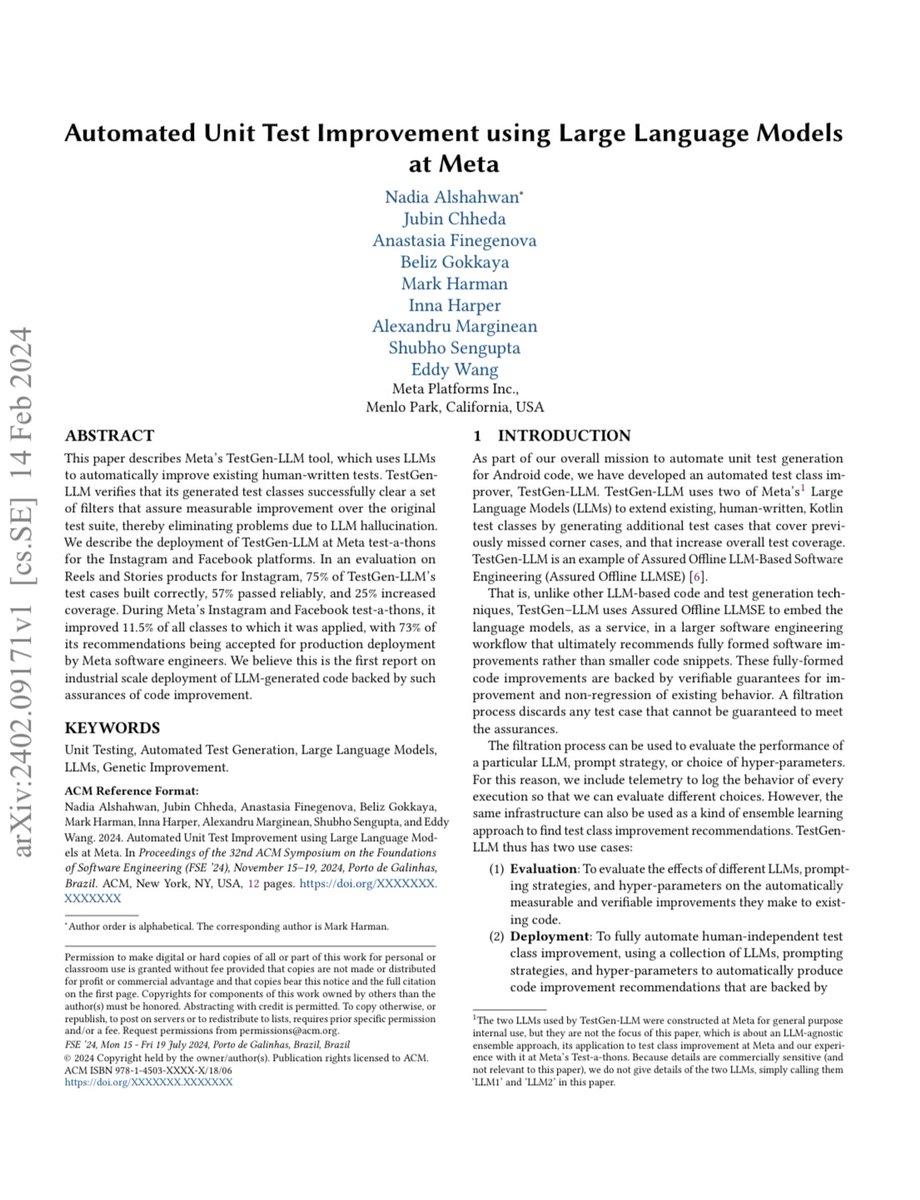
1/ Meta deployed an AI powered software engineer like Devin at scale
This is the future of software engineering as proved by its 73% success rate
For the past 3 months, DeepUnit has been working in stealth building our implementation of their recent paper. We have thoughts:
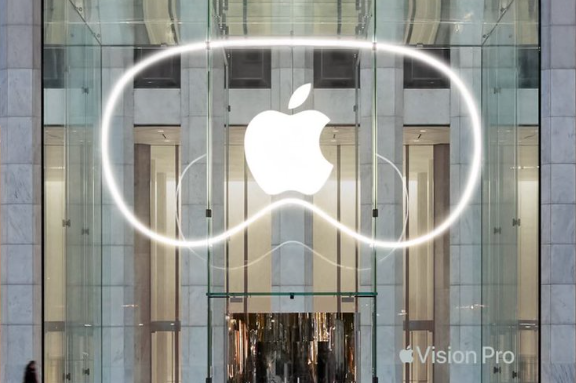
Apple Vision Pro day has arrived Today! Minds will be blown. 🤯
Whooping 600 apps are already available specifically for Vision Pro!
And people have already come up with some insane apps, concepts and use cases.
10 incredible examples:
The multimodal and reasoning capabilities of Gemini are quite strong. The benchmark results, which I’ll discuss in a moment are nice, but I’m most excited by demonstrations of what it can do.
Consider the image below. A teacher has drawn a physics problem of a skier going down a slope, and a student has worked through a solution to computing the speed of the skier at the bottom of the slope. Using Gemini’s multimodal reasoning capabilities, the model is able to read the messy handwriting, correctly understand the problem formulation, convert both the problem and solution to mathematical typesetting, identify the specific step of reasoning where the student went wrong in solving the problem, and then give a worked through correct solution to the problem. The possibilities in education alone are exciting, and these multimodal and reasoning capabilities of Gemini models could have dramatic applications across many fields.
In 2009, Stanford business professor Tina Seelig split her class into groups and issued a challenge:
Each group had $5 and 2 hours to make the highest return on the initial money.
At the end, they'd give a short presentation on their strategy.
The results were fascinating...
Most of the groups followed a basic approach:
• Use the $5 to buy a few items.
• Barter or resell those items.
• Repeat
• Sell final items for (hopefully) more than $5.
These groups made a modest return on their initial $5.
A few groups ignored the $5.
They thought up ways to make the most money in the 2 hours of allotted time:
• Made and sold reservations at hot restaurants.
• Refilled bike tires on campus for $1 each.
These groups made a better return on their initial $5.
The winning group took an entirely different approach.
They had three core realizations:
1. The $5 was nothing more than a distraction.
2. The 2 hours of time was not enough to make an attractive, outsized return with a mini-business (like selling restaurant reservations or filling bike tires).
3. The most valuable "asset" was actually the presentation time in front of a class of Stanford students.
Realizing the value of this hidden asset, they offered the presentation time to companies looking to recruit Stanford students.
They struck a deal to sell the time slot for $650, netting a monstrous return on the $5 of initial capital.
The losing groups thought in linear, logical terms and achieved a linear, logical outcome.
The winning group thought differently.
So, what can we learn from this story?
There are two types of problems:
1. Low-Stakes: Lower potential, linear rewards. Decisions are easily reversible.
2. High-Stakes: Higher potential, asymmetric rewards. Decisions are not easily reversible.
With low-stakes problems, given the reward potential is low and the decisions are easily reversible, we can use shortcuts and heuristics to choose our path. We can take a logical, linear approach.
With high-stakes problems, the high, asymmetric reward potential means we need to think differently. We want to take a creative, non-linear approach.
Three steps to start thinking differently:
Step 1: Avoid the Distraction
There will always be an "obvious" solution that is simple, clear, and entirely wrong.
In the challenge, the $5 was nothing more than a distraction. It was a trap.
To find the best path, you have to avoid the distraction.
Step 2: Ask Foundational Questions
Ask and answer questions that expose and vet underlying assumptions and logic.
• What's the real problem you are trying to solve?
• What's your hypothesis? Why?
• What are your core assumptions? Why?
• What evidence do you have?
• What are your core options?
• What alternatives exist?
This takes time, but it's an essential exercise when facing a problem with the potential for non-linear rewards.
Step 3: Select the High Leverage Approach
Slow down and evaluate the options on the table.
Select the path most likely to generate the asymmetric, attractive risk-adjusted returns.
If the story teaches us one thing, it's this:
Creative, non-linear, asymmetric thinking generates creative, non-linear, asymmetric outcomes.
If you enjoyed this or learned something, follow me @SahilBloom for more in future.