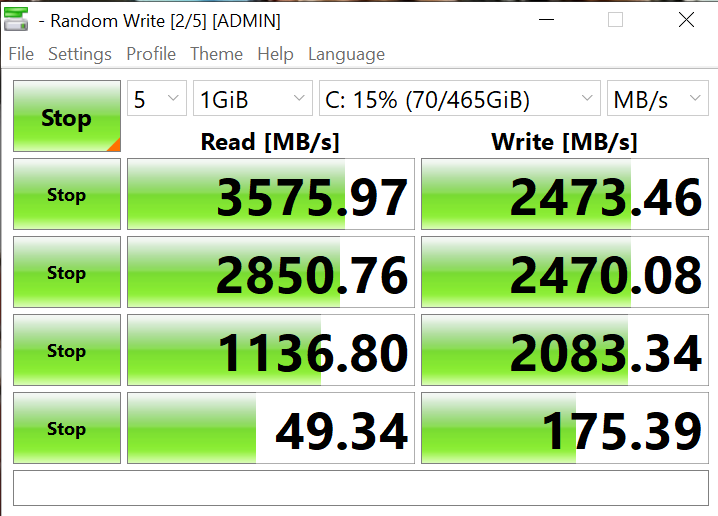
Big shout out to @Newegg for helping me build my dream PC !!! This was only made possible cause i was a weekly winner during the #scholasticlegends sweepstakes.
Here's some pics, parts list, and speed test via #crystaldiskmark !!!
@JeffreyBrandes Imagine being a contractor trying to secure work after a hurricane and having different permit requirements for all of these places listed here. It truly is a nightmare for contractors and homeowners alike
"you can't negotiate with the IRS"
no mf
they approved 42% of the offers they got last year and the form costs $205
it's called an Offer in Compromise. Form 656. you tell the IRS what you can actually pay, they check your math, and if the number is real they take it and zero out the rest. permanently.
the reason they do this isn't kindness. collection costs them money. agents cost money. liens cost money. they'd rather have $6,000 today than spend a decade chasing $100,000 from somebody who will never have it.
they even published the formula they use:
RCP = (monthly disposable income x 12) + equity in your assets
disposable income isn't what you think you have left over. it's your gross income minus the IRS allowable expense tables for your county. their numbers, not yours. if you make $4,200 and their table says your allowable expenses are $3,900, your disposable income is $300.
$300 x 12 = $3,600. add $2,100 in a bank account. your offer is $5,700 on $100,000 owed.
while your offer is pending, all collection stops. no levies, no garnishment, no new liens. that's IRC 6331(k)(1).
and if the IRS fails to make a determination within 24 months, your offer is automatically accepted. IRC 7122(f). they wrote an auto-approve clause into their own law.
"my accountant said i just have to pay it"
your accountant files returns. this is a negotiation. those are different jobs and most preparers have never submitted one of these in their life.
a woman owed $213,000 across four years. we calculated her at $8,400. accepted nine months later. she paid 3.9 cents on the dollar.
the scariest creditor in america built a discount window and hid the sign lol
(we fix credit and stack capital. owe back taxes? handle that first. link in bio)
A guy bought a $1,500 Samsung TV 3 years ago.
He watched Netflix. He watched YouTube. He watched sports on the weekends. He thought the picture looked fine. He assumed that's just what a modern TV looks like.
His friend, a home theater installer who's calibrated over 2,000 TVs for a living, walked into his apartment, looked at the screen for about 5 seconds, and said:
"You're watching everything in demo mode. The motion smoothing is on. The eco dimmer is cutting your brightness by 40%. Your TV is taking a screenshot of your screen every 30 seconds and selling your viewing data to advertisers. And you're watching a $1,500 panel in the same picture mode Best Buy uses under fluorescent lights to make TVs pop on a showroom wall."
He changed 9 settings in 12 minutes.
The picture looked like a different television. The soap opera effect disappeared. The colors became natural. The TV stopped spying on him.
He told him: "I install TVs in homes that cost $2 million. And I install TVs in apartments that cost $1,200 a month. You know what they all have in common? Nobody has changed the default settings. Every single TV I walk up to Samsung, LG, Sony, TCL, Hisense is running in a picture mode designed to look good in a store, not in your living room. And every single one is collecting data about what you watch and selling it to third parties. Out of the box."
He said TV manufacturers make more money from your data than they do from the TV sale itself.
"That's why a 65-inch 4K TV costs $400 now. The hardware is sold at a loss or near-zero margin. The profit comes from tracking what you watch, when you watch it, and how long you watch it then selling that behavioral data to advertisers. Your TV is a surveillance device that also shows movies. And the settings to stop it are buried 6 menus deep on purpose."
Here are the 9 settings he changed:
🧵
Circular motion conceals a real inward force and an illusory outward one.
The centripetal force Fc = mv²/r pulls an object toward the center, changing only the direction of its velocity.
The centrifugal force appears solely in a rotating frame as Ff = −mv²/r, felt as an outward push.
This principle shapes vehicle stability on turns, laboratory centrifuges, and spacecraft trajectory design. Mathematics carefully separates the genuine from the fictitious.
Most people first see Euler’s Formula as a strange equation in a textbook.
Then years later, they realize it quietly powers the modern world.
Leonhard Euler discovered that these seemingly unrelated mathematical ideas:
→ exponential growth
→ imaginary numbers
→ sine waves
→ cosine waves
→ rotation
… are all deeply connected through one identity:
e^(iθ) = cos(θ) + i·sin(θ)
At first glance it looks impossible.
How can an exponential function suddenly produce circles and waves?
The key insight is that multiplying by a complex exponential creates rotation.
As the angle θ changes:
- the cosine term tracks horizontal motion
- the sine term tracks vertical motion
- together they trace a perfect circle in the complex plane
Euler showed that waves and rotation are mathematically the same phenomenon viewed differently.
That single idea changed science and engineering forever.
Today, Euler’s Formula sits underneath:
→ Fourier Transforms
→ signal processing
→ wireless communication
→ MRI scanners
→ quantum mechanics
→ electrical engineering
→ audio compression
→ radar systems
→ GPS
→ neural network frequency analysis
Even modern AI systems indirectly rely on mathematics built on top of these foundations.
The famous special case is Euler’s Identity:
e^(iπ) + 1 = 0
Richard Feynman reportedly called it: "our jewel."
Because it revealed that mathematics is not a collection of separate topics. It is one connected language describing reality itself.
Insurance is the oldest of the four ways. It is a nine-trillion-dollar global industry. The equation underneath it was invented in 1560 by a broke Italian gambler.
His name was Girolamo Cardano. He wrote a book called Liber de Ludo Aleae. A short manual on how to win at dice. Nobody in finance read it for four hundred years.
Then in 1996 a ninety-year-old man in New York wrote a book that traced every modern risk model back to that manual. He called it Against the Gods. One thesis. Every dollar of premium ever collected on Earth is a footnote to a gambler scribbling in Milan.
His name was Peter Bernstein. He founded the Journal of Portfolio Management in 1974 and ran money at Bernstein-Macaulay before that. Wall Street called him the historian of risk.
In 2008 a small production company filmed him for thirteen minutes. He walked through the entire five-hundred-year arc. Cardano to Pascal to Fermat to Black-Scholes. Then he stopped and said the industry had built glass towers on the back of an idea a broke Italian scribbled to settle a card debt.
He died the following summer. Age ninety.
Reinsurance premiums crossed six hundred billion dollars last year. Every actuary on Earth prices catastrophe risk with the same expected-value framework Cardano invented to shave the house edge in Milan.
The video is thirteen minutes and twenty-two seconds long. Free. Eleven years on YouTube. Twenty-nine thousand people have watched it.
Almost none of them work in insurance.
For years we were told America was declining.
That Europe had figured it out. That patriotism was cringe. That national identity was dangerous. That the future belonged to bureaucrats, technocrats, and people who thought flying a USA flag was somehow controversial.
Then the World Cup shows up.
Millions of people from around the world land in the United States and immediately start posting about the size of everything. The roads. The homes. The trucks. The gas stations. The food. The friendliness. The optimism.
And most importantly: freedom
That spirit is contagious.
And the timing couldn't be better.
All of this is happening as America approaches its 250th birthday. A quarter of a millennium after a handful of rebels looked at the most powerful empire on earth and said, "Nope. We'll do it ourselves."
The entire world is getting a front-row seat to the American experiment.
And from where I'm sitting, it looks good.
Happy 250th, America 🇺🇸
The thief on the cross might be my favorite salvation story in the whole Bible.
· Never fasted
· Never baptized
· Never took communion
· Never recognized a Pope
· Never prayed the the rosary
· Never performed any works
That man was saved by faith alone.
This Easter, I invite you to look at Jesus, consider what he said and did, and ask for yourself what I believe is the most important question you will ever answer: Did he really leave behind an empty tomb? And if he did, what does that mean for you?
This video was made possible and in collaboration with my friends at @ChildlikeMedia.
HEARTBREAKING: In 2002, #49ers star Mike Evans was only nine years old and his father Mike Evans Sr. was brutally murdered by his uncle Sam Kilgore in Texas.
💔💔💔
Mike speaking about this tragedy will truly break your heart. A horrific story.
(🎥ESPN)https://t.co/tjHLFadms0
Dr. Russell Barkley, leading ADHD expert, explains the heartbreaking reality many parents face: A child with ADHD can play video games for hours without issue... but struggle to do homework for even a few minutes.
Why? Video games deliver constant, immediate, 100% external consequences and feedback—every action gets instant reward or response. Homework? Nothing happens when a problem is solved. Consequences are delayed (or invisible), so the brain's motivation system flatlines.
This isn't laziness, willpower failure, or "they could if they wanted." It's a neurogenetic executive function deficit: ADHD impairs self-motivation. Without external structure, immediate cues, and consequences, the work simply won't get done—no matter the goals or good intentions.
Put an ADHD brain in a low-consequence environment, and failure follows. It's not a choice; it's how the wiring works.
The takeaway? Stop blaming the person. Build environments with external motivators: timers, immediate rewards, gamified tasks, accountability.
Parents/teachers: What's one external structure (timer, reward chart, body doubling) that's helped an ADHD kid bridge that motivation gap?