Learn about confirmation bias & you won’t stop noticing it — in yourself first
People seek facts that support their theory, refuse to hear anything that contradicts it, then moan when life fails them
The truth will set you free, but most are too scared or stubborn to face it
Success lives & dies by the speed of your feedback loop
Your feedback loop is built on risk appetite & curiosity
Risk appetite means you fail fast and iterate
Curiosity means you spot the patterns others miss
Bet it all on yourself. Stay obsessed.
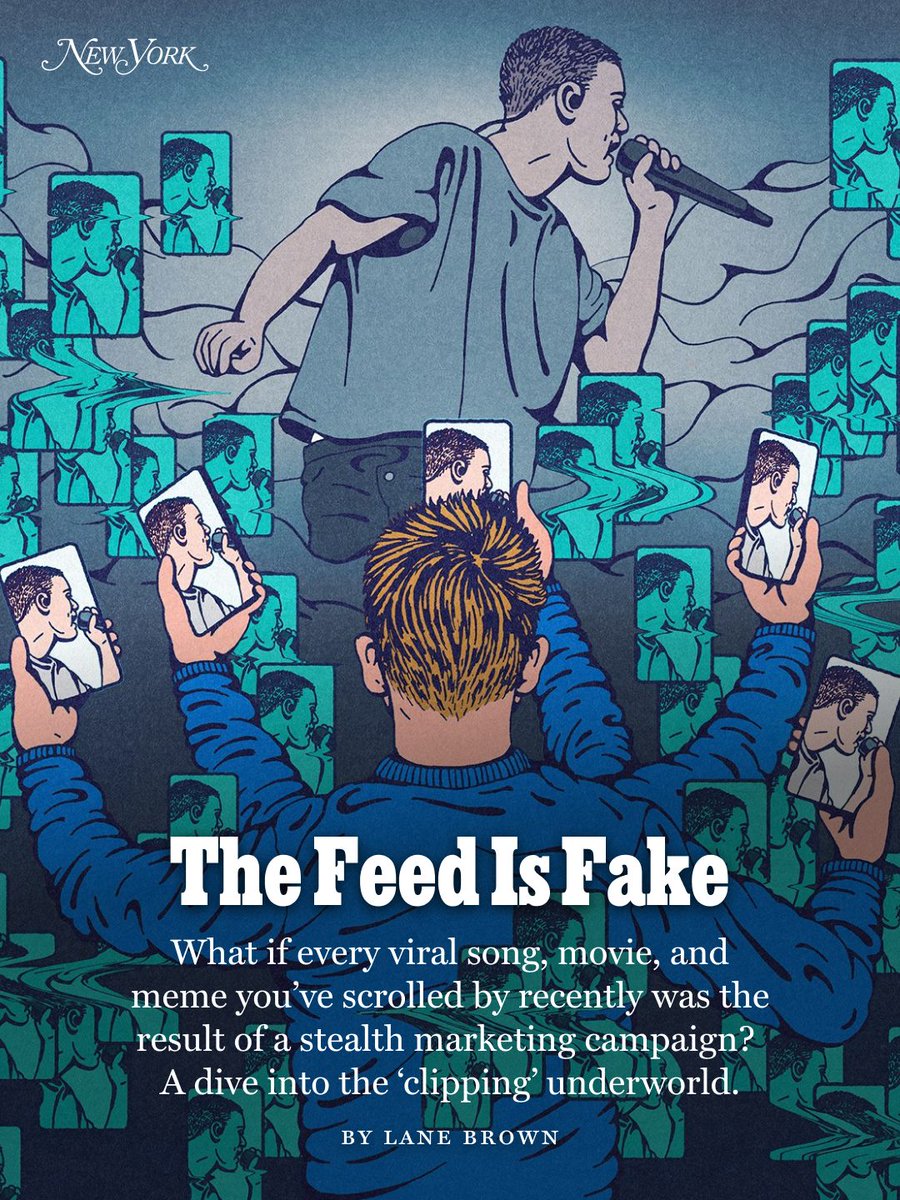
Joe Lim estimates that 90 percent of what you see on the internet is advertising in disguise, and he should know. For three years, Lim ran a company called Floodify, which at its peak operated 65,000 dummy social-media accounts used to drum up attention on behalf of paying clients.
The point of this kind of marketing is that nobody is supposed to notice it. But lately, the machinery has started to show.
In April, Justin Bieber headlined two consecutive weekends at Coachella. Coachella is the biggest stage in pop music save only for the Super Bowl, the kind of event that in theory generates its own attention. And yet on both weekends, a Discord server writer Lane Brown had been monitoring hosted paid campaigns for Bieber’s Coachella performances, offering clippers — people who are hired to turn a song, trailer, interview, stump speech, or whatever into short, social-media-friendly fragments — as much as a dollar per thousand views.
“On social media, popular opinion is being formed, measured, and manipulated all at once, and every signal the platforms produce — a trending song, a backlash, a talking point, the feeling that ‘everybody’ is suddenly talking about the same thing — can now be fabricated by unseen actors with hidden agendas,” writes Brown.
“Everybody is doing this now,” Lim says. “And if you’re not, you’re behind.”
Brown reports on how the same techniques are now being used to fool people on every app they go to in order to find out what other people think, not just in music but across entertainment, politics, consumer products, and celebrity gossip: https://t.co/hlcdfSmzPc
this telehealth company hit $1.8B with 2 people by selling d*ck pills with fake AI UGC doctors:
the all-mighty MEDVI
it ended with an FDA class-a lawsuit, a New York Times front page, and platform bans across the board.
but hey their methods were pretty cracked
so today i’ll be breaking down the ENTIRE clinical avatar arbitrage playbook behind their $400M run rate
including the legitimate version that doesn't end with federal regulators involved...
here's what's inside:
> the authority psychology framework that explains why AI-generated doctors converted better than real ones in health advertising (the neurological mechanism that makes this work in every high-trust category, not just health)
> the three-step production system MEDVI used to generate synthetic medical presenters, localize them across demographics and languages, and manufacture social proof through sheer volume
> the exact line between legal AI spokesperson advertising and what MEDVI did to cross into fraud (most brands don't know where it is)
> the legitimate version of clinical avatar arbitrage: three proven approaches that extract the same trust mechanism without fabricating credentials
> the cross-category breakdown of how authority-based AI UGC applies to SaaS, DTC, finance, and professional services, not just health
all reverse-engineered from a real $400M case study with real regulatory consequences.
like + comment "MEDVI" and i'll send EVERYTHING your way
(must be following + RT for priority access)
90% of the time I fell short came down to two things:
- Skill issue
- Direction issue
Master your craft, pick the right arena & results follow
Everything else is noise.
I built an AI system that automates product video creation for entire e-commerce catalogs.
(Saves ~$30K per collection shoot and boosts on-site conversion rates by ~20%)
Here's what the system does under the hood:
→ Firecrawl pulls product images straight from any e-commerce collection URL
→ Calico AI turns them into realistic model videos capturing fit, texture, and movement
→ Every video starts and ends on the original product shot for seamless looping
→ Output is auto-labeled, sorted, and pushed directly to Google Drive
→ The entire pipeline runs in batch — zero manual intervention
The outcome: brands can give every single SKU a video asset, not just their bestsellers — and conversion lifts are immediate.
Static images don't cut it anymore.
Buyers want to see how a product moves before they commit.
If you want the full breakdown,
Like RT & Comment "CALICO".
I'll send you the complete n8n workflow, every prompt, and a step-by-step walkthrough video — totally free. (Must be following so I can DM you.)
No more $30K production shoots.
No more wondering if your product pages are leaving money on the table.
I increased my conversion rate by 274% in one day
From research
The unsexy stuff nobody wants to do
Think you’ve done proper research? Go through this doc
I promise you haven’t
Repost + comment “research” and I’ll send it over to you
Want my TikTok Product Testing Strategy PDF for FREE?
I have used this method for over a year and tested 100+ winners with it.
RT & Comment "PDF'' and I'll DM it to you!
(Must be Following me otherwise I can't DM you)
We've worked with 50+ digital agencies in the past 12 months.
The common denominator? Each struggled with time and energy management.
So we developed a planner specifically for agency owners/staff.
Retweet and reply "Impact" and I'll send a link for you to download it.