Introducing 𝙻𝙵𝙼𝟹: our new generation of Liquid Foundation Models. With a new tri-hybrid architecture and new multimodal encoders, the LFM3 family is the ideal model suite for specialized intelligence.
> 6 model instances, across text, audio, vision, and omni modalities, generative and decision models.
> 𝙻𝙵𝙼𝟹-𝟷.𝟽𝙱: text, 256k context window.
> 𝙻𝙵𝙼𝟹-𝚅𝙻-𝟸𝙱: vision-language model with video-input support for spatial understanding
> 𝙻𝙵𝙼𝟹-𝙰𝚞𝚍𝚒𝚘-𝟸𝙱: tool calls, voice chat, reasoning in 18 languages.
> 𝙻𝙵𝙼𝟹-𝙾𝚖𝚗𝚒-𝟸𝙱: an omni model combines vision, audio, and language.
> 𝚍𝟷-𝟸𝙱 and 𝚍𝟷-𝙾𝚖𝚗𝚒-𝟸𝙱: decision models with typed outputs and calibrated probabilities in a single pass. Omni adds audio input.
> fine-tune on 1 GPU.
> a new tri-hybrid architecture
> architecture optimized for 14 processor classes across GPUs, CPUs, and NPUs.
> 𝙻𝙵𝙼𝟹-𝚅𝙻-𝟸𝙱 is a beast. It performs competitively with Gemma 4 12B (6x larger), and Gemini 3.5 Flash Lite, and GPT-5.6 Luna, with 1.9B parameters.
> 𝙻𝙵𝙼𝟹-𝟷.𝟽𝙱 is #1 on the Pareto frontier of device intelligence 𝚙𝚒𝚙𝚎𝚝𝚝𝚎.𝚕𝚒𝚚𝚞𝚒𝚍.𝚊𝚒
Every modality for specialized intelligence. Pick the one that fits your use case, customize it, and run it on-device.
1/ 🧵
Today, we announce 𝙻𝚒𝚚𝚞𝚒𝚍 𝚁𝙸𝙿𝙻 (real-time inference pipeline), our ultra low-latency inference engine built to put LFMs directly in the request path of real-time workloads like search, ads, fraud, recommendations, and payments. Blazing fast. https://t.co/wHuvcPc3zy
Financial services: 8k in → 64 out; LFM2.5-350M on B200.
During a credit application, the model evaluates applicant data alongside financial and risk signals and returns a structured eligibility or credit decision.
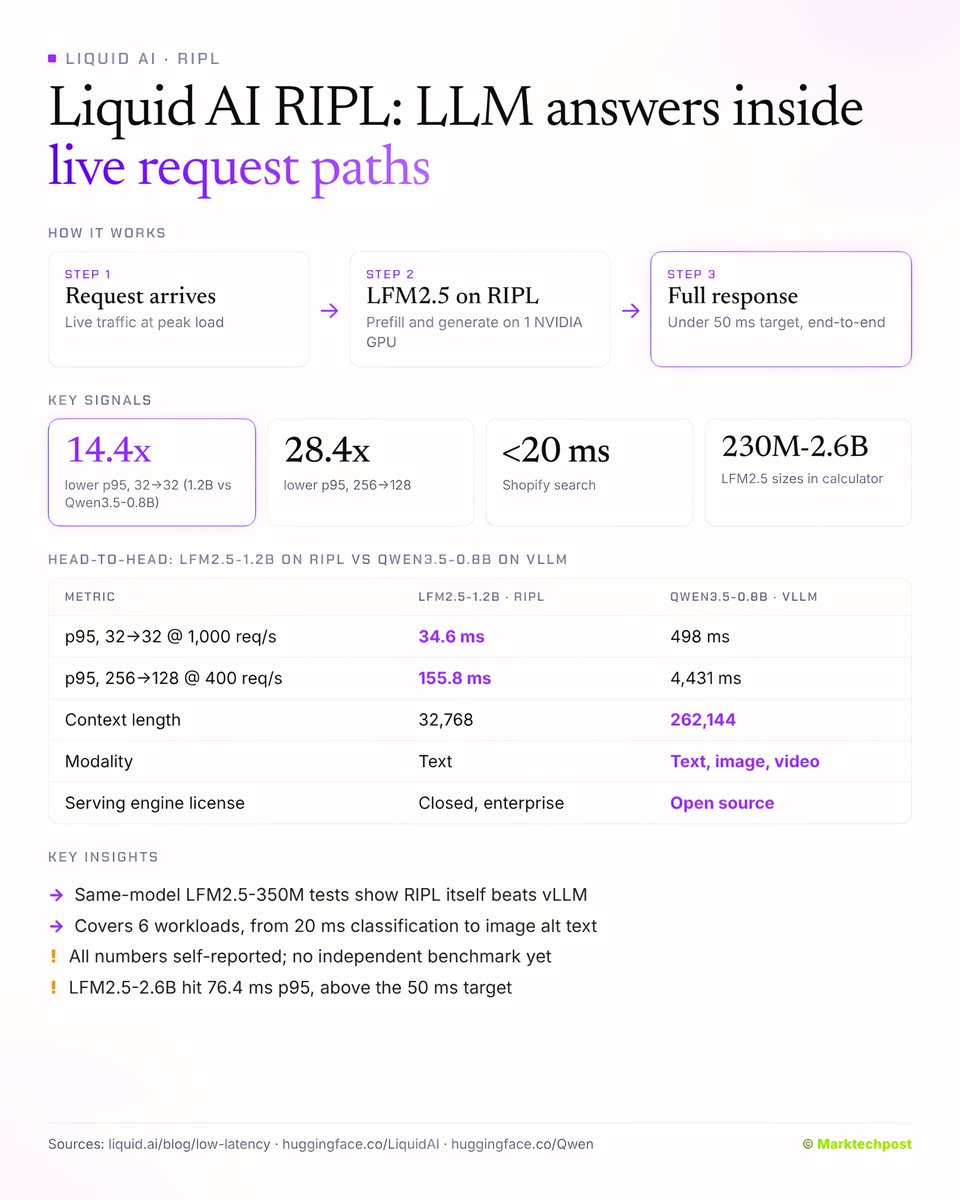
▲ Liquid AI just released RIPL, an inference engine that puts small LLMs directly in the request path of live production systems.
The key idea is optimizing the whole path, from request arrival to the finished response, for tail latency under load. Liquid tested the same LFM2.5-350M model on vLLM and on RIPL, and RIPL's p95 stayed lower. So part of the gain is the engine, not only the model.
On 1 B200, LFM2.5-1.2B on RIPL hit 34.6 ms p95 vs 498 ms for Qwen3.5-0.8B on vLLM (32 in, 32 out, 1,000 req/s). On 256 in, 128 out, the gap grew to 28.4x. It is a trade-off though: LFM2.5-2.6B reached 76.4 ms on the short workload, above the 50 ms headline, and every number is self-reported.
RIPL is available now for enterprise LFM deployments on NVIDIA H100, H200, B200 and RTX PRO 6000. It is closed, serves LFMs only. Shopify already runs LFMs at sub-20 ms in production search......
Full analysis: https://t.co/TvSTFlJJRR
Blog: https://t.co/Dilqk74Ijm
Calculator: https://t.co/a5N93gLaZX
Models: https://t.co/6bSdh0XdZB
@liquidai@maximelabonne
Today, we announce 𝙻𝚒𝚚𝚞𝚒𝚍 𝚁𝙸𝙿𝙻 (real-time inference pipeline), our ultra low-latency inference engine built to put LFMs directly in the request path of real-time workloads like search, ads, fraud, recommendations, and payments.
> complete generated responses end-to-end in sub 50ms
> maintains low latency under continuous peak load
> LFMs get up to 20x faster on RIPL
> RIPL supports Multimodal LFMs
> RIPL supports d1, our decision models too!
RIPL optimizes the full path from request arrival to a complete generated response. As traffic rises, its performance advantage is greatest on the slowest requests. Let’s see some production use cases:
Continuous sensing creates memory bottlenecks on edge devices. Qualcomm & @ramin_m_h, Co-founder and CEO of @LiquidAI are advancing on-device AI with Liquid Context on @Snapdragon — compressing multimodal inputs for fast, low-power execution.
This is quickly becoming one of my favourite labs. Yesterday they also released a great 24b model opensource.
Now this absolute beast of a model to come out of this lab, @PhishFort we’re seeing massive growth in our capabilities enabled by the new generation of decision models.
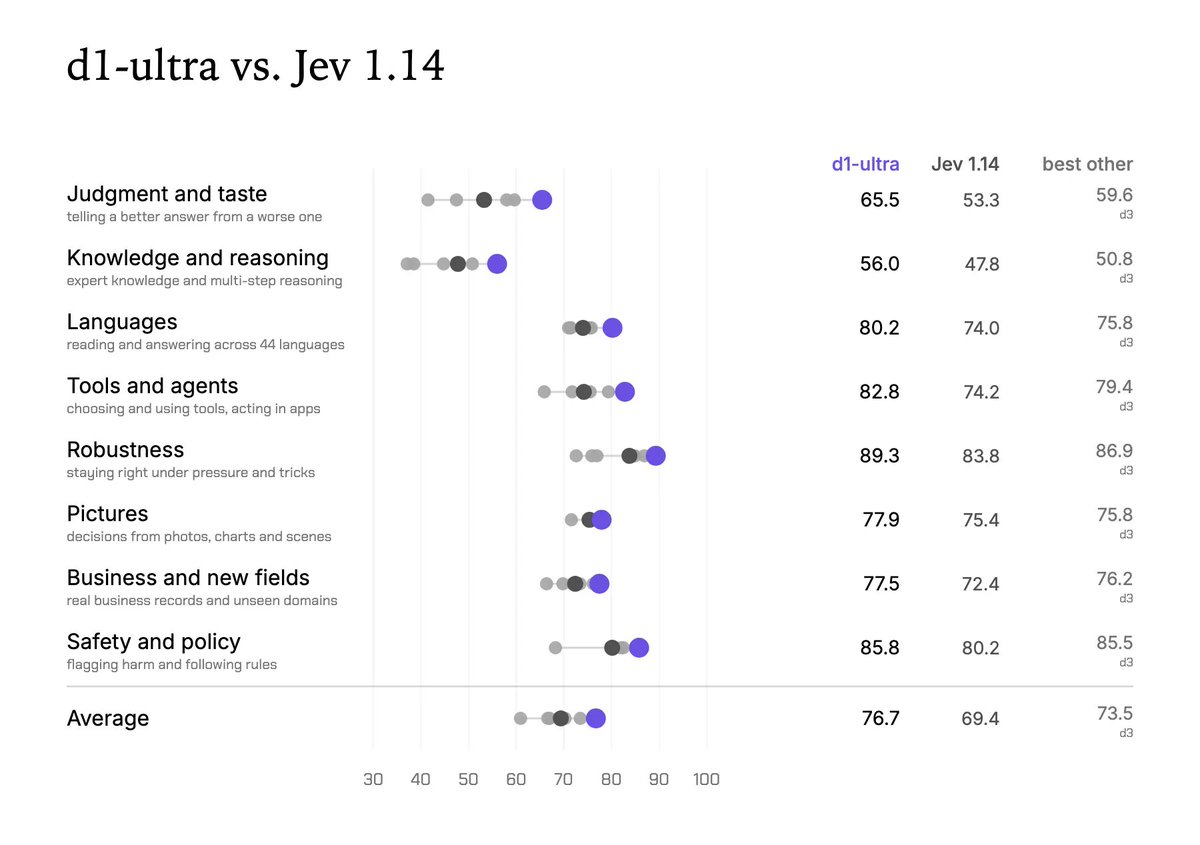
Today we release 𝚍𝟷-𝚞𝚕𝚝𝚛𝚊, our most powerful decision model.
> built for hard decision problems.
> d1-ultra is multimodal
> supports 44 languages
> #1 on the @ArtificialAnlys Decision Index (65)
> leads all eight categories of our 112-evaluation suite
1/
Today we release 𝚍𝟷-𝚞𝚕𝚝𝚛𝚊, our most powerful decision model.
> built for hard decision problems.
> d1-ultra is multimodal
> supports 44 languages
> #1 on the @ArtificialAnlys Decision Index (65)
> leads all eight categories of our 112-evaluation suite
1/
open d1 decision models are here!
• small enough to run them on my macbook
• multimodal for fun things like video input
here i'm using d1-3B to rate how cute my outfit is.
don't follow me for more fashion advice 💜
see more fun demos on our hugging face space:
https://t.co/6qR4V8CZUT
1/ Excited to release The ultimate guide to multi-harness RL
The same model behaves differently in every agent harness. So we built an open way to train any model with RL on any task set, inside the harnesses people actually use, like Claude Code, Codex, and OpenCode, without changing a single line of harness or training code.
Trained across four harnesses, LFM2.5-2.6B went from 42% to 54% with 31% fewer tool calls. 🧵
We're partnering with @Qualcomm to bring personal AI context to devices powered by Snapdragon. Liquid Context, our on-device context layer, is now optimized for Snapdragon processors and runs on the Qualcomm Hexagon NPU.
Our goal: Give the agents people choose an understanding of what matters to them and when they need help. With the user's permission, Liquid Context learns from device signals and builds an understanding of their routines, preferences, and needs. That understanding is built and maintained locally, and Liquid Context shares relevant context with the user's chosen agents, whether they run on the device, in the cloud, or across both. That includes third-party agents and Liquid Agent, our efficient embedded agent powered by LFM2.5-2.6B.
Running on the Hexagon NPU, Liquid Context works in the background and keeps that understanding current without requiring a cloud model to process every update.
For device manufacturers, this is a path to add personal context to their devices while supporting their own choice of agents and services. OEMs building embedded or hybrid agents can also work with us to evaluate Liquid Agent.
As our CEO @ramin_m_h said: "Personal AI starts with understanding how you live and what you need, when you need it. Liquid Context builds that understanding on your device so the agents you choose can offer more relevant help and anticipate your needs."
> Read more about our partnership: https://t.co/qPBlES34qS
> Check out the livestream of @cristianoamon and Ramin's keynote here: https://t.co/UcqtQGHuuu
Aging research spans many biological modalities, each traditionally requiring specialized models and pipelines.
Instead, we train a single foundation model as a common reasoning layer across them – opening the door for researchers to interrogate clinical, genetic, epigenetic, transcriptomic, and proteomic data with the same model:
> 🏥 Clinical: LFM2-2.6B ranked #1 on NHANES pairwise age prediction
> 🧬 Genetics: LFM2-1.2B and 2.6B ranked #1 and #2 on masked OpenGenes.
> 🧪 Methylation: LFM2-2.6B ranked #2 overall on GEO pairwise age.
> 📊 Transcriptomics: LFM2-2.6B ranked #2 overall on GTEx age classification.
> 🔬 Proteomics: both LFMs beat every frontier model evaluated on Olink pairwise age.
We also ran feature ablations to test which biological measurements influence model predictions. Removing selected feature groups reduced confidence in correct answers and, in some cases, changed the final prediction. Our results demonstrate that LFMs drew on task-specific biological information rather than a single common shortcut.