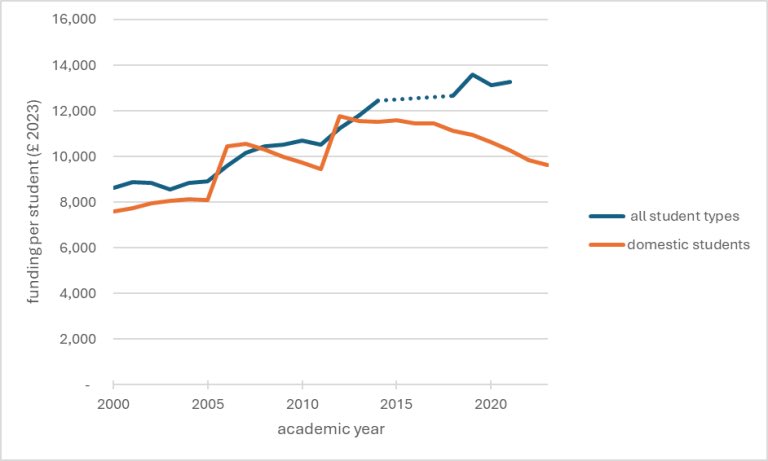
How has the UK HE system fared over the last decade? Answer: the lack of index linking has left it in a very fragile state. @gillwyness_econ and I outline key metrics in the run up to the UK election
https://t.co/6T4pYv7tJf
🚨#JMP Alert🚨
Hi #econtwitter! I am happy to share my JMP: "Scaling up: Advanced Placement (AP) Incentive Program".
You can find the full paper here: https://t.co/om2vU74Y1e, and I will share some of the highlights below. 1/5
@JeffDenning Can’t agree more with Jeff, if you’ve read and liked the first rank paper but not seen the technical bits of this one, I’d recommend. Lots of nuances - turns out Texas has more sorting to schools than the UK!
Working on this was mind-bending a bit--thinking through what these rank papers actually do was a fun and difficult exercise.
@RichMurphy_Econ and I often referenced this gif after working on the paper.
@RichMurphy_Econ and @FelixWeinhardt were great to work with!
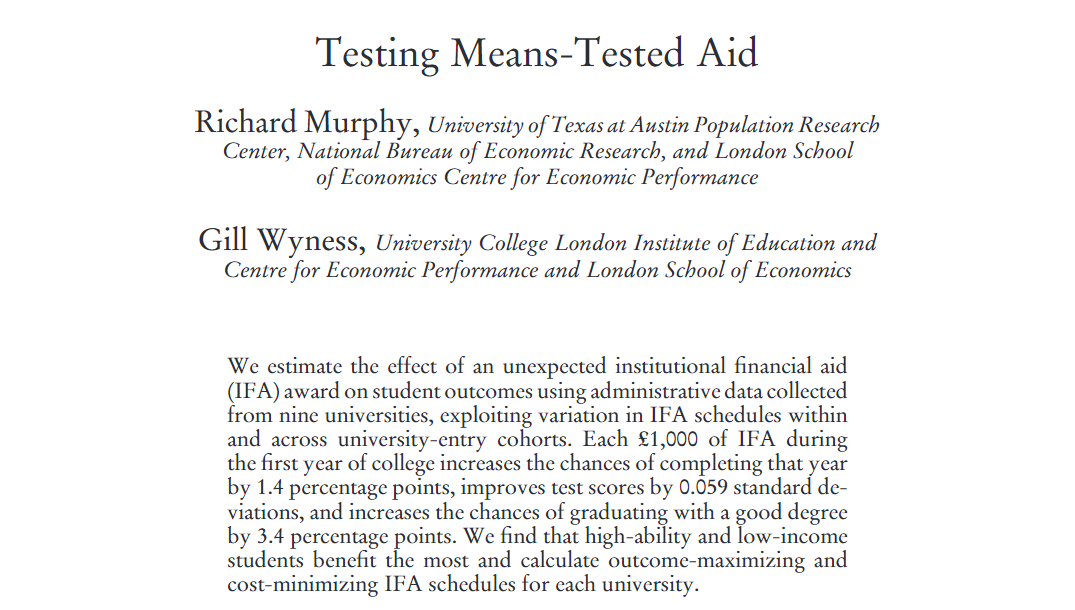
How do means tested undergraduate bursaries affect academic achievement and graduation rates?
Awesome new paper in Journal of Labor Economics by @RichMurphy_Econ and @gillwyness_econ
This link gives the first 50 people a free copy...
https://t.co/zPkcAmSFC7
For some English context, it's been shown repeatedly students from disadvantaged backgrounds do better at university than their more advantaged peers with the same entry qualifications
https://t.co/WkAndK9sh4
https://t.co/I8ODni3w8j
https://t.co/OE6Wy8eTmz
https://t.co/xJtGNCSRDe
In light of today’s ruling, here is a piece I wrote with @gillwyness_econ providing an economic perspective on affirmative action in @IZAWorldofLabor https://t.co/wMw5dYPHLt
The first workshop I organized regarding Access to HE and Labour Market transition. Amazing speakers and nice location and view 😎
https://t.co/dtclart7OY
Here is really nice biographical writeup from my ramblings about my own counterfactuals, my family, US-UK educational systems, and how they have influenced my research. Oh, and honkytonk. #EconomicsOfEducation#Multiverse
We conclude that centralized pay-scales drive a misallocation of resources by preventing teacher retention. Removing them reduces educational inequalities, but at the cost of exacerbating teacher wage inequalities. 5/5
Ever wondered what would happen if teacher pay scales disappeared overnight? Ellen Greaves, @profsimonb and I find in higher wage labor markets teachers experience relatively higher pay progression, retention, and student performance 1/5 (open access @ https://t.co/6AIDx9MgPu
Teacher labour markets are typically highly regulated.
What happens after a radical deregulation as in England in 2013?
Happy that our paper now out: https://t.co/RqTe0QfNj4
By Ellen Greaves @BristolUniEcon@RichMurphy_Econ and myself.
Blog: https://t.co/XMZKDIHgpJ
(1/7)
Consistent with a compensating wage hypothesis, all of these effects are larger for schools with more disadvantaged students. We also find that after pay-scales are removed, a gender wage gap emerges. 4/5
These are only the papers that instantly came to mind, if #EconTwitter knows of any others do let the Chair of the UK's Social Mobility Commission know @miss_snuffy@smcommission
Subject preferences aren’t fixed @miss_snuffy@smcommission. Our research sets out how subject choice are due to social norms and market failures (https://t.co/zr9U4yGyKT) It’s the govt role to fix these market failures. Here’s a thread on how STEM gender gaps can be closed
Parental Beliefs: @alexeble shows that the STEM gender beliefs of the parents of your schoolmates impacts your STEM performance https://t.co/Or4XySMdGo
Why do certain beliefs persist in the face of strong evidence that contradicts them?
How do some societal inequalities persist across generations?
This 🧵 explains a new paper I have with @trifen_hu studying these questions through the lens of #gender
https://t.co/dp04HVezhw