An agile, untethered, and easy-to-use ankle exosuit could help stroke survivors improve their gait outside of the lab and during their daily routines, according to a new proof-of-concept study led by Conor Walsh's team at @harbiodeslab. https://t.co/AnbCWd7EFF @walshharvard
Faculty Position in Human-Centered Robotic Technologies, University of Waterloo, Canada https://t.co/O3cDOxtMnR. Reach out to me if you have any questions. We're excited to review applications from a rich and diverse candidate pool. @CSBiomech@BlackBiomechs@AmSocBiomech
New paper alert! We investigated how small changes in the onset time of belt acceleration #perturbations affects step placement and margin of stability. Great work by Pawel Golyski, Esmeralda Vazquez, @jenniferleestma, @gregory_sawicki.
Paper: https://t.co/CjcbSXDVUL
Our new article in @SciRobotics shows how direct measures of calf muscle dynamics can be used to individualize ankle exosuit assistance for multiple walking tasks and reduce the metabolic cost of walking with relatively low forces. https://t.co/yWBcq2hlC5 1/8
Thank you to funding sources: NIH, NSF, Harvard University John A. Paulson School of Engineering and Applied Sciences, Wyss Institute, Samsung Scholarship. Thank you to co-authors! Sangjun Lee, @KrithikaS01123, Dorothy Orzel, Rob Howe and @walshharvard. 7/8
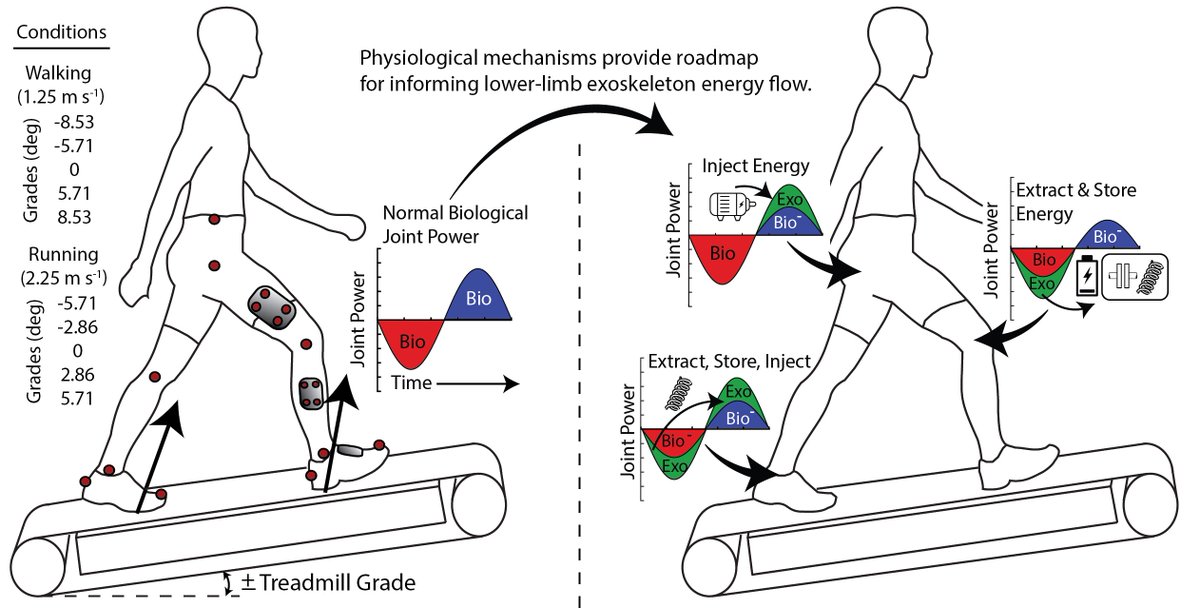
We examine changes in joint power during up and downhill walking and running. Then suggest methods for how gait mechanics can be used as a roadmap to guide wearable robotic design. https://t.co/RhcHb0kqj3
@RichNuckols@gregory_sawicki