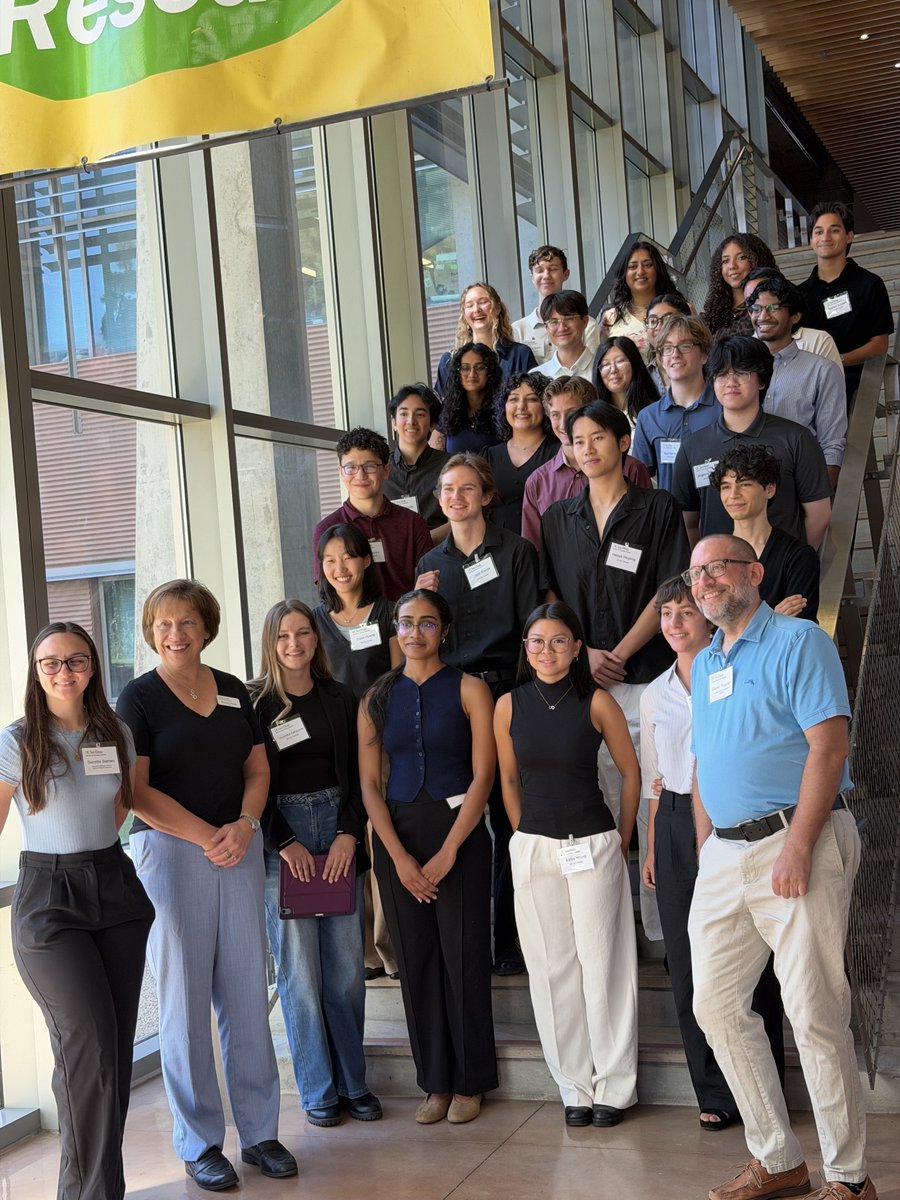
And here’s some of the science Richa leaves us with! 🌊🧊⚡️
🔹 Many-body physics in machine-learned water models ➡️ https://t.co/fuh9RTzdiD
🔹 A molecular view of the ice surface ➡️ https://t.co/LzqB8DyNBQ
🔹 Water next to neutral and charged graphene ➡️ https://t.co/vXOr0eqIj9
🔹 How dissolved halides affect surrounding water ➡️ https://t.co/mGOCHZdcYH
🔹 Decoding the vibrational spectrum of hydrated fluoride ➡️ https://t.co/AmLQqRG01g
🔹 Water inside polarizable carbon nanotubes ➡️ https://t.co/PJAp1yeRNo
🔹 Separating surface and bulk responses at graphene oxide interfaces ➡️ https://t.co/bDIR8JLEIH
🔹 Why free OH groups at the water surface aren’t all alike ➡️ https://t.co/iwb0FLYmju
🔹 Our review connecting many-body potentials to aqueous properties ➡️ https://t.co/IRvcNwCRiu
🔹 Following the hydration of protonated glycine ➡️ https://t.co/wAPi2xfP2T
🔹 Explaining where halides reside near the water surface ➡️ https://t.co/UTpsEfg6LN
Thank you, Richa! 🙌
@UCSanDiego@UCSDPhySci@UCSDChem@HDSIUCSD@SDSC_UCSD@RichaRashm
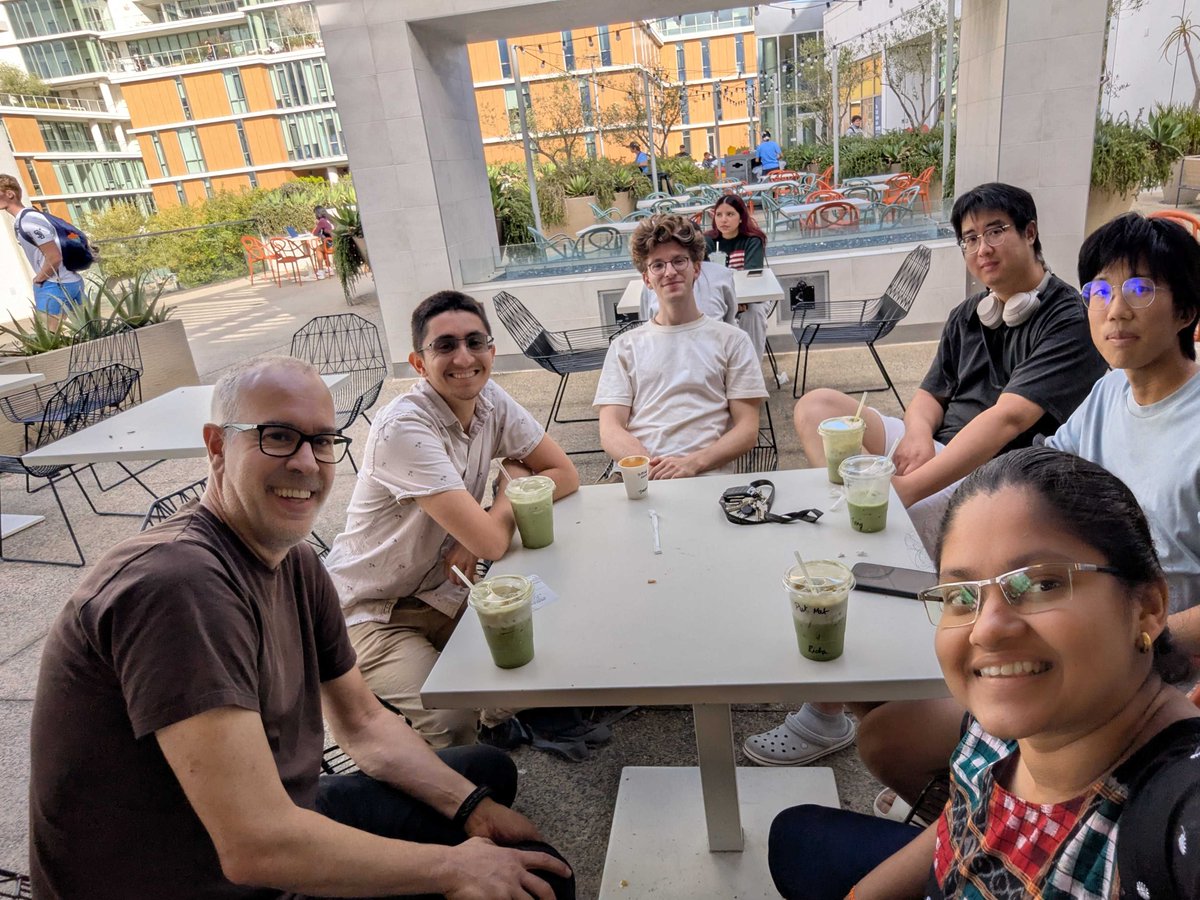
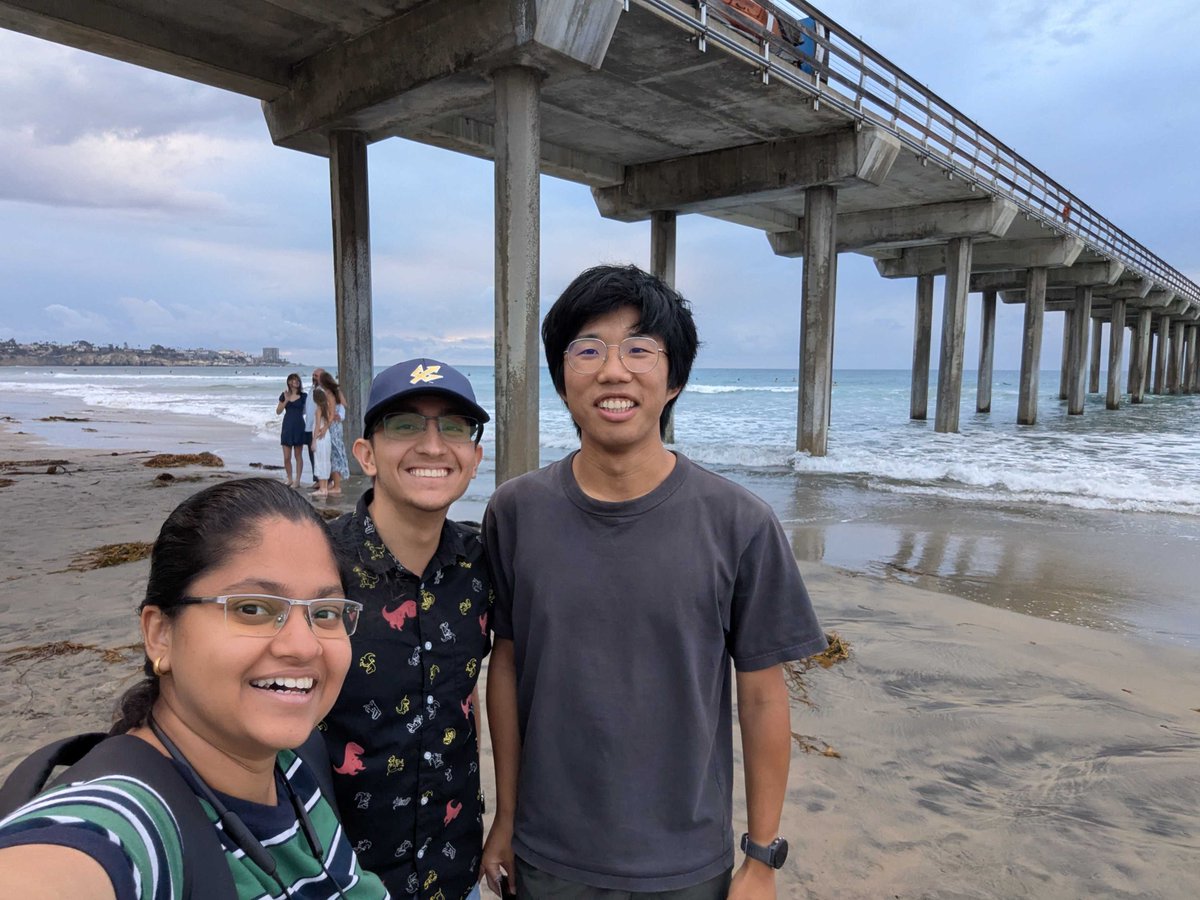
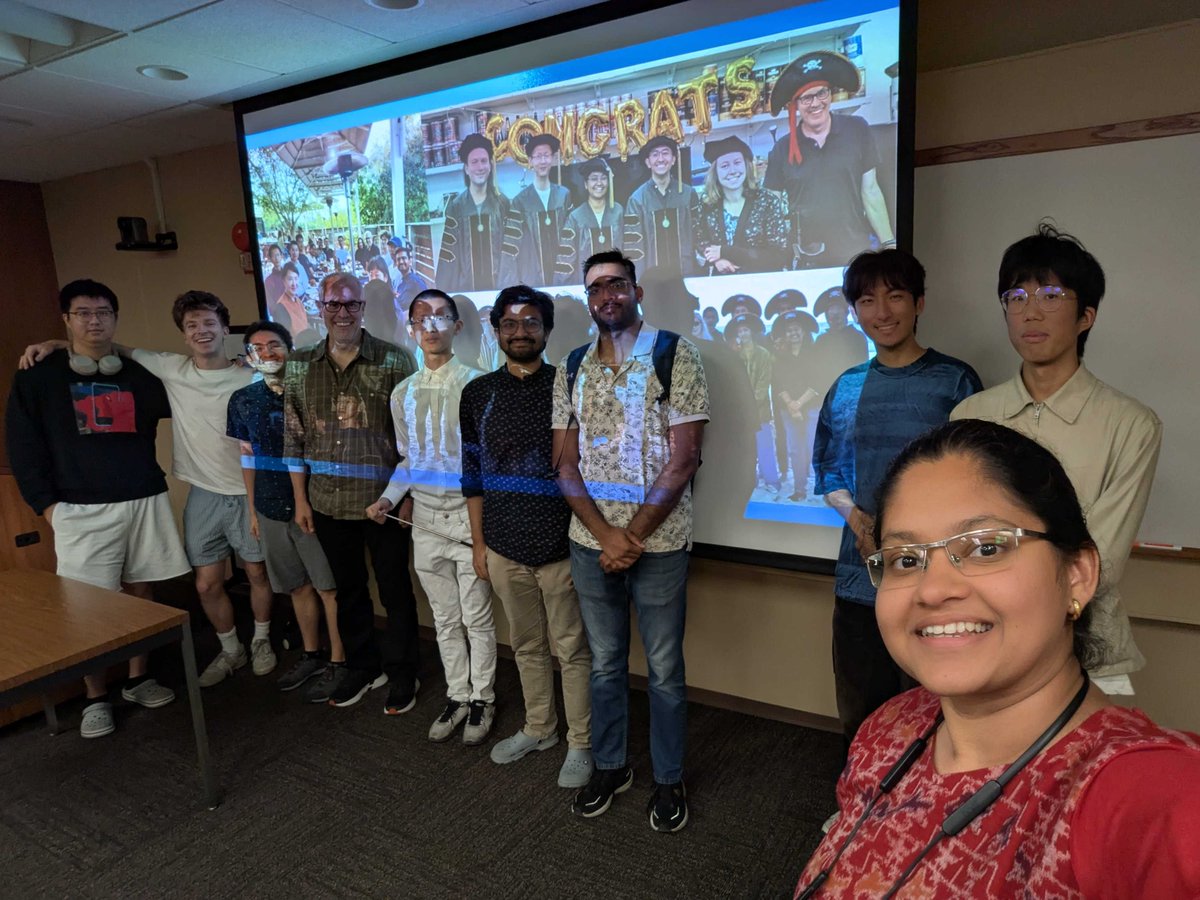
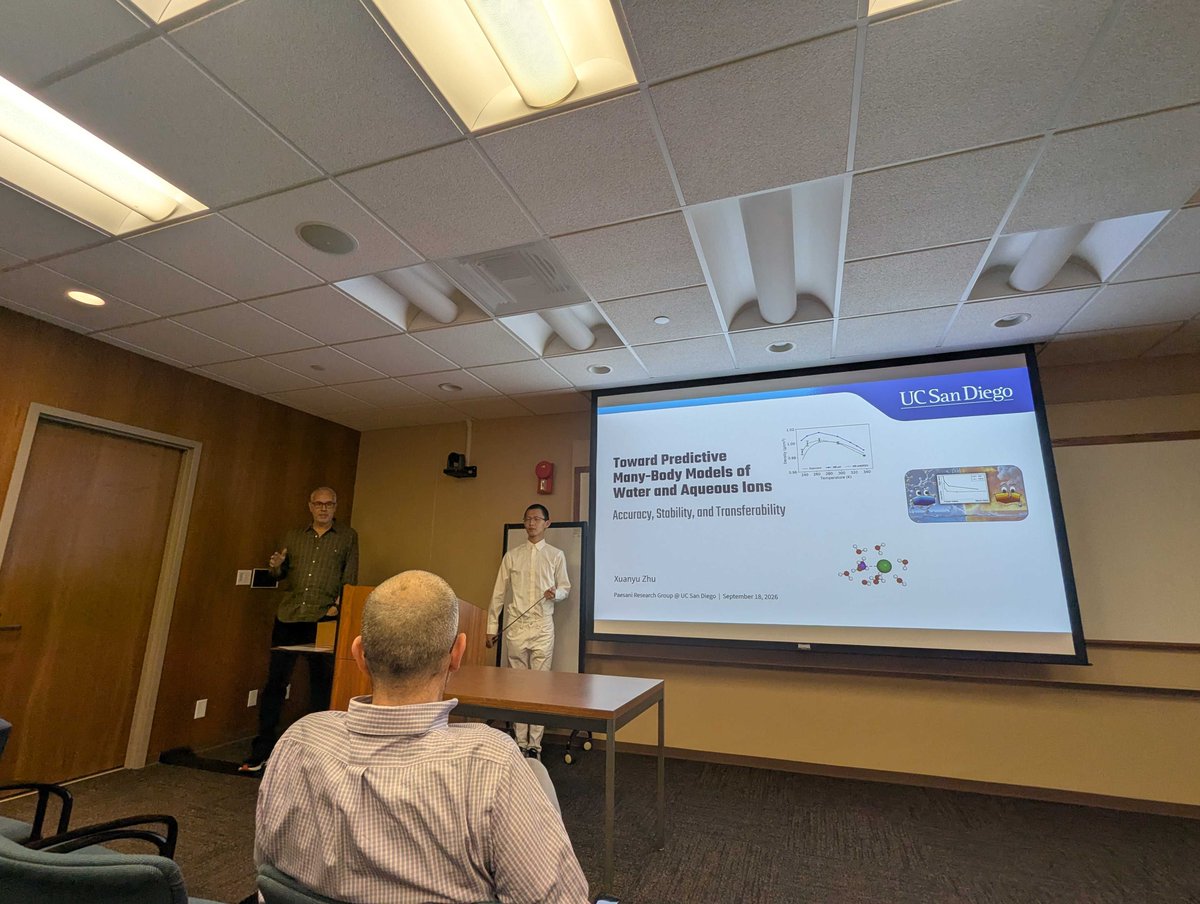
Today was Richa’s last day in the group. We knew it was coming, but saying goodbye still isn’t easy! 🥹
Richa, thank you for all the wonderful science, for mentoring our undergrads, and for being so generous with your time and ideas. So much to celebrate and so many good memories over these past five years! 🫶
We’re going to miss you! Good luck with your postdoc at @Columbia! We’re excited to see what you do next! Stay in touch and come back to visit! ❤️
#OnceAPirateAlwaysAPirate 🏴☠️
@UCSanDiego@UCSDPhySci@UCSDChem@HDSIUCSD@SDSC_UCSD@RichaRashm
1/2
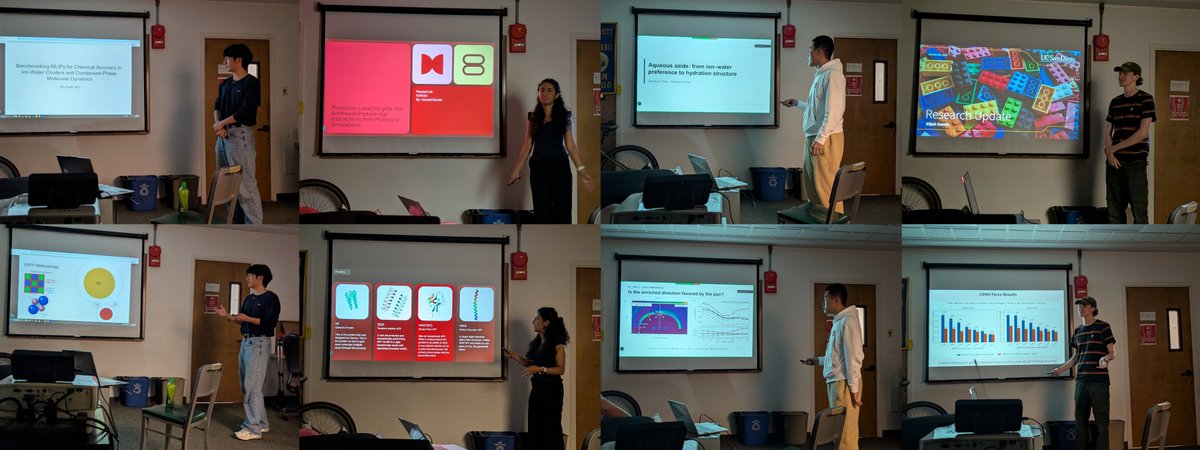
Our undergrads did it again! 🤯
Today, four more of our fantastic students shared their summer research on testing and improving machine-learned molecular models 💻, ion hydration 🌊, and how antifreeze proteins interact with ice. 🧊
Seven presentations over two Fridays and so much to be proud of! 🙌
A huge thank you to @NSF for supporting our undergraduate summer research program! 🙏
@UCSanDiego@UCSDPhySci@UCSDChem@HDSIUCSD@SDSC_UCSD
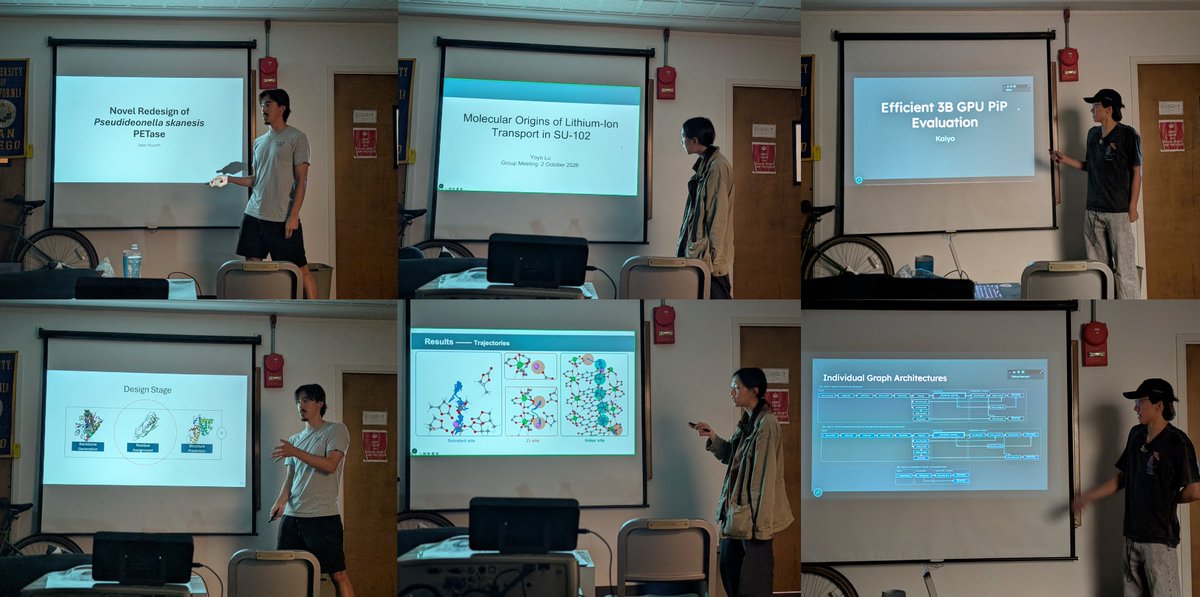
Our undergrads blew us away today! 🤯
Thanks to @NSF funding, we were able to support our fantastic undergrads in doing research this summer. Today, Jake, Yoyo, and Kaiyo kicked off our summer research presentations with work on #enzyme design 🧬, #MOFs as quasi-solid electrolytes 🔋, and #GPU implementation of our #datadriven #manybody potentials 🖥️.
More presentations next Friday... Stay tuned! 👀
@UCSanDiego@UCSDPhySci@UCSDChem@HDSIUCSD@SDSC_UCSD
Huge congratulations to the newly minted Dr. Zhu, who successfully defended his #PhD thesis today! 🎓
Xuanyu first joined our lab as a physics undergraduate and stayed for his #PhD, working on several theoretical aspects of our #datadriven#manybody potentials. In particular, he has focused on understanding how to make #machinelearning models accurate, robust, and transferable, all at once. 😎
A few highlights from his work:
🔹 MB-pol(2023): improving accuracy from water clusters to liquid water
https://t.co/jMx8Fbkzwg
🔹 Fourier series for accurate and robust many-body potentials
https://t.co/CS4dnXNg6I
🔹 Exploring plastic ice VII under high pressure
https://t.co/kdewfUGoIE
We are so proud of him and look forward to seeing where his creativity and intuition will take him! 🚀
#OnceAPirateAlwaysAPirate 🏴☠️
@UCSanDiego@UCSDPhySci@UCSDChem@HDSIUCSD@SDSC_UCSD
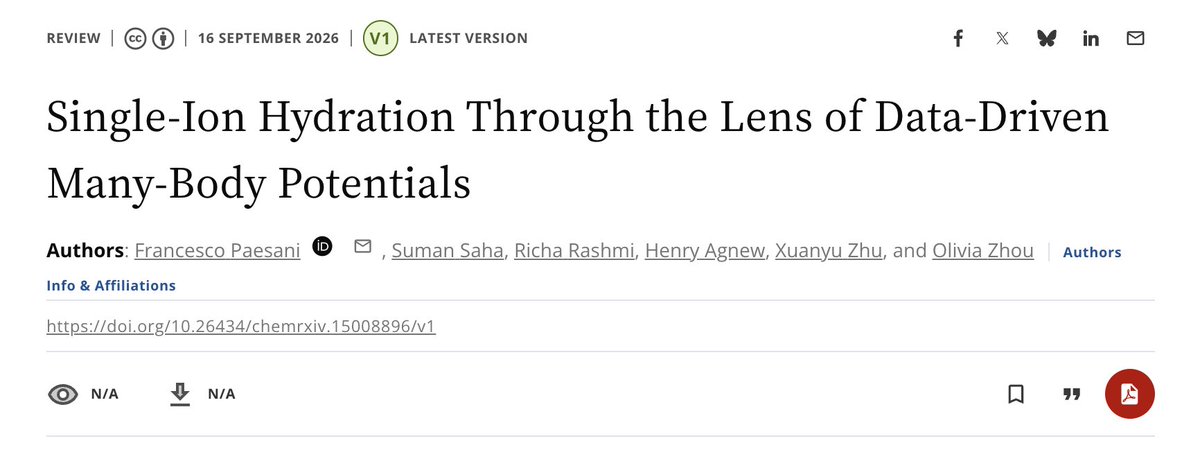
🚨 Our mini review on single-ion hydration is now on @ChemRxiv!
👉 https://t.co/cNQZoZN00C
We summarize what we have learned with our #datadriven#manybody potentials, following ions from small water clusters to bulk solutions and interfaces. 🌊
A central theme is how these predictions emerge from the interplay between short-range #machinelearned n-body terms trained on CCSD(T) data and #physics-based representations of electrostatics, polarization, and dispersion. 🏄♀️
Interested in performing #datadriven #manybody simulations? Check out #MBX:
✅ https://t.co/bVIx3HIxcB
✅ https://t.co/eY2zrSwbKd
✅ https://t.co/EFiOa7rtCh
Big thanks to @NSF for supporting the development of #datadriven #manybody potentials and #MBX and to
@ACCESSforCI for providing computational resources! 🙏
@UCSanDiego@UCSDPhySci@UCSDChem@HDSIUCSD@SDSC_UCSD
Greetings from the 2026 @NSF CSSI/CyberTraining/SCIPE PI Meeting in Rockville, Maryland! 👋
Francesco presented our latest work on #MBX, the open-source software behind our #datadriven#manybody simulations.
By combining #machinelearned low-order n-body terms trained on CCSD(T) data with #physics-based representations of many-body effects, our #datadriven #manybody potentials transfer chemical accuracy across phases. 🏄♀️
Interested in running your own #datadriven #manybody simulations? Check out #MBX:
✅ https://t.co/bVIx3HIxcB
✅ https://t.co/eY2zrSwbKd
✅ https://t.co/EFiOa7rtCh
Big thanks to @NSF for supporting our research on #MBX and #datadriven #manybody simulations, and to the organizers, program officers, and all the presenters for a great meeting! 🙌
@UCSanDiego@UCSDPhySci@UCSDChem@HDSIUCSD@SDSC_UCSD
Reproducing experimental measurements is rewarding. Seeing experiments confirm something we predicted a year earlier is even more exciting! 🎯
A recent hyper-Raman study in @JPhysChem Letters found that fluoride shifts #water’s librational band to higher frequencies, reflecting more strongly hindered rotations of nearby #water molecules. Chloride and bromide shift it in the opposite direction. ⚡️
👉 https://t.co/RlKxdbd7HW
The study confirms our 2025 predictions! 😎
👉 https://t.co/AmLQqRG01g
These predictions emerged from our #datadriven #manybody description of molecular interactions, without fitting to these experimental spectra. 🖥️
By combining #machinelearned n-body terms trained on high-level quantum chemistry data with #physics-based representations of many-body effects, our #datadriven #manybody potentials transfer chemical accuracy from molecular clusters to condensed phases, enabling robust predictions that experiments can test. 🔬
Interested in performing #datadriven #manybody simulations? Check out #MBX:
✅ https://t.co/bVIx3HIxcB
✅ https://t.co/eY2zrSwbKd
✅ https://t.co/EFiOa7rtCh
Big thanks also to @NSF for supporting our research on #datadriven #manybody potentials and to @ACCESSforCI for providing computational resources! 🙏
Stay tuned for more predictions! 🏄♀️
@UCSanDiego@UCSDPhySci@UCSDChem@HDSIUCSD@SDSC_UCSD
It’s our distinct pleasure to introduce Dr. Richa Rashmi, #PhD #17 from our lab! 🎓
Through #datadriven#manybody quantum simulations, Richa has helped explain what vibrational spectra tell us about water 🌊, ice 🧊, and aqueous interfaces. 🏄♀️
Along the way, she has been a wonderful mentor and collaborator, sharing her time and ideas and helping all of us grow as scientists and as people. 🫶 We are so grateful for everything she has contributed to our group! 🙌
We could not be prouder and look forward to seeing what she does next as she heads to @Columbia for her postdoc! 🚀
Congratulations, Richa! 🎉
#OnceAPirateAlwaysAPirate 🏴☠️
@UCSanDiego@UCSDPhySci@UCSDChem@HDSIUCSD@SDSC_UCSD
A great way to wrap up the summer! ☀️
Elijah, one of our fantastic undergraduate researchers, presented his work at the @UCSDPhySci SPURS poster session. 🎤
Elijah explored how machine learning interatomic potentials (#MLIPs) can be used to calculate the #IR spectrum of penta-alanine, a short peptide. ⚡️
Huge congratulations, Elijah, on a very productive summer! 🏄♂️
@UCSDChem@UCSanDiego
#UndergraduateResearch #MachineLearning #MolecularSimulation
Celebrating @PaesaniLab#PhD #16! 🎓
Huge congratulations to Dr. Henry Agnew, who successfully defended his thesis today on #datadriven#manybody simulations of ions in bulk water and at interfaces! 🎉
Henry also played a key role in making our #MBX software faster 🚀 and more accessible to everyone. 🤝 But even more importantly, over the past five years, he has always been there to help everyone around him.
He has made our science and our group better. We could not be prouder! 🙌
@UCSanDiego@UCSDPhySci@UCSDChem@HDSIUCSD@SDSC_UCSD
🚨 New preprint alert! 🚨
Our latest work with @DincaGroup at @PrincetonChem is now online at @ChemRxiv:
👉 https://t.co/RIm0SEBzgH
In this study, we combined variable-temperature solid-state ⁷Li NMR ⚡️ with molecular dynamics simulations 🖥️ to determine the transport mechanism in SU-102 filled with propylene carbonate (PC). 🔦
Main takeaways:
✅ ⁷Li NMR reveals two dynamically distinct Li⁺ populations, while the simulations resolve three recurring coordination environments: Zr-associated, linker-associated, and fully PC-solvated.
✅ Zr-associated sites stabilize Li⁺ most strongly, but linker-associated Li⁺ exchanges more readily and shows the largest trial-weighted displacement.
✅ Linker-to-linker hopping is the most frequent classified event in the simulations.
✅ Nonequilibrium MD gives an ionic conductivity of 1.34 ± 0.48 mS cm⁻¹, in reasonable agreement with the experimental value of 0.52 mS cm⁻¹.
The central result is that, under the simulated conditions, Li⁺ moves mainly through PC-assisted hopping between framework-associated sites, rather than through the pores as fully solvated ions. The key design principle is therefore to balance ion–framework stabilization with facile exchange along connected transport pathways. 🚀
Huge congratulations to the entire team! 🙌
Big thanks also to @NSF for supporting this research and to @ACCESSforCI for providing computational resources! 🙏
@UCSanDiego@UCSDPhySci@UCSDChem@HDSIUCSD@SDSC_UCSD
🚨 New paper in @NatureComms! 🚨
Do halide ions adsorb at the air/water interface, or do they prefer to remain in bulk water? 🌊
This deceptively simple question has been debated for more than a century, with classical theories, continuum models, molecular simulations, and experiments often producing very different pictures. 🤔
Our new paper is now online:
👉 https://t.co/gcjT3Wp3gS
Vibrational sum-frequency generation (#vSFG) studies have added to the controversy, leading to opposing molecular interpretations, from extreme enrichment of the heavier halides at the surface to a stratified interface with an ion-depleted topmost layer [J. Phys. Chem. B 108, 2252 (2004); J. Phys. Chem. B 108, 5051 (2004); Nat. Commun. 5, 4083 (2014); Nat. Chem. 16, 644 (2024)]. ⚡️
Because vSFG probes atomic ions only indirectly through the response of interfacial water, translating the spectra into molecular structure depends critically on computational models whose accuracy and predictive power across different environments and properties are not always independently established.
We address this problem using MB-pol for water and a controlled hierarchy of ion–water models built on increasingly complete and physically correct approximations to the many-body expansion. 🖥️
By keeping the description of water unchanged and systematically improving only the ion–water interactions, we reconstruct the major pictures proposed over the past century and identify the physical approximations behind each one:
1️⃣ Purely pairwise-additive (2B)-MB-nrg potentials recover the generic ion exclusion predicted by the image-charge theories of Wagner [Phys. Z. 25, 474 (1924)] and Onsager–Samaras [J. Chem. Phys. 2, 528 (1934)].
2️⃣ The classical polarizable TTM-nrg potentials recover the strong adsorption of the heavier halides predicted by earlier polarizable models, including those of Jungwirth and Tobias [J. Phys. Chem. B 106, 6361 (2002)].
3️⃣ Adding an accurate short-range 2-body ion–water interaction to classical many-body polarization, as in (2B+NB)-MB-nrg, recovers the more moderate qualitative picture of Yan Levin’s extended continuum theory, which combines ionic polarizability with cavitation and interfacial solvation [Phys. Rev. Lett. 102,147803 (2009); Phys. Rev. Lett. 103, 257802 (2009)].
4️⃣ With the full (2B+3B+NB)-MB-nrg #datadriven #manybody potentials, strong adsorption disappears: F⁻, Cl⁻, and Br⁻ remain bulk-favored, while I⁻ retains only a shallow interfacial minimum of order kT.
The resulting picture supports neither extreme surface enrichment nor a completely ion-depleted topmost layer. Instead, only iodide displays a weak intrinsic surface preference in the dilute single-ion limit.
What we found is that short-range quantum-mechanical many-body effects beyond classical polarization are decisive.
Why is iodide different? Not because its direct interaction with water becomes more favorable at the surface. Instead, a localized reorganization of interfacial water offsets part of the ion–water desolvation penalty. Entropy opposes this energetic stabilization, leaving only a weak surface preference.
At a time when “physics-aware” molecular models are receiving so much attention, this paper also highlights a philosophy that has guided our work for more than a decade. Our MB-pol and MB-nrg #datadriven #manybody potentials combine physically correct long-range interactions with data-driven representations of short-range quantum mechanics trained on CCSD(T) data.
This paper also completes a major chapter in our work on single-ion hydration. After MB-pol provided a realistic and quantitative description of water from gas-phase clusters to liquid water and ice, MB-nrg extended the same framework to hydrated single ions, connecting ion–water dimers and clusters with structural, thermodynamic, dynamical, and spectroscopic properties in bulk solutions and now at aqueous interfaces. 😎
Huge congratulations to Henry, who led this project, and to Richa (@RichaRashm), Xuanyu (@philipzxy), and Saswata (@quantum_winger) for their contributions! 🎉
The next challenge is to develop a quantitative description of finite-concentration electrolyte solutions, where counterions, ion–ion correlations, ion pairing, and concentration-dependent restructuring take us beyond the Debye–Hückel theory.
We believe our #datadriven #manybody potentials can get us there. Stay tuned! 🏄♀️
Interested in performing #datadriven #manybody simulations? Check out #MBX:
✅ https://t.co/bVIx3HIxcB
✅ https://t.co/eY2zrSwbKd
✅https://t.co/EFiOa7rtCh
Big thanks also to @NSF for supporting this research and to @ACCESSforCI for providing computational resources! 🙏
@UCSanDiego@UCSDPhySci@UCSDChem@HDSIUCSD@SDSC_UCSD
🖥️ Hackathon mode ON! 🖥️
👉 https://t.co/I3mU0cwsCQ
Ethan, Xuanyu, Xinmao, and Zitong are spending the week coding side by side with the @MikPavanello and @OAndreussi groups and the broader Quantum Multiscale community as part of our joint @NSF project.
Our group is currently working on #GPU acceleration of #MBX electrostatics and the integration of #MBX with the #ELECTRODE package in #LAMMPS. These developments will further expand the scope of #datadriven #manybody simulations, enabling realistic modeling of increasingly complex molecular systems and electrochemical interfaces. Stay tuned! 🏄♀️
#MBX resources:
✅ https://t.co/bVIx3HIxcB
✅ https://t.co/eY2zrSwbKd
✅ https://t.co/EFiOa7rtCh
@UCSanDiego@UCSDPhySci@UCSDChem@HDSIUCSD@SDSC_UCSD@Rutgers_Newark@BoiseState
🚨 New paper alert! 🚨
How does #water reshape the simplest amino acid, one molecule at a time? 💧
Our latest work is now out in @JPhysChem:
👉 https://t.co/wAPi2xfP2T
We developed a new #datadriven#manybody MB-nrg potential for protonated glycine–water interactions and combined it with MB-pol, replica-exchange molecular dynamics, and path-integral quantum simulations to connect microscopic hydration structures directly to experimental infrared spectra. ⚡️
Below is a short summary of the main takeaways:
✅ The simulations capture the evolution of the spectra from bare GlyH⁺ to GlyH⁺(H₂O)₆ without empirical frequency scaling.
✅ Inverse spectral reconstruction disentangles the contributions of competing hydration motifs and infers their relative populations.
✅ Four water molecules complete the first solvation shell: three hydrate the NH₃⁺ group, while one binds to the carboxyl –OH group.
✅ Additional water molecules predominantly form the second solvation shell.
✅ The relative populations of the hydration motifs are strongly temperature dependent, while nuclear quantum effects modify both peak positions and intensities.
More broadly, this work lays the groundwork for following how #water reorganizes around #biomolecules, from gas-phase clusters toward increasingly complex aqueous environments. 🌊
Huge congratulations to Zoe, who led this project while she was an undergraduate in our group and has just begun her #PhD at @MichiganChem, as well as to and Ruihan for all their contributions and guidance! 🙌
Big thanks also to @NSF for supporting this research and to @ACCESSforCI for providing computational resources! 🙏
@UCSanDiego@UCSDPhySci@UCSDChem@HDSIUCSD@SDSC_UCSD
🚨 New paper out today in APLComputational Physics!
👉 https://t.co/uF2Ykg9cFt
Our latest work on #MBX shows how memory-aware SIMD vectorization can significantly accelerate #datadriven#manybody simulations. ⚡
By optimizing the n-body kernels for modern CPUs, we achieve nearly 4× speedups with AVX2 and 8× with AVX-512, translating into up to 3.2× faster MB-pol #water simulations. 🚀
The improvements are already available in #MBX v1.4 💻:
https://t.co/Y98JJqdU1O
Besides making CCSD(T)-lelvel #datadriven #manybody simulations faster and more accessible, these developments provide a strong foundation for the GPU implementation of MBX that is now underway. Stay tuned! 🏄♀️
Huge shoutout to Shishir and Ethan for leading this work, and big thanks to Chris for the collaboration! 🙌
Big thanks also to @NSF for supporting this research and to @ACCESSforCI for providing computational resources! 🙏
@UCSanDiego@UCSDPhySci@UCSDChemBiochem@HDSIUCSD@SDSC_UCSD
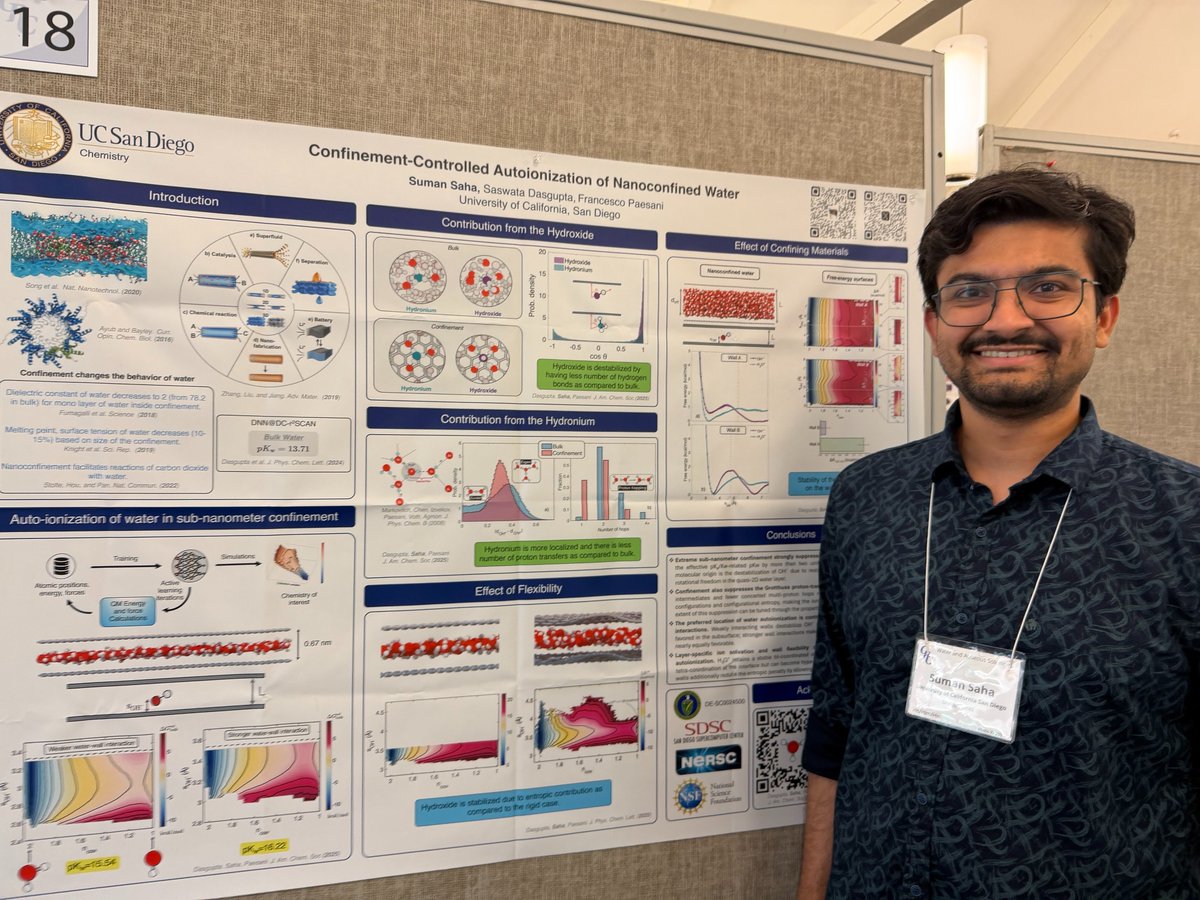
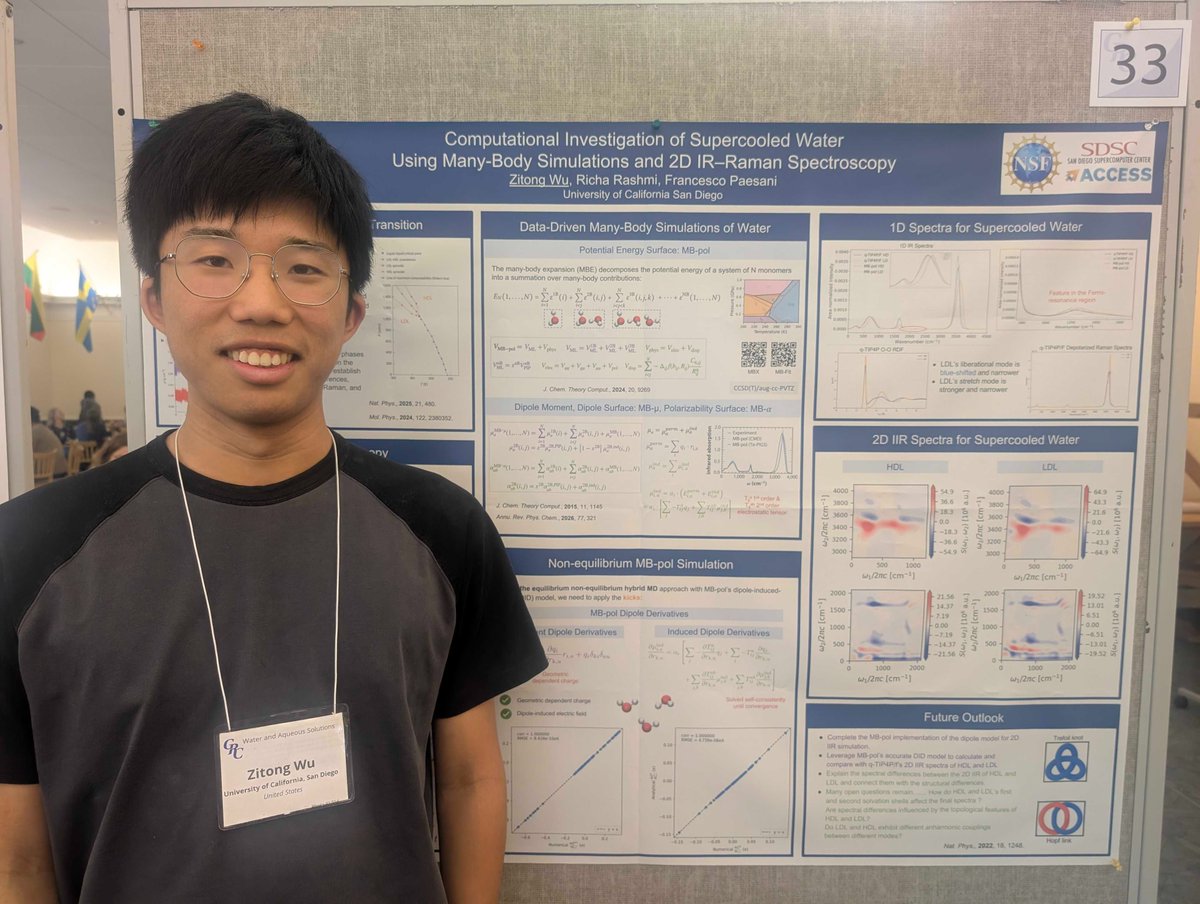
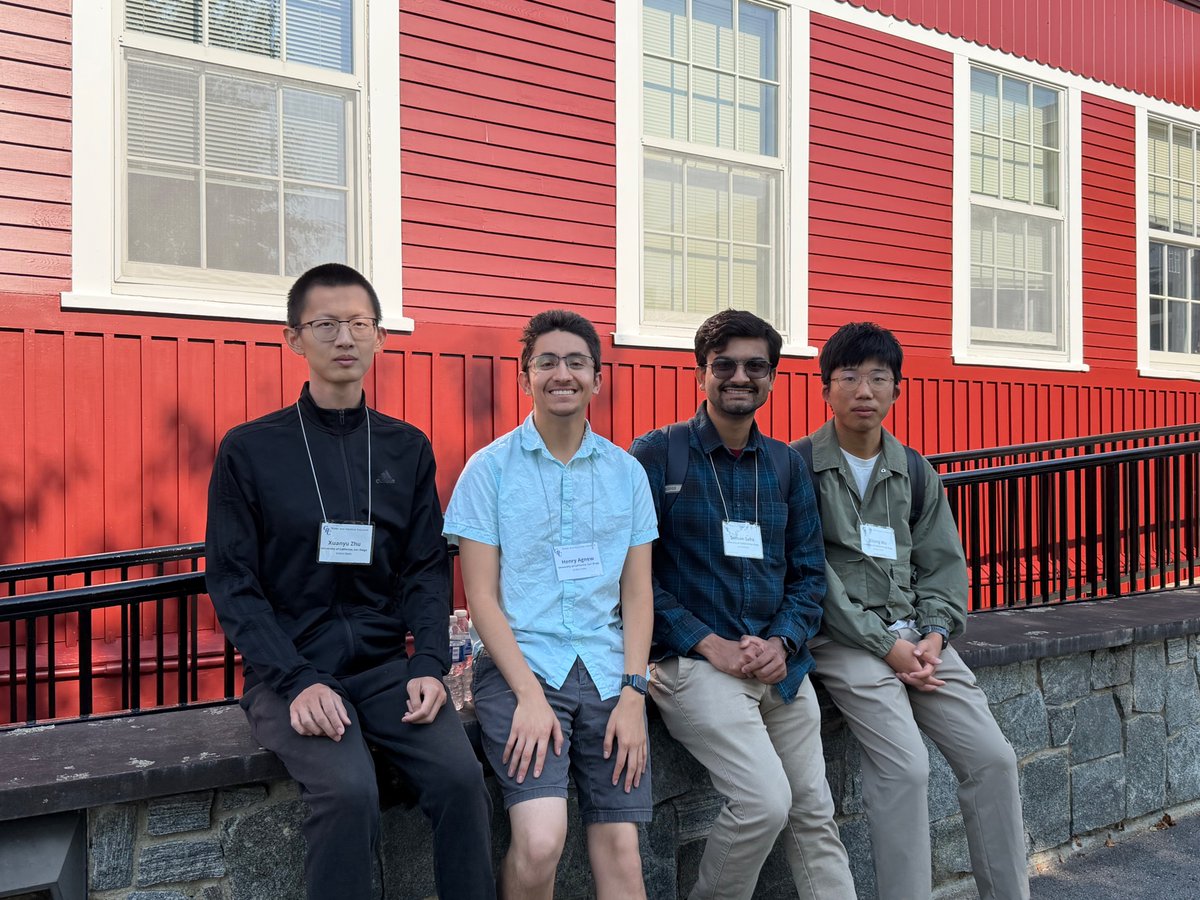
🚨The pirates presented at the 2026 @GordonConf on Water & Aqueous Solutions in Holderness, NH!💧
A fantastic week of exciting science, great discussions, and reconnecting with friends old and new. #WaterGRC #CompChem
Four of our PhD students presented their research🎉:
Henry — Many-Body Effects Determine the Propensity of Halides for the Air–Water Interface
Xuanyu — Many-Body Effects for Solvated Ion Pairs
Suman — Confinement-Controlled Autoionization of Nanoconfined Water
Zitong — Computational Investigation of Supercooled Water Using Many-Body Simulations and 2D IR–Raman Spectroscopy
We’re incredibly proud of them for representing the group and sharing their work with the water community.
Well done, pirates! 🏴☠️👏
#PhDLife #ManyBody #WaterScience
@UCSanDiego@UCSDPhySci@UCSDChemBiochem@HDSIUCSD@SDSC_UCSD
🚨 Greetings from the 2026 Gordon Research Conference on Water and Aqueous Solutions in New Hampshire!
It’s great to reconnect with old friends, meet new people, and of course spend the week talking about #water. 🌊
Our group will be presenting posters on #datadriven#manybody simulations of ionic aqueous interfaces and ion pairs, nanoconfined water reactivity, and simulations of the 2D IR spectra of liquid water. 😎
Looking forward to a fun week of science and good conversations! 🏄♀️
@UCSanDiego@UCSDPhySci@UCSDChemBiochem@HDSIUCSD@SDSC_UCSD@GordonConf