🎙️ Podcast Highlights Summarized by Kevin Coutinho, Founder of Layer One X 🔥
From hours of deep-dive discussions to a powerful 5-minute reel — get the essence of L1X:
⚡ Quantum security
🌉 Bridgeless swaps
🌐 The future of cross-chain tech
Watch the full highlight 👇
L1X Community Live Webinar
Join us on April 10 at 1PM UTC as we recap the past couple of weeks.
🔹 Official Partnership with UWA
🔹 Exciting development updates
🔹 Hackathon insights
📅 Join here: https://t.co/0DhkssG1WD
Don’t miss out 🔥
🧬 Quantum-Resistant Cross-Chain Execution Flow Explainer. Explained simply, even if you don’t speak blockchain - or quantum.
A 6-part breakdown of how L1X secures blockchain interoperability in a post-quantum world. One Post - One Step.
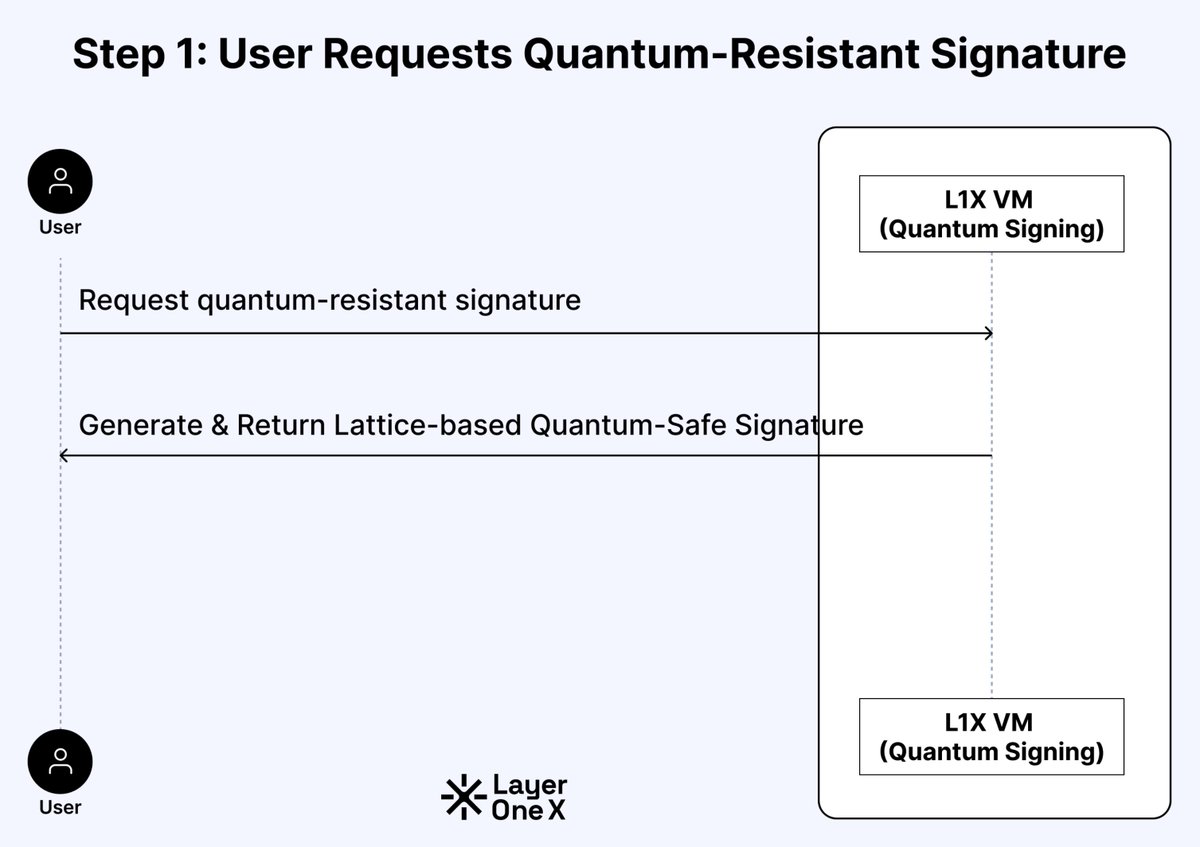
🔐 Step 1 of 6: Getting a Post-Quantum Signature Before Sending to Ethereum as an Example
What It Does:
Before your transaction is even sent to Ethereum, it’s signed by L1X using quantum-resistant cryptography. This creates a secure, tamper-evident message—ready to be verified, even if Ethereum isn’t quantum safe.
✅ 1. Why Sign First? Middleware State Verification
Think of L1X like a secure notary that stamps your transaction before it leaves for another blockchain. This stamp means that, even if Ethereum (or any chain you’re sending to) gets compromised in the future, there’s still an unbreakable record on L1X proving what the original state and intent were. You’re essentially locking your message with a post-quantum “black box” that no hacker—classical or quantum—can open or forge.
🛡 2. L1X as a Firewall Between Chains
Let’s say you’re sending funds or a smart contract call from Chain A to Chain B. If Chain A is vulnerable to quantum attacks and gets exploited, it could try to send bad data downstream. But with L1X in the middle, that data is stopped unless it passes L1X’s quantum-grade checks. In other words, L1X filters the noise and only lets the “real, verified” message through—acting like a firewall between blockchains of different security levels.
🌐 3. Why L1X, Not Just Any Quantum-Signing Service?
Multiple blockchains will eventually adopt quantum safety—but not at the same pace, or using the same tools. That chaos creates gaps. L1X solves that by becoming the one common layer every chain and dApp can rely on to handle quantum-safe messaging, verification, and record-keeping. It’s like having a universal translator that also notarizes your messages, no matter what network you’re on.
@LayerOneX@uwanews@UWAresearch How will the blockchain + Quantum resistance Lab contribute to L1X solutions to cross chain interoperability and security ?
🔬 The future of blockchain needs more than just code — it needs research, collaboration, and quantum foresight.
That’s why Layer One X has teamed up with The University of Western Australia @uwanews & @UWAresearch for a 3-year partnership to build the Blockchain + Quantum Resistancy Lab.
Here’s what we’re doing together 🎥👇
🌍 One of the biggest challenges in DeFi today?
Multi-chain liquidity fragmentation.
Projects launch across networks, but their liquidity ends up siloed, split, and inefficient.
At L1X, we are working on solving this — not with bridges, but with X-Talk and X-MNAIS —
🧱 X-Multi Network Asset Issuance and Liquidity Management Standard.
🔥 Liquidity will be Unified. Not Simulated.
🔁 The Flow (In Development):
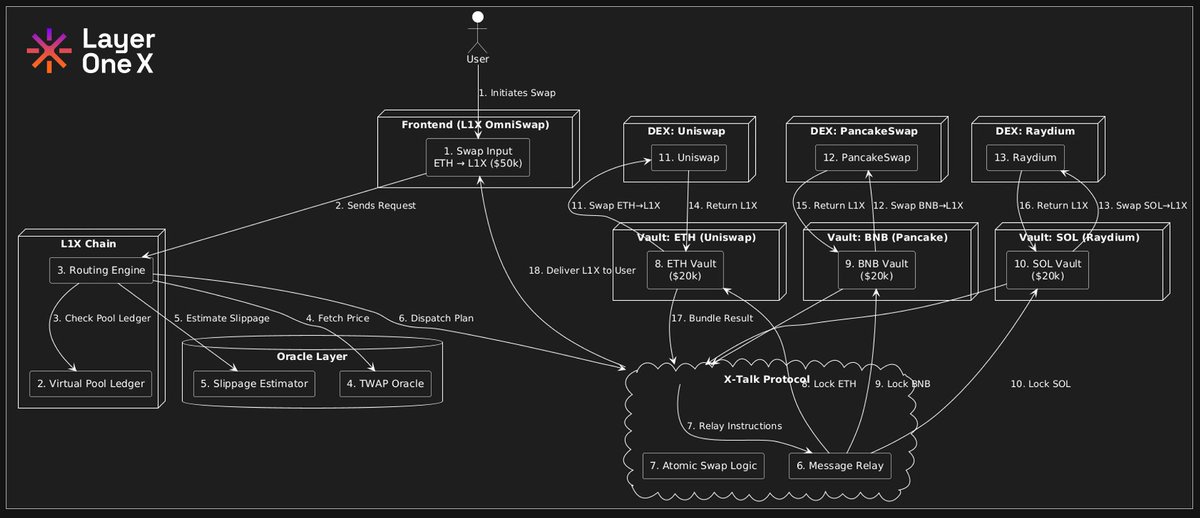
1️⃣ A project issues its token natively on multiple chains via X-MNAIS
2️⃣ Liquidity is added to L1X vaults across supported DEXs on ETH, BNB, Solana, etc.
3️⃣ A Virtual Liquidity Pool is formed across these chains
4️⃣ Users interact via L1X-Swap, powered by X-Talk
5️⃣ X-Talk coordinates swaps: routes through vaults + executes native DEX trades
6️⃣ Liquidity remains local 🏦 execution is global 🌐
7️⃣ Users receive tokens in a single, seamless UX — no bridges, no switching ⚡
🚀 L1X-Swap will become the first natively cross-chain swap system to offer this:
✅ Embedded directly into every project building with X-MNAIS
✅ Eliminates the need for aggregators, simulators, or custom routers
💡 Liquidity fragmentation won’t be a limitation — it will be a solved layer in the L1X stack.
🛠️ This system is currently under active development.
📡 Stay tuned.