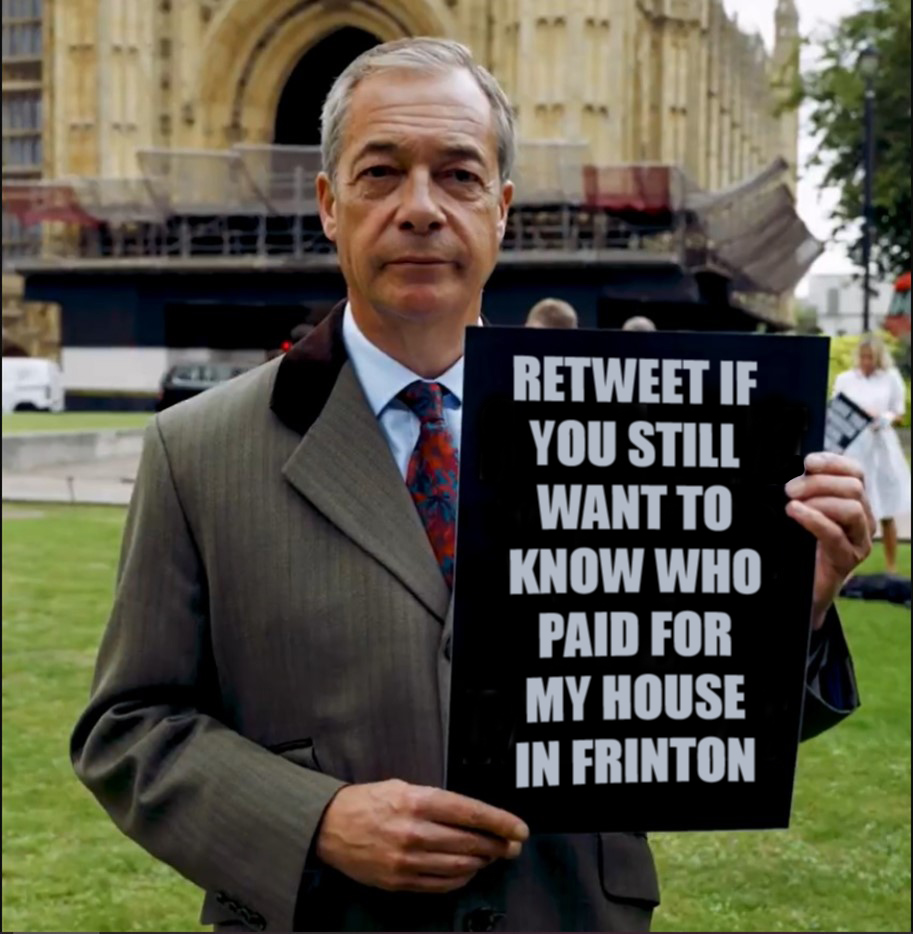
@Nigel_Farage You are the most longstanding “professional politician” of my lifetime.
You’ve been a politician forever - an MP, an MEP, party leader of UKIP, Party leader of Brexit Party, Party leader of Reform UK, political presenter… No-one is more of a professional politician than you.
A British scientist invented the single most valuable piece of technology in human history, then signed a document that legally guaranteed he would never make a cent from it, and he did it on purpose while every university around him was racing to patent everything they could.
His name is Tim Berners-Lee, and the invention was the World Wide Web (WWW).
Not the internet, which already existed as a way to connect computers, but the actual web of pages and links you are using to read this right now. HTML. HTTP. The URL. He built all three while working at CERN, a physics lab in Switzerland, between 1989 and 1991.
He wrote the first browser on a NeXT computer and stuck a label on it that said "DO NOT POWER IT DOWN" because if anyone unplugged it, the entire web would vanish.
Here is the part that should stop you cold.
CERN owned the invention. Under the rules of the time, the lab could have licensed it, charged a fee for every installation, and collected a royalty on every server that ever came online.
His colleague Robert Cailliau confirmed they actively discussed exactly this, because in the early 1990s patenting university inventions and squeezing money out of them was the standard move.
They could have charged for every search. Every upload. Every page load on Earth, forever.
Berners-Lee fought to give it away instead.
He pushed CERN to release the source code into the public domain with no patent and no fee of any kind. On April 30, 1993, two CERN directors signed a half-page document that relinquished all intellectual property rights to the World Wide Web. A few signatures on a single sheet of paper.
That was the moment nobody came to own the thing that now connects more than five billion people.
His reasoning was not sentimental. It was mechanical.
He understood something most inventors never grasp. The value of the web was not in the code. It was in the network. And a network only grows if everyone can join without asking permission.
The second you charge a toll, people route around you, and you end up with a hundred tiny incompatible webs instead of one universal one. He said it plainly years later.
If he had demanded fees, there would be no World Wide Web. There would be lots of small webs, and none of them would have mattered.
So the thing that made the web worth trillions is the exact same thing that guaranteed he would never personally capture any of it. Openness was not a sacrifice he made against the invention's success. Openness was the success. The free part was the product.
People who made far less consequential things became billionaires off the platform he built. He watched it happen and kept running a nonprofit standards body out of an office at MIT, setting the rules that keep the web working for everyone, paid like a normal professor.
When an interviewer once asked him why he never cashed in, he refused the premise of the question. He said that framing only makes sense if you measure a person's worth by their net worth. People are what they have done and what they stand for, not what sits in their bank account.
The man who could have owned a piece of every click ever made chose to own none of it, because he understood that the only way to give the world something this big was to make sure he could never take it back.
The most valuable thing ever built belongs to everyone, and that was the entire point.
Not my usual tweet but I want a little rant. I got gifted 2 tickets to the Chelsea Flower Show so went with a friend yesterday. We paid for an overnight stay in a hotel, train fares and food. I can honestly say it was AWFUL. It was unbelievably busy with huge numbers of people making it impossible to walk - we were just shoved along by the crowd. I couldn’t see any of the show gardens because the fight to see them was 5 people deep. Even if you did get to the front you were being pressured to move on. We gave up after 3 hours and went to the Chelsea Physic Garden along the road which was a much welcome oasis of calm. The organisers of the show should be ashamed of themselves. Visitor numbers need limiting and I feel so sorry for anyone for whom this was a first time long awaited visit #RHSChelsea #RHSChelseaFlowerShow
@GWandShows@GWandShows@The_RHS
Farmers have figured out that the cheapest pesticide is a strip of flowers.
When you plant wildflowers through a crop field, not just around the edge but in strips running through the middle, you get ladybugs, lacewings, hoverflies, and parasitic wasps living in the field instead of visiting it.
They eat the aphids, the caterpillars, and the mites for free, all summer long.
In controlled trials, fields with tailored flower strips had leaf-beetle numbers 40 to 50% lower and crop damage cut by around 60%, enough to drop below the threshold where spraying was even considered worth it.
The flowers attract a standing army to our fields.
We spent decades engineering chemicals to kill the insects eating the crop, when the insects that eat those insects would have worked for the price of seed.
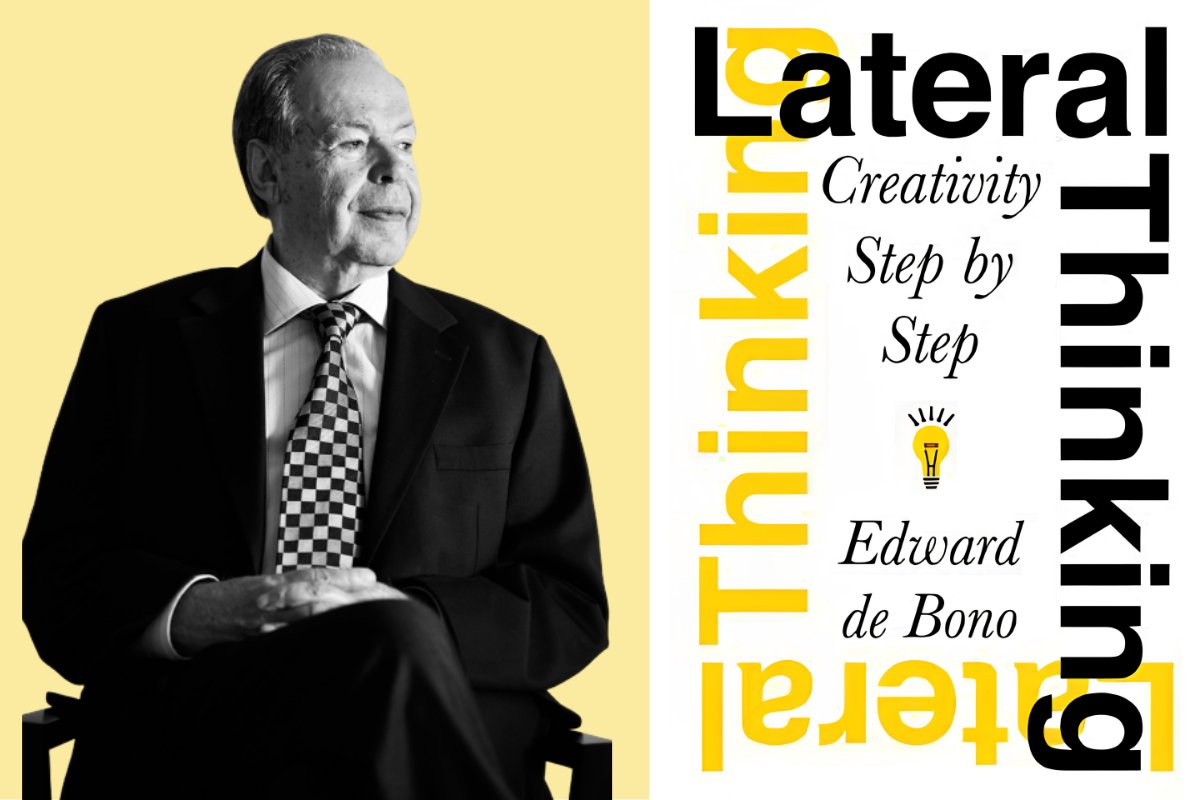
A doctor from Malta with degrees from Oxford, Cambridge, and Harvard coined a phrase in 1967 that ended up in the Oxford English Dictionary and became the most widely used thinking framework in corporate history.
His name was Edward de Bono. The phrase was "lateral thinking."
De Bono grew up in Malta and finished his undergraduate degree at 15. His nickname at school was Genius. He qualified as a doctor at 21, won a Rhodes Scholarship to Oxford, completed a PhD at Cambridge, and held faculty appointments at Oxford, Cambridge, London, and Harvard simultaneously.
His father told him he had a great career in medicine and should not throw it away by writing books.
He wrote 85 of them.
The idea that made everything started with a simple observation about how the brain actually works.
Your mind is a pattern-recognition machine.
Every time you encounter a problem, your brain scans its memory for the most familiar framework it has ever used on something similar and routes your thinking straight down that groove. This is efficient. It is also the reason most people keep solving new problems the wrong way.
The groove deepens every time you use it. The more experienced you become at anything, the more aggressively your brain routes you toward the same familiar paths. De Bono called this vertical thinking. You dig the same hole deeper. More logic, more analysis, more effort, all inside a frame you never question.
The harder you work, the deeper into the wrong hole you go.
The problem was not intelligence. No amount of better logic can correct an error that happened in perception before the logic even started. If the frame is wrong, the reasoning is wrong. Every time. A genius applying perfect logic to the wrong frame still gets the wrong answer.
Lateral thinking was his answer.
Not brainstorming. Not creativity in the vague sense people throw around at workshops. A specific set of deliberate techniques designed to force the brain off its established grooves and approach a problem from a direction it would never reach by digging straight down.
His most useful technique was provocation. He gave it the symbol Po.
A provocation is a deliberately absurd or impossible statement used not because it is true but because it breaks the pattern and forces the mind to construct new pathways around it.
The classic example: a factory is polluting a river. Vertical thinking produces filters, regulations, process changes. The lateral provocation is: the factory is downstream of itself. Physically impossible. But sitting with that impossibility produces a real insight. What if the factory had to use the water at the exact point where its own discharge ends up? The incentive structure changes completely. Zero-discharge solutions become visible that conventional thinking would never reach because they lie outside the groove.
The DuPont result is the number that ends every argument.
One employee applied a single lateral thinking technique to their Kevlar manufacturing process. Eliminated nine steps. Saved the company $30 million a year. One person. One different way of looking at the same problem.
IBM used it. McKinsey used it. Shell used it. NASA used it. Prudential used it to restructure the entire concept of life insurance, creating policies that let people access their benefits while still alive. The president of Prudential said publicly that de Bono's framework made the innovation possible.
Channel 4 television in England trained its staff for two days and said they generated more new ideas in those two days than in the previous six months combined.
De Bono spent the second half of his life furious about one thing.
Schools were still not teaching thinking.
They taught content. They taught facts. They taught students what to think rather than how to think. His frustration with this never softened. He said repeatedly that we spend enormous resources teaching children information and almost nothing teaching them what to do with it. The entire educational system was training vertical thinkers at industrial scale and then wondering why genuine innovation was so rare.
He tried to fix it. His CoRT program brought thinking skills into classrooms across 20 countries. His Six Thinking Hats method was used to train juries in several US states to examine evidence more objectively. In Australia, marine biologists credited it with transforming meetings that had been paralyzed by ego and argument for years.
In 2005 he was shortlisted for the Nobel Prize in Economics.
He died in 2021 at 88.
His most famous line contains the whole thing in one sentence.
"You cannot dig a hole in a different place by digging the same hole deeper."
Every person who has ever worked harder on the wrong approach without changing the approach has lived inside that sentence. Every company that poured resources into optimizing something that should have been abandoned. Every person who applied more logic to a frame that was wrong from the start.
De Bono was not arguing against logic. He was arguing that logic only works once you are standing in the right place.
Most people never question where they started digging.
That was the only problem his entire career was trying to solve.
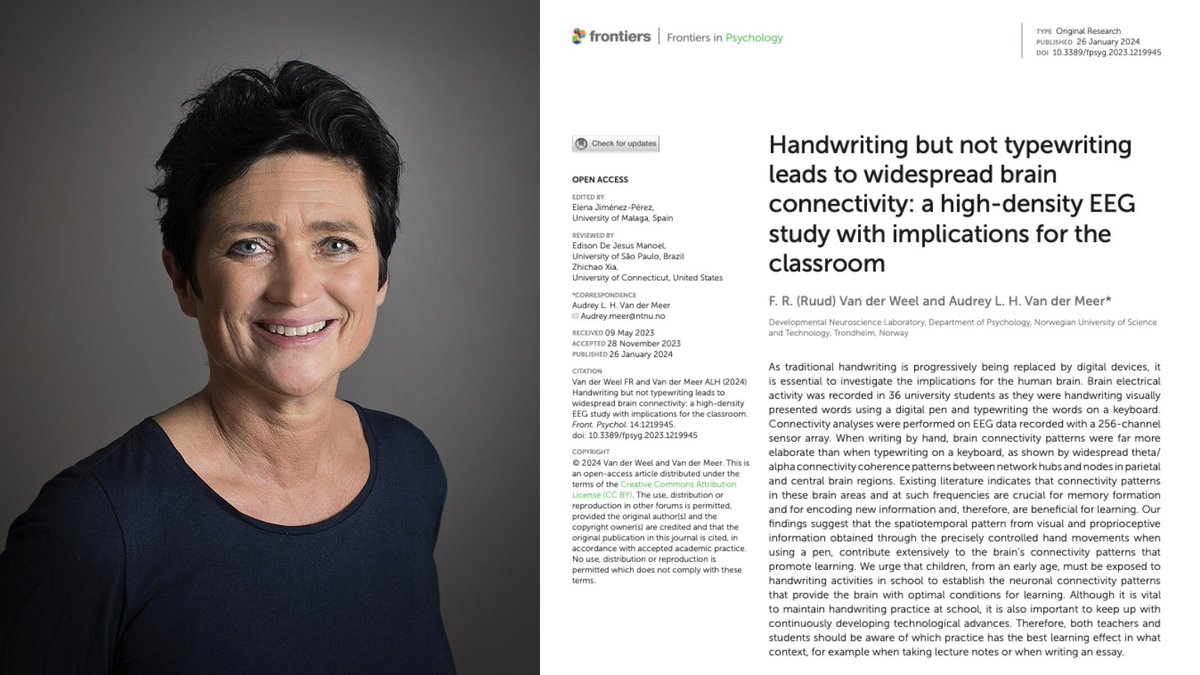
A Norwegian neuroscientist spent 20 years proving that the act of writing by hand changes the human brain in ways typing physically cannot, and almost nobody outside her field has read the paper.
Her name is Audrey van der Meer.
She runs a brain research lab in Trondheim, and the paper that closed the argument was published in 2024 in a journal called Frontiers in Psychology. The finding is brutal enough that it should have changed every classroom on Earth.
The experiment was simple. She recruited 36 university students and put each one in a cap with 256 sensors pressed against their scalp to record brain activity. Words flashed on a screen one at a time.
Sometimes the students wrote the word by hand on a touchscreen using a digital pen, and sometimes they typed the same word on a keyboard. Every neural response was recorded for the full five seconds the word stayed on screen.
Then her team looked at the part of the data most researchers had ignored for years, which is how different parts of the brain were communicating with each other during the task.
When the students wrote by hand, the brain lit up everywhere at once.
The regions responsible for memory, sensory integration, and the encoding of new information were all firing together in a coordinated pattern that spread across the entire cortex. The whole network was awake and connected.
When the same students typed the same word, that pattern collapsed almost completely.
Most of the brain went quiet, and the connections between regions that had been alive seconds earlier were nowhere to be found on the EEG.
Same word, same brain, same person, and two completely different neurological events.
The reason turned out to be something nobody had really paid attention to before her work. Writing by hand is not one motion but a sequence of thousands of tiny micro-movements coordinated with your eyes in real time, where each letter is a different shape that requires the brain to solve a slightly different spatial problem.
Your fingers, wrist, vision, and the parts of your brain that track position in space are all working together to produce one letter, then the next, then the next.
Typing throws all of that away. Every key on a keyboard requires the exact same finger motion regardless of which letter you are pressing, which means the brain has almost nothing to integrate and almost no problem to solve.
Van der Meer said it plainly in her interviews.
Pressing the same key with the same finger over and over does not stimulate the brain in any meaningful way, and she pointed out something that should scare every parent who handed their kid an iPad.
Children who learn to read and write on tablets often cannot tell letters like b and d apart, because they have never physically felt with their bodies what it takes to actually produce those letters on a page.
A decade before her, two researchers at Princeton ran the same fight using a completely different method and ended up at the same answer. Pam Mueller and Daniel Oppenheimer tested 327 students across three experiments, where half took notes on laptops with the internet disabled and half took notes by hand, before testing everyone on what they actually understood from the lectures they had watched.
The handwriting group won by a wide margin on every question that required real understanding rather than surface recall.
The reason was hiding in the transcripts of what the two groups had actually written down.
The laptop students typed almost word for word, capturing more total content but processing almost none of it as they went, while the handwriting students physically could not write fast enough to transcribe a lecture in real time, which forced them to listen carefully, decide what actually mattered, and put it in their own words on the page.
That single act of choosing what to keep was the learning itself, and the keyboard had quietly skipped the choosing and skipped the learning along with it.
Two studies. Two countries. Same answer.
Handwriting makes the brain work. Typing lets it coast.
Every note you have ever typed instead of written went into your brain through a thinner pipe. Every meeting, every book highlight, every idea you captured on your phone instead of on paper was processed at half depth.
You did not forget those things because your memory is bad. You forgot them because typing never woke the part of the brain that would have made them stick.
The fix is the thing your grandmother already knew.
Pick up a pen. Write the thing down. The slower road is the faster one.
BREAKING: A renowned psychologist warns that Trump's mental "deterioration" is "accelerating" with clear signs of "frontotemporal dementia" and yet he still "has the nuclear button.”
We demand a full cognitive assessment by a nonpartisan doctor NOW!
“He’s more like an out-of-control mental patient—only here is somebody who has the nuclear button,” Dr. John Gartner told The Daily Beast podcast.
He explained that the president has been “showing signs of frontotemporal dementia since 2019" and his “rate of deterioration is accelerating" which should alarm everyone because of the enormous power that Trump has at his fingertips.
Gartner said that the cognitive deterioration is moving so rapidly that Trump is "not the same man he was four weeks ago." Given that he's currently waging an illegal and bloody war against Iran and flirting with another one against Cuba, that should terrify every sane American.
“What is most disturbing for the world is that people with frontotemporal dementia lose all judgment, all inhibition, all ability to inhibit their behavior, and they become disinhibited and aggressive,” said Dr. Gartner.
Over the weekend, Trump supercharged the concerns about his rotting mind with a truly insane Easter Truth Social post—
“Tuesday will be Power Plant Day, and Bridge Day, all wrapped up in one, in Iran. There will be nothing like it!!! Open the F*ckin’ Strait, you crazy bastards, or you’ll be living in Hell - JUST WATCH! Praise be to Allah," the President of the United States, a supposed Christian, wrote.
Dr. Gartner said that the post “shows the interaction” between frontotemporal dementia and malignant narcissism. While Trump has long been prone to cursing and violent rhetoric, he is growing "more coarse and more abrasive."
“Now instead of just saying liars and losers, he’s using the word ‘f*ck,’” said Dr Gartnet. “Just that level of cursing is so unpresidential. It’s just showing how he’s losing all the internal controls and he’s more like an out-of-control mental patient, only here is somebody who has the nuclear button.”
“My fear is that Donald Trump is getting off on this. He is getting sadistic pleasure from scaring the world and blowing things up,” said the doctor. “He’s a raging id with no frontal lobes and no guardrails.”
Beyond the obvious outbursts of mental illness, Trump regularly gets confused while speaking, loses his train of thought, and forgets who people are. Were he a regular American his family would already have him committed to a psychiatric nursing facility. Instead, he's dropping bombs all around the world.
Gartner previously laid America's Trump problem out in the starkest terms imaginable—
"We're in a hell of a lot of trouble. Us, America, but the world is in a hell of a lot of trouble because the most powerful man in the world is both evil and demented," he said.
We couldn't agree more.
What is YOUR diagnosis of Trump?
Please ❤️ and share to demand a full suite of cognitive tests!
I’m reminded of Churchill:
‘We shall f*cking fight those bastards on the f*cking beaches, we shall fight on the f*cking landing f*cking grounds, we shall fight in the f*cking fields & in the f*cking streets,we shall fight in the f*cking hills; we shall never f*cking surrender.’
Yeah, @Nigel_Farage wouldn’t want this video to be shared over and over of him lavishing poodle-like praise on Donald Trump.
He’s trying to disassociate from him, so every time it’s shared it ruins that.