Final version: “What is the Business of the Warren Court?” https://t.co/hdn2Jdhvay
Special thanks to the editors of @HarvardJLPP for their work on this.
my book about the urgent need for legal reform — which comes out in a week! — will surely buck the trend
pre-order Why We Can’t Have Nice Things now!
https://t.co/CtO7GFjaGb
In light of the news that law firms are working for free for the government, I've posted an analysis of this "induced government capacity": conditioning legal forbearance on such help is both an abuse of the laws being enforced and an end run around Congress's power of the purse. https://t.co/0nd5HwRSoH
Yale Law Journal (@YaleLJournal) will be publishing my latest, "The New Criminal Docket and the Clemency Court."
It shows that the current Supreme Court fills its criminal docket with narrow issues and resolves them on narrow grounds.
🔗⬇️
I have been struck that this major issue seems mostly to have been overlooked in the commentary. See Sam Bray’s great article on hendiadys. (NOTE: a “see” signal indicates inferential support, not replication!!!! ;) )
@OrinKerr I think the core disagreement is one side thinks the disjunctive “dangerous OR unusual” is inclusive of the conjunctive “dangerous AND unusual” (i.e. that an OR can be clear support for an AND); the other side thinks those are opposing propositions? Is this correct?
Nick Bagley's book, aptly subtitled "How Legal Reformers Accidentally Broke America" comes out Dec 1. Nick's scholarship has been foundational to the Abundance movement. Pre-order today to learn directly from the source about why excessive process is such a problem. Links 1/2
I recently had the chance to read “Prosecuting Prisoners” by @ari_tolman. It’s a fantastic study of the phenomenon of prosecuting people who are already incarcerated for crimes that happen in prison. It’s worth the read!
https://t.co/0uPtuVDbOE
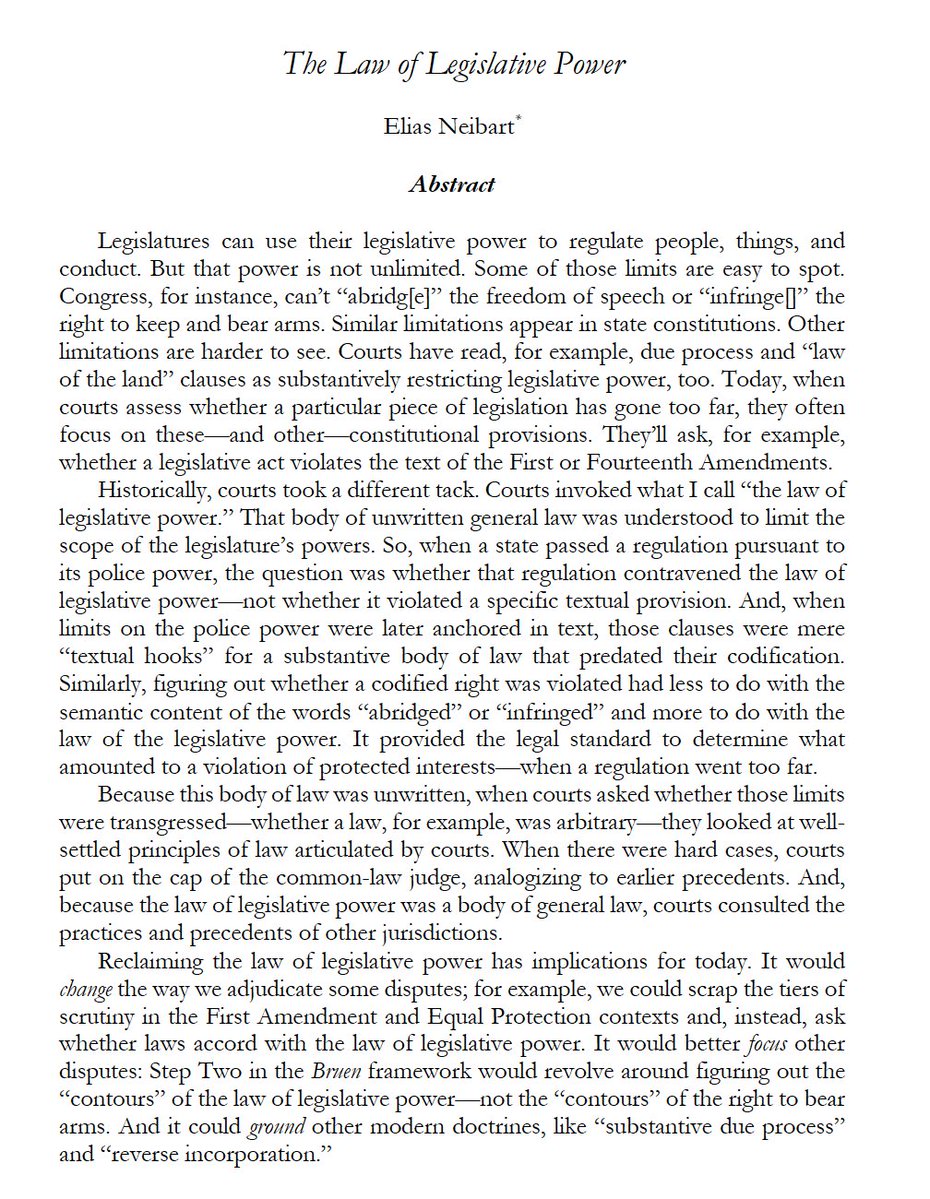
Finally sharing a draft of The Law of Legislative Power! Here's a link: https://t.co/aVTOhSznBH
When does a legislative act go too far? Historically, courts answered that question by asking whether the legislature transgressed an unwritten body of general law: what I call "the law of legislative power." From substantive due process to the tiers of scrutiny to "reverse incorporation," I also show why reclaiming the law of legislative power matters today.
Thoughts are welcome!
BREAKING: Measles is no longer eliminated in the U.S., reversing one of the country’s greatest public health achievements this century. https://t.co/L6XoZxUBeF
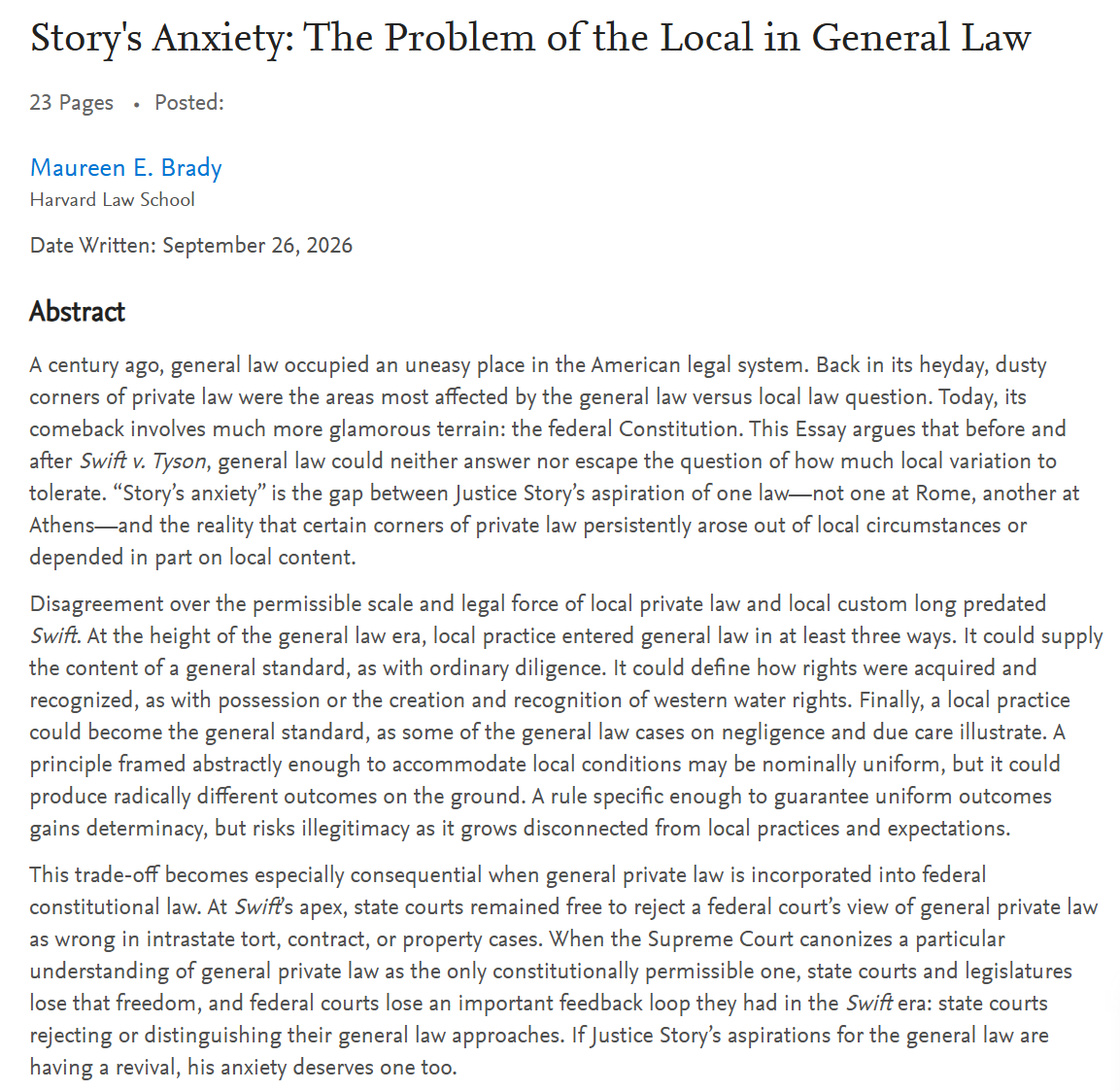
I've finally gotten around to posting a draft of "Story's Anxiety: The Problem of the Local in General Law." It uses some of Story's own writings and cases to illustrate how pesky local variation was (and is). Abstract below! https://t.co/XrJVbQJdqk
Instead of a Roman general who was later beheaded with a sword, I prefer to cite an American Founding Father, John Adams, who called a republic, "an Empire of Laws, and not of men". When people in power tell you they believe might makes right, believe them.
Thanks to @lsolum for highlighting "Presidential Administration to the Slaughter" as the Download of the Week on his indispensable Legal Theory Blog. Draft here: https://t.co/EyARXTob4y. Comments appreciated!
Exactly. The electoral college makes election shenanigans useful only in purple states, where officials of both parties can catch them. A national vote gives fraud/suppression in deep-blue or deep-red states national force.
https://t.co/DOniE8npKS
Nielsen v Watanabe, argued and much discussed this week, reminds me of this old blog post. How many more times will the Court be accused of overruling Bivens?
https://t.co/bx3HJOqvHL