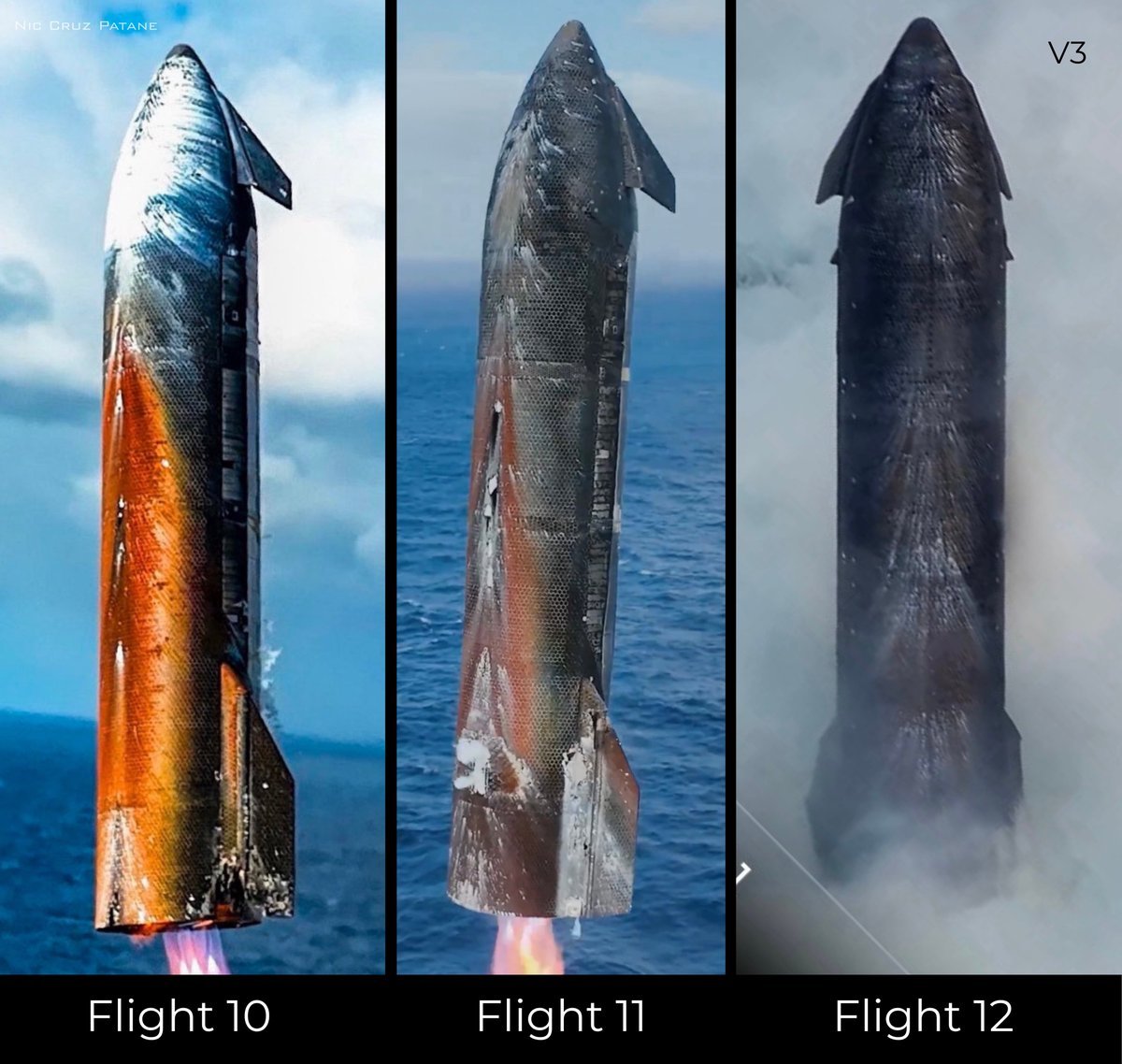
We need heat shields to protect us, since we use the air to slow us down as we return to Earth.
From orbital speed, it gets to 1650°C / 3000°F. From the Moon: 2750°C / 5000°F.
For yesterday's Starship suborbital test flight, peak was 1450°C / 2600°F. Great to see the @SpaceX progress over the last 3 flights. Making them truly reusable is complex and necessary for permanent, cheap space access.
image compilation: @niccruzpatane
In 2011, Japanese telecom company Docomo created one of the most beautiful adverts we've ever seen.
A giant xylophone in Kyushu playing Bach's "Jesu, Joy of Man's Desiring" with a wooden ball rolling down its keys.
Old cathode ray tube TVs were essentially miniature particle accelerators sitting in our living rooms.
It's fascinating to think that for decades we watched images created by an electron gun firing beams at a phosphor-coated screen, making pixels glow thousands of times per second.
For an industrial robot built for the rigors of factories and power plants, tidying up a living room may seem like a light day at the office for Spot. Yet, this demonstration represents the promise of AI models in robotics. In this case, @GoogleDeepMind's visual-language model (VLM) Gemini Robotics-ER 1.5 was empowering Spot with embodied reasoning.
Go behind the scenes and watch the full demo in our blog: https://t.co/TKyKVKemoe
Me parece una jodida pasada que haya podido "programar" un simulador 3d del vuelo de la misión Artemis II mejor que el de la mismísima NASA en unas pocas horas.
LINK EN ES SIGUIENTE POST 👇
Es que hasta la rotación de la tierra y el día/noche coincide a la perfección con al realidad (y cuando mueves el slider temporal la tierra rota en consonancia). Puedes comprobarlo según la hora si quieres (que por cierto cargará tu hora local del navegador).
Y todo texturizado: la luna, la tierra e incluso con un modelo 3d de la nave.
La trayectoria 3d de la nave encima PERFECTA y con los datos en tiempo real de la nave oficiales de la NASA para que puedas ver exactamente dónde está en cada momento.
Y todo esto sin escribir NI UNA SOLA LÍNEA DE CÓDIGO. Con su proyecto subido a Github y descripción y todo hechos también por Claude. Os doy más detalles en el siguiente tuit.
Qué locura. Todavía no me acostumbro a la nueva normalidad.
“In Loving Memory ‧ The Eternal Butterfly “Koji Wada – 10th Anniversary Memorial
🎵 "Mugendai na yume no ato no, nanimo nai yo no naka ja..."
When that melody starts, does it take you back to that summer filled with courage?
Today, April 3, 2026, marks 10 years since we lost one of the most iconic "Chosen Children"—the "Immortal Butterfly" singer, Koji Wada.
Back in April 1999, he made his legendary debut with "Butter-Fly", the theme song for Digimon Adventure. More than just a childhood anthem, this song became a symbol of dreams and hope for a whole generation.
Despite having to pause his career twice due to his battle with laryngeal cancer, Wada-san never surrendered to fate. With every comeback, his soulful, slightly raspy, yet powerful voice proved to the world: as long as you don't give up, a butterfly can always fly against the wind.
Though he has journeyed to a Digital World we cannot see, the voice he left behind will forever guard our passionate hearts.
Thank you, Koji-san.
【緬懷 ‧ 不朽的蝴蝶】和田光司逝世 10 週年悼念
🦋 「無限大な夢のあとの ...」
當音樂響起,是否也帶你回到了那個充滿勇氣的夏天?
今天是 2026年4月3日。10 年前,我們失去了一位最動聽的被選中細路——「不死蝶」歌手 和田光司。
回顧 1999 年 4 月,他以《數碼暴龍大冒險》主題曲**《Butter-Fly》**正式出道。這首歌不僅是無數人的童年神曲,更成為了代表夢想與希望的圖騰。
縱使在演藝生涯中兩度因喉癌被迫休養,和田先生卻從未向命運低頭。每一次的回歸,他都用那帶點沙啞、充滿力量的靈魂嗓音,向全世界證明:只要不放棄,蝴蝶依然能逆風飛翔。
雖然他已前往了那個我們看不見的數碼世界,但他留下的歌聲將永遠守護著每一顆熱血的心。
謝謝你,光叔。