The government ignored established UK PPE suppliers as far back as April 2020, in favour of the VIP lane which provided late, useless and expensive PPE.
https://t.co/OpiLKxIruU
🚨 The UN's Scientific Panel on AI has just published its new report, and it offers a much needed GLOBAL perspective to a heavily US-focused debate.
Bookmark it below.
Why are AI companies worrying about consciousness? And should they? Great piece in @washingtonpost by @nitashatiku - in which I offer a few skeptical words. (For more, see my @TEDTalks https://t.co/FQLrSbssgo): https://t.co/t3r5oBD2Z2
LLMs can learn better coding behavior from problems with no known answers.
Many real problems do not have a gold solution waiting in a database, especially in optimization, where the best answer may be unknown, expensive, or impossible to certify.
Normal reinforcement learning works well when it can check a clear right answer, but that breaks down when the best answer is unknown.
The paper’s method, called RiVER, lets the model write several programs, runs them on the same hidden tests, and rewards the programs that perform better than the others.
The key trick is that RiVER does not trust raw scores directly, because some test cases naturally produce much bigger numbers and can distort training.
Instead, it ranks programs within each test case, gives extra weight to the best one, and still gives smaller graded feedback to other valid programs.
The authors trained models on 12 AtCoder Heuristic Contest tasks, and RiVER improved both score-based contest performance and normal pass-or-fail coding benchmarks.
----
Link – arxiv. org/abs/2606.27369
Title: "Reinforcement Learning without Ground-Truth Solutions can Improve LLMs"
🚨 The most significant factor currently shaping global AI policy is the real and projected national security risks posed by AI.
We are entering a never-before-seen, newly emerging, AI-driven state of exception in which the government controls access to AI.
My full article:
We stress tested many frontier AI models for multimodal medical reasoning (including GPT-5, Claude 3.5, Gemini 2.5 Pro). They’re not ready. Faulty reasoning, use of inappropriate shortcuts, hallucinations. Published today @NatureMedicine https://t.co/P6eHZEmfbW
@Midge1415 "Stephen"? Is the Daily Mail normally on first name terms will sex offenders? Do they refer to Epstein as 'Jeff'?
What was he actually convicted of? One year seems excessively lenient if found guilty of the offences Louise Raw states.
Intelligence may be less about bigger models and more about better knowledge structures.
This paper argues that current AI is being built mostly on network mathematics, not on a theory of knowledge.
A human brain makes fast, adaptive decisions on roughly the power of a dim light bulb, while frontier AI often buys competence with enormous computation.
The paper says biological intelligence may be efficient because it organizes meaning around goals, context, and decisions, instead of mainly searching through language patterns.
It separates mental activity into physical cognition, emotional cognition, mental cognition, and intelligence, where intelligence means making useful decisions while the situation still matters.
The proposed answer is Synthetic Intelligence, which would use structured semantic knowledge, meaning information tied to purpose, rather than only syntax, statistics, or neural network weights.
The paper uses Asymmetric Information Resolution models to show how knowledge can be arranged into decision maps, with a simple predator-prey example where each state has only a few possible moves.
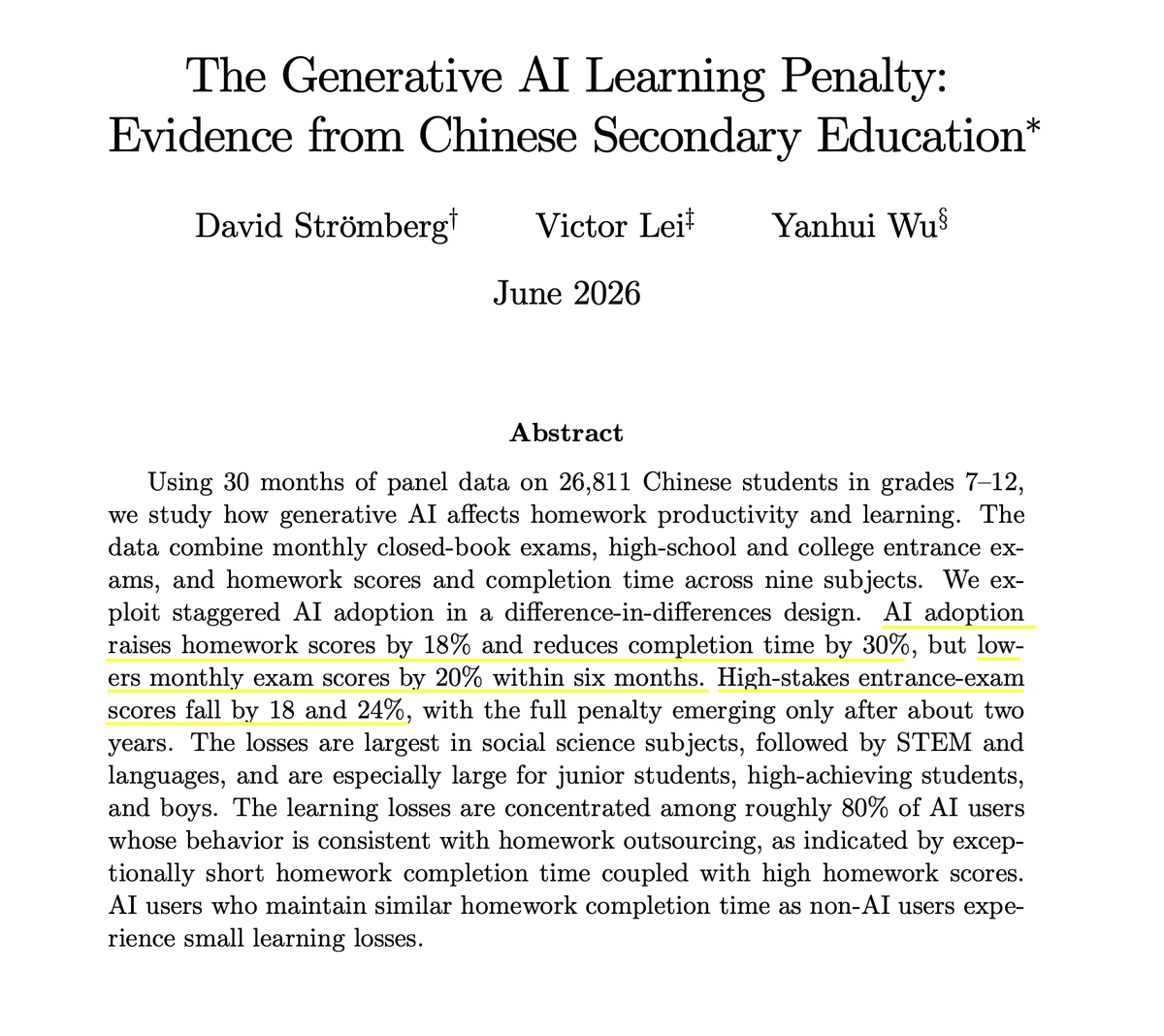
🚨 In a surprise to NOBODY, a study shows that generative AI use raises homework scores, but substantially reduces learning. My takeaways for AI ethicists and educators:
The study analyzed data from 26,811 Chinese students in grades 7-12.
AI use led to higher homework scores and reduced homework time (well, it's AI that is answering, it's certainly fast).
However (and as expected), AI use lowered the students' performance on closed-book exams.
The study also stated that the negative effects on learning outcomes appeared to be driven by the 81% of AI-using students who spend less time on homework than even the fastest non-AI student.
In practice, this means these students were not really engaging with the homework but were merely copying and pasting AI outputs.
In a more optimistic turn, the study shows that AI-using students who spent as much time as non-AI-using students doing homework scored similarly on closed-book exams.
This means that even though these students were using AI, they were actually thinking through their homework and engaging with it.
I like this study because it highlights questions that educators worldwide are having to engage with:
1. How to design homework and assignments that truly support intellectual development in the "age of AI" (i.e., when students can have quick access to AI tools);
2. How to design interesting and engaging homework and assignments that take into consideration the technological landscape without undermining learning.
The questions above are only relevant for older students (such as those in this study), as, in my opinion, younger children should not be exposed to AI, as it will undermine learning without offering any tangible benefit.
The study offers three potential paths to deal with these issues:
- Providing information about the long-term learning costs of homework outsourcing (*I like that, and we don't see it broadly discussed; maybe because only now data is starting to come out).
- Increasing the weight placed on closed-book, in-person assessments (*my guess is that it's already happening).
- More monitoring of homework and school effort by parents and teachers (*easier said than done; it might create trust issues between educators and students).
A super interesting paper. Congratulations to the authors!
-
👉 I'm adding this paper as the 12th recommended paper of our AI Ethics Paper Club. To receive all my paper recommendations, you can join the club for free below.
👉 To stay up to date with AI's legal and ethical challenges, join my newsletter's 97,200+ subscribers (link below)
In their latest essay, @random_walker and @sayashk argue that AI will most likely NOT cause mass layoffs.
Pay attention to the "decide-execute-deliver" sandwich.
According to their cautiously optimistic essay, "Why AI hasn’t replaced software engineers, and won’t," software engineering and most professions will be sufficiently cushioned.
Hopefully they're right (link to the article below).
Why diffusion denoising-based generative methods do not suffer the curse of dimensionality even though the data may lie in extremely high-dim spaces? Our new work, accepted by the JMLR: https://t.co/njMEqzH3TF reveals the not-so-surprising secret: as long as the intrinsic dimension of the distribution is very low, the generative process can be extremely efficient and effective! It seems that a mixture of low-rank Gaussians is a universal model for all informative real-world data. as we stipulated in a former textbook of mine: Generalized Principal Component Analysis: https://t.co/nEy8qcFN7e, published exactly ten years ago!
Our new open-source book on the Principles and Practice of Deep Representation Learning (A Mathematical Theory of Memory) is now posted on the arXiv: https://t.co/EGURnwZr6H I will offer a new graduate course this fall at the University of Hong Kong. Everything will be open sourced!
The Library of Alexandria created the first catalog of all human knowledge 2,300 years ago, and a team of fewer than 20 people just finished the modern version and made it free for the entire planet.
It is called OpenAlex. The name is not an accident.
The ancient library had the Pinakes, a catalog mapping every scroll, every author, every subject. When the library fell, the map of what humanity knew fell with it.
For the last two decades, that map existed again, but it was locked up.
Elsevier owns Scopus. Clarivate owns Web of Science. If your university could not afford the subscription, you could not see the structure of science itself. Entire countries were priced out of knowing what research existed.
OpenAlex indexes 474 million scholarly works. Every author disambiguated. Every citation traced. Every institution and funder connected. It updates with roughly 50,000 new works every day.
The whole thing is CC0. Not just free to search. Free to download, copy, sell, and build on. The API allows 100,000 requests a day without an account.
The ancient library burned and the catalog was lost for two millennia.
The new one cannot burn. Anyone can hold a copy.
https://t.co/peUYYpucnc
In the last 48 hours I’ve been deluged with 100s of vile, misogynistic tweets and death threats. Why? For doing my job: asking @ZiaYusufUK questions about claims by @Nigel_Farage of 2-tier policing. I spoke about this on tonight’s show. Enough is enough. https://t.co/SSHiAI3Umc
@Scobleizer@LuizaJarovsky Great post. As a minimum be clear on your working definition; for consciousness I'd add state your core beliefs (a lot of arguments are irresolvable because those involved are arguing from a different basis).
Why haven’t you signed your papers as a councillor or attended a single meeting yet @RobKenyonReform?
No DBS check, no attendance, nothing.
#Makerfield needs to know you’re not doing your job.