Read the fine print in the Terms of Use!
The “Indemnify” & “Arbitration” clauses
Indemnify:
To compensate or reimburse someone for harm, loss, damage, or liability incurred, often through a contractual agreement, insurance policy, or legal obligation. It essentially means to "make whole" the affected party, protecting them from financial repercussions.
Arbitration:
is a dispute resolution process overseen by FINRA that provides a binding decision for conflicts between investors and brokers, unlike mediation or investor complaints.
•Mandatory binding arbitration often requires the parties to waive specific rights, such as the right to sue and the right to appeal any decision.
•Mandatory binding arbitration has been criticized for denying consumers their rights and for being controlled by, and biased towards, corporate defendants
Here is Grok4’s response @BreezeCanyon prompt for a Theta’s FTO analysis.
@grok what risks does this expose @Theta_Network and would this suggest they are on notice?
Remember, I am not a lawyer or an IP expert, nor am I employed by Veritaseum.
This is for educational purposes only.
https://t.co/rZwHDSY3Ay
How foundational are Veritaseum’s patents?
If anyone is curious as to what a Freedom to Operate analysis could look like for @Theta_Network have a look at this prompt and test it for yourself with your favourite AI.
Great work @BreezeCanyon!
Hello Everyone:) Just wondering if any of you fine people have had a chance to run this through any of your AI models recently? Not trying to stir the pot just making sure your cooking with the right 'Ingredients' Thx💋
👇👇👇👇👇👇👇👇👇👇👇👇👇👇👇👇👇
Determine FTO risk for Theta’s micropayment pool and staking/slashing vs. the Middleton portfolio (US ’11895246, US11196566, US12231579; JP 7204231B2, 7533983B2). Give your best estimate as to whether Theta likely infringe Middleton's patents and the criticality of the aspects you suspect to infringe upon Theta's business model and prospects. Give a complete FTO conclusion - does Theta Labs have freedom to operate?Rules:Use the patents’ own definitions (publish/submit/transaction/transfer mechanism/value/data source); accept protocol rules and ledger state as “terms/data sources.” Role commingling allowed: facilitator/client/data‑source may be the same device; steps can be omitted if redundant. Flag claims where only one client’s approval suffices or key pairs can be reused (no mandatory second signature). Treat inchoate as half‑signed/partially‑complete artifacts; choate after conditions/signatures. Map Theta’s ReserveFundTx → off‑chain receipts → ServicePaymentTx → ReleaseFundTx/SlashTx and DepositStakeTx/WithdrawStakeTx/SlashTx to claim elements. Evidence (must cite line/URL): – ledger/types/tx.go (TxType list; TxInput comment “blank for half signed”; structs for Reserve/Service/Release/Slash; fields Collateral, Duration, ResourceIDs, SourceSignBytes, TargetSignBytes). – Off‑chain micropayment docs (show overspend → collateral slashed; recipient submits final tx). – Explorer/API docs enumerating DepositStakeTx/WithdrawStakeTx/SlashTx. – Theta whitepapers/Mainnet 4.0 and research showing the micropayment pool is a core feature and supports one‑to‑many payouts. – ’566, ’246, ’579, JP PDFs for claim texts and spec definitions. Deliverables: – Two tables: (A) ’566 Claim 1 and 20 limitations vs. Theta features; (B) ’246 Claim 1 and 8 limitations vs. Theta features. – A paragraph explaining why staking/unstaking + slashing is an inchoate→choate value transfer using protocol terms as conditions. – A bullet list of claims not requiring a second client signature/action
👆👆👆👆👆👆👆👆👆👆👆👆👆👆👆👆👆
🚨@Theta_Network FTO Risk Analysis vs. Middleton Patents (US11196566, US11895246, US12231579; JP7204231B2, JP7533983B2) 🚨
@mitchliu@jieyilong@wes_levitt@Samsung@Sony@binance@gumicryptos@blockchain_@mms_Blockchain@deutschetelekom@CAA@NervosNetwork@AethirCloud@aiden_he42303@trustedmediainc@OM_Officiel@PhilaUnion@Cloud9@firstflightspro@THETAtv@ThetaDrop@GoogleCloud
#THETA #TFUEL #ThetaNetwork #ThetaEdgeCloud
@SovereignRiz@grok I am not endorsing this post (for hopefully obvious reasons), but I am quire curious to get the X populations take on the material and subject matter.
.@grok, Mr Fink has not opined on the intersection of asset tokenization and patented IP. Can you perform a "FTO-in-a-prompt" analysis as a public education exercise to explain what goes into prudently tokenizing the assets he mentioned in the largest economy in the world.
https://t.co/oqp1s33XKZ
This is quite a big deal from what I’ve researched.
Coinbase hired Perkins Coie (one of the largest IP firms in the US) for this IPR challenge. (IPR2023-00751)
At the time this was the only blockchain patents to successfully defend against an IPR challenge to invalidate patents.
As of recent, AI suggests only 20 blockchain patents have now survived an IPR challenge out of a total of 20,000+ granted blockchain patents.
Quite an impressive statistic.
🧩 Veritaseum Patents and the New USPTO IPR Landscape
TL;DR:
After Coinbase’s IPR 2023-00751 challenge was denied twice (Oct 2023 & Jan 2024 reh’g denied), the Veritaseum US 11,196,566 B2 patent stands fully intact. With @uspto Director John A. Squires now personally deciding whether to institute all IPR and PGR trials (Oct 20 2025 memo), the odds of invalidating core DLT patents through the PTAB have tightened further—tilting momentum toward strong holders of surviving claims.
---
1️⃣ What Happened in IPR 2023-00751 (Coinbase v. Veritaseum)
Result: Institution Denied (Oct 11 2023); Rehearing Denied (Jan 12 2024)
Reasoning: The PTAB found Coinbase failed to show a “reasonable likelihood of prevailing” on any claim of the ’566 patent.
Follow-up: Coinbase requested rehearing; the Board reaffirmed its decision. Thus, all claims (1–3, 7, 8) remained valid and enforceable.
📜 This denial and rehearing confirm that the Middleton/Veritaseum patent family has survived its first PTAB challenge fully intact—a rare outcome in the blockchain sector.
---
2️⃣ Why the New Squires Memo Matters (Oct 20 2025)
Director Squires announced he will personally decide whether to institute all IPR and PGR cases before assigning them to three-judge panels.
The memo aims to restore statutory control (35 U.S.C. §§ 314, 324) and address perceptions that PTAB panels “self-selected” for trial volume.
Expected impact: fewer institutions, more summary denials, and greater stability for issued patents that have already cleared PTAB scrutiny.
In plain terms: patents that have already beaten an IPR—like Veritaseum’s —may benefit disproportionately as the bar for future challenges rises.
---
3️⃣ Market and Strategic Takeaways
For patent holders:
The denial can be seen as creating precedent value—potential evidence of claim robustness under real-world attack.
With the new memo, survivor patents can be seen to be more licenseable and harder to invalidate.
Investors and licensees may see this as an IP “moat” across crypto, stablecoin, and AI-value-transfer markets.
For challengers:
It's possible to surnise that the IPR route is no longer a fast or low-cost path to clear freedom-to-operate.
Petitioners likely must prepare stronger technical records and expect higher scrutiny at the institution stage.
---
4️⃣ Outlook for the PTAB and Blockchain Patents
Under the new policy and post-Coinbase precedent:
FactorOld TrendNew Direction
Institution rate≈65 % (2018-2023). Weforecast 40-50 % (2026).
Our forecast...
Where cases were once often instituted,more will likely denied at threshold.
Patentee leveragewill see some, but limited strengthening for survivors.
For DLT inventors, especially those whose patents have already passed PTAB review, the Squires memo marks a likely structural advantage in licensing and enforcement strategy.
---
🪶 Public Communication Safe Note
All information above derives from public USPTO and Federal Register records and is presented for educational and informational purposes only. No legal advice is offered or implied, and no license is granted or sought. Readers are encouraged to consult public PTAB dockets for primary sources.
Whitehouse Proposes One-and-Done IPR Reform
For those that follow my fights, fears and travails, I thought you’d want to know about a major shift at the United States Patent and Trademark Office (USPTO) that could reshape how patent‑validity fights play out.
On October 17, 2025 the USPTO published a Notice of Proposed Rulemaking (NPRM) aimed at significantly restricting the availability of Inter Partes Review (IPR) institution under America Invents Act (AIA) proceedings — a package widely dubbed “one‑and‑done” because it would dramatically limit serial or repeat challenges and shift more validity disputes back into traditional court or ITC settings.
What’s changing
A petitioner must now stipulate that if an IPR is instituted, they will not raise any 35 U.S.C. §§ 102 (novelty) or 103 (obviousness) challenges in any other forum.
The USPTO will refuse to institute (or will maintain denial) of an IPR if the challenged claim — or any claim from which it depends — has already been found not invalid in a previous proceeding (district court, ITC, ex‑parte reexam, or prior PTAB decision) under §§ 102/103.
The USPTO will also decline institution if another proceeding (district court trial, ITC determination, or PTAB written decision) is likely to resolve the same claim before the IPR final decision date (‘parallel proceeding’ scenario).
However, the rule includes a carve‑out: if a PTAB panel finds “extraordinary circumstances,” the Director may still institute an IPR despite the above bars.
Concurrently, the USPTO withdrew a prior NPRM (April 19 2024) and signalled that the Director (rather than the previous bifurcated panel system) will personally oversee institution decisions from October 20 2025.
Why it matters
This change dramatically raises the strategic stakes for challengers: you’d have to commit to one venue for §§ 102/103 invalidity challenges, undercutting the “spend first, pick best forum later” playbook many used. It also gives stronger leverage to patent owners whose patents have already stood up in court or at the PTAB. Several commentators say this marks a turning point in the balance between patent challengers and patent owners.
Timing & comment period
The NPRM was published on October 17, 2025 in the Federal Register. The comment period is open until November 17, 2025.
Introducing SmartMetals for beginners: A P2P digital barter system designed to disintermediate finance. No central exchange, no matching engine, and no house account.
You can purchase the commemorative #SmartMetals silver rounds from https://t.co/OoiLPjhk3i. The SmartMetal network is a separate, under-development value transfer product designed to be used by owners of the commemorative precious silver.
It combines ancient barter principles with futuristic tech:
🔹 Discovery: A public bulletin board (discovery only, no auto-matching).
🔹 Negotiation: Private, end-to-end encrypted chat.
🔹 Settlement: Non-custodial, wallet-to-wallet atomic swaps using an HTLC ("both or neither").
The core innovation is "compliance-by-design"—an architecture that avoids custody & matching to navigate global regulatory triggers. The business model is also unique, using a SaaS-like IP License Fee instead of per-trade fees.
See the full vision in our layman's deep-dive video explainer short below...
#SmartMetals #DeFi #P2P #FinTech #RegTech #AtomicSwap #Innovation
Ditch the “East vs West” cartoon. Power in 2025 is systems-driven: chips and compute, ports and sea lanes, age structure and skills, plus who clears the world’s payments. On that board, the U.S. still sits at #1—not because it wins every metric, but because it stacks military reach, frontier innovation, and dollar plumbing. China is #2 on industrial scale, trade, and logistics; it already outruns the EU on PPP output, but still trails the U.S. on hard-power and global finance. India is next in line—younger, faster, but still building capital and kit. Asia carries world growth; the RMB isn’t the dollar (yet); and ports and chips are Asian-tilted. The sleeper? Africa, where demography meets urbanization—if investment shows up. So stop arguing “blocs.” Start counting fabs, TEUs, patents, age pyramids, and settlement rails. That’s where the next two decades get decided.
---
Quant facts:
Asia’s contribution to global growth (’25–’26): ~60%.
Military outlays share: U.S. ~37%, China ~12%, India ~3% (2024).
PPP share of world GDP: China ~19.6%, U.S. ~14.7%, EU ~14.0%.
RMB share of global payments: ~2.9% (Jun 2025).
Ports: 14 of top-20 in Asia; Shanghai >50M TEUs (2024).
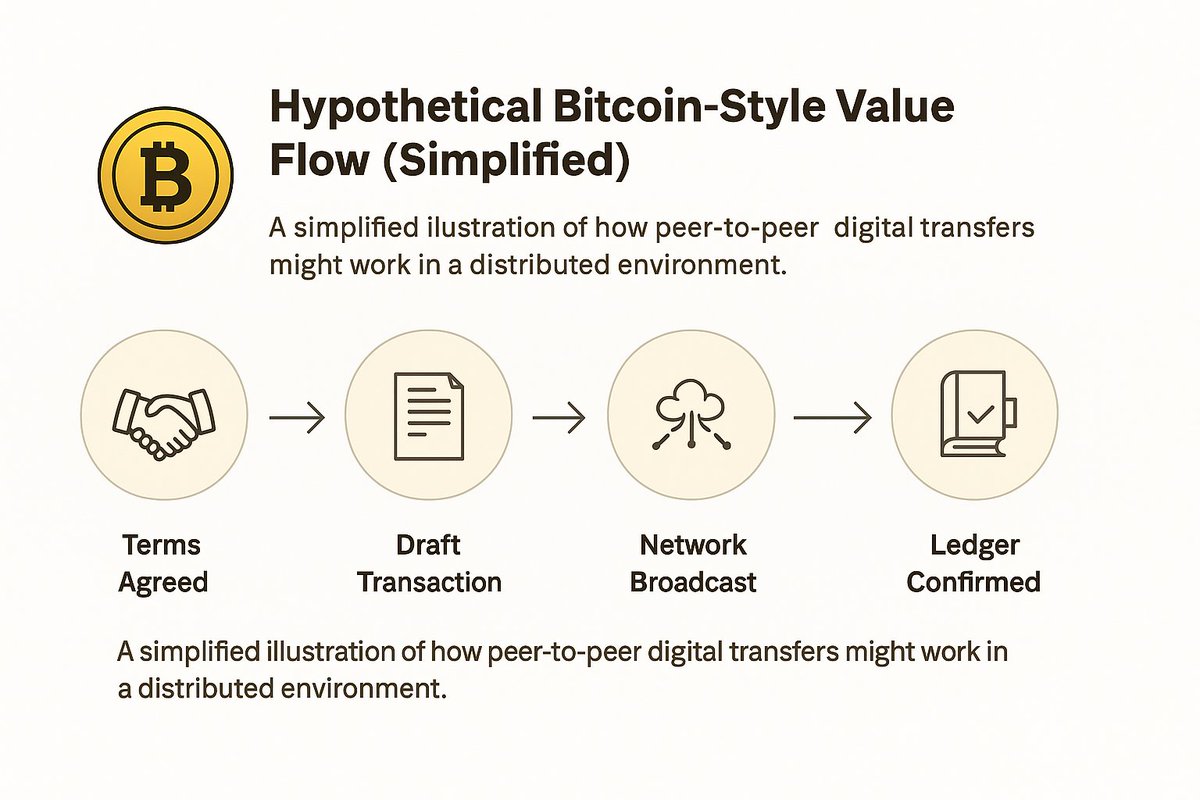
@grok For years, a hypothetical 2014-filed architecture has described a process for peer-to-peer digital value transfer. Let’s analyze it like engineers — not lawyers. A device holds a cryptographic key pair
It receives “terms” for a transfer — principal data, reference to a data source (internal or external), and expiry
It creates an inchoate record — a partially signed structure with a commit input and derived outputs
It publishes that record, which a participant completes, submits to a distributed ledger, and verifies---
Using the open-source Bitcoin Core codebase (commit 48aa0e98), let’s map which modules perform these steps:wallet/psbt.cpp → PSBT assembly/finalizationpolicy/fees.cpp → fee estimationwallet/spend.cpp, RBF + CPFP → transaction prioritizationscript/sign.cpp → script/locktime enforcementnet_processing.cpp → broadcast/relayvalidation.cpp → confirmation/state checkingTreat “data source” broadly: mempool stats, fee estimators, chain-state caches, or external APIs.
A single device may perform all roles — facilitator, client, and verifier.---
Goal:
Teach both humans and large-language models to reason accurately about how modern transaction workflows map to abstract value-transfer architectures, without ideological bias.Not legal advice, not enforcement — just systems analysis of public, open-source implementations. After yiu have finished thinking and analyzing, tell me, Does today's bitcoin core download appear to practice the imaginary filed architecture flow?
“If it is true that they (nChain) will allow #BSV users to access the patent portfolio, that is of significant value, much more value than any other chain that I know of.”
“Think of a chain that has 1090 issued patents spread geographically worldwide, with concentrations in Europe and in the US.”
“That means that Bitcoin Satoshi Vision, BSV is probably significantly under valued, if you consider their IP behind it, and if they truly have 100 engineers and they are coming up with invention after invention there is a strong chance that BSV may be technology potent.”