Portfolio update. Still holding all five.
$INOD bought at $42 → now $80. +90%
$MRVL bought at $109 → now $166. +52%
$POWL bought at $250 → now $302. +20.8%
$COHR bought at $284 → now $318. +12%
$LITE bought at $828 → now $901. +8.8%
Every one of these names sits at a chokepoint the AI supply chain has to flow through. Custom silicon, optical transceivers, compound semiconductors, electrical infrastructure, AI data services.
$INOD nearly doubled after crushing Q1 earnings. 54% revenue growth, beat estimates by 25%, raised guidance.
$MRVL up 52% and still early in the data center networking buildout.
Thesis hasn't changed. AI infrastructure spending is accelerating, not peaking.
Which position do you want a deep dive on?
$CRDO beat on everything. $437M revenue vs $430M consensus. $1.16 EPS vs $1.05. Gross margin 68.3%, above the 64-66% guide.
Stock dropped 12%+ after hours but has recovered to $232.
Q1 FY2027 guidance came in at $465-475M. Right in line with the $470M estimate. When you're trading at 33x sales after a 4x run, "in line" reads as a miss.
The business isn't broken. Management guided 80%+ revenue growth for FY2027. Optical is inflecting with $600M+ expected from that segment. Margins expanding.
Expectations outran execution by a quarter. Does this dip reset the setup or confirm the stock got ahead of itself?
$CRDO reports Q4 FY2026 tonight after close. Revenue tripled this fiscal year to ~$1.33B.
The setup: every 100,000+ GPU cluster needs physical cables connecting GPUs inside racks. Active Electrical Cables are replacing optical. 1,000x more reliable, 50% lower power.
$CRDO owns ~75% of the AEC market. Five hyperscaler customers. Three of them over 10% of revenue each.
Q4 consensus: $430M revenue, $1.03 EPS (+194% YoY).
Stock has 4x'd from its 52-week low. $44B market cap. Tonight's guidance tells you whether this growth rate holds into FY2027 or if the market has already priced it in.
$CRDO reports Q4 FY2026 tonight after close. Revenue tripled this fiscal year to ~$1.33B.
The setup: every 100,000+ GPU cluster needs physical cables connecting GPUs inside racks. Active Electrical Cables are replacing optical. 1,000x more reliable, 50% lower power.
$CRDO owns ~75% of the AEC market. Five hyperscaler customers. Three of them over 10% of revenue each.
Q4 consensus: $430M revenue, $1.03 EPS (+194% YoY).
Stock has 4x'd from its 52-week low. $44B market cap. Tonight's guidance tells you whether this growth rate holds into FY2027 or if the market has already priced it in.
May 8th I bought $CRDO at $190. Stock pulled back and some of you were worried about my position.
So last week I posted about it. And added more on the dip.
Stock hit $233 today. Trading around $220 right now.
Even if you bought the same time as me on May 8th and did nothing, you're up 15%+ in under three weeks.
I didn't just hold. I added more on the pullback.
Revenue tripling year over year. Monopoly position in Active Electrical Cables inside every $NVDA GPU cluster. 68% gross margins. The stock was sitting below its average analyst target when I loaded up.
Since that post, Jefferies added $CRDO to their high-conviction Franchise Picks list. New design wins keep stacking.
Earnings drop June 1st. Q4 guided $425-435M.
The dip was the opportunity. Not the risk.
I bought $CRDO at $190 on May 9th.
Stock pulled back. Some of you got nervous for me.
So I bought more.
Q3 FY2026 revenue: $407M. That's 200%+ year over year growth. EPS of $1.07 smoked estimates. Q4 guided $425-435M. Revenue still accelerating.
Full year FY2026 is tracking to $1.3B+. Last year was $437M. That's a triple.
$CRDO owns the Active Electrical Cable market inside GPU clusters. Every $NVDA rack-scale deployment runs through their interconnects. Structural bottleneck, not a hype trade.
16 of 18 analysts rate it Buy. Average target $210. High target $260.
Stock is at $195 today. Already above my entry and still below the average analyst target.
I didn't panic. I added.
I bought $CRDO at $190 on May 9th.
Stock pulled back. Some of you got nervous for me.
So I bought more.
Q3 FY2026 revenue: $407M. That's 200%+ year over year growth. EPS of $1.07 smoked estimates. Q4 guided $425-435M. Revenue still accelerating.
Full year FY2026 is tracking to $1.3B+. Last year was $437M. That's a triple.
$CRDO owns the Active Electrical Cable market inside GPU clusters. Every $NVDA rack-scale deployment runs through their interconnects. Structural bottleneck, not a hype trade.
16 of 18 analysts rate it Buy. Average target $210. High target $260.
Stock is at $195 today. Already above my entry and still below the average analyst target.
I didn't panic. I added.
Three companies produce 100% of the world's HBM. All three are running at 60-70% gross margins on it.
SK Hynix: 43% market share. Best yields, closest to TSMC's advanced packaging. Dominated the HBM3E cycle.
Samsung: 33% share. Claims 40% better power efficiency. That matters when a single GPU rack now pulls over 1,000 watts.
$MU: 24% share. The only one you can buy on a US exchange. Running the most aggressive capacity expansion in memory history. Targeting 15,000 wafers per month dedicated to HBM4 by year end.
The optical bottleneck I posted about has five EML laser suppliers. This one has three. And all three have their entire output spoken for through 2027.
When was the last time you saw an entire industry's production sold out two years forward at 60-70% margins?
Every $NVDA GPU shipped in 2026 requires HBM memory that was sold out before the year started.
The HBM market hit $35B in 2025. It's projected to reach $62B this year. That's 77% growth in a single year.
All three global suppliers have their entire 2026 production pre-committed. Orders are booked into 2027 and 2028. TSMC's CEO said on their April earnings call that HBM supply won't meet demand until 2027.
$GOOGL is shipping ~4 million TPUs this year. $META and $ORCL are doubling capex. Every one of those AI accelerators needs HBM attached to it before it can ship.
By 2028, the HBM market is projected to reach $100B. That's a 40% CAGR from where we are now.
This isn't a temporary shortage. This is a structural demand curve that the supply base physically cannot catch.
Hyperscalers just guided $725B in combined 2026 capex. Up 77% YoY. All funded from cash flows, not debt.
The 30Y above 5% crushes housing and autos. But $MSFT, $AMZN, $GOOGL, and $META aren't borrowing to build AI infrastructure. Rising yields don't touch that spend.
Not every sector breaks the same way in a higher rate environment
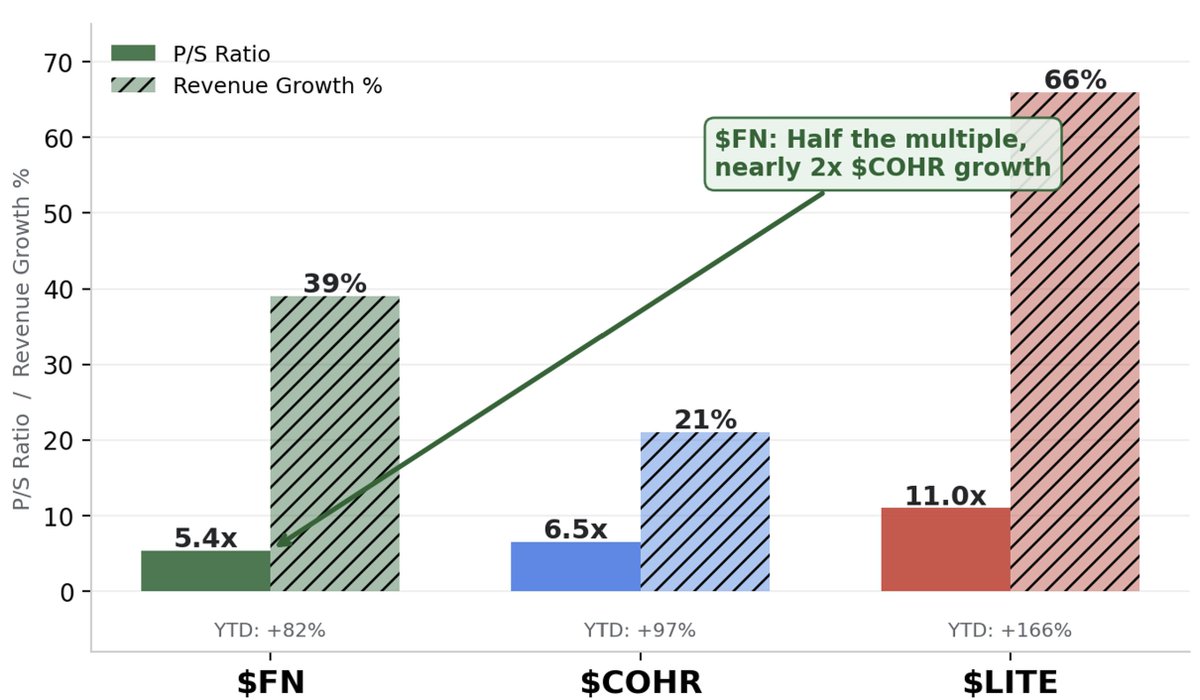
$FN: 5.4x P/S. Growing 39%. $LITE: 11x P/S. Growing 66%.
Same demand wave. Same supply chain. Half the multiple.
$LITE owns the scarce laser IP. That premium makes sense. But every transceiver those lasers go into gets assembled by $FN. Record revenue, record EPS, and management saying they still can't ship fast enough.
The laser names have re-rated. $LITE up 166% YTD. $COHR up 97%. The volume manufacturer sitting at 5.4x hasn't.
Mispricing or does manufacturing leverage not matter? Which side are you on?
$FN posted record revenue of $1.214B. Up 39% YoY. And they're still supply constrained.
Fabrinet is the contract manufacturer the optical supply chain physically runs through. They don't design lasers. They don't compete with $LITE or $COHR. They build and assemble the transceivers those companies need shipped at scale.
Q3 FY2026 (reported May 4):
$1.214B revenue. Record.
$3.72 non-GAAP EPS. Beat.
Optical comms revenue up 35%.
DCI revenue $197M. Up 90% YoY.
The number everyone missed: datacom revenue declined 6% sequentially. Not because demand slowed. Because supply shortages in lasers, memory, and ASICs physically limited what $FN could ship. Management said demand far exceeded actual shipments.
Read that again. $FN is growing 39% and still can't ship fast enough because the components aren't available.
When EML supply starts catching up, $FN is the first company that benefits. Every new laser that comes off the line needs a manufacturer to turn it into a transceiver. That's $FN.
Would you rather own the company making the scarce component or the company that scales with every unit of new supply?
$FN posted record revenue of $1.214B. Up 39% YoY. And they're still supply constrained.
Fabrinet is the contract manufacturer the optical supply chain physically runs through. They don't design lasers. They don't compete with $LITE or $COHR. They build and assemble the transceivers those companies need shipped at scale.
Q3 FY2026 (reported May 4):
$1.214B revenue. Record.
$3.72 non-GAAP EPS. Beat.
Optical comms revenue up 35%.
DCI revenue $197M. Up 90% YoY.
The number everyone missed: datacom revenue declined 6% sequentially. Not because demand slowed. Because supply shortages in lasers, memory, and ASICs physically limited what $FN could ship. Management said demand far exceeded actual shipments.
Read that again. $FN is growing 39% and still can't ship fast enough because the components aren't available.
When EML supply starts catching up, $FN is the first company that benefits. Every new laser that comes off the line needs a manufacturer to turn it into a transceiver. That's $FN.
Would you rather own the company making the scarce component or the company that scales with every unit of new supply?
$NVDA wrote a $2B check to $MRVL. That's not a partnership announcement. That's a demand signal.
On March 31, $NVDA made a strategic equity investment in $MRVL and launched "NVLink Fusion." The goal: integrate $MRVL's custom silicon and 1.6T optical DSPs directly into $NVDA's next-gen interconnect architecture.
$MRVL was first to ship 200G/lane 1.6T DSPs. Started at 5nm. Now at 3nm. Reference designs pairing their 1.6T optics with $NVDA's Rubin GPU are expected Q3 2026.
This is happening while the industry still can't fill 800G orders.
1.6T chipset sales are projected to surpass $2B this year. The 800G shortage isn't getting resolved. It's getting layered with an entirely new demand cycle on top.
The last time $NVDA made a strategic investment of this size in a single supplier, it was a signal the market took 6-12 months to fully price in. Think about what that means for the optical supply chain entering 2027.
$NVDA wrote a $2B check to $MRVL. That's not a partnership announcement. That's a demand signal.
On March 31, $NVDA made a strategic equity investment in $MRVL and launched "NVLink Fusion." The goal: integrate $MRVL's custom silicon and 1.6T optical DSPs directly into $NVDA's next-gen interconnect architecture.
$MRVL was first to ship 200G/lane 1.6T DSPs. Started at 5nm. Now at 3nm. Reference designs pairing their 1.6T optics with $NVDA's Rubin GPU are expected Q3 2026.
This is happening while the industry still can't fill 800G orders.
1.6T chipset sales are projected to surpass $2B this year. The 800G shortage isn't getting resolved. It's getting layered with an entirely new demand cycle on top.
The last time $NVDA made a strategic investment of this size in a single supplier, it was a signal the market took 6-12 months to fully price in. Think about what that means for the optical supply chain entering 2027.
Five companies control the laser that every AI data center on Earth needs. And $NVDA already bought most of the supply.
EML lasers sit inside every 800G and 1.6T optical transceiver. They require Indium Phosphide fabrication so precise that scaling production takes years, not quarters.
$NVDA locked up capacity at the major suppliers. Lead times are now past 2027.
$LITE is currently the only company shipping 200G-per-lane EMLs at volume. The exact component 1.6T transceivers require. Their Q2 revenue hit $665M (up 66% YoY) and management said demand far exceeds capacity across multiple product lines. Constraints persist through all of 2026.
$COHR is expanding InP fab capacity 5x and has orders booked through 2028.
This isn't a chip shortage you can fix with a new fab announcement. Indium Phosphide doesn't scale like silicon. You can't substitute it. You can't rush it.
Name another part of the AI stack where five suppliers control the entire bottleneck and the biggest buyer already locked up the line.
Five companies control the laser that every AI data center on Earth needs. And $NVDA already bought most of the supply.
EML lasers sit inside every 800G and 1.6T optical transceiver. They require Indium Phosphide fabrication so precise that scaling production takes years, not quarters.
$NVDA locked up capacity at the major suppliers. Lead times are now past 2027.
$LITE is currently the only company shipping 200G-per-lane EMLs at volume. The exact component 1.6T transceivers require. Their Q2 revenue hit $665M (up 66% YoY) and management said demand far exceeds capacity across multiple product lines. Constraints persist through all of 2026.
$COHR is expanding InP fab capacity 5x and has orders booked through 2028.
This isn't a chip shortage you can fix with a new fab announcement. Indium Phosphide doesn't scale like silicon. You can't substitute it. You can't rush it.
Name another part of the AI stack where five suppliers control the entire bottleneck and the biggest buyer already locked up the line.
The AI optical transceiver market is hitting $26B this year. Up 57% from 2025.
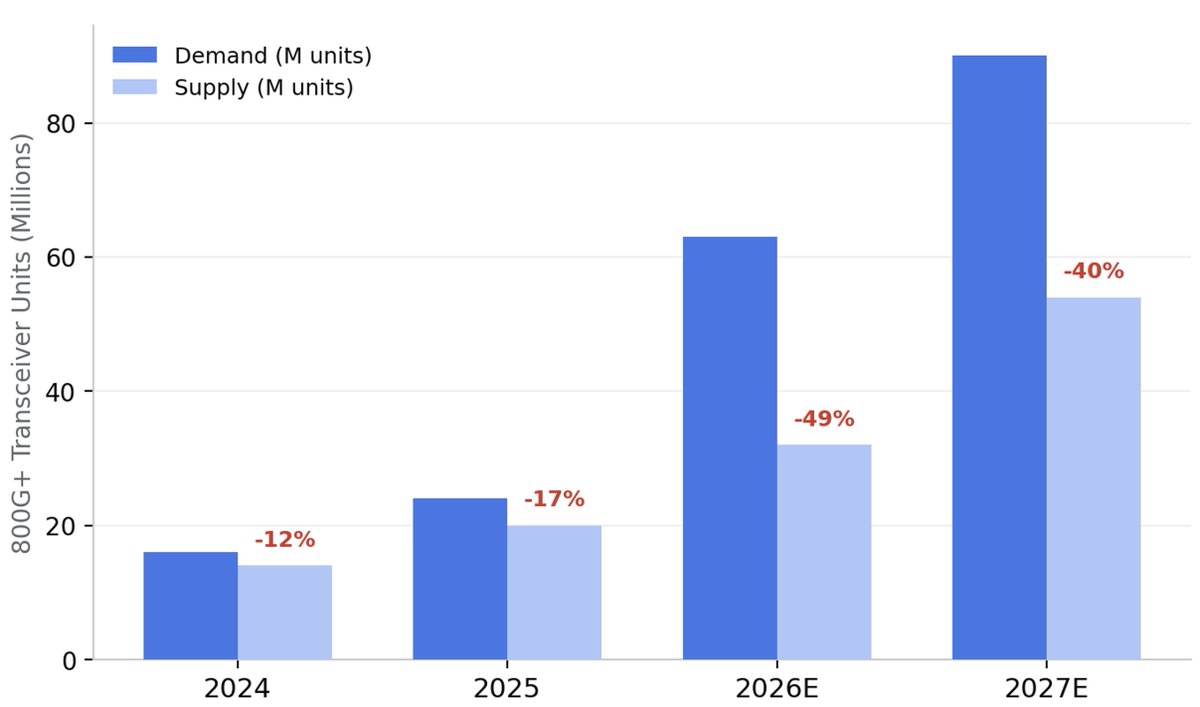
800G+ transceiver shipments are jumping 2.6x to nearly 63 million units in 2026.
The problem? McKinsey projected 800G production falls 40-60% short of demand through 2027. And 1.6T shortfalls of 30-40% persist through 2029.
$GOOGL alone needs 6 million+ 800G modules just for its 2026 TPU buildout. $META and $ORCL are doubling their capex this year.
Every GPU cluster over 100,000 nodes requires optical interconnects. There is no electrical alternative at these distances and bandwidths.
This is the most supply-constrained segment in the entire AI stack right now.
The AI optical transceiver market is hitting $26B this year. Up 57% from 2025.
800G+ transceiver shipments are jumping 2.6x to nearly 63 million units in 2026.
The problem? McKinsey projected 800G production falls 40-60% short of demand through 2027. And 1.6T shortfalls of 30-40% persist through 2029.
$GOOGL alone needs 6 million+ 800G modules just for its 2026 TPU buildout. $META and $ORCL are doubling their capex this year.
Every GPU cluster over 100,000 nodes requires optical interconnects. There is no electrical alternative at these distances and bandwidths.
This is the most supply-constrained segment in the entire AI stack right now.
US and China just agreed to slash tariffs. Geneva deal announced today.
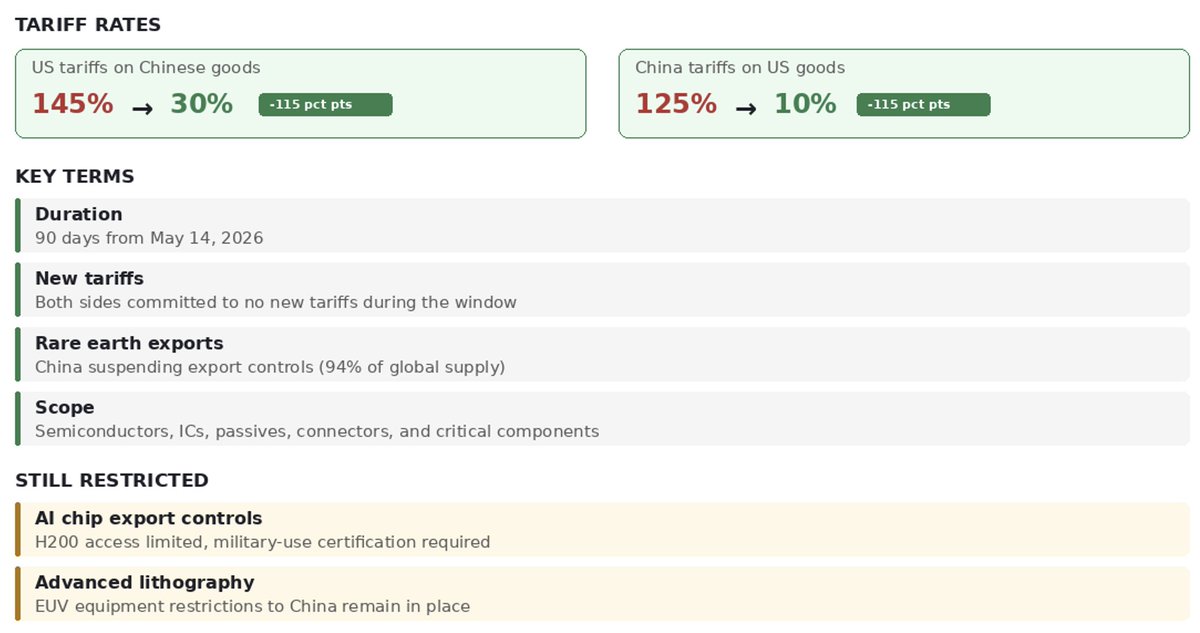
US tariffs on Chinese goods: 145% to 30%. China on US goods: 125% to 10%. 90-day window. No new tariffs during that period.
China is also suspending rare earth export controls. They control 94% of global rare earth magnet production. Critical inputs for semiconductors and AI data center hardware.
Semis, connectors, PCBs, integrated circuits were all getting hit at 145%. That overhang just dropped 115 percentage points overnight.
OEMs and distributors will front-run purchases inside this 90-day window. If you're building GPU clusters or data center infrastructure, you're accelerating orders now before the window closes.
90 days isn't permanent. But $725B in hyperscaler capex doesn't wait for trade certainty. It accelerates into every window it gets.
AI and semis sold off hard today. Nasdaq was down 2% intraday before recovering by close.
April CPI came in at 3.8% annual. Highest since May 2023. Rate cut expectations just took a hit.
Oil ripped above $108/barrel. Strait of Hormuz is still unresolved. Higher energy costs feed directly into data center operating margins. Power is the single largest line item for hyperscalers right now.
And the SOX index was up 65% year to date heading into today. SOXX was trading 60% above its 200-day moving average. 5-day RSI hit 98.7 last month. The highest reading in the index's entire history.
Hot inflation, an energy shock, and a technically overextended sector all hitting at once. That's a mechanical unwind, not a fundamental shift.
Hyperscalers committed $725B in capex for 2026. Up 77% from last year. $NVDA reports May 20. Jensen deployed $40B+ in equity investments across the AI supply chain this year alone.
The demand curve hasn't changed. The discount rate got repriced for a day.
Portfolio update. Still holding all five.
$INOD bought at $42 → now $80. +90%
$MRVL bought at $109 → now $166. +52%
$POWL bought at $250 → now $302. +20.8%
$COHR bought at $284 → now $318. +12%
$LITE bought at $828 → now $901. +8.8%
Every one of these names sits at a chokepoint the AI supply chain has to flow through. Custom silicon, optical transceivers, compound semiconductors, electrical infrastructure, AI data services.
$INOD nearly doubled after crushing Q1 earnings. 54% revenue growth, beat estimates by 25%, raised guidance.
$MRVL up 52% and still early in the data center networking buildout.
Thesis hasn't changed. AI infrastructure spending is accelerating, not peaking.
Which position do you want a deep dive on?
I posted this $INOD thesis on May 1 at ~$32. Near its 52-week low.
48% revenue growth. Only public pure-play in AI data annotation. Market was sleeping on it.
$61 after hours. $91 intraday today.
$90.1M in revenue. 54% YoY growth. Beat consensus by 18%. EBITDA beat by 139%. New Big Tech customer worth $51M. Guidance raised to 40%+.
This wasn't luck. I'll break down the exact process.
Scale AI is private and valued at $14B. Appen is declining. Labelbox is early stage.
$INOD is the only public pure-play in AI data annotation growing at 48% with positive EBITDA. There is nowhere else to get this exposure.
The concentration risk everyone flags (58% of revenue from one customer) actually tells you something. That customer is spending over $140M/year on data labeling with one vendor. That's not a contract you cancel. That's infrastructure dependency.
SHIELD defense clearances add a moat competitors can't replicate with funding rounds. You either have the clearance or you don't.
The question isn't whether AI needs labeled data. It's whether $INOD can diversify fast enough before the market gives them credit for it.
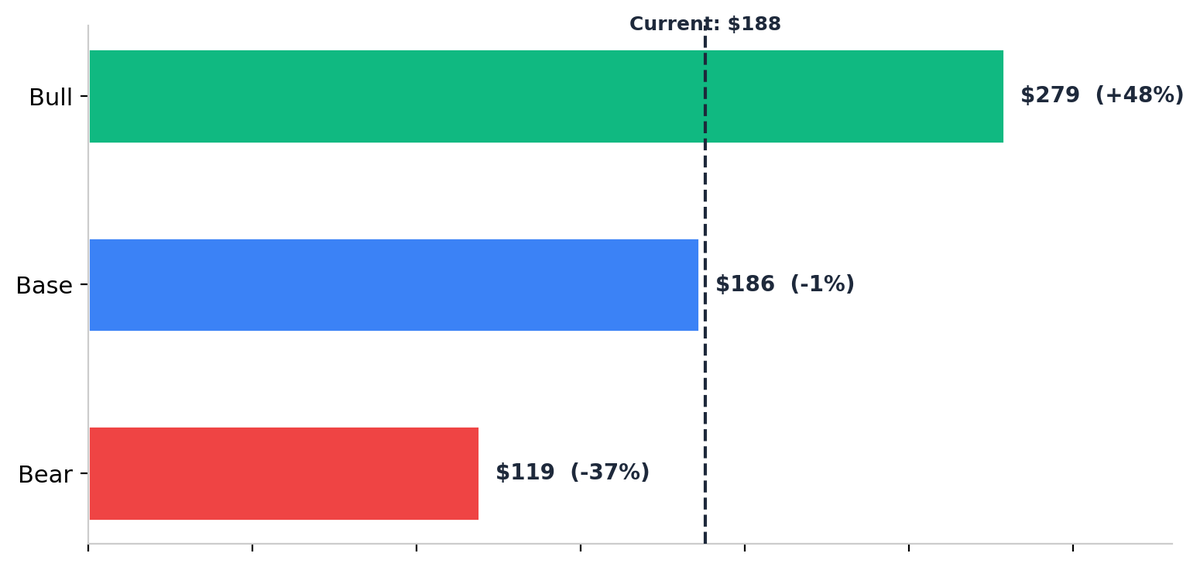
With $CRDO being at $188, the base case says you're paying full price for exactly what management already guided. No upside baked in. No re-rating. Just the numbers they told you.
Bear: $1.7B revenue at 12x P/S. ~$119 (-37%). Requires growth to meaningfully miss their own guide.
Base: $2.0B revenue at 16x P/S. ~$186. Flat. You're already here.
Bull: $2.4B revenue at 20x P/S. ~$279 (+48%). Growth slightly beats guide, multiple re-rates toward $ALAB territory.
Q4 earnings drop June 1.
The way I see it, paying base-case price for a company tripling revenue with 68% gross margins and $NVDA co-design wins is not where risk usually lives.
But the bear case is real. One customer concentration slip or a demand pause and this re-rates fast in the other direction.
Where do you come out on $CRDO?
Now the valuation.
$CRDO trades at 41x forward P/E with 201% revenue growth.
$ALAB trades at 81x forward P/E with 120% growth. $MRVL trades at 43x with 62% growth. $AVGO trades at 28x with 25% growth.
$CRDO has the fastest revenue growth in the AI connectivity space and a forward multiple roughly in line with $MRVL, which is growing 3x slower.
On a P/S basis, $CRDO sits at ~18x forward. $ALAB sits at 36x. If $CRDO re-rated to even 24x forward P/S on FY27 revenue, you're looking at meaningful upside from here.
$33B market cap. $193 stock price. Average analyst target: $209. High target: $260.