The lab coats stay on but the gloves are coming off. Welcome to Ro Research Lab 😈
We’re taking our real-world data about sex, GLP-1s, weight loss, relationships, and more and sharing our insights in real time. Follow along, folks. https://t.co/Q8Zid7LooF
Food noise drops fast on GLP-1s, and keeps dropping.
By month 1, patients' average RAID-FN (food noise) score fell 22% from intake. By month 6? 31%.
New data from Ro Research Lab on branded GLP-1s 👇
Ozempic nails? Let's pump the breaks. Once researchers looked closer, it seemed to be more related to someone’s medical conditions than to the medicine itself.
At the “JAMA and National Academies Present the Future of Obesity Care Delivery: Systems, Care Models, and Research” session at #OW2026, Dr. Louis Aronne emphasized that coverage—not demand—is the bottleneck.
“Care has to start with coverage.” —Dr. Aronne
GLP-1s are famous for what they take off your body. But as it turns out they take a lot off your mind too.
Reported food noise related self-hatred among our patients: cut in half in 3 months.
Medicaid stopped paying. Most of the prescriptions went with it.
Pennsylvania: −95.5%
New Hampshire: −88%
California: −75.2%
South Carolina: −60.8%
That's in just one quarter after 4 states dropped coverage for GLP-1s for weight loss. The 10 states that kept it? About −8%.
After 4 state Medicaid programs withdrew coverage for weight loss–approved #GLP1 drugs on January 1, 2026, prescriptions in those states declined sharply vs states that maintained coverage.
These findings indicate that Medicaid coverage policy can substantially affect access to pharmacotherapy for #Obesity treatment.
https://t.co/QTrz26HNUs
Insurance companies don’t make it easy to know where you stand with your GLP-1 coverage. So we did.
Our improved coverage checks and prior authorizations now live in one place on @ro - under your profile. See what's approved, what's in progress and what's next. No phone call required.
CVS just put a number on the GLP-1 break-even question. Using Aetna claims, they estimate that at ~$350/month, medical savings roughly offset the drug cost over 3 years.
Compared with matched non-users, GLP-1 users had:
- 10-12% fewer ER visits in years 1 and 2
- 14% lower odds of a major cardiovascular event
- 34-42% fewer hospitalizations among those still on the drug at year 3
At today’s employer prices (~$617-766/mo), plans saved $9,400 per person on medical but spent $13,300 more on Rx. Net: +$3,900.
The interesting part: cash prices (~$299-349) and Medicare’s $245 pilot price are already below CVS’s break-even. The barrier isn’t what these drugs can be sold for. It’s what employers are paying.
Family coverage now costs $28,303 a year (KFF). That’s why employers are dropping GLP-1s, not because the drugs don’t work. At ~$350/mo, they wouldn’t have to choose.
A few call outs: it's a CVS white paper... (insert disclaimers). Observational. Diabetes and obesity pooled. The year-3 group (n≈4,000) is people who stayed on, who may differ from those who stopped. And CVS has a seat at this negotiating table.
Affordability drives access.
@bryan_johnson if insurance companies weren't so heavy handed with denials maybe people could afford to take their medications 🥴 (data on insurance denials here, tldr: it's a lot https://t.co/YGPviNJvtU)
The @RoResearchLab team breaking down just how hard it is to get insurance coverage for GLP1s.
We’ve invested a ton of time and energy here to fight for patients at each step but it’s often pushing a boulder up a hill.
I’m hopeful as the ROI improves (breadth of label expands, we get more data on benefits of GLP1s and reduction in hc costs are proven out), coverage will increase but I do think it will take a while. Unfortunately, we see large companies like Starbucks and entire states pulling coverage (it’s going in the wrong direction)!
Petrelintide provides two things: ~10% weight loss in 42 weeks, and THE best trial name in the game (ZUPREME!).
One thing you won’t get? Nausea and vomiting, which was very similar to placebo... nice #ObesityWeek2026#OW2026
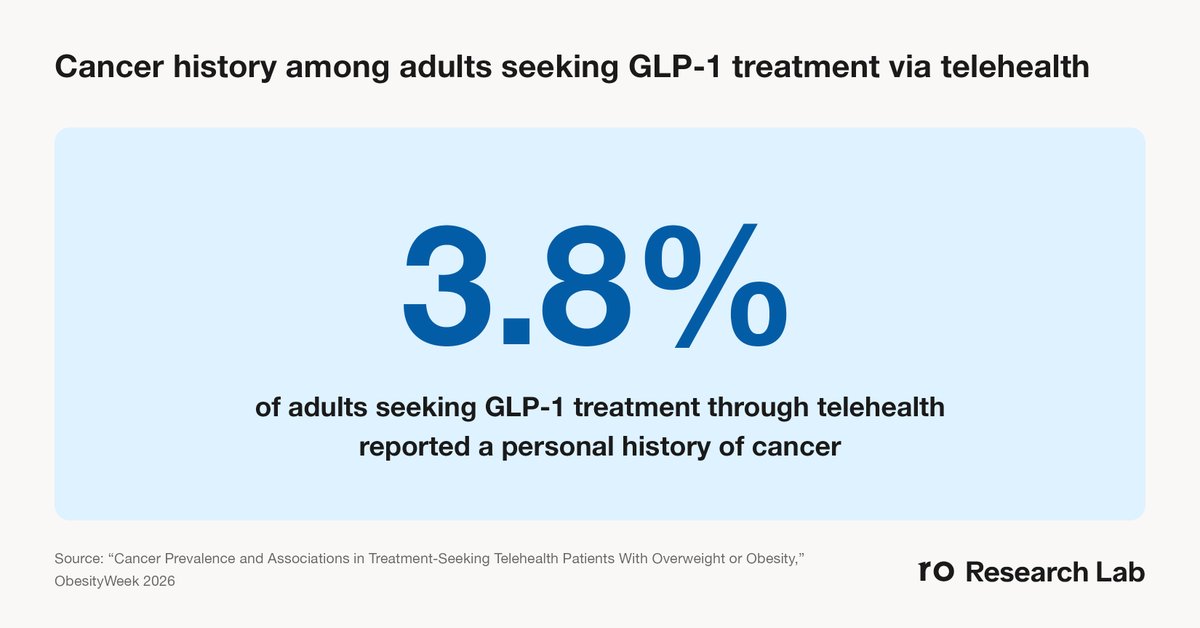
Could GLP-1s play a bigger role in cancer survivorship? We're exploring the possibilities.
Weight gain is a common side effect of some cancer treatments, and maintaining a healthy weight is an important part of life after cancer. While GLP-1s may offer a promising option for weight management, more research is needed to understand whether GLP-1 treatment or weight loss could help reduce the risk of cancer recurrence.
That's where real-world data can help. We collaborated with @AmericanCancer Society to explore how Ro's data could support future research on GLP-1s among cancer survivors. After further review, we found that cancer survivors make up a meaningful proportion of Ro’s patient population, highlighting an opportunity to help close these research gaps.
Research shows that being metabolically healthier is crucial to helping ward off cancer recurrence, and we see an opportunity for Ro Research Lab to help lead the way in answering important questions about GLP-1s, metabolic health, and life after cancer. #OW2026 #obesityweek2026