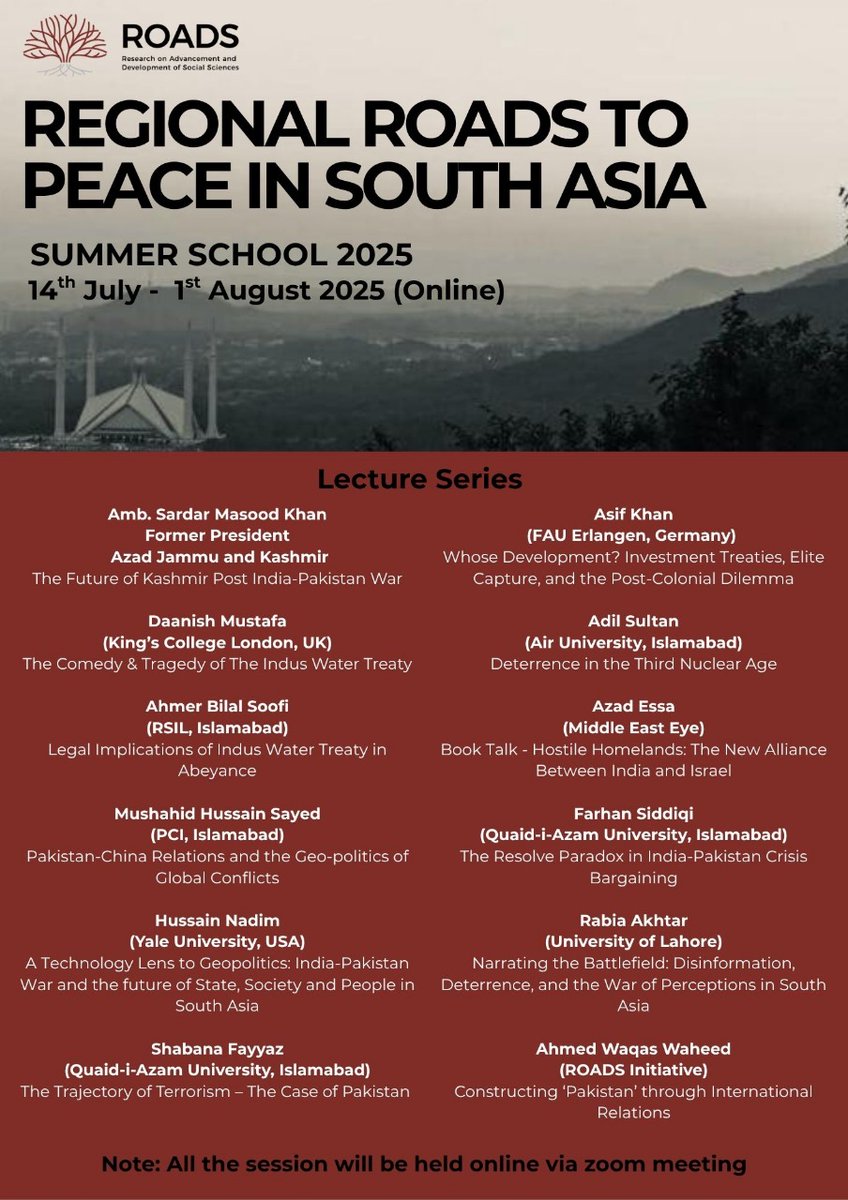
We are excited to announce that the former President of Azad Jammu and Kashmir, Amb. Sardar Masood Khan and Chairperson Department of Defense and Strategic Studies, Prof. Shabana Fayyaz have also agreed to join us for the Summer School.
Delighted to share that our research article titled “Exploring Coloniality of Knowledge in Pakistani Public Policy,” co-authored with my MS Supervisor Dr. Uzair Hashmi & Decolonial Author Dr. @waqaswaheed , based on my MS thesis, has been accepted by Third World Quarterly (Q1).
@USEmpire argues vociferously against Tony Blair's involvement in Palestinian issues. Palestinians, he argues, deserve self-determination, not a messiah who prays for peace while profiting from war. Please also sign the petition https://t.co/LLK5QHnQDX
https://t.co/XWVURsGEDM
Our colleague at @fass_air, Dr @waqaswaheed has published an excellent book on "The Myth of Decolonization and the Global South".
This is well researched and addresses structural and ideological impediments in indigenous knowledge production in the post colonial era especially the field of IR and social sciences in Pakistan.
A must read for all those who are associated with HEI's, to understand why we have not been able to develop new and indigenous thought processes.
@fass_air (Air University) will have a conversation on this book in November at our new H-11 campus.
Regs
Nothing beats the satisfaction of holding years of toil in your hands. This book is dedicated to my peers in the Global South suffering from crushing neoliberalism conditions & a response to my peers in the North who have reduced decoloniality to mere epistemological tweaks.
My book has a webpage now! 🥳
Check it out and order it for your libraries. Maybe you might learn a thing or two about the social life of International Relations in the Global South and Pakistan or why 'global IR' and 'decolonial IR' have it backwards .
https://t.co/nvxTT60ekx
I argue that rather than representing tech modernization, Pakistan’s surveillance-driven governance shows a deepening of its postcolonial crisis, a crisis in which digital tools are used to mask institutional fragility &reproduce the very hierarchies the state claims to transcend
Pakistan’s digital surveillance technologies, from NADRA to PECA, do not modernize governance but instead reproduce colonial logics of control that deepen exclusion & simulate sovereignty thru coercion rather than consent, writes @Haleema_Saadia
Read more: https://t.co/RLXonMP5vm
In this blog Sana Alam argues that Pakistan’s struggle with terrorism is deeply rooted in its historical alliances, political decisions, and external interventions.
Read more: https://t.co/8pNP5TwGyj
In this blog @theinamnaqvi argues that India and Pakistan remain trapped in a cycle of escalation without meaningful post-crisis diplomacy, where nationalist politics and militarized mindsets perpetuate instability and chaos.
Read more: https://t.co/GnsV2dmQNl
In this blog @haris_basharat argues that Pakistan’s nationalism is trapped between the Islamic moral vision & the colonial modern state it inherited. This unresolved contradiction rooted in epistemic coloniality continues to shape its gov & policy-making.
https://t.co/joSuuiweLp
In her piece Decoloniality and AI, Ayiza Salman argues that the rise of Artificial Intelligence is entangled with ‘techno-neocolonialism,’ where resource extraction, data appropriation, and exploitative labor practices replicate colonial power dynamics.
https://t.co/uqva7miwwe
Grateful to the @RoadsInitiative Dr. @waqaswaheed for the opportunity to speak to such an engaged and thoughtful cohort of fellows. It was a truly enriching interaction as we explored how narrative is fast becoming the new battlefield in contemporary geopolitics. In an age of disinformation and perception warfare, shaping the story can shape outcomes. Thank you for the warm welcome and the meaningful dialogue. Conversations like these are essential for preparing the next generation of strategic thinkers.
Delivered a session at @RoadsInitiative last week on:
"A Technology Lens to Geopolitics: India-Pakistan War and the future of State, Society and People in South Asia"
Some key points from my talk:
1. India and Pakistan are both artificial constructs and the people must see them as what they are - a fleeting moment in the long history of this region; not some divine entities that are here forever. The people will outlive these silly notions of state and religious identities.
2. Technology has fundamentally challenged the core concepts of what it is to be a human, society, and nation. The future of the state is societies built around AI, not AI built around existing society and state. Humans will be the participants in this new infrastructure that would either liberate or enslave the human depending on what kind of people are the helms of AI.
3. Much of the global chaos and uncertainty we see right now is primarily due to this technological rupture - the speed of tech R&D moved faster than our ability to absorb it. Net result is the total collapse of existing infrastructures of power, economy, and culture.
4. The global leadership, especially the leadership of India and Pakistan are both incapable and lack imagination on how to operate in this new world of uncertainty and change which is why they keep resorting to Machiavellian and Hobbesian instincts on negotiating.
5. India and Pakistan have a real opportunity to build a new society for over 2 billion people in South Asia, that isn't structured around the ridiculous Radcliffe border but something much more tangible, like culture and technology.
Technology is the single most significant element of decolonisation, if done right! Much of the work we do at @3rd_AI_ is building technologies that democratise, empower, and enable the humans.
Looking forward to my talk this evening in the Summer School by @RoadsInitiative I will be speaking on 'Narrating the Battlefield: Disinformation, Deterrence, and the War of Perceptions in South Asia'. Thank you for the opportunity Dr. Ahmed @waqaswaheed
We are excited to announce that the former President of Azad Jammu and Kashmir, Amb. Sardar Masood Khan and Chairperson Department of Defense and Strategic Studies, Prof. Shabana Fayyaz have also agreed to join us for the Summer School.