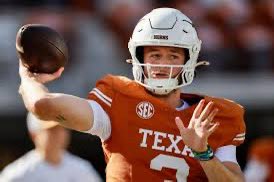
BREAKING: QB Brendan Sorsby and Texas Tech are mutually parting ways, @PeteNakos reports.
Sorsby will not play College Football in 2026.
https://t.co/IG2DYwzv4c
The Big 12 has gone to federal court to ask permission to have a conviction. There was a time when a conference could simply disapprove of a player who bet on his own team's games. Now it needs a declaratory judgment first.
The Texas AG's threatening letter to the Big 12 was an unforced error of the first order. Strip it out and there's no lawsuit— because there's no justiciable controversy. A conference privately mulling a sanctions vote isn't a "case"; it's a meeting. The AG's 200M per se antitrust threat is what manufactured the ripeness, handed the Big 12 its MedImmune, Inc. v. Genentech, Inc hook, and let Sidley walk into federal court in Dallas with a complaint instead of a press release. Paxton's office didn't just pick a fight— it wrote the other side's standing argument for them, then signed it. Now TTU and the AG get to defend a theory the Oklahoma AG already called "facially absurd," in a real courtroom, against a national firm on its home turf. The letter was meant to intimidate. It functioned as service of process.
The complaint itself is well made, and its strongest section is also its most dangerous. Paragraphs 32 through 36 are devastating on TTU's hypocrisy: TTU voted for the Baylor sanctions in 2017 and now insists the conference has no power to sanction anyone. That is good lawyering, and it should sting.
But it cuts both ways. Baylor was sanctioned after findings, through process, for institutional conduct. The Big 12 wants to sanction TTU preemptively, for fielding a player a Texas court has enjoined the NCAA from declaring ineligible.
The state court injunction is the elephant in the room, and paragraph 62 works very hard not to look at it— "this isn't about the injunction." But it is. The District Court of Lubbock County enjoined the NCAA from barring Brendan Sorsby from practicing or playing for Texas Tech, on a 5K bond, through a trial not set until February 2027. The practical effect is that Sorsby plays the entire 2026 season. The Big 12 now asks a federal court to declare that it may bar Texas Tech from competing for letting him. Strip away the labels, and the conference is asking one sovereign's courts to restore the very exclusion another sovereign's court just lifted—relabeled, from "NCAA eligibility" to "conference governance," but identical in result.
That's a real trap, and it is structural. Federal and state courts keep a wary distance from one another's orders; neither likes to be handed the other's ruling to undo. A federal court will rarely enjoin a state proceeding, and it is nearly as reluctant to grant relief that achieves the same end through the back. The Big 12 was shrewd to choose a declaratory judgment over an injunction— a softer vehicle that does not, on its face, touch the state order. But that shrewdness cuts both ways: declaratory relief is discretionary, and a federal judge may simply decline to issue a declaration whose only real function is to neutralize a state court's ruling. The conference says it is exercising independent governance authority. A skeptical judge may see a conference trying to do through the side door what a state court has barred the NCAA from doing through the front— and may decline to hold the door.
The Big 12 should win this, and it should win because the law is not actually close: a private association enforcing its own bylaws against a member who bet on his own games is ordinary self-governance. The Texas AG has managed the rare feat of threatening a lawsuit so weak that he walked his adversary into court, drew a public rebuke from a fellow attorney general within 24 hours, and turned a meeting the Big 12 might never have held into a federal complaint with his own letter stapled to the back as an Exhibit. Crazy times.
Thanks to @TomMarsLaw for making the complaint available.
@CorporalKscards@BarstoolBig12 Those crimes should be handled by the teams…there should be punishment for those as coaches are molding young men. Full stop. However, those things, although abhorrent, do not impact the integrity of the game.
The courts don't take on cases unless there's an actual controversy at issue. The system is constantly at capacity, and we don't try cases for hypotheticals - only when there's a real dispute to resolve.
Texas Tech wants this to drag out. If they'd mostly kept their mouths shut, they could have waited for any punishment, and then sued to stop the rules in the venue (particular court) and time of their choosing.
Texas Tech's wishy-washy statement saying they weren't party in the dispute helped to distance any controversy between them and the B12/NCAA. But then Texas AG Paxton threatened to sue anyone who enforced rules against him, making it concrete.
That opened the door for the B12 to proactively file a DJ now so things don't drag out into the season, and likely venue shop for a neutral judge. It helps the Big 12 and NCAA gain control of how things proceed hereinafter.
NEWS: The Oklahoma Attorney General's office issued a rebuttal letter to the Texas AG's office's letter to the Big 12. Oklahoma AG Gentner Drummond says that the idea that Big 12 may not sanction its members is “facially absurd” and says Texas Tech’s actions have “constituted a shameful chapter in the story of college football.” Per me and @max_olson.
@sholnufff@TTU_86@CJVogel_OTF Cinci should be dealt with. Full stop. However, that’s in the past and THIS is current times. The integrity of the game can not stand for a habitual gambler to play.