@WalkerDReynolds 💯 These tools can help an experienced engineer test new ideas faster and iterate more quickly, but the innovative spark still has to come from a human.
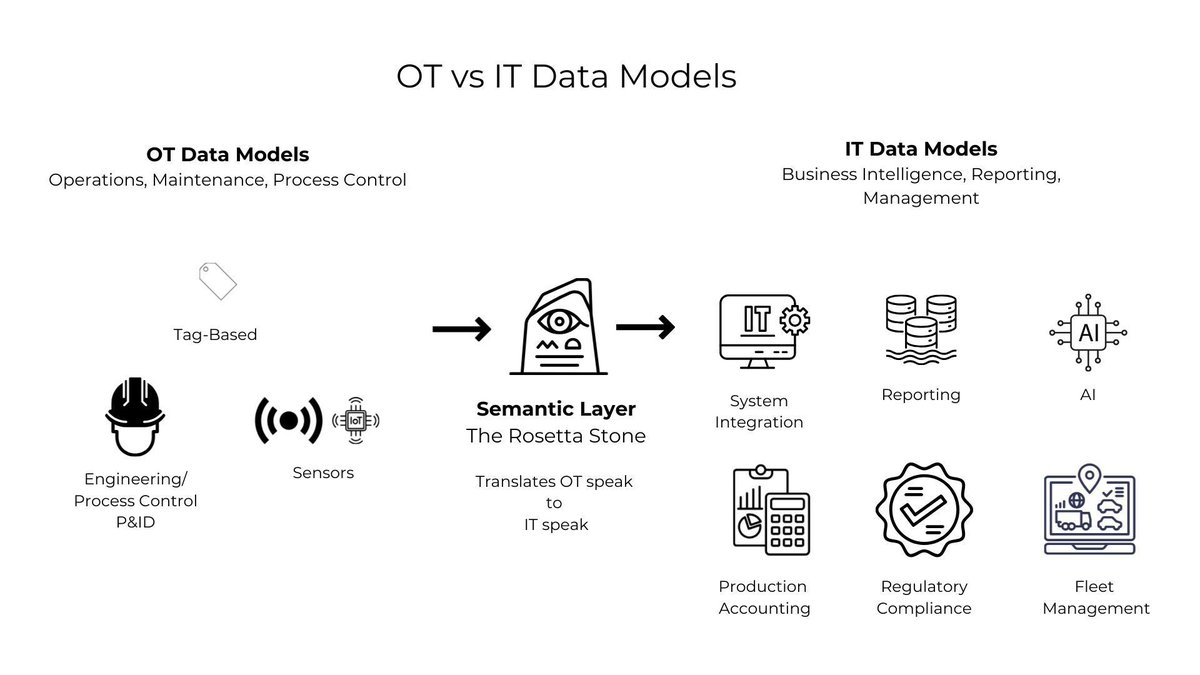
I've been posting about developing effective semantic layers to bridge the OT data models to more user-friendly IT data models.
CESMII is working on standards for this. https://t.co/ie2Ez8HeDg
The OT side has developed needed standards for other problems to increase interoperability, but these standards are usually implemented in proprietary solutions. Each vendor creates their own version to implement the standard. Interoperability between the standard implementations is still an issue, and new features are adopted on different schedules. Vendors often implement new features that are not standard to meet their needs undermining interoperability.
The pitfalls of the standards approach are well known. Open source should be able to alleviate some of these issues. It has on the IT side, but OT adoption of the strategy is rare. This seems like a leadership issue to me. What do you think is needed?
I’ve volunteered to contribute to the Linux Foundation’s State of the Edge report, specifically the section on Industrial Edge.
The Industrial Edge is where IT meets OT, deploying compute resources close to manufacturing lines, energy systems, and logistics operations. Think real-time monitoring, predictive maintenance, AI deployments, and similar applications.
I’d love to tap into the collective experience of the X community.
What are the most important trends, challenges, and opportunities at the industrial edge?
Your insights could shape the Linux Foundation's most-read report. Please drop your thoughts below or DM me.
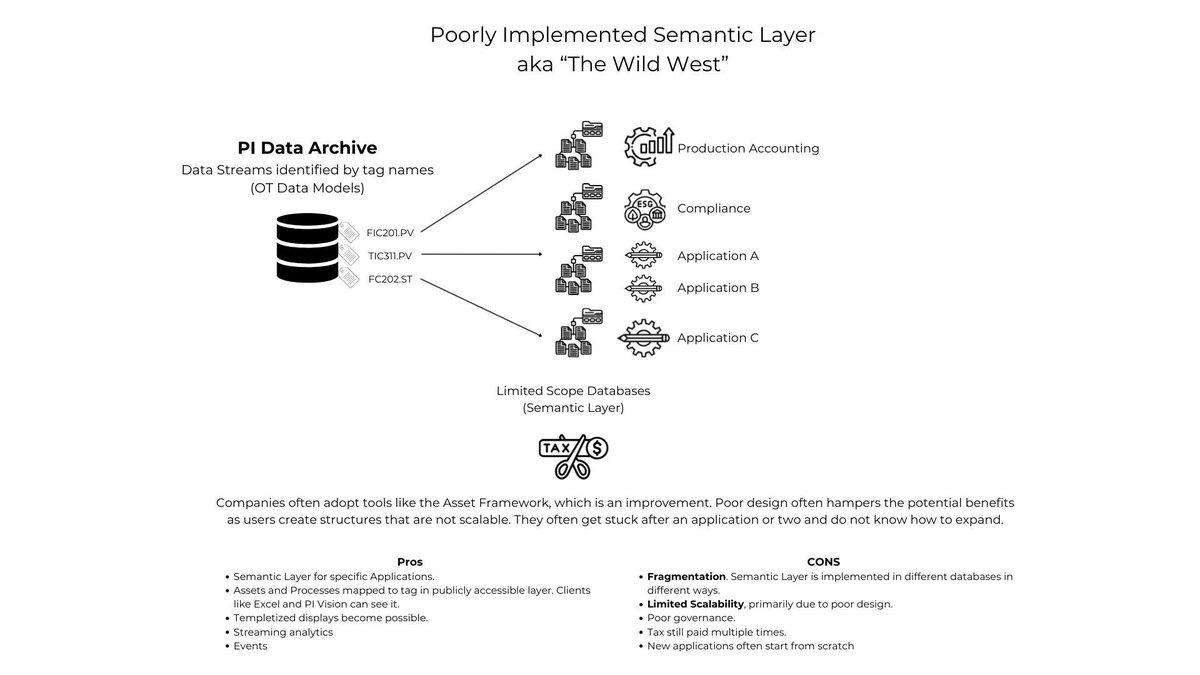
Poorly implemented Semantic Layers result in the "Wild West"
The next step in historian evolution at most companies involves poorly conceived semantic layers that over-fit the problem being solved. They are not generalizable enough to be widely reused so they address one problem or a limited set of problems. New problems get put in new databases. Databases are implemented differently for different applications. Nothing is reusable or scalable.
There are still benefits, but there is still too much unrealized potential.
Poorly implemented Semantic Layers result in the "Wild West"
The next step in historian evolution at most companies involves poorly conceived semantic layers that over-fit the problem being solved. They are not generalizable enough to be widely reused so they address one problem or a limited set of problems. New problems get put in new databases. Databases are implemented differently for different applications. Nothing is reusable or scalable.
There are still benefits, but there is still too much unrealized potential.
Why do Historian systems get stuck at a primitive level?
Advanced use cases like Condition-Based Maintenance, Fleet Optimization, and AI integration are never realized. Companies leave millions of dollars on the table, shouldering the cost of avoidable waste and downtime.
The main problem is that they brute-force the absolute essentials and never develop a systematic approach to using the system. These essentials take so much time and effort that they can't scale to the next level of nice-to-have applications. They get stuck fighting fires and never have time to prevent the problems.
There are several ways to deal with the brownfield technical debt associated with a lack of adherence to tag naming conventions or changing control system landscapes, which results in changing standards. Most systems have tags that are decades old and have been collected by a series of control systems as equipment is upgraded.
A popular tag naming approach to mitigating this issue is establishing a unified namespace (UNS), which uses tagging conventions to develop a taxonomy. This approach is appealing, and there is nothing wrong with it, except you run into logistical constraints in extensive brown field remediation, as renaming all of your tags is a nonstarter. It is an appealing approach because it is conceptually simple and requires no new tools. It is essential to realize that taxonomies are a tool in semantic modelling, but only a subset of what you can and should do.
Having a tool that can implement a namespace while aliasing the existing tags allows you to build what you need as you need it, without having to tackle the enormous task of renaming everything all at once. It also has the advantage of multiple aliases pointing to the same tag.
The Linux Foundation's LF Edge group publishes the most widely read Linux Foundation publication, the State of the Edge report. I contributed to the Industrial sections last year and will again this year.
Last year, I discussed the skills gap in the OT world in adopting new technologies. Let me know if you have any thoughts on trends or concerns for this year.
https://t.co/VjqTWPAczW
Did you hire a new Data Scientist and expect them to make sense of your OT data mess? Many companies are disappointed with the results.
A Semantic Layer translates your OT-centric data models into the data scientist's IT models. It is the key to turning operational data into business insights at scale. Without this layer, each user has to organize and relate the OT data to data in other systems by hand. You hired one of your most expensive employees, asked them to build the Panama Canal, and gave them a spoon.
Give your people the infrastructure they need to be highly productive by building a proper Semantic Layer
"I just need the PI tags for..."
Hearing those words means you haven't built a semantic model to group your tags into assets or processes and relate to data in other systems. The person asking you for the tags will have to arrange everything from scratch, probably in a spreadsheet.
This becomes a hidden tax on every analysis anyone does. You pay it over and over again.
Today, industrial OT applications are specialized proprietary Windows-based applications often deployed in VMs. This was IT tech from over a decade ago, with each vendor doing things its way.
As OT systems adopt more modern IT designs, often based on open source technology, an IT DevOps approach to deploying and securing OT applications is required. OT needs standards and baseline designs.
I'm still learning about Margo, and I hope I'm describing it properly. I started working with the Linux Foundation on Fledge some years ago, so I'm excited to see another LF OT project. I will be looking out for the videos in this series.
Introducing Margo 101: Series Introduction & What's Next https://t.co/b3KVQI1B2H via @YouTube
Many companies get stuck on the OT data model using ICS tags as the basis for identifying the data streams in their Data Historian. Adopting naming standards seems like an easy way to impose some order, but it always falls short
You need a full semantic layer to organize your tags, relate it to phycial assets and processes, and relate the process data to data in other systems.
Over 25 years ago, I started integrating IT and OT systems, beginning with deploying emissions monitoring systems to meet Clean Air Act compliance, pushing my company to adopt new technologies. This early work led me to install the first PI System data historian, integrating most operations and setting the stage for a career consulting with multi-billion-dollar industrial firms worldwide.
Today, I’m Co-Chair of the LF Edge Fledge Project Technical Steering Committee, driving next-generation edge computing innovations for Industry 4.0. I’ve pushed data historians to their limits and want to share my insights on this feed—follow along for thoughts and insights in industrial IoT and IT/OT Integration!
It’s funny that I’ve worked on transformers that are older than I am. They built them to last forever, which is a good thing.
Demand in the US stagnated as industries globalized moving overseas and energy efficiency gains cancelled additional load due to population growth.
There was no need to expand manufacturing capacity. Now there is.
@adamgusky It needs an option to automatically create git commits prior to making changes so you can see what exactly changed. It’s too easy to forget to manually commit as you’re working.
It is the mark of a genius to make this material so approachable. I wish material like this was available back when I first started studying this subject. @karpathy, I can imagine how many young engineers will start with a much better understanding not only of this particular subject,but also how to communicate technical subjects. In this respect, you are the Feynman of our age.