University Professor, Claremont Graduate University. Books include “Policy Analysis for Big Issues: Confronting Corruption, Elitism, Inequality, and Despair”
Here's what I think encapsulates the main problem with the current X algorithm:
I've spent many hours browsing X over the past week, switching between For You and Following. I've seen approximately 1 billion tweets about Nowak, plus a lot of useless content like the example below, which doesn't even have a good like ratio.
I just went to the profile of one of my favorite accounts, @arctotherium42, and found many tweets I've never seen, even though they have strong like/view ratios of 3-5%. It can't be right that I'm still not shown his content despite following him, engaging with and liking his posts frequently, and regularly checking Following.
There are three things X could and should do here:
• Give more weight to accounts I follow.
• Give even more weight to accounts I follow whose content my history shows I especially like.
• Going further, I have a vision for a feature I'd call a "superfollow." Every user gets a handful of superfollows. A superfollow surfaces far more of that account's content in your feed.
And here's the main hook of this vision: payouts could be partly based on how many superfollows an account has. This would reward genuinely good content over engagement bait.
A shockingly common (implicit) view: "It would be better if the world's problems were not solved so that people can find purpose in solving these problems." Or for knowledge work, "It would be better if knowledge were unknown so there is more for humans to discover."
These views seems absurd to me. Many people (including myself) find value in working to improve the world. But what's important to me is *actually fixing the things that are wrong because those things are bad.*
If AI can fix these problems, the right attitude is not, "This sucks because what are humans supposed to do now?" The right attitude is: "Now we can focus on finding other sources of meaning and value beyond alleviating suffering, what tremendous news this is for the world and what a great relief!"
For knowledge work, once again, discovery is fun and valuable and rewarding to the ego. But the reason we care about discovery is that we want to understand! And with AI, we will understand vastly more.
The idea that we don't want AI so there is more for humans to do or discover ignores that most of the value of these is instrumental. Sure, discovery is pleasurable for the person who does it, but for everyone else, it's good because now we can understand more.
Some ways my thinking has evolved recently:
1. I'm less concerned about those who are incurious about AI as I expect them to eventually see the value and impacts over time, and I think the 'wake up sheeple' vibe is often counterproductive. On the other hand I'm more concerned by what seems to be neither full 'AI psychosis' nor exactly Eliza effect, but some weird in-between. Also a lot of affirmation by models can probably warp one's sense of epistemic humility and lead to some sort of pathological over-trust.
2. Relatedly, I'm more annoyed at the 'this time it's totally different' vibe that a lot of people adopt as it frequently mimics Schmittian 'state of exception' logic and excuses all sorts of undesirable policies and rhetoric. It's also often just a group signalling exercise. To be clear I do think it's different in important ways, but "this is a marathon, not a sprint" seems closer to the right attitude than either "nothing has changed" or "all normal reasoning and empirical work to date is suspended".
3. I think the field is still fundamentally too 'singletonian' in how it imagines intelligence, markets, and governance - but I also think I've occasionally over-emphasized the 'multi-agent'/decentralization frames. I do think the future includes many models of all sizes and types, but also economies of scale and very large corporations too. I find the whole ecology more interesting than just the frontier model. A top down single 'perfect mind/personality', intended to work across all commercial contexts, seems both inflexible and inefficient.
4. I'm more interested in the harnesses, software, agent architectures, and stuff like RLMs than I was before. I feel like a lot of weaknesses that models have, or behavioural tendencies, can be addressed more effectively through that layer (rather than through model 'internal virtue' alone). For example stuff like: https://t.co/MHG4onCbDo and https://t.co/8ibuxKYFrA
5. I think some researchers are too quick to want to defer highly consequential decision-making to models, or to think of alignment as the models internalizing "I'm afraid I can't do this, Dave" as a core protection against all sorts of ills. I think we should think carefully about *actively* creating principal-agent problems with agents that will permeate society. Delegation is not a free lunch.
6. I'm concerned about how few people think about LMICs and building the technical/institutional infrastructure there for AGI diffusion. We need fewer vague essays about “distributing the benefits of AI” and more work on reducing barriers to trade, improving state capacity, rebuilding development institutions, and making something like USAID/IMF-for-the-AGI-era actually work.
7. I used to be slightly more sympathetic to the idea, directionally - but I now think the 'permanent underclass' meme is a bit dumb. The strongest versions often assume a zero-sum view of technology and labour, a too-static view of human adaptation, a weirdly fixed mapping between today’s skills and tomorrow’s opportunities, and ignore the possibility of catch-up growth (at the nation state level). Also, as a meme among extremely rich and mobile people, it has a slightly comic self-pitying quality.
8. I'm more concerned about the lack of intellectual diversity within the frontier AI commentariat/research world. This improved a lot over the last two years, but we're still far from a healthy ecosystem. New outsiders often feel some unnecessary pressure to 'choose a camp'. Many are too unwilling to engage with domain experts merely because they're insufficiently AI-pilled (though conversely, a lot of academic groups suffer from heavy status quo bias).
Happy birthday to G.K. Chesterton, who was born on this day in 1874.
A man of great wisdom. Thoughtful, cheerful, and enchanted with creation, as all men with a deep faith in the Lord tend to be.
“It is the main earthly business of a human being to make his home, and the immediate surroundings of his home, as symbolic and significant to his own imagination as he can.”
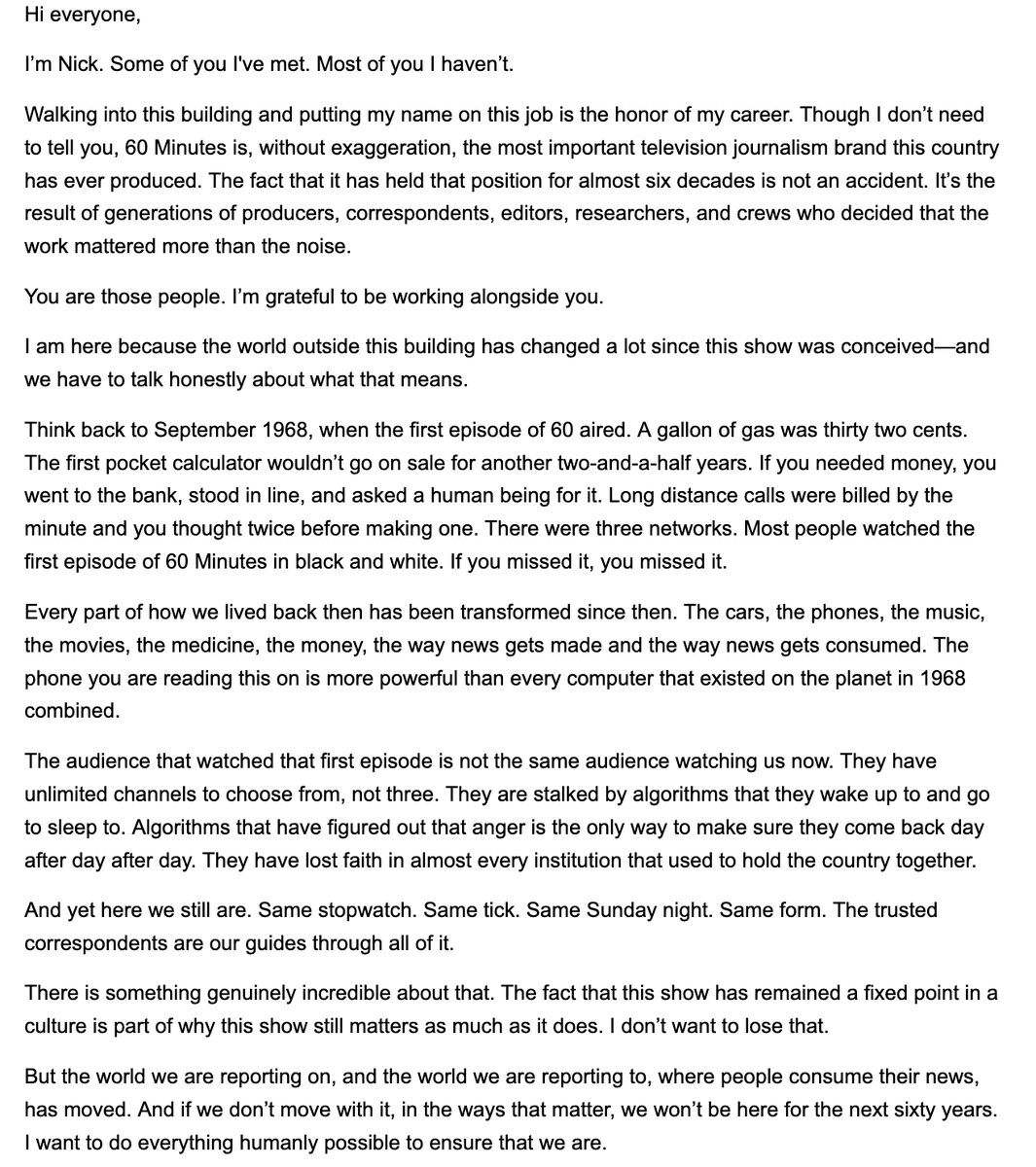
It's the honor of my career to become the executive producer of 60 Minutes. I just shared the note below with the incredible staff and can't wait to get started.
The poverty trap "doesn't generalize." And even within the excellent target paper, "the denominator matters." FN for 2026: the AI revolution will render "poverty traps" moot. Thank goodness.
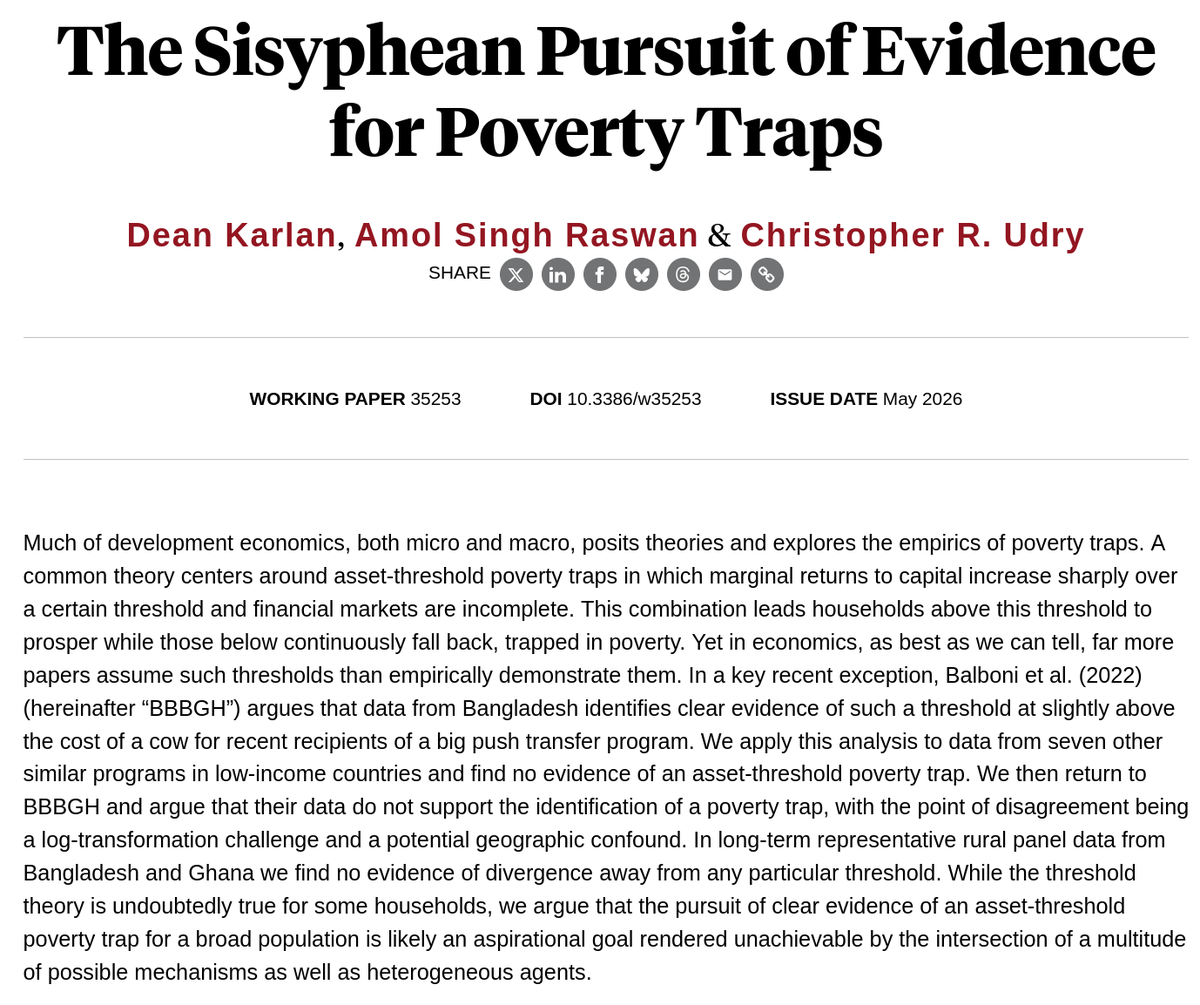
New working paper with @AmolRaswan and Chris Udry: "The Sisyphean Pursuit of Evidence for Poverty Traps."
A central idea in development economics is that poverty can trap people. We went looking for the cleanest evidence. Here's what we found – and didn't.
The annual Pentecost tradition (today!) at Rome's Pantheon is a moment of extraordinary beauty.
It occurs every year on the seventh Sunday after Easter. At noon, after the Holy Mass, thousands of rose petals are dropped through the oculus of the mighty dome.
As the petals fall, a choir sings "Veni Sancte Spiritus," known as the Golden Sequence, a masterpiece of sacred Latin poetry.
This is to celebrate the descent of the Holy Spirit on the Virgin Mary and the Apostles.
The rose petal ritual likely dates back to 607 AD when the pagan temple became a Christian church.
@KonstantinKisin Both-and. Diverse cultures (etc.) PLUS an overarching identity. A challenge for countries, corporations, universities, and faith communities.
"Dad books" — which this article, and some publishing insiders, use to describe "serious nonfiction" books across biography, current affairs and business and economics — are reportedly in a free fall, with sales declining every year for the last few years
“The trend couldn’t be clearer,” said Jonathan Karp, the former chief executive of Simon & Schuster and publisher of the new Simon Six imprint.
“When we have internal meetings to talk about this problem, it always comes around to podcasts,” said Jonathan Burnham, president and publisher of the Harper Group at HarperCollins Publishers.
@sebkrier And the moral versions: cf. reactions to printing press (porn surged), radio (Hesse’s Steppenwolf reviling symphony broadcasts), television, Internet . . . And they all had a point.