Critical metals such as scandium are essential to technology and infrastructure. Technology and infrastructure enable progress. If we do not progress, we fall behind, and the wolves get in the door.
Energy powers every step of the way to independence, security, and prosperity…
@AgniSemi’s non-volatile memory chips, manufactured with aluminum scandium nitride (AlScN) from @SunriseMetals, are set to power the next generation of geothermal power by @IPulseGroup, AI, and all manner of heavy-duty, high-temperature applications.
These are the chips of the future that will allow us to get there…
Read this @PHLBizJournal article on our investment in Agni Semiconductor: https://t.co/ucV0e3KQS4
Read this great article in the Philadelphia Business Journal about Agni Semiconductor and our investment in the non-volatile memory chip maker.
The @PHLBizJournal explored the applications for @AgniSemiAI chips to meet the processing and energy demands of AI, and to operate in extreme temperatures common for both civilian and defense applications. Today’s standard memory chips can only operate up to 200°C. Agni is developing advanced memory chips that can operate at up to 600°C, making them ideal for heavy-duty, high-temperature applications, such as @IPulseGroup’s geothermal drilling at the Millungera Basin.
Additionally, Agni’s non-volatile memory chips are extremely energy-efficient, addressing one of the key constraints to AI: energy consumption. The chips are set to serve as a “replacement for AI processors … that is much lower cost, much higher speed,” said Agni CEO Chris D'Couto.
Sunrise Energy Metals’ investment in Agni marks an important first in advancing our strategy of
participating in the downstream value chain for scandium produced from our 100% owned Syerston Scandium Project in Australia. “The investment represents an attempt by Sunrise to capitalize on applications for the raw materials it harvests. Agni’s memory devices are built using scandium, a rare and expensive metal Sunrise is hoping to extract from a large site in southeast Australia,” Reporter Nishanth Barghava noted.
Sunrise Energy Metals is developing the Syerston Scandium Project, the world’s largest and highest-grade scandium deposit, set to become the first primary scandium mine rather than a by-product source. Our deposit holds over 32,000 tonnes of contained scandium in mineral resources: enough to meet global demand for many decades to come.
Read the full article here: https://t.co/TW44Bxecab
#Scandium #Semiconductors #Chips #Technology
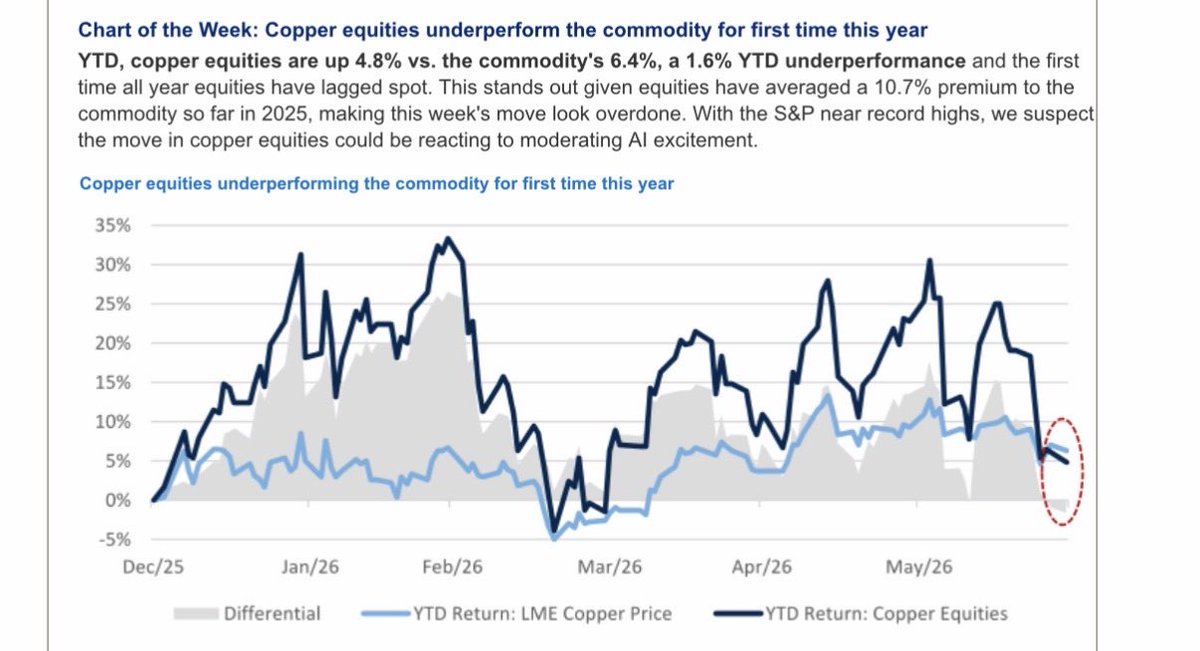
Analysis out by @RBC today rightly points out that copper equities are underperforming the underlying copper price for the first time this year.
Copper prices are off only ~5% since hitting all time highs earlier this month, whereas the sell off in copper equities is significantly higher as shown in this chart 👇.
Copper equities are oversold. The copper price outlook is bullish. The dip will be bought. Copper equities will soon catch up.
Chinese zinc smelters are cutting capacity, which will continue to drive zinc prices higher.
Sixteen major Chinese zinc smelters, representing 4.7 million tonnes of annual capacity (> 75% of the country’s primary zinc smelting capacity) agreed at a quarterly industry meeting in Xining last week to reduce zinc concentrate consumption by 600,000 - 1,000,000 tonnes this year, according to @Bloomberg.
The cuts come as Zinc treatment charges (TCs) are already at historic lows, which are impacting smelter profitability.
Spot zinc TCs according to @Fastmarkets are NEGATIVE $95 per tonne CIF China. Smelters are therefore paying (not charging) their suppliers $95 per tonne to smelt their metal.
LME copper stockpiles continue fall. As previously mentioned, on April 30th, net available LME copper stocks were 350,850 tonnes.
Today, on June 30th, LME copper stocks are 329,225 tonnes with 127,300 tonnes as cancelled warrants = net available 201,925 tonnes of copper. A reduction of nearly 45%.
Both the LME to SHFE (China) and LME to Comex (USA) arbitrage remains open, continuing to pull LME copper metal stocks to both the USA and China.
Today, the December 2026 Comex premium is $570/tonne and the SHFE premium is ~$50/tonne. The market is anticipating US tariffs.
Reminding people of what @Citi and @MorganStanley said earlier this month: buy the dip in copper.
While copper is off recent highs, its fundamentals are unchanged. Stocks of LME copper continue to rapidly decline. The chart below shows LME copper stocks falling despite recent wider market noise.
Two months ago on April 30th ($6.00/lb. on the COMEX), LME warehoused copper stocks were 399,725 tonnes, with 48,875 tonnes as cancelled warrants = net available copper of 350,850 tonnes.
Today, LME copper stocks are 339,100 tonnes with 133,225 tonnes as cancelled warrants = net available copper of 205,875 tonnes.
Across our operations, 92% of our workforce is locally employed, including 100% local employment at the Kipushi concentrator.
At Platreef, 69% of employees and contractors are from local communities, with nearly 30% female representation.
Local talent. Long-term impact.💥
Watch 👉 🎞️ In this interview with Rick Rule in advance of the Rule Symposium 2026, @IvanhoeElectric President Taylor Melvin discusses how the company is advancing its Santa Cruz Copper Project in Arizona, its proprietary Typhoon™ exploration technology, and the broader need for responsible domestic critical minerals development.
Worth watching for anyone following copper, critical minerals, energy transition infrastructure, or the future of domestic mining.
https://t.co/KB6ug6zZLJ
#CopperMining #SantaCruzCopperProject #CriticalMinerals
The U.S. Department of Commerce’s $250 million CHIPS R&D Award marks an important milestone in developing next-generation semiconductors that will strengthen American manufacturing, advance national security, and accelerate reindustrialization. These advanced semiconductors will enable @IPulseGroup’s pulsed-power technologies, making it possible to drill deeper, faster and more economically into hot granite rock, unlocking America's vast, untapped geothermal energy resources.
Watch the full @Bloomberg Open Interest interview with @Dani Burger and @Sarah Hunt: https://t.co/wbW0jk500a
#CHIPSAct #Semiconductors #Geothermal #PulsedPower
@IPulseGroup has signed a definitive agreement with the U.S. Department of Commerce @CommerceGov for a $250 million CHIPS R&D Award.
The funding will advance our U.S.-based development of pulsed power technology and high-temperature silicon-carbide semiconductors.
This supports national security, strengthens domestic supply chains, and enables cost-effective geothermal energy production from hot dry rock formations.
https://t.co/CQMHaoHkLh
Reminding people of what @Citi and @MorganStanley said earlier this month: buy the dip in copper.
While copper is off recent highs, its fundamentals are unchanged. Stocks of LME copper continue to rapidly decline. The chart below shows LME copper stocks falling despite recent wider market noise.
Two months ago on April 30th ($6.00/lb. on the COMEX), LME warehoused copper stocks were 399,725 tonnes, with 48,875 tonnes as cancelled warrants = net available copper of 350,850 tonnes.
Today, LME copper stocks are 339,100 tonnes with 133,225 tonnes as cancelled warrants = net available copper of 205,875 tonnes.
In addition to @MorganStanley , @Citibank have also revised higher their near-term copper price target to $15,000 per tonne over the next 6-12 months ($13,636 per tonne today). Citibank expects price tailwinds from supply growth concerns, US copper tariffs, as well as strong global growth even if the Strait of Hormuz remains closed through the summer… and the reopening of the Strait being even more bullish for copper.
This is why Morgan Stanley says buy the dip
America invented the semiconductor.
Then regulated it off its own soil.
Then spent $280 billion trying to bring it back.
Marc Andreessen just laid out the most expensive own goal in industrial history.
Andreessen: “40 years ago all the chips were made in California. Why are all the chips made in Taiwan? Because in California, the regulations got set so that you couldn’t make chips in California anymore.”
Rogan: “What regulations specifically stop them from being able to manufacture…”
Andreessen: “Environmental.”
Silicon Valley no longer manufactures silicon.
One word gutted the most critical supply chain on Earth.
California didn’t lose chip manufacturing to a competitor.
It buried the industry in paperwork until it all relocated to an island 100 miles off the coast of China.
Andreessen: “And now we have to figure out what to do if China invades Taiwan.”
The bureaucracy successfully protected the local groundwater by accidentally manufacturing the coordinates for a global conflict.
That is the operating logic of the regulatory state.
Strangle. Export. Let the consequences compound for decades. Then position yourself as the only solution to the crisis you manufactured.
Regulation never eliminates risk.
It relocates it.
America traded a fixable problem at a California fab for the possibility of losing every advanced chip in a single afternoon.
The administrative class chose paper safety over physical resilience.
They would rather watch an industry die under their jurisdiction than see it innovate outside their control.
But the regulatory class miscalculated something fundamental.
Our vulnerabilities are not a law of physics.
They are an artificial choice.
And artificial choices get reversed.
You cannot secure the future with bits alone.
You have to move atoms.
The era of exporting survival to protect a bureaucracy is ending.
The country that cannot build what it invented has already lost the war it is trying to prevent.
@BankofAmerica make the point that China’s primary copper production fell year on year in May, which is very unusual… especially when global demand is strong.
China’s primary copper production fell, because they cannot find enough copper concentrates, scrap and blister feed.
All the copper raw materials supplies are in deficit.
The latest spot copper concentrate treatment and refining charges (TC/RCs) are a record NEGATIVE 220/22. In other words, Chinese copper smelters are paying (not charging) their customers $220 per dry metric tonne of copper concentrate and 22 cents per pound of payable copper contained in the concentrate.
It was a pleasure for Sunrise Energy Metals’ CEO Sam Riggall to appear on CNBC for a conversation about scandium, other rare earths, and the G7 countries’ efforts at the summit in Evian, France, to establish alternative supplies of critical metals.
Conversations addressing the security of supply chains for critical metals were high on the agenda at the G7 meeting. G7 countries agreed on Wednesday to collaborate on increasing supply, with the goal of decreasing their reliance on “outside sources” for rare earth metals to a maximum of 60% by 2030. China currently controls approximately 60% of the production and 90% of refining capacity of rare earths. The country also accounts for approximately 85% of the world’s scandium supply and is the only supplier globally of refined scandium metal used by the semiconductor industry.
The G7 also agreed to collaborate on establishing stockpiling initiatives for critical minerals and rare earths, similar to the U.S.’s Project Vault. The G7 countries will begin by stockpiling lithium and nickel, then expand to 5 more metals each year, with a focus on rare earths in this initiative.
Sunrise Energy Metals CEO Sam Riggall explained why G7 nations must continue to accelerate investment in new projects. Importantly, he also stressed the need to create lasting conditions for those companies to operate sustainably to strengthen the supply chain for these vital metals.
“You need to have a policy setting in place that ensures that there is a high enough incentive price for Western developers of new raw materials to build, and once it's built, to be able to compete effectively,” Sam told @CNBC and @CNBCi Anchor @RitikaGuptaTV. “If you want to solve this problem in the West, you need policies that address pricing, whether it's trade policies, whether it's quotas, whether it's floor pricing. That is what will eventually bring new supply to market and what will make it sustainable against Chinese raw material supply.”
Sunrise Energy Metals is developing the Syerston Scandium Project, the world’s largest and highest-grade scandium deposit, set to become the first primary scandium mine rather than a by-product source. Located in the Australian state of New South Wales, our deposit holds over 32,000 tonnes of contained scandium in mineral resources: enough to meet global demand for many decades to come.
Watch the full interview here: https://t.co/ipretbMZyX
Find out more about Sunrise Energy Metals’ Syerston Scandium Project: https://t.co/eEPs4OLjvg
#G7 #RareEarths #SupplyChains #Technology #Scandium #Interview