@tokeemb I think it explains why spikes often occur in language models: because language data follow Zipf's law of which the exponent 0.5 is right on the threshold; so many factors can affect it to become relevant. We don't have a cure for all but the exponent is the metric to monitor
If you have ever trained a Transformer Language Model and wondered why there are "spikes" in loss -- our recent paper (https://t.co/XFXzK2OGpq) gives an explanation that arguably gets to the most essence so far, as it replicates loss spikes by simple quadratic models.
@GodResourceInc Well, I know the Deepseek tech report bragged they are using muon and no spikes occurred in pretraining; but I think it's more about the effort of tuning hyperparameters rather than using a specific optimizer🙂 If you try muon on the quadratic models in our paper it still spikes
@hmdolatabadi Yes, the detailed discussion in the StableAdamW paper on the "stuck-in-the-past scenario" when ��₂ is large, matches every intuition I had about the process~👍 I have been looking for papers likes this; thanks for bringing it up! Definitely a related work to discuss 🙂
In the past few years, joining Jeffrey Pennington's team and getting to know @cypaquette and her theory was the best serendipity that could happen in one's research life. A lot of things have changed recently in @GoogleDeepMind, but I'm happy that the paper finally gets out.
@khanhvu207 I think this is a deep question. Intuitively a neural network can approximate more distorted functions with larger model weights, which fit the training data better, while might sacrifice generalization... But I don't have a good reference for this intuition. Does anyone know🤔?
Amos is a new optimizer that we propose to pre-train large language models. It is more efficient and converges faster than AdamW: ≤ 51% memory for slot variables, and better valid loss within ≤ 70% training time!
New from Google Research. Preprint: https://t.co/HjNAZQsyM9
@mi3fa5sol4mi2 Yes, conv can be viewed as linear kernels, e.g. a convolution on 3x3 patch size and 64 input channel size can be viewed as a linear of input shape (3, 3, 64). But it gets a bit tricky when combined with max-pooling: Max of n i.i.d. normal has stddev 1/sqrt(2log(n)).
We have released the code for Amos along with Jestimator, a lightweight library for training models in Jax. Results of Amos applied to more models and tasks (e.g. WMT, ImageNet, etc.) are on the way!
https://t.co/Z7QwQryKHA
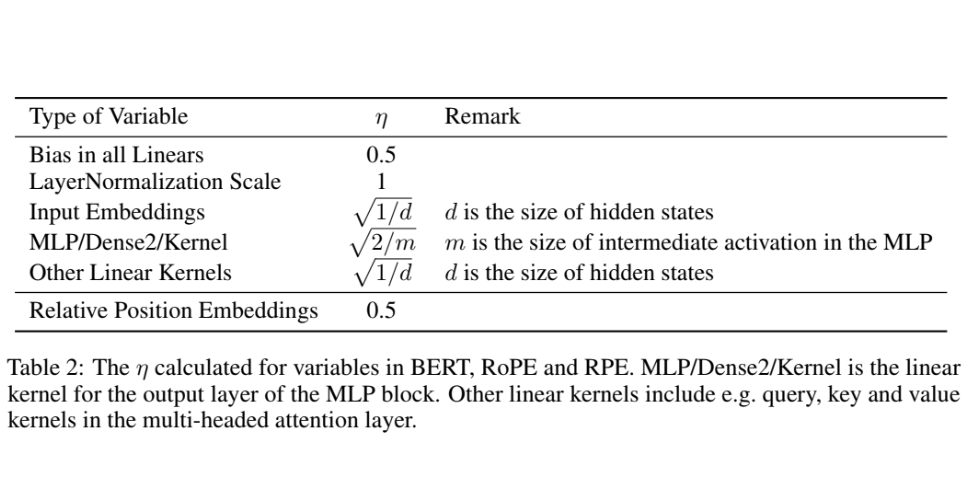
The scale of each trainable variable is specified by a hyper-parameter η, which is calculated from the model architecture and brings model-specific information to Amos. Theoretically supported learning-rate schedule and weight decay will lead the weights to the specified scale.