@n0riskn0r3ward@deepseek_ai Sorry for the inconvenience. Will fix it later. The license files are exactly the same as those in other DeepSeek papers, e.g.: the license files in this repo. https://t.co/BRlk3Zktp4
DeepSeek-Prover-V1.5: Harnessing Proof Assistant Feedback for Reinforcement Learning and Monte-Carlo Tree Search
> New SOTA: 63.5% on miniF2F (high school) & 25.3% on ProofNet (undergrad)
> Introduces RMaxTS: Novel MCTS for diverse proof generation
> Features RLPAF: Reinforcement Learning from Proof Assistant Feedback
Download: https://t.co/d06dFvPRiT
Technical report: https://t.co/guYgD3PuDs
#DeepSeek #DeepSeekProver
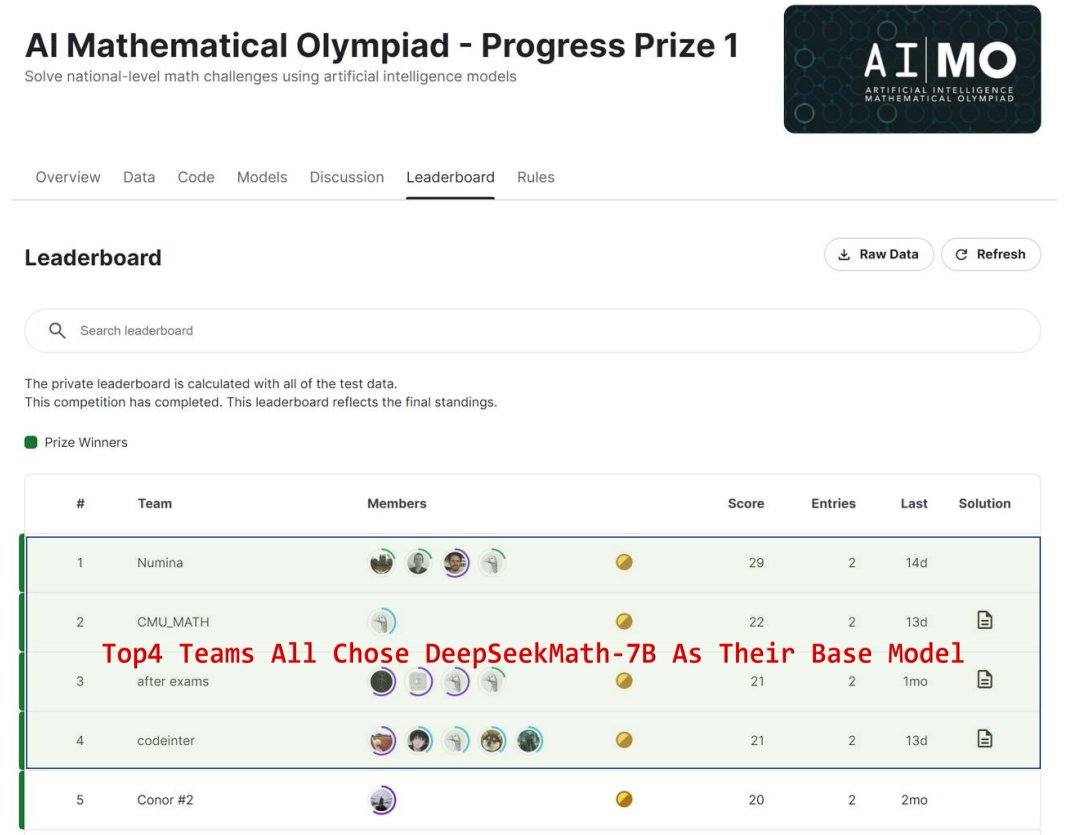
As I said, a good model speaks for itself. Many people suspect #DeepSeekMath suffer from severe data contamination because they simply don't believe a 7B model can do this, but now the AIMO competition leaderboard explains everything.
📢 After 3 months, the AI Mathematical Olympiad (AIMO) on Kaggle has announced the winners! 🎉
We're thrilled to see the Top 4 teams all chose DeepSeekMath-7B as their base model, with Numina @JiaLi52524397 achieving 29/50 correct answers! 👏 Even Terence Tao was amazed. 🤯
DeepSeekMath proves its worth for IMO candidate standards. 🌟
https://t.co/wokaAjwNV7
#AIMO #DeepSeekMath #Kaggle #AIMathOlympiad
Many people suspect that there must be data contamination in our data pipeline. Well, this is really hard to prove or disprove, but THE MODEL SPEAKS FOR ITSELF. #DeepSeek
@deepseek_ai new model DeepSeek Math 7B is the first open-source model that is able to do this task, and still run on my M2 MacBook (Mixtral too slow). Very impressive.
🌟 Meet #DeepSeekMoE: The Next Gen of Large Language Models!
Performance Highlights:
📈 DeepSeekMoE 2B matches its 2B dense counterpart with 17.5% computation.
🚀 DeepSeekMoE 16B rivals LLaMA2 7B with 40% computation.
🛠 DeepSeekMoE 145B significantly outperforms Gshard, matching DeepSeek 67B with 28.5% (maybe even 14.6%) computation in the early experiment.
Code&Paper:https://t.co/OTTNmBYkyE
#DeepSeek #MoE #DeepSeekMoE
📚Out Now: Technical Report on DeepSeek LLM 67B! Read more: https://t.co/ZTmdBeSQxp
🔍Discover our in-depth study on scaling laws and how data quality influences them.
✨In the MT-Bench evaluation, DeepSeek surpassed GPT-3.5-turbo, ranking just behind GPT-4.
#DeepSeekLLM
Introducing DeepSeek Coder!
- SOTA large coding models with params ranging from 1.3B to 33B.
- Building games, testing code, fixing bugs, and analyzing data... You dream it, we make it.
- Free for commercial use and fully open-source.
Try it out now at https://t.co/NlfpubcP9N
🚀 Introducing #DreamCraft3D, our breakthrough hierarchical technique for 3D content generation. Leading the way in AIGC, we're redefining 3D generation:
Project page: https://t.co/q1i1wGg18s
Paper: https://t.co/9AhCxFb7NP
Code: https://t.co/NkoKTOfUdo
DreamCraft3D: Hierarchical 3D Generation with Bootstrapped Diffusion Prior
paper page: https://t.co/QkKLR82sQy
present DreamCraft3D, a hierarchical 3D content generation method that produces high-fidelity and coherent 3D objects. We tackle the problem by leveraging a 2D reference image to guide the stages of geometry sculpting and texture boosting. A central focus of this work is to address the consistency issue that existing works encounter. To sculpt geometries that render coherently, we perform score distillation sampling via a view-dependent diffusion model. This 3D prior, alongside several training strategies, prioritizes the geometry consistency but compromises the texture fidelity. We further propose Bootstrapped Score Distillation to specifically boost the texture. We train a personalized diffusion model, Dreambooth, on the augmented renderings of the scene, imbuing it with 3D knowledge of the scene being optimized. The score distillation from this 3D-aware diffusion prior provides view-consistent guidance for the scene. Notably, through an alternating optimization of the diffusion prior and 3D scene representation, we achieve mutually reinforcing improvements: the optimized 3D scene aids in training the scene-specific diffusion model, which offers increasingly view-consistent guidance for 3D optimization. The optimization is thus bootstrapped and leads to substantial texture boosting. With tailored 3D priors throughout the hierarchical generation, DreamCraft3D generates coherent 3D objects with photorealistic renderings, advancing the state-of-the-art in 3D content generation.
Ghost in The Machine
JH Kim joins the Chem Dept in Korea University in 1996, fresh faced, 24 years old.
He’s a synthesist, an experimental chemist of the old school. He believes the truth is in the making, and that you follow the truth even when it destroys your reality.
He joins a Chem Dept led by its founder TS Chair, a charismatic elder statesman, who’d expounded on an ill-received 1-dimensional superconductor theory in 1994. Lee is his fervent disciple, publishing his Masters in the same topic in 1995.
But Kim goes to work on battery materials, getting his Masters in 1997. Lee and TS Chair then persuade him to join the superconductor team for his PhD.
Hundreds of experiments follows on dozens of ceramic mixtures. In 1999, a single sample of lead apatite shows a blip on a graph. They repeat the experiment and the blip repeats in two more samples out a several dozen.
But this is too vague, could it be an error from somewhere. Kim is all too practical, he recognizes that it may lead nowhere. He backs out of pursuing the SC further and switches back to battery materials.
4 years later he completes his PhD and joins a small but globally renowned manufacturer of batteries for hearing aids.
Lee continues to pursue the SC, with him and Chair making theories on ways to narrow the search space. Lee publishes his PhD thesis in 2008 on both theory and synthesis of the SC, absorbing Kim’s work to that point.
Lee joins a small private university as an adjunct in the computer science department. He produces no research and is disinterested in teaching.
In 2008, him and Kim found Qcenter. Kim drops in now and then. Qcenter picks up run of the mill consulting work. They run some experiments, but also spend time mapping the solution space. It is a hobby.
TS Chair falls ill at the beginning of 2017. The word goes out to former students, and people begin visiting his bedside.
Chair fixes upon Lee and Kim, and tells them they have to chase down the trace of the ghost in the machine in 1999. He passes in May.
JH Kim tells Lee they need an ESR machine and SQUID machine. With a wife and son now, he can’t grind like grad school, he tells Lee to raise the money if he wants Kim full time.
Lee and TS Chair buddy Hanyang emeritus prof scrounge for dollars. They write up a proposal to Korean National Science Foundation for funds to buy an ESR, but as Lee and Kim are not published since grad school, it goes nowhere.
Kwon, a tenured professor, a stellar and credible physicist with both ESR expertise and access to a SQUID machine, gets introduced by a contact.
Kwon finds the duo amateurish, but the prospect of grant money without too much responsibility is attractive. He signs on in late 2017. He keeps his university appointment, dropping in occasionally. They buy an ESR machine.
JH Kim joins full time in early 2018.
There is immediate friction with Kwon. Kim looks for a particular signal on the ESR. Kwon, the physicist finds this theoretically unsound, they argue.
Lee, aware that the only person in the last 2 decades to come close to the ghost is Kim, runs interference between the two.
With their own ESR machine, Kim spots the 1999 trace SC in early 2018. Then Kim, grinds.
Transformer Puzzles
- (https://t.co/tel0v1v7uZ)
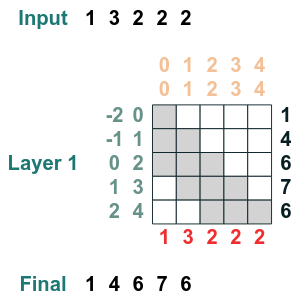
7 short visual puzzles for learning how Transformers can compute basic algorithms. Based on Thinking Like Transformers.
(Presented at ICLR Blog today. Doing these has been one of the most useful ways to grok how LLMs compute)
So, you think GPT-4 can't make a complex game... think again!
Here's how I used GPT-4, @Replit, MidJourney, Claude, assembling a team of AI assistants, to create a 3D space runner from scratch with ZERO knowledge of Javascript or 3D game programming
Follow along for a saga! 🧵