It's great to see momentum building in Washington DC for policies that will support the success of the US robotics industry. I was honored to have my views quoted in this @politico article on recent developments and future aspirations.
If you've ever worked on your feet all day, you know how important a good pair of shoes is. Mechanical design engineer Chastity Kelly shares how we built Atlas functional feet.
Learn more about Atlas' design, Chastity's path to robotics, and starting on the right foot: https://t.co/7rdiNnMIYc
I spent the last week in over a dozen pitches with robotics companies across Silicon Valley, NY and Europe...then I looked at the US Census Bureau Data
Turns out 88% of US manufacturing plants don't own a single robot...and that's the opportunity Founders are seeing.
Despite the endless deluge of humanoid robot demos and "AI factory" hype in our feeds, nearly 9 out of 10 American factories look exactly the same as they did 20 years ago.
Manual labor, mechanical machinery, a retiring workforce and challenges in filling roles.
The reasons why they haven't been "updated" historically breaks down into two clear buckets that I call:
1. The Integration Iceberg: A robot arm might cost $25,000 and has come down in price, but the custom tooling, safety cases and software integrations to make it work cost $125,000.
2. The Agility Tax: A traditional robot does one thing a million times. But the average US shop does "high-mix, low-volume" work. To reprogram a robot for a new part has required an expensive software engineer and could take days depending on engineer availability.
The next generation of massive robotics outcomes won't come from building shinier hardware for the 12% of factories that are already automated.
It will come from the Founders solving the integration and business model friction for the 88% that aren't.
If your GTM strategy doesn't solve the 18-month ROI math of a shop owner in Ohio who needs financing, fast onboarding and the ability for the robot to handle a variety of tasks, then you're likely going to struggle.
If you're working on a robotics business solving our countries biggest talent bottlenecks, I want to chat.
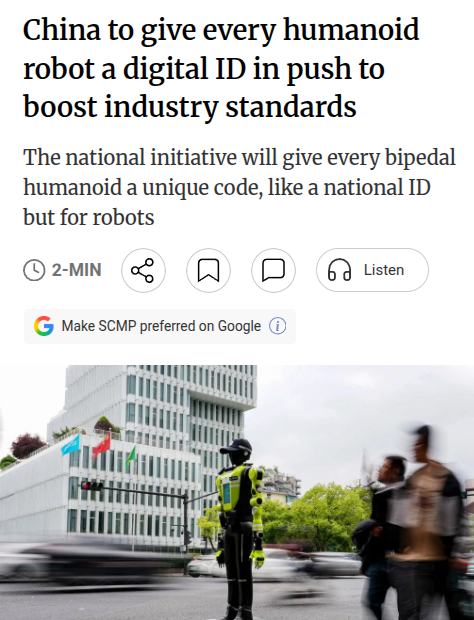
China has started giving every humanoid robots 29-character ID codes, with 28,000+ assigned so far.
The system works like a robot passport: each unit gets a code that records its country link, maker, model type, and individual serial identity.
The goal is not only paperwork, because humanoids are moving from demos into public roads, factories, homes, and service jobs where failures need clear responsibility.
A robot that falls, damages property, leaks data, or gets modified after sale becomes easier to trace when regulators can link the machine to its maker, seller, user, service history, and recycler.
---
scmp .com/tech/policy/article/3354747/china-give-every-humanoid-robot-digital-id-push-boost-industry-standards
You can buy this 3,000 sq ft, ten-room château in France for $665,000.
Then wait a few years, and you will be able to have humanoid robots do all the work.
And it will be only a 15-minute flight to Lyon with your own personal eVTOL.
There are thousands of castles and châteaux for under one million dollars across Europe.
Europeans can't afford them, they can't afford to staff and maintain them, and they are too far from major cities.
eVTOLs will reduce a two-hour drive to 15 minutes, and inexpensive humanoid robots will restore, maintain, and staff the house.
Listing link in the replies.
What are you waiting for?
Here is my take on one of the questions that I’ve heard most often recently: why humanoid?
The thing that drives the current bet on humanoids is the perceived potential value of a generalist solution to physical work. Outside of some applications that have very large and very stable volumes, for all other physical work, automation becomes unfeasibly expensive if we have to specialize hardware, or models or deployment strategies.
BREAKING: “Yet again, a carriage horse violently spooked at the 7th Ave entrance to Central Park today, flipping the carriage, throwing and trapping the driver underneath in yet another terrifying and completely preventable crash in Midtown.
The driver was reportedly seriously injured and taken away in an ambulance, and there are reports of injuries to other drivers and passengers. We still do not know the traumatized horse's condition.
NYCLASS urgently calls on @SpeakerMenin and the @NYCCouncil@Lynn4NYC to quickly reintroduce and fast track Ryder’s Law before more people or horses are seriously injured or killed.
Today, both a heat advisory and an air quality alert were in effect, yet these horses were still being forced to work in dangerous conditions. These incidents keep happening because horses are skittish prey animals who do not belong in chaotic city traffic.
Seventy-eight percent of polled New York voters support passing Ryder’s Law, along with the Mayor, the Central Park Conservancy, and countless horse experts and welfare groups. The City Council must act now before the next tragedy occurs.”
Edita Birnkrant, Executive Director, NYCLASS
Atlas hauling a 50 lb mini-fridge
- Practiced the maneuver for millions of hours in a virtual environment.
- Focused the training policy on full-body engagement rather than just hand-grasping, allowing the robot to leverage its entire frame for the lift.
If you want to work with us and @_albertorod_, we are also hiring for RL roles!
Research Scientist: https://t.co/hF54HcD5yy
Research Engineer:
https://t.co/Vv3JKxT0q6
Everyone's talking about VLAs and VLMs for robotics. For humanoids, the whole body controller underneath matters a lot too. Without good whole body control, even the most capable VLA can't complete the task. 🧵
https://t.co/9VdF1IwDe6
Everyone asks if Atlas can bring them a drink, but this robot can bring you the whole fridge. Using AI-driven behaviors, Atlas is doing hard work and coordinating its whole body to manage heavy objects, balancing complex contact points with accuracy and reliability.
Former Tesla President @jonmcneill breaks down China's strategy to dominate the global auto industry:
Every five years, China selects five industries to enter and dominate.
They subsidize ~100 market entrants, and let competition play out.
That gets whittled down to the top 3–5 winners. In this case: BYD, Geely, and NIO.
Then they consolidate capacity under those winners—effectively handing them the infrastructure built by the entire field—and tell them: your job now is to export and dominate these markets.
"So—they've gotten subsidies to get started, subsidies to operate and now they're getting capacity for free. And they've proven themselves as the winners in a hyper competitive market. And now they go enter the rest of the world where the competitors are soft."
"That's their formula, and they run this formula across all kinds of industries: solar panels, TVs, bicycles, and electric cars. It's a very powerful flywheel."