On Sundays, Mexico City closes down the Paseo de la Reforma (modeled after the Champs-Elysees in Paris) to cars — so it’s all cyclists and joggers and just a great vibe
The market east study is the result of a process that doesn’t know the right questions to ask.
We shouldn’t be flailing to subsidize one underperforming corridor; we should be strengthening the regional economy, and let market east thrive as one of its natural centers.
@gben78 One thing that feels funny about the cards for local businesses is that fairmount’s restaurant spaces all being owned by the same family really seem to hold back the quality a bit. It’s so rare any fairmount restaurant makes any kind of rating, not sure what we’re protecting here
@Aden_Yacobi@ninthhostage They might not be destination neighborhoods, but there’s tons of walkable areas throughout North, South Philly, lower northeast like Tacony etc.
@Aden_Yacobi@ninthhostage I dunno that I’d call anywhere outside of those three areas sprawl…kinda a wild take. Drop a pin anywhere in Philadelphia besides say Chestnut Hill or the Far Northeast and there’ll be plenty of walkable neighborhood destinations interspersed - groceries, shops, pizza, parks 1/2
@_NotA_Bot_@jongeeting Either or thinking isn’t helpful right now, we need to walk and chew bubble gum. Assuming @BlvdSubway is selected as the LPA PennDOT will presumably have one contractor/consurtium the entire project. They have a much deeper bag of managing construction projects of this scale
This is what you get for 2018-present.
Under Jim Kenney it seems like a lot of the open data stuff in Philly just completely fell off. We need to bring this back!
@_NotA_Bot_@jongeeting capital projects we need to extend high capacity transit in Philly *while* we enhance Regional Rail. That being said the state (and Philly to some degree) have a much larger track record of managing major construction projects - PennDOT and/or Philly, should be tapped in to help
@_NotA_Bot_@jongeeting I disagree that extending heavy rail isn’t a good priority. Only focusing on regional rail helps the metro area but many of the highest transit ridership neighborhoods are not close to regional rail, resigning them to insanely slow buses. While the state shouldn’t fund all (1/2)
This is bad, pot holes are the only traffic calming in Philadelphia. This is just more money to help cars speed through our neighborhoods, while the city drags its feet on protected bike lanes and traffic safety improvements
Worth noting that this economic impact is a base case where the legislature makes no reforms to land use near transit.
Imagine it with Sydney or Montreal level TOD.
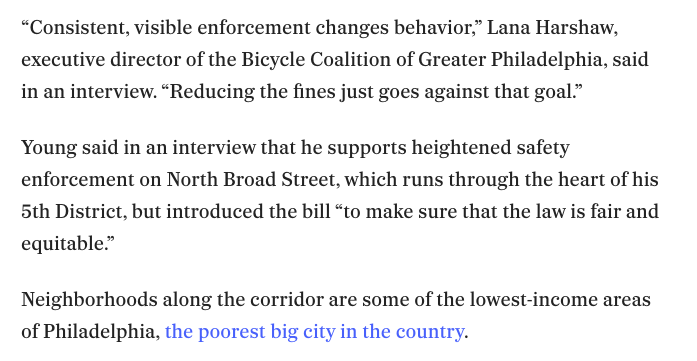
Analysis from the Philadelphia Dept. of Public Health shows zip codes with high rates of poverty see the highest rates of traffic crash hospitalizations.
Nerfing a proven tool to reduce crashes in the name of "equity" is pants-on-head stupid and I'm begging Jay Young to think.
@SaveSEPTA@himbo_urbanist Tax increment zones have been allowed since the 90’s in PA, should be fine. Funding mass transit stations is specifically called out in the language.
https://t.co/M6EQXH2Uxt
@himbo_urbanist@SaveSEPTA The beauty of it too is that county governments are already allowed to fund septa with property taxes so should be relatively simple to implement in the existing (deeply flawed) framework.
@himbo_urbanist@SaveSEPTA Tie these together - Reimagining Regional Rail funding is linked to a state zoning bill permitting more density around the stations. In the surrounding area apply a tax increment zone where the increase in values goes to SEPTA to fund improvements & more frequent train service
Disappointing to wake up to this.
On the left, the 1st sentence of a New York Times article, published today on overall results in NC.
On the right, the subheading of our Bolts article on the Alamance County sheriff's race. (No credit/link to it in the NYT piece).