Professor @NYUStern; Director @NYUSternCFM; former Obama CEA Senior Economist for tech & innovation; research on AI, robots, entrepreneurship, strategy
It’s time for everyone to realize that the fight against data centers has nothing to do with data centers.
They have become a proxy for the hate towards AI and the concentration and accumulation of wealth it’s creating.
Until those running the big LLMs understand this and start a community tour, not to explain the benefits of AI, it’s too late for that, but to help towns and cities that may be impacted by job losses (and I’m a believer their will be a net gains in a few years), this battle is only going to get more intense and let me tell you now , no matter how much money you pay to buy politicians and races, you will lose.
One thing I have learned is being hated is not good for business.
How can they help ? They will tell you. You will need to do what they ask. Billions of dollars is a lot of money across towns and city programs. Across the major LLMs, it’s a cost of doing business.
At the same time, I would go to LA and NYC and ask the arts and creative unions what kind of programs would help and protect their artists. DO NOT GO TO THE MUSIC OR FILM COMPANIES. that will make it worse.
Don’t try to pay famous people to endorse what you are doing. That’s dumb.
Talk to artists and ask them what you can do to provide financial and creative support. Every creative I know is TERRIFIED about what AI will do to their profession. You must meet them face to face and basically do what they say.
The big LLMs have lost the PR battle. Why ? Because they all suck at putting people first. They have an SV attitude that makes them all think they are John Galt saving the
world
Given the number of data centers and power that is needed, today and going forward , If you don’t kiss the asses of the people that go to work every day, and are just trying to pay their bills, you will fall far far short of the capacity you need to make your business work.
"In a dynamic AI-enabled economy, it is quite plausible that a moderate step-up in the pace of job creation will boost gross job gains enough to absorb most AI-related job losses and mitigate the labor market hit from AI disruption." - Goldman Sachs
The GenAI economy has generated $110 billion in sales over the past 12 months. It is growing fast. On an annualized basis, the revenue run rate exceeds $175 billion.
These numbers took us several months to construct, and as far as we know, it’s the first bottom-up, deduplicated measure of consumer and enterprise AI spending across the full stack.
We are releasing this research today in our first The State of the AI Economy report.
https://t.co/cJwZb0T99C
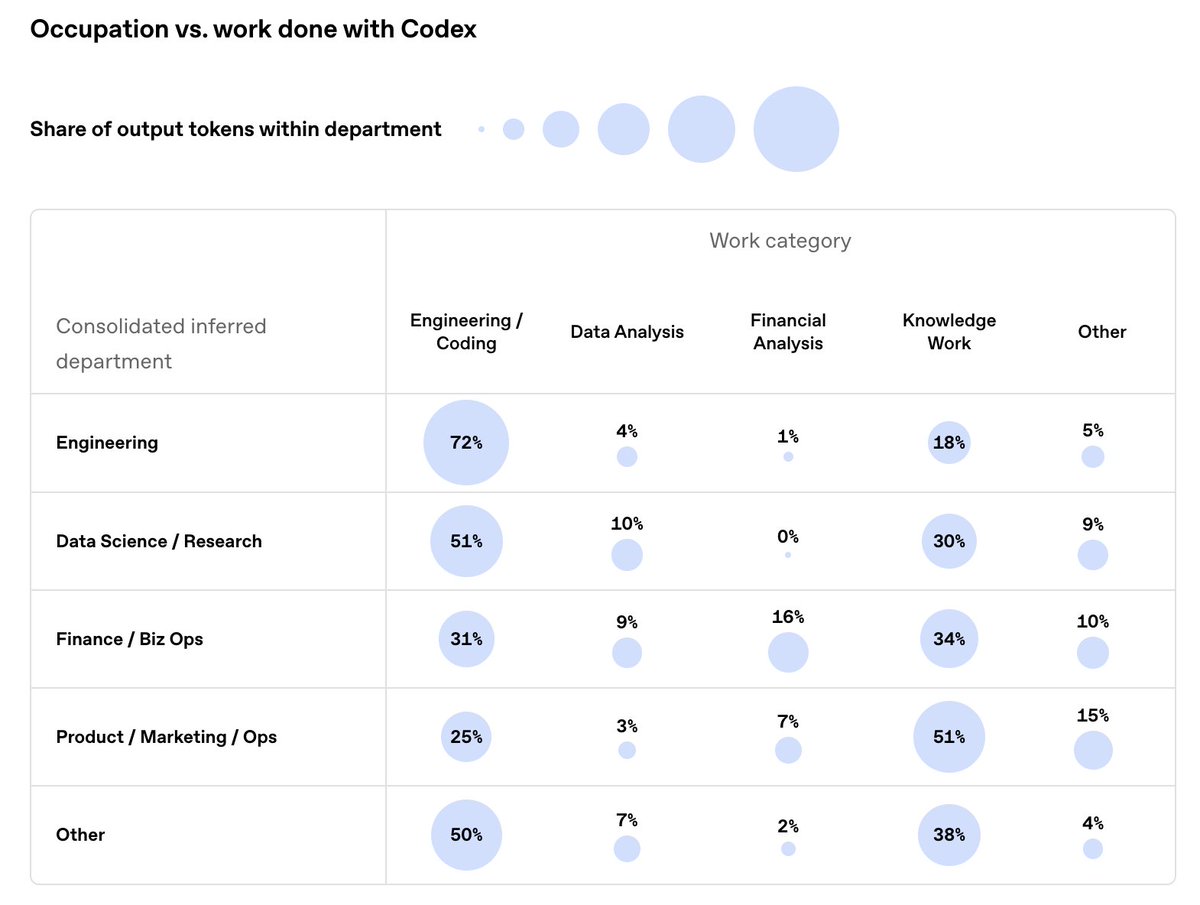
This is a fascinating look at how work is changing as a result of agentic AI.
"work increasingly takes the form of delegated tasks rather than isolated exchanges"
The biggest shift in AI for work may be the move from chat to delegation.
In a new paper, we study how Codex usage evolved over the past year - especially within @OpenAI - as agentic tools became more capable.
We saw an expansion of users and usage in this time.
https://t.co/mjGLDrt7ST
@goldman Great seeing you Jason! Thanks for all your hard work making the last few days a huge success (and all your hard work over the past 10+ years)!
Vibes on opening weekend at the Obama Center are immaculate. I left feeling good about myself, my country and the power of all of us to do amazing things.
Had a fantastic visit to the Obama Presidential Center today. Was impressed by the building, the campus and the fantastic @ObamaFoundation crew. And great weather too!!
@cblatts I visited it today and was pleasantly surprised by how well the building fits in its environment. It’s like a big block of granite jutting out of the earth.
Insane: Marshawn Lynch reveals that he didn’t touch any of the $56,769,878 he made while playing in the NFL.
"On my off days, I’d go work with these brands and get a bag, bring in a couple 100 bands, and I could just eat off that and not worry bout my game check."
A true role model on and off the field 👏
While we were celebrating the Knicks, NYC got more good news:
May jobs numbers are out today. Private-sector employment in NYC rose by about 15k, putting us back in positive territory for 2026.
Unemployment here fell from 5.6% to 5.4%, lowest in 10 months.
Earlier this spring, a bipartisan group of nine senators sent a letter to DOL, Census, and BLS urging improved data collection on AI's workforce impacts.
Our new @joinFAI blog post discusses concrete options to improve govt surveys, addressing each of the senators' recommendations directly.
We draft full sets of survey questions that could be considered for the CPS and NLSY before the 2027 cohort starts. Co-authored with @t6aguirre.
This particular bundle much better matches non saturated/hackable metrics. Benchmarks that are long term, human + AI, creativity based, and/or "avoids BS" are the benchmarks we still need more of if we care about models that create value.
@abhishekn@avi_collis@soumitrashukla9 I enjoy social media for posts like this but I’m also exhausted by social media for short form posts that make it harder to engage meaningfuly.
Was very fun to join @jc_econ and @nabe_econ to discuss the labor market and how conversations about AI focus too much on technological capability and not enough on the non-tech factors that will play a role here. Link below!
If you're going to Manifest, check out my talk on prediction markets. Next steps from my ReStud/MS papers about markets inside organizations. Overview/links below.
Today SpaceX will become the largest IPO in history. It may also be the least democratic.
The reason: instead of protecting investors, major index providers are bending long-standing rules under pressure from Elon Musk.
I am joining fellow leaders of large pension funds to demand that @FTSERussell and @LSEplc pause the SpaceX fast track—and urging all major index providers, including @Nasdaq, to put investors first.
SpaceX will not have even the semblance of a democratic governance structure: no mandatory independent board, Musk serving as both chair and CEO, veto power over his own removal, perpetual super-voting shares, and severe restrictions on shareholder legal action.
And then there’s the fact that SpaceX’s IPO valuation appears disconnected from business fundamentals.
Because index providers are bending their own rules to fast-track SpaceX, our city workers and retirees will automatically become major shareholders. (We have over $80B in index funds.)
Public markets work best when companies are transparent and accountable. For the public-sector workers and retirees we serve—and for millions of Americans with index funds—we strongly urge index providers to stop bending the rules for SpaceX and put investors first.
I am pleased to be joining @NYSComptroller, @ILTreasurer, and @MDComptroller in this fight.
📢 NEW essay: the narrative that AI is replacing software engineers seems to be based on AI-washing of layoffs. Among the many lines of evidence: New York State requires firms to disclose which layoffs were due to AI. When there are legal consequences to lying, almost no company blames AI.
The best data suggests that software engineer employment in the U.S. is still growing, though slightly more slowly compared to a no-AI counterfactual world. But even this doesn’t account for increased entry into entrepreneurship.
Why haven’t AI agents replaced software engineers? Many kinds of knowledge work, including software development, can be seen as a “decide-execute-deliver sandwich”. AI compresses the middle but the other two layers resist automation in a way that will not be overcome by capability improvements alone. In 2026, the middle has already been squeezed and there isn’t much room for further compression, so there isn’t a future capability leap that will cause discontinuous impacts, either.
The essay also has a detailed breakdown of the difference between vibe coding and agentic engineering. Conflating the two has unfortunately led to a lot of confusion.
We acknowledge that there’s a lot of uncertainty about the future. But we think the unknowns are more about how we will define and carve up roles and who can adapt to the changing needs, and less about whether software engineering skills and judgment will remain in demand (they will).
Given that the AI-capabilities-cause-mass-layoffs narrative seems to be false even in a sector with very few regulatory barriers, we think most other professions are likely to be even more cushioned. (The claim isn’t that automation never displaces jobs, but that there are many downstream links in the causal chain, and that we have collective agency to act on those downstream decision points to ensure better outcomes for workers.)
This essay by me and @sayashk is the first in a series. Feedback is welcome! We hope that our unique vantage point (leading an AI agent evals research group + fluency with the labor economics literature + the "normal technology" framework for understanding AI impacts + being coders ourselves and well connected to the software engineering community) gives us a way to bring complementary perspectives together for a deep dive into how AI is transforming the profession, in a way that hasn't been done before.
Read the essay here for lots of other details: https://t.co/8ZofeCz8yS