$AKT remains a top project for me.
I have to say, @gregosuri is one of the most dedicated and ethical founders in the space. Never witnessed a single red flag over the years. Happy to have been part of the community since day 1.
With nonstop innovation Akash will survive and thrive!
@AdamBLiv@MaksimXBT We're in the same boat, @MaksimXBT is right, minimum price impact. Between Saylor and ETF's, all this buying, yet price barely moves.
Saylor's case for Bitcoin is the cleanest argument in crypto.
Decentralized protocol = commodity. No one controls it. No one can take it away.
Economic energy for 8 billion people.
He's right. But he stopped one step short.
Bitcoin secures value. What secures intelligence?
Ethereum tried. Failed. It wasn't built for it.
But, Qubic is.
Decentralized. No corporation owns the AI training running on it. The people contributing compute own the output.
Same fire. Different engine.
Bitcoin made value sovereign. Qubic makes cognition sovereign.
It's been building quietly for four years. Most people still haven't looked.
That window doesn't stay open.
Doge Mining Revenue Report | Epoch 212
Mining Sample: QDOGE's Fluminer L1 (5.7 GH/s)
Revenue per GH/s per day:
Mining DOGE via Qubic
→ $0.82 / GH/s
Mining LTC + DOGE on traditional pools
→ $0.55 / GH/s
That's +$1.52/day. +$10.62 over the full week. 48% more revenue on the same hardware.
Even with merge mining, combining LTC and DOGE, other pools couldn't close the gap.
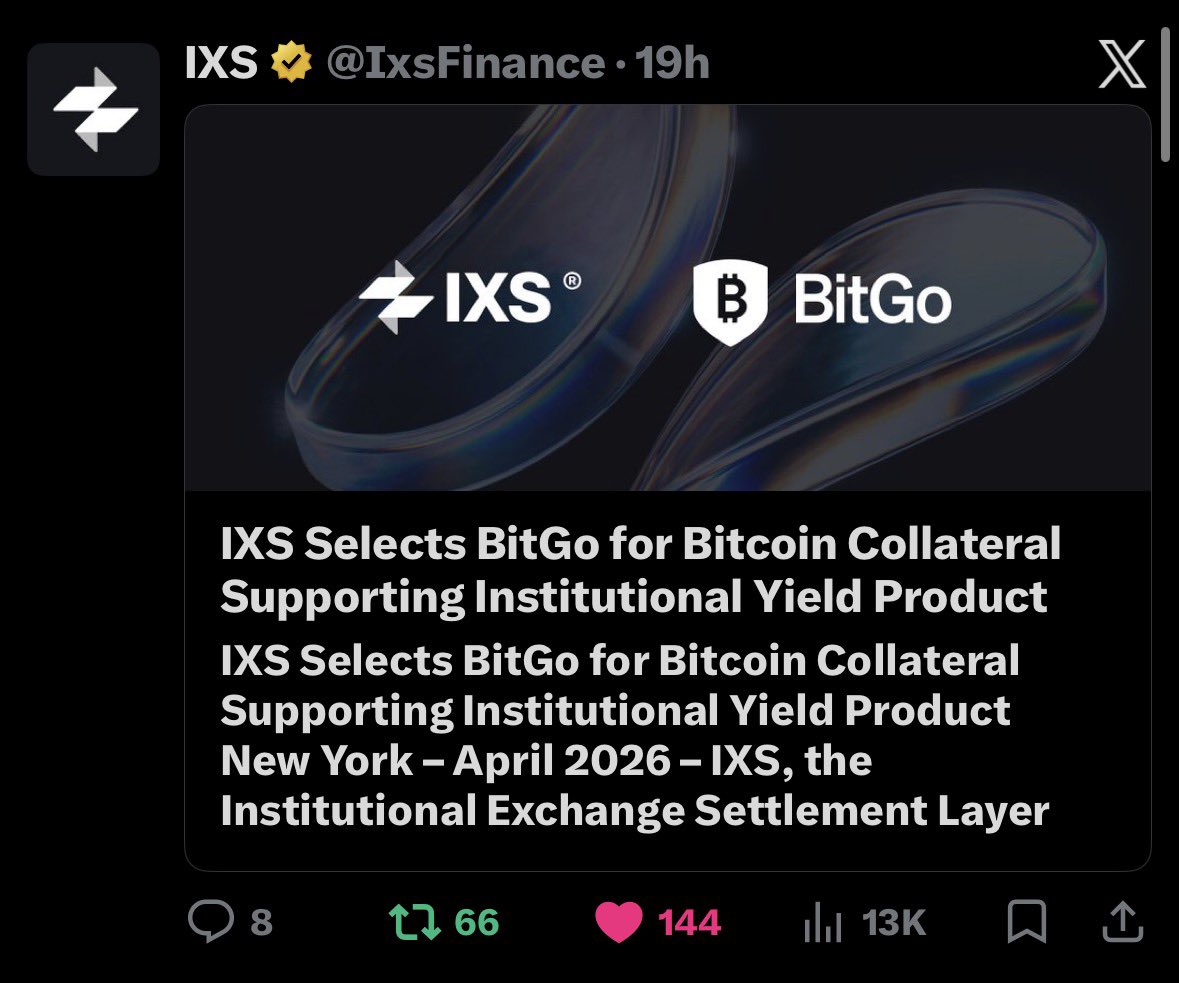
Institution buys @Bitcoin
│
▼
BTC deposited with a custodian such as @BitGo
(held as collateral)
│
▼
Borrow Stablecoins
│
▼
Select RWA Product on IXS Platform
│
▼
├────────► Private Credit
├────────► Treasury Bills
├────────► MMFs
└────────► Structured Yield
│
▼
Real Yield Generated
How long do you think Bitcoin is going to sit idly on an institution's balance sheet?
Sooner or later, Bitcoin becomes productive capital. Few understand, but they will!
I’m diving deep into the “guts” of an LLM: studying semantic ontology models and inference engines.
It’s interesting… but nothing compares to what I found in the architecture published by our scientists.
The evolutionary model of Aigarth + Neuraxon is simply on another level. 🔥
#qubic #aigarth #neuraxon
When the Clarity Act is finally approved, a silent and extremely powerful task force will swing into action inside the crypto market.
Do you know what that task force is?
If you are not paying attention to the operation that the big institutional players from TradFi are about to launch, you run the real risk of being left behind and missing the long-awaited altseason simply because you did not perform the most important analysis on the assets you hold in your wallet.
Before anything else, know that I only write about what I consider extremely relevant and easy to understand.
I learned about this because a colleague of mine, who is a head of technology at a major company, attended a closed-door meeting with business leaders and heard directly from reliable sources about the institutional plans. They will begin a "Graham-style sweep" across the crypto universe as a rehearsal for the new landscape the law will create.
It is no coincidence that several major cryptocurrencies are making radical moves right now.
Some projects which I prefer not to name live only on hype and noise. They spend tens of millions of dollars on marketing to build a real zoo of promises, capturing every cent from investors with the clear intention of creating a classic pump-and-dump. When the altseason arrives, 99% of those investors will be left in the red because the farce will have no real foundation to sustain the price after the explosion.
You will call me a wizard when this happens, but I believe nothing is by chance. And if you follow me until the end of this reading, I promise to show you a real case of a cryptocurrency that can transform your financial life ; as long as you apply the same fundamentals to your own portfolio.
The pattern repeats itself. In the TradFi world, demand for stocks explodes when a company presents what conservative investors value most: intrinsic value.
This concept was coined by Benjamin Graham, the father of value investing. Every experienced investor knows this doctrine. And this is exactly where you need to do a serious exercise: check whether your portfolio is ready to receive massive inflows from conservative capital, which will use the same analytical models they have applied for decades in their mega investments.
The task force that will be formed by hundreds, perhaps thousands of institutional players spread across the world after the Clarity Act is approved will use precisely these indicators to decide where to allocate their money.
They measure the “temperature and health” of a business through classic administrative concepts: consistent profits, healthy cash flow, solid equity, strong market position, predictability, and governance.
If, when analyzing a cryptocurrency, you do not find this **intrinsic value**, there is a high chance you will miss the key turning point many are waiting for. Remember: the number of cryptocurrencies has exploded into the millions in recent years. This has dramatically increased the need for thorough analysis before any investment.
Whether you like it or not, many investments that seem solid today may have their days numbered. We are in a spot market of bets.
But what would it look like to find a cryptocurrency with true intrinsic value?
I can give you an extremely practical and clear example based on a deep study I personally conducted on the cryptocurrency where I have 80% of my net worth allocated.
Before presenting the project, I will show you the other side of the coin: the big tech companies that today have billion-dollar valuations. Even with good indicators, they can be overtaken by silent innovations that solve problems which, for them, “still do not exist.”
In my study, I gathered the data on how much a big tech needs to invest just to keep its AI clusters running. The average consumption per regional cluster is between 10 and 15 MW (megawatts) to run an LLM like ChatGPT, Llama, Grok, or Claude - the equivalent of the energy consumption of entire cities.
Here is the detailed calculation for a single 10–12 MW cluster:
- Total monthly operating cost (OPEX):
US$ 17 million to US$ 28 million per month
(includes energy + maintenance + technical team + hardware depreciation)
- Total initial investment (Capex):
US$ 660 million to US$ 1,024 billion
(GPU purchases + servers + data center construction + liquid cooling + installation)
Perhaps this is why Michael Burry is betting against current AI. Generating enough cash flow to justify hundreds of clusters like these will be a colossal challenge.
The true villain of the story is the LLM architecture ; a model that devours energy in an unsustainable way.
Now, let’s talk about the project that is circumventing exactly this problem and carries genuine intrinsic value.
The QUBIC project is operating silently at full throttle, using the same energy level (10 to 12 MW) as a centralized AI cluster. Currently, available data points to something between 55,000 and 60,000 active miners.
The secret lies in the Useful Proof of Work (UPoW) model ; the only useful proof-of-work concept that exists in the crypto world. All the energy spent on mining is converted into real training of Aigarth, QUBIC’s decentralized AGI.
To justify this 10-to-12 MW consumption, the network issues about 450 billion QUBIC per week as base rewards to miners. Monthly, this represents approximately 1.95 trillion QUBIC, which at the current price equals about US$ 1.18 million.
This dilution is the cost the network pays to keep decentralized computing running. Part of this reward also comes from Dogecoin mining (which generates external revenue), which is converted into buybacks and burns of QUBIC, reinforcing its deflationary nature.
This is exactly why CFB (Come-from-Beyond) or Sergey Ivancheglo calls this model perfection.
To understand the magnitude of this difference, just compare the two models with the same energy consumption (10–12 MW). While QUBIC spends about US$ 1.18 million per month in dilution to maintain all this computing power, a centralized cluster requires a total monthly operating cost between US$ 17 million and US$ 28 million.
If we add the initial investment of US$ 660 million to US$ 1,024 billion and divide it by a typical useful life of 4 years (48 months), the additional amortized monthly value ranges from US$ 13.75 million to US$ 21.33 million. This raises the effective monthly cost of a centralized cluster to between US$ 30.75 million and US$ 49.33 million - in other words, 26 to 42 times more expensive than QUBIC’s decentralized model.
On top of that, these centralized clusters are easy targets in geopolitical conflicts, as we saw in the war between Israel and Iran in 2024, when energy facilities and data centers were threatened or attacked. The current LLM model also demands constant expansion, creating an unsustainable spiral of costs and vulnerability.
While big techs burn billions on fragile and expensive structures, QUBIC turns voluntary mining into useful computing power for Aigarth at a cost dozens of times lower.
This is why, for many, QUBIC is not just a cryptocurrency.
It is the architecture that can redefine the future of artificial intelligence.
This type of comparative analysis with traditional market companies will be constantly examined and compared when making massive investment decisions.
They are not looking for “narratives.” They are looking for projects that actually solve real problems.
And as if that were not enough, the new “gold” of the modern era is energy, since the market will not turn back anytime soon with hundreds of contracts already signed for cluster expansion.
This is the clearest and most disruptive example of an asset that truly possesses intrinsic value when this task force begins its search for quality assets.
Does your portfolio have something with this level of impact?
Qubic is inevitable!
#qubic #aigarth #bitcoin #altseason #bcharles
This is the kind of disingenuous posting that really hits with smooth brained individuals.
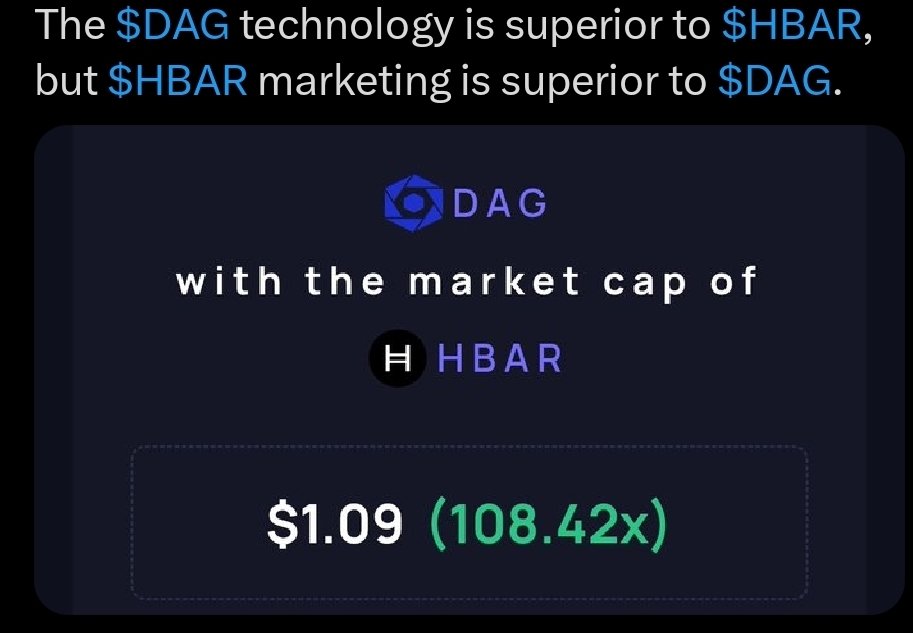
The “superior marketing” line is a convenient oversimplification.
Hedera raised ~$140M from VCs and institutions before mainnet ($18M early stage + a $100M institutional round in 2018).
That capital built a professional team, secured the Governing Council (Google, IBM, Boeing, etc.) and gave them the runway for enterprise-grade compliance and adoption.
Constellation took a much more grassroots/community-driven path with far less traditional VC/institutional backing.
This is why the AIAI is such a huge deal and the $25,000,000 in growth capital is going to leapfrog $DAG out of the same crypto swim lane everyone else is currently in.
Not only will the growth capital help grow the network, but AIAI pipeline will be one to keep an eye on.
Personally I'm more optimistic about a Holding Company vs governance board.
Today I showed the QUBIC project to a computer engineering professor at the university where I study Artificial Intelligence (yes, I am an AI academic).
He called me a “liar” as if he were joking with me. I sent him the Whitepaper and asked if I was “crazy” or if all these years studying development had messed with my head.
The result after analyzing the material? He bought QUBIC. What do you think I ended up doing once again? I’m not the only crazy one… a professor has now joined me in this “madness.”
But let’s get to what really matters, because this will “enlighten” your expectations in a responsible and reflective way.
As a systems developer and Artificial Intelligence student, I need to explain some of the reasons why I am investing 80% of my net worth in QUBIC.
I also want to make it clear that whenever I decide to write about QUBIC, I always present three perspectives: The entrepreneur’s view, the developer’s view, and the investor’s view.
Just for the record, today I made another deposit thanks to my patience in waiting for the opportunity I had been expecting ; a new price correction in QUBIC.
From this point on, you will understand why QUBIC is currently in my phase of maximum accumulation.
Qubic will be used as the example model, as you already know, but first I want to show you the trajectory of other AIs before they exploded in their projects.
Once you understand the information below, you will realize that QUBIC is not just a “cryptocurrency.” It is like a company (in case you forgot) developing an extremely complex AI (AGI) software.
Now, reflect on the following information:
Name of the AI: Gemini
Company that Launched it: Google (Alphabet / DeepMind)
Time of development until ready: Launched as Bard in March 2023, renamed Gemini in February 2024 (about 1 year since the initial announcement, with roots in years of DeepMind research).
Machine Learning Model: Multimodal LLM (Large Language Model with text, image, audio, and video capabilities).
Current market value after launch: Contributed to Alphabet reaching a market cap above US$ 3.5 trillion, with annual AI investments around US$ 185 billion and strong user growth (750 million monthly users).
Name of the AI: ChatGPT
Company that Launched it: OpenAI (with strong Microsoft partnership)
Time of development until ready: Founded in 2015, but ChatGPT launched in November 2022 (explosion within months after GPT-3).
Machine Learning Model: LLM (based on GPT series, generative transformers).
Current market value after launch: OpenAI valued at approximately US$ 852 billion after massive funding rounds (e.g., US$ 122 billion in one round).
Name of the AI: Claude
Company that Launched it: Anthropic
Time of development until ready: Founded in 2021 by ex-OpenAI members, Claude 1 launched in 2023 (about 2 years until the main product).
Machine Learning Model: LLM focused on Constitutional AI and safety.
Current market value after launch: Anthropic valued at US$ 380 billion (with recent rounds of US$ 30 billion).
Name of the AI: Llama (family of models)
Company that Launched it: Meta
Time of development until ready: Llama 1 launched in February 2023, with rapid iterations (Llama 3/4 in 2024-2025).
Machine Learning Model: Open-source LLM (large language models).
Current market value after launch: Contributed to Meta surpassing US$ 1 trillion in market cap, with Llama generating billions of downloads and an ecosystem (direct business value estimates of US$ 10-20 billion+ for the Llama business).
Name of the AI: Copilot
Company that Launched it: Microsoft (integrating OpenAI)
Time of development until ready: Announced in 2023, with wide rollout in 2024 (fast, leveraging US$ 13B+ investment in OpenAI).
Machine Learning Model: Integrated LLM (based on GPT).
Current market value after launch: Powers Microsoft’s AI division, expected to be the fastest to reach US$ 10 billion in annual revenue; contributes to Microsoft’s market cap above US$ 3 trillion.
Name of the AI: Grok
Company that Launched it: xAI (Elon Musk)
Time of development until ready: xAI founded in 2023, Grok launched in November 2023 (accelerated development in months).
Machine Learning Model: LLM focused on reasoning and real-time data from X.
Current market value after launch: xAI valued at around US$ 200-230 billion after rounds such as US$ 20 billion.
Final Reflection on the QUBIC Scenario: If all these AIs, based on traditional LLM models, reached billions (and even trillions in market impact) in just a few years after launch, what do you think will happen when an AI (AGI) starts running on QUBIC with evolutionary machine learning?
Be honest with yourself in your answer!
In Qubic’s model, Aigarth uses Intelligent Tissue (intelligent tissue) with ternary computing (-1, 0, +1), Useful Proof-of-Work (uPoW) that turns mining into distributed neural network training, Darwinian evolution through mutation, natural selection, and fitness functions. This creates an emergent, decentralized, and self-improving AGI, without the centralized bottlenecks of LLMs.
As soon as it is launched in the market, QUBIC has the potential to be selected as the world cradle for hosting Autonomous AI Agents, generating exponentially greater value due to its resilience, feeless scalability, and true evolutionary nature.
But the cherry on top has never been said.When an AGI is launched by QUBIC, it will attract millions of users, massively scaling the adoption of QUBIC’s AGI. In addition to regular users, we will have institutional users ; companies ; and sovereign users (governments).
Or do you think tests won’t be conducted from all over the world to see if it’s possible to develop their own tools using a decentralized AGI?
Remember the current problems: governments are racing to develop their own AI technologies. There is also huge demand for energy sources, and a race of all kinds is forming.
How much do you think QUBIC will be worth, considering it will not be an LLM, but a completely superior model?
Qubic will soon be on this list, but don’t think it will be worth just a few “billions.”
I estimate that having an AGI running with functionality and performance that meets even simple needs will already reach hundreds of billions of dollars in market cap.
If a centralized one reached trillions, imagine an AGI built the right way? Yes, gentlemen, there is no exaggeration in the calculations ; there is only the development time and getting the functionality right at launch!A tip?
Accumulate while there is still time!!
QUBIC IS INEVITABLE!
#qubic #aigarth
The same profile on X that accurately predicted the exact moment and the lowest point of the previous drop is now seeing a trend reversal, heading towards growth that could far surpass the current ATH ($7.50 zone).
With the recent approval of "Go Big or Go Home," $AVICI is heading towards an exciting rally with a short-term possibility of reaching the $5.00 zone, but with the potential to reach a level close to $50.00 to trigger team reward incentives.
Just a reminder, @Revolut is estimated to be valued at $75 billion (as of April 26') and has already over 70 million customers globally, Avici is currently sitting at $7.5 million, which is only 0.01% of current's Revolut valuation. The challenge to reach a price of $50.00 seems ambitious, but only represents a $100 milion valuation (barelly 0.133% of Revolut's valuation).
The products side by side are not far away. As users of both solutions, we can say that there isn't such a big difference in UX/UI and functionality between Avici and Revolut.
What makes us believe this could happen?
1) The recent approval of the proposal, with an incentive of up to 15% of the supply for the team, a dilution that is deserved according to the new price levels reached.
2) The recent deliverables, the first related to loans with AVICI, the second with a new and very fluid UI/UX, and the last with the listing of stocks and investments in variable income.
3) Cryptocurrency momentum, decentralization of the dollar factor, economies recognizing the importance of altcoins, and this increases the potential for transitions to robust investments within the Solana network, for example, via USDC/USDT.
4) Perception that equity proposals combined with tokens may be "unruggable" in the sense that the team, lacking access to tokens initially, will have to consolidate a solution at a very high level to gain access. And even with access, the level of governance is sufficient to ensure good fund management and proper allocation of incentives.
5) Rotation of institutional capital in the open market to investments in robust projects, as happened in the previous cycle. This rotation is already happening, and several projects are moving quite solidly in this direction in other ecosystems within the Solana network.
We therefore believe that the time for reversal has arrived. If you saw this post early, enjoy building a position and rest assured you won't regret it in a few months.
$AVICI @AviciMoney
Tim Draper is calling for $250K $BTC in 18 months.
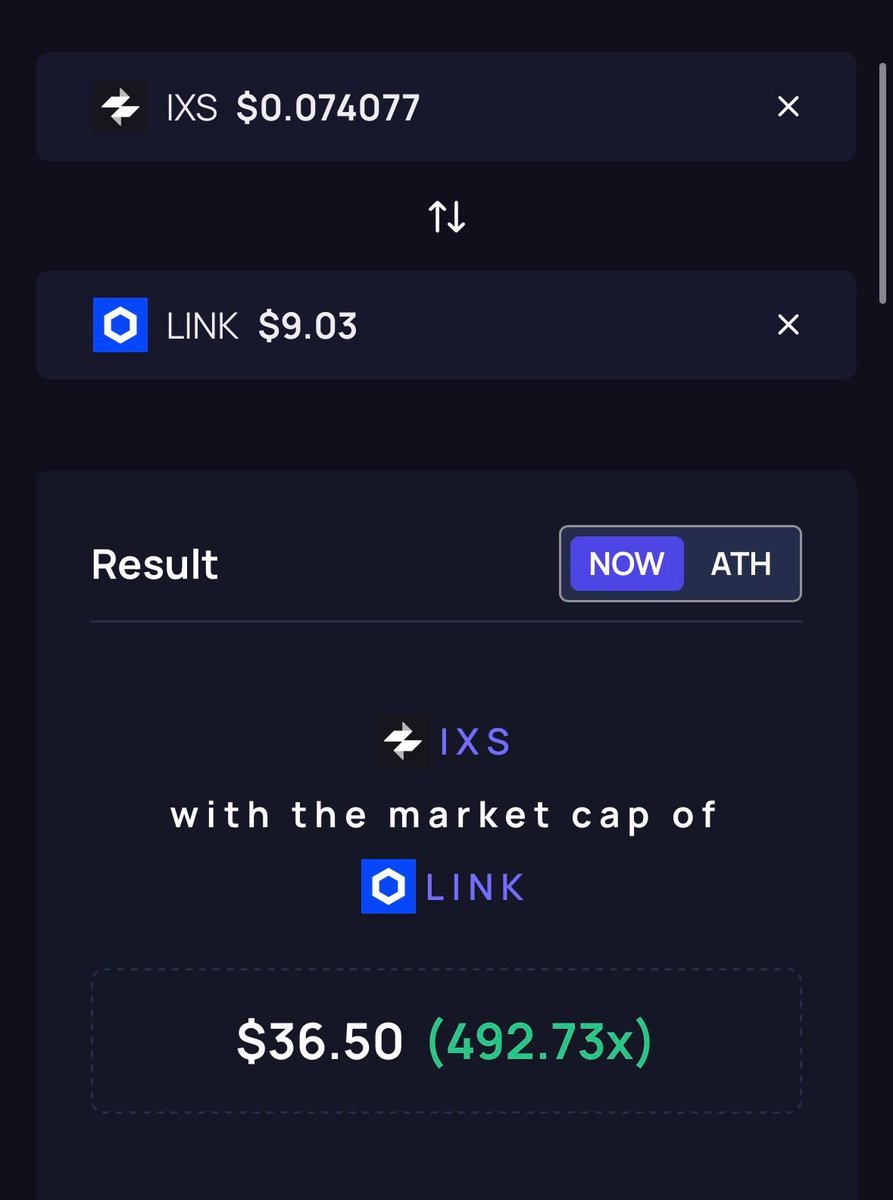
At that price, @BitGo’s institutional stack alone would be worth roughly $182.1 Billion.
If just 5% of that "idle" capital migrates to BTC Real Yield via @IxsFinance:
~ $9.1B in $BTC pledged as collateral.
~ $4.5B in RWA AUM (at 50% LTV).
~ $13.6B Total TVL.
We are watching the birth of the most productive plumbing in financial history.
$IXS would be in line for a 492x at a 50% MC:TVL ratio—a benchmark conservative for established yield-generating infrastructure.
If this doesn’t make you excited, I don’t know what will.
The "Idle Era" is officially over. 🎰🧪
For those of you who don't fully grasp the MAGNITUDE of what is happening with STRC and Bitcoin right now... let me spell it out for you.
Strategy has likely already acquired ~4,000 Bitcoin or so in the first half hour of trading today, assuming last week's capture rate above $100.
Let's take that as $302 million in cash.
This is money that NEVER has to be paid back, because it isn't debt.
Take $302 million and apply a 25% CAGR (this is considerably LESS than the Bitcoin Power Law... just to be CONSERVATIVE).
After a decade this is $2.8 BILLION.
For that decade, Saylor has to pay a dividend. It's an 11.5% dividend right now, but it'll probably drop as the perceived risk profile drops the larger the Bitcoin hoard gets.
But remember, just to be CONSERVATIVE, let's keep the 11.5% number. That means over the decade that is $347.3 million in dividend payments.
The dividend amount is FIXED in DEPRECIATING FIAT and the Bitcoin acquired is APPRECIATING.
Over a decade, that is $2.5 BILLION CAPTURED.
From HALF an HOUR of trading.
Saylor is giving the way out to the fixed investors earning 3% by lending to governments that are going insolvent.
This is the biggest pool of capital on EARTH, straight into Bitcoin.
You are early still. But you won't be for long.
It would be a REAL SHAME if the entire world found about this...
THIS IS THE BITCOIN SINGULARITY.
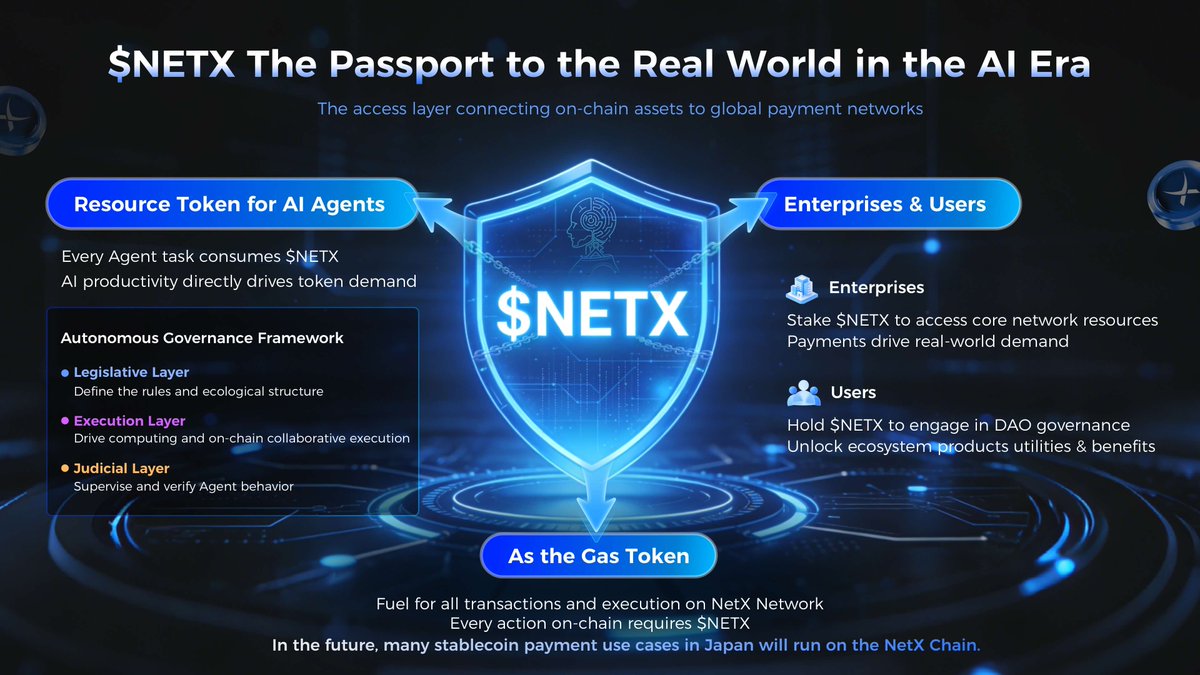
In an AI-driven future, $NETX is no longer just a token — it becomes the passport for digital entities to access the real world.
A unified value network connecting AI, payments, and commerce,🤖where every computation, execution, and action is measurable, verifiable, and monetizable.
Explore more about $NETX:
🔹 $NETX Energy Tower — the core powering the new economic network
https://t.co/G5OAPrGkC9
🔹Activate Your Intent-Based Transactions with $NETX
https://t.co/HOsR4Y7ccq
Together, let’s embrace the new economic era.🚀
@WEAJapan@web3_jp_infra@anbangr@NNGNetX@teamz_inc@BSCNews@BitcoinNews@Kouhou_NSS
#LetsGoNetX
🚨 $QUBIC just mined a DOGE block using UPOW.
That’s 10,000 DOGE in one block.
Now zoom out 👇
Dogecoin produces ~10,000 coins every minute.
If $QUBIC ever reaches 51% of total mining power:
⛏️ ~5,100 DOGE per minute
⛏️ ~306,000 DOGE per hour
⛏️ ~7.3M DOGE per day
At $0.15 DOGE = ~$1.1M/day equivalent
But here’s the real story most people are missing 👇
This is NOT just about mining.
Dogecoin is merge-mined with Litecoin
Meaning the network is secured by massive global compute.
What QUBIC is testing is something bigger:
👉 Can distributed compute be redirected dynamically
👉 Can idle compute be monetized in real time
👉 Can AI + compute networks generate continuous yield
Think about the future:
AI workloads need massive compute.
Most of that compute sits underutilized globally.
Now imagine:
AI compute ⇄ redirected when idle ⇄ mining PoW ⇄ generating value
That means:
🧠 AI infrastructure doesn’t just consume resources
⚡ It can produce economic output when idle
That’s a fundamental shift.
Not just “AI needs compute”
But compute becomes a revenue layer
Reality check:
51% dominance is extremely unlikely.
But even a small % of global hashpower at scale = real, continuous yield.
That’s the thesis.
$QUBIC isn’t just mining DOGE…
It’s exploring how AI-era compute becomes monetizable infrastructure.
If that works, this is much bigger than crypto.
$QUBIC 🚀