There are 3 billion fewer birds in North America than there were in 1970.
This data is from a 2019 Science paper that combined 48 years of citizen-science bird counts with continent-wide weather radar tracking nighttime migration.
The losses are concentrated in the birds people see most often: grassland birds (down 53%, 700 million gone), forest birds (1 billion gone), and shorebirds (down 37%). Even common species (blackbirds, swallows, warblers) are vanishing.
Habitat loss is the biggest reason, but the rest of the list is short and largely fixable for the average person.
1. Pesticides killing the insects birds eat.
2. Outdoor cats kill an estimated 2.4 billion US birds annually.
3. Window collisions killing roughly a billion more. Lawn chemicals.
4. Light pollution disrupting migration.
What you can do, ranked by impact: keep cats indoors, treat your windows for bird strikes, plant native trees and shrubs, stop spraying pesticides, leave the leaves and seed heads through winter, and turn off outdoor lights at night during spring and fall migration.
No one person killed 3 billion birds, obviously, but your yard can be a part of the solution that rebuilds their numbers.
Keep Android open. Google's proposed start for blocking "unverified" apps is this year, 2026, and runs through Play Services, which Google can modify at any time. https://t.co/2ObMwn8J26 #KeepAndroidOpen
"Hidden Horizons" is the topic and Szilvia Fábián the speaker in Bratislava on Wednesday, 6 May at 17:30. Come join us to learn about interpreting everyday and symbolic life of Late Copper Age societies in the Carpathian Basin. #archaeology
"Palaeoenvironmental reconstruction of the polycultural archaeological site Vajnory--Farkasek, SW Slovakia." Join us in Bratislava on Wednesday, 15 April at 17:30 to hear Peter Pišút. #archaeology
Is the "Big Idea" in archaeology being downsized?
With the closure of J. of World Prehistory and length cuts at JAR, publishers are prioritizing volume (and APC fees) over deep research. We lose the space for complex syntheses.
https://t.co/gZAGko0DBo
#Archaeology
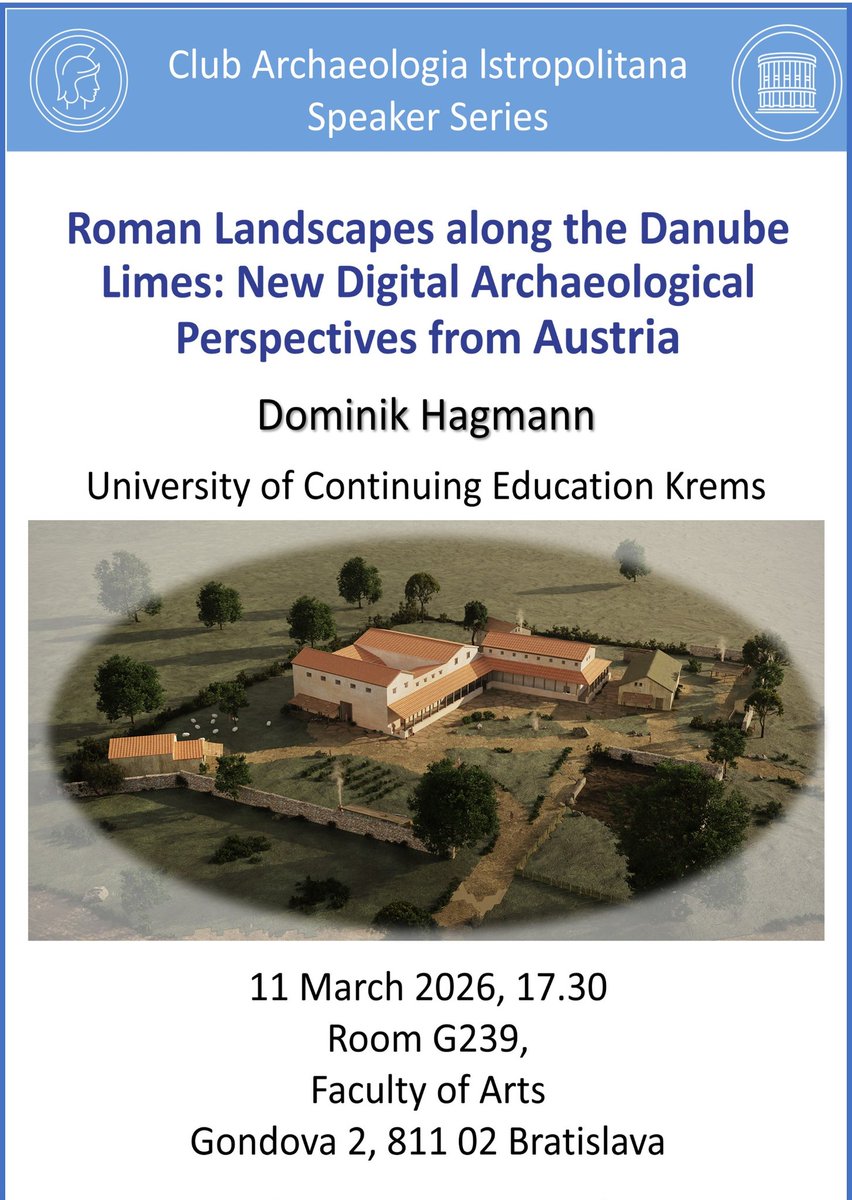
Roman Landscapes Along the Danube Limes! Dominik Hagmann! Coming tomorrow to the Faculty of Arts, Comenius University Bratislava. Don't miss it! #archaeology
@jaynordlinger My, it's difficult to comment on your post about the Superbowl halftime show. Elsewhere in that post you mentioned collecting language. If you collected Spanish, you might hear the string of obscenities and vulgarities given to the public in that lovin' life show.
A recent survey of nearly 900 postdocs at the Max Planck Society reveals:
🔹 28% show signs of severe depression
🔹 25% struggle with severe anxiety
🔹 More than half oppose contract caps that force them out after 4–6 years
🔹 International researchers (75% of the cohort) face extra hurdles: bureaucracy, language barriers, even bullying
Postdocs carry much of the research load, yet remain overworked, undervalued, and uncertain about their future.
If global research institutions can’t retain talent, support mental health, and offer real career pathways, how sustainable is the system?
Link to the Nature article:
https://t.co/8CznV3dWb3