Moats! Does anyone have one anymore?
Yes. Yes, they do.
But only a small subset of what people call moats create real long-term value and defensibility.
Not actually a moat:
1. Distribution: This does matter more than ever. Building products has gotten easier, but getting them to customers has not. Distribution, however, does not create durable defensibility. It helps create the raw ingredients for one, but it is not itself a moat.
2. Execution: Yes, speed is critical for startups. But a company that has to sprint forever is not a good business. Ultimately, it will misstep, slow down, and competition will catch up. Speed gives a company more shots on goal as it tries to build a great product and a great business, but it must eventually find something more durable.
3. Brand: The idea is that when everyone is building the same thing, the most resonant brand will win. But for startups, brand works more like customer acquisition spend: Put money in, get growth out. It’s not something that will effectively keep others from competing long-term. Brand can become a true moat over time (as with Coke or Nike or Apple), but it just takes too long to really matter for most startups.
What you're looking for is compounding advantages: a self-reinforcing flywheel that gets stronger and stronger over time, ultimately making a company very hard to compete with long-term.
There are only four compounding advantages that really matter. Every major tech company has at least one:
1. Switching costs: The more deeply embedded a product is in the way a customer works, the harder it is for that customer to switch. This increases retention and revenue per customer, which can be reinvested into the product.
2. Network effects: The more users a product has, the better it gets for everyone. This increases engagement and attracts more users.
3. Scale economies: The more volume a company has, the larger and more efficient its operations can be. This lowers unit costs, funding lower prices or a better product at the same price, further driving up volume.
4. Data effects: The more usage a product has, the more data it generates. This data can be used to improve the product and increase usage.
If you can’t see the potential for any in the startup you’re considering joining, that’s a red flag.
In today’s incredible post, @danhockenmaier shares a simple framework you can run in about an hour after getting an offer:
1. Identify a startup’s compounding advantage
2. Gauge how strong it could get
3. Measure whether it’s working
Inside: dozens of real company examples, the specific metrics to track, and benchmarks for what good and great look like.
Read it here: https://t.co/jMdyoPpeF6
Can there be a one-size fit all approach for paid media for all brands? Absolutely no
But, can there be a basic paid media strategy template which works for most digital first consumer brands in the 0-100 cr journey?
I think, yes. And this is how I would go about it 👇👇
He sold over 20,000,000 pairs of sunglasses with a 240 word story.
And is considered to be one of the greatest copywriters, ever.
Here’re 5 of Joe Sugarman’s most powerful writing secrets:
(Starting with the two he called “THE most powerful”)
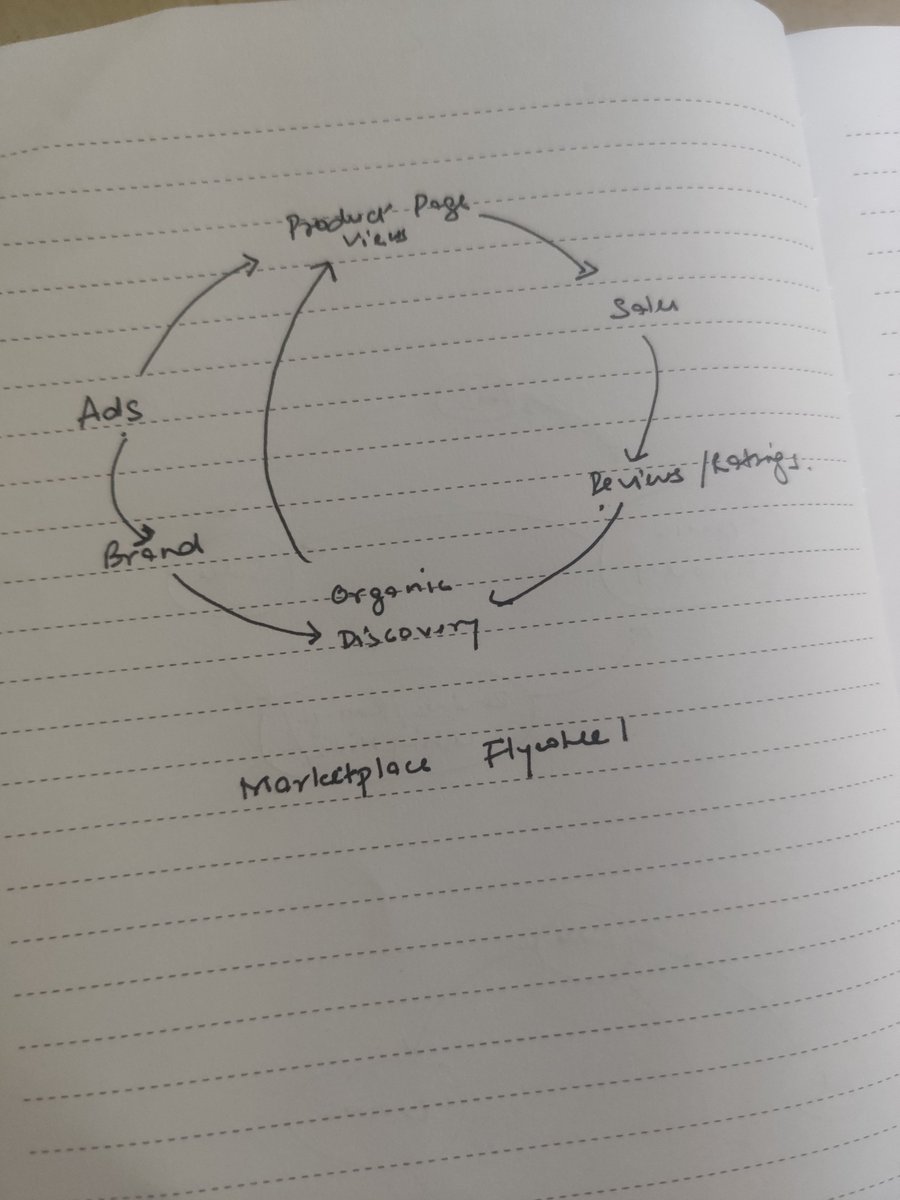
Compounding channels are those where profitability increases with scale. The 3 most compounding ones are GT, EBO and Amazon. And for new age consumer brands, the easiest compounding channel to crack is often Amazon
The Amazon Flywheel, and how to get it moving
Explained Below👇
Presenting 'Beautiful Stranger' - our maiden research report on Beauty in Bharat. Link in the thread below : hope you enjoy reading the insights we so enjoyed discovering. 1/3
Spring turns 4 today. In human terms, we're a pre-schooler. And true to form, we're big fans of NapTime, and not averse to colouring outside the lines.
Luckily though, we never struggle with the "school nahin jaana hai" sentiment.
#SpringTurns4#SpringIsHere