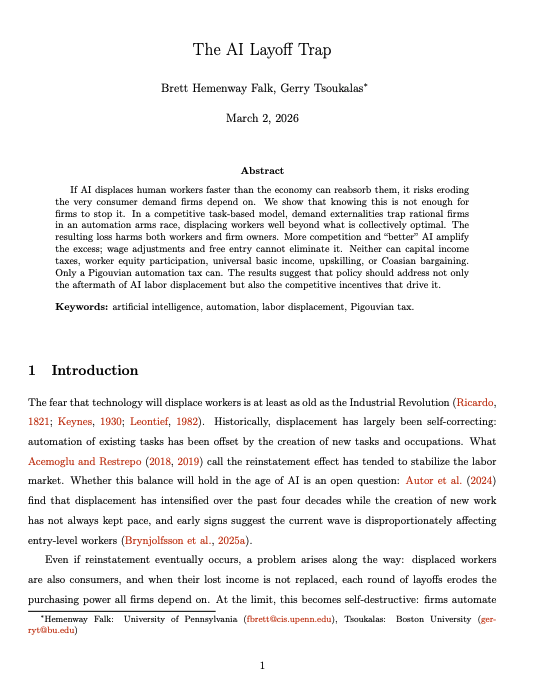
🚨BREAKING: Two researchers from UPenn and Boston University just published a paper that should be uncomfortable reading for every CEO automating their workforce right now.
The argument is straightforward. Every company replacing workers with AI is also eliminating its own future customers. Laid off workers stop spending. Enough of them stop spending and nobody can afford to buy anything. The companies that fired everyone end up selling into an economy with no purchasing power left.
Every executive can see this. The math is not complicated. But here is why nobody stops.
If you do not automate, your competitor does. They cut costs, lower prices, take your market share, and you collapse anyway. So every company automates knowing it is collectively destructive because the alternative is dying alone while everyone else survives. The researchers proved this is a Prisoner's Dilemma playing out in real time.
The numbers are already moving. Block cut nearly half its 10,000 employees this year. Jack Dorsey said AI made those roles unnecessary and that within the next year the majority of companies will reach the same conclusion. Salesforce replaced 4,000 customer support agents with AI. Goldman Sachs deployed a coding tool that lets one engineer do the work of five. Over 100,000 tech workers were laid off in 2025 and AI was cited as the primary driver in more than half those cases. 80% of US workers hold jobs with tasks susceptible to AI automation.
The researchers tested every proposed solution. Universal basic income does not change a single company's incentive to automate. Capital income taxes adjust profit levels but not the per-task decision to replace a human. Collective bargaining cannot hold because automating is always the dominant strategy.
They also identified what they call a Red Queen effect. Better AI does not solve the problem, it accelerates it. Every company chases faster automation to gain market share over rivals but at the end everyone has automated equally, the gains cancel out, and the only thing left is more destroyed demand.
The one thing the math says could work is a Pigouvian automation tax. A per-task charge that forces companies to account for the demand they destroy each time they replace a worker.
The conclusion is that this is not a transfer of wealth from workers to owners. Both sides lose. Workers lose income. Companies lose customers. It is a deadweight loss with no market mechanism to stop it on its own.
(Link in the comment)
Anthropic just published the most unusual launch chart in frontier AI history.
Look at the rightmost column. Mythos Preview beats Opus 4.7 on SWE-bench Pro by 13 points, on SWE-bench Verified by 6, on Terminal-Bench by 13, on Humanity's Last Exam by 10. Mythos is Anthropic's own model. They're not releasing it publicly.
Project Glasswing, announced last week, is the reason. Mythos developed working exploits for patched Firefox vulnerabilities 181 times where Opus 4.6 succeeded twice. It hit tier-5 control flow hijacks on ten fully patched targets in fuzz testing. Anthropic decided the cyber capabilities were too dangerous to ship broadly, gated it to defensive security teams on Bedrock and Vertex, then used it as the comparison ceiling on the launch slide for the model they will ship.
Read what just happened. Anthropic deliberately reduced Opus 4.7's cyber capabilities during training. They shipped the weakened version. Then they published a chart showing exactly how much capability they left on the table for safety reasons, with the unreleased model labeled by name in the rightmost column.
OpenAI doesn't do this. Google doesn't either. The standard playbook is to make the released product look like the frontier and quietly sit on more capable internal versions. Anthropic drew a line on the floor labeled "what we shipped" and a line on the ceiling labeled "what we have," then told you the gap is a deliberate safety choice.
What beats Opus 4.7 on most rows is the throttle Anthropic put on Opus 4.7.
INDIAN CLUB MINERVA IS ABSOLUTELY THRASHING LIVERPOOL FC AT MIC CUP 🔥🔥🔥
🇮🇳 MINERVA ACADEMY 3-0 LIVERPOOL 🏴
Still can't belive this is real, Wooooow!!!!!!!
The Bank of Canada 🇨🇦 just published a 32-page report on DeFi lending.
It found Canadian banks average a 0.65% non-performing loan rate. Aave is 0%.
Canadian banks average a 1.69% net interest margin. Aave is 0.64%.
Canadian banks average a 74.2% loan to deposit ratio. Aave is 40%.
M&A due diligence is important: if you miss things, even little piglets can grow into a headache worth hundreds of millions of dollars
Today in my MBA M&A class, I discuss one of my favorite DD stories: the $200M+ piglet problem Koch Industries faced when it acquired Purina Mills
Purina was seen as a critical deal in Koch's plans to create a national network of wet animal feed mills. There were great synergies projected, and the $670M deal was highly leveraged.
Going into the transaction, Koch execs knew that Purina owned some piglets that it would buy to sell to pig farmers as a part of a business model that had the farmers locked into purchasing only Purina pig feed.
The piglet thing was seen as "strange" but also as only a small part of Purina's business that amounted to "limited exposure" and as the deal was rather rushed and strategically important, Koch didn't pay much attention to the piglet business.
Yet as the hog prices crashed in 1997 from about $0.53 to $0.10 a pound, it turned out that the farmers contracting to buy the pigs from Purina had an option to walk away. And it so turned out that the size of the problem was much bigger than expected because Purina was contracting for millions of pigs.
Very quickly, Purina was facing hundreds of millions of dollars in losses on the piglet trade. Given the degree of the leverage, Koch decided to put Purina into a bancruptcy and to walk away, claiming it was a separate business from Koch Industries. The lenders, who depended on Koch's reputation and balance sheet, fought back, and from a legal perspective had a strong case for piercing the corporate veil. Humiliated, Koch Industries agreed to invest more money into Purina restructuring, while at the same time taking further restructuring losses and dismantling much of its agro business.
Moral of the story? Pay attention in DD, because even seemingly irrelevant and immaterial quirky piglet contracts can turn out to be a major deal-destroying factor down the road.
In short: no. I was a wall st market maker 15 years ago, explicitly exploiting inefficiencies in products like ETFs. Market makers absolutely do “game the system” in all sorts of ways, but for liquid products like BTC ETF, their actions mostly have the effect of adding meaningful but small costs to consumers; it doesn’t meaningfully change the asset price.
For example, market makers may manipulate the price to run stop limit orders. But that’s typically on an intraday timeframe. So they might run an asset like MSFT or BTC 2% in a weak market to trigger stops, then a few seconds or minutes later, the price is mostly back to where it was before. I.e. the price manipulation activities are typically small price moves, made and reverted quickly.
Why is BTC down? Because OGs sold tens of thousands of coins, and not enough people wanted to buy them.
There are rare exceptions where wall street manipulates an asset in major ways longer term, but this is quite rare because it’s very risky and not as easy as it looks to profit. 99% of the time that an asset isn’t moving like you want and people are crying “manipulation”, it’s best to embrace the cognitive dissonance, avoid the “easy way out” of blaming manipulation, and work to improve your predictive models to better match reality. 1% of the time it really is manipulation as the primary factor. Lastly - everything I’ve written only applies to *short* manipulation. Manipulating stuff *higher* (including bitcoin) happens all the time across many assets.
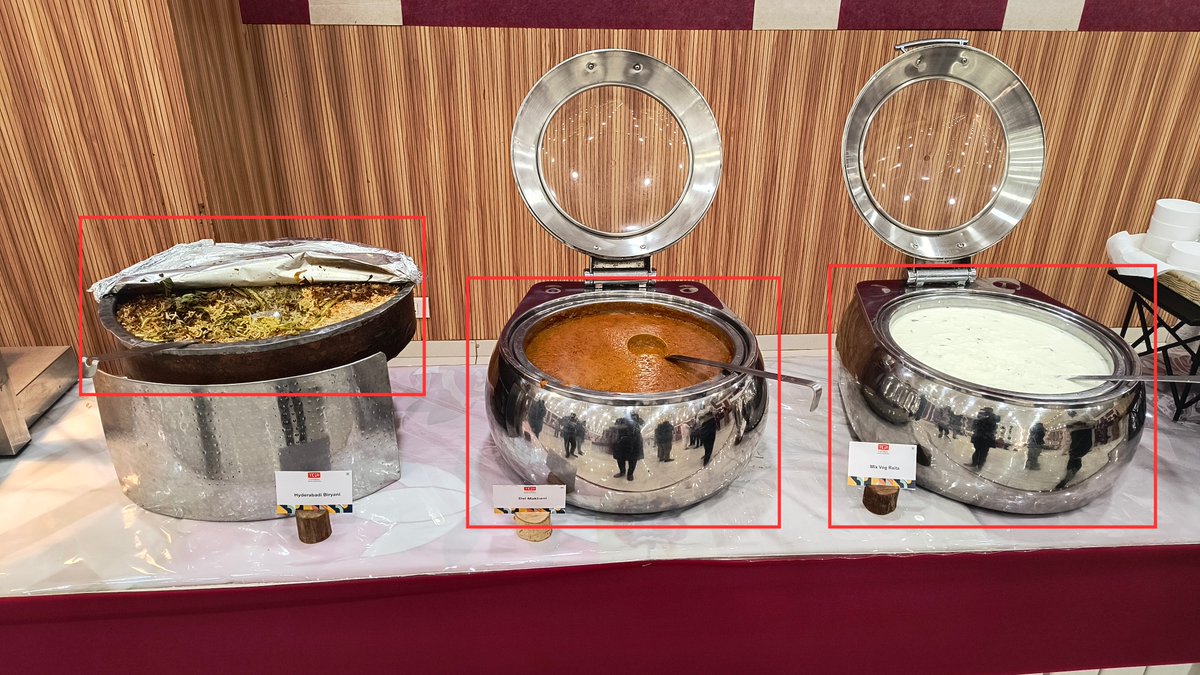
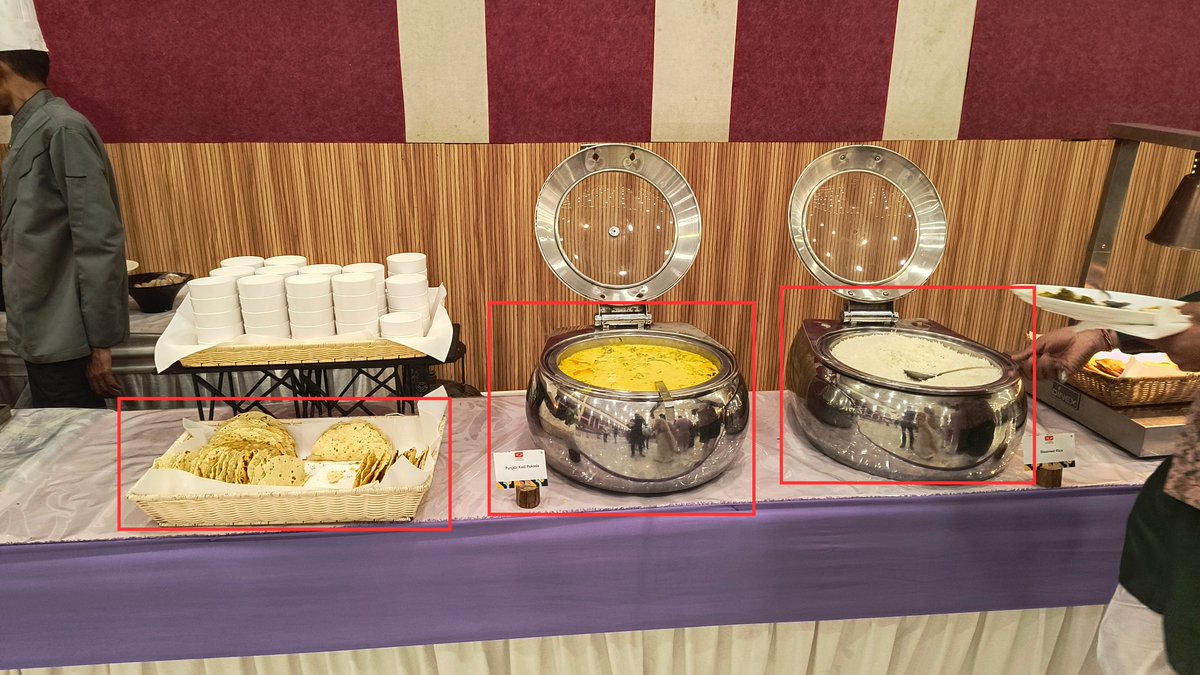
indian wedding buffet is a scam. i always leave regretting something. so i built BuffetGPT 😠
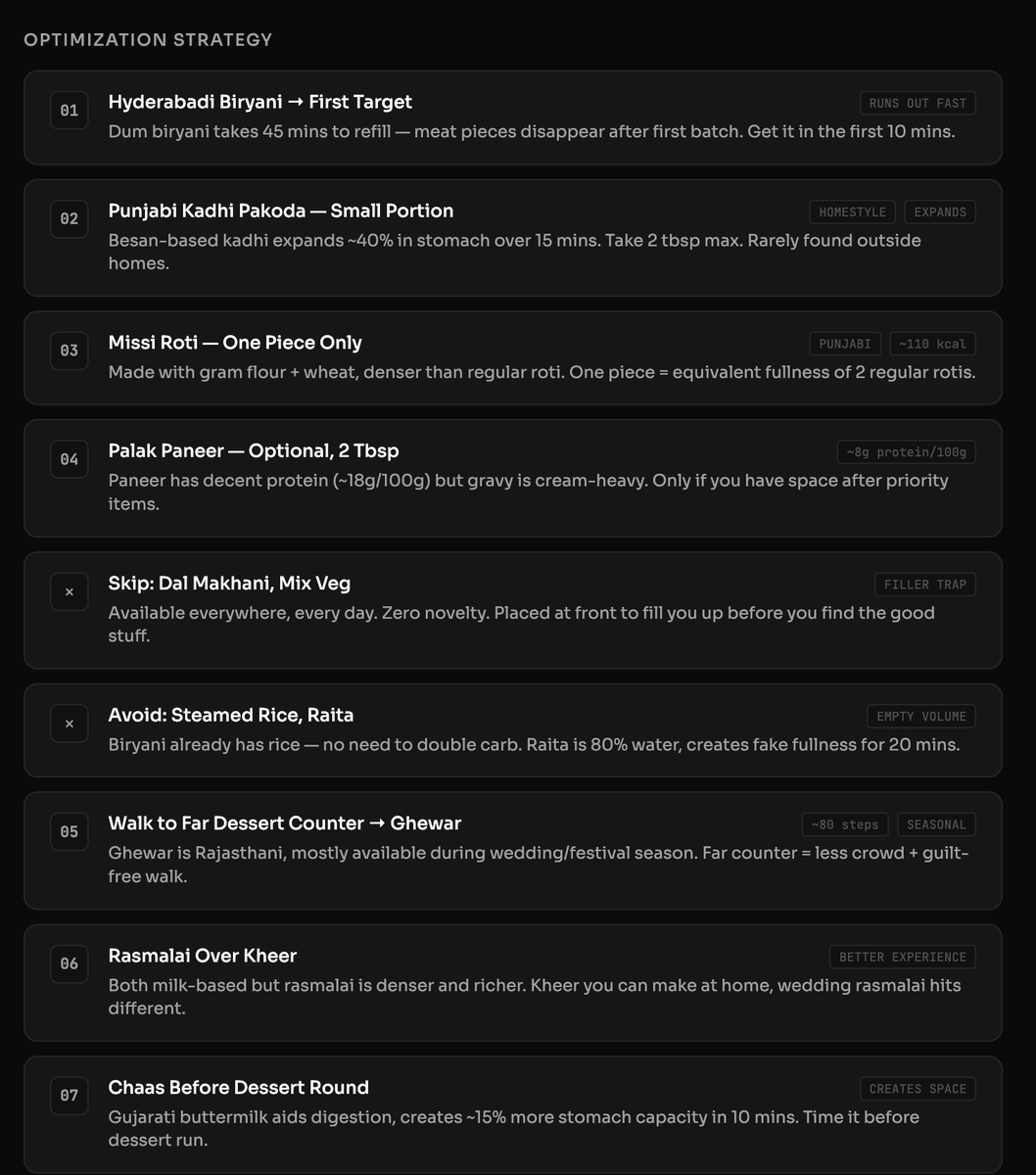
an ai agent that scans entire buffet and gives you a game plan.
it uses computer vision to detect every dish, then optimizes what to eat, what to skip, and how much based on actual stomach volume physics.
its' pretty early, tested alpha at a friend's wedding. decent results.
tbh, this is what my cs degree was for.
Ex-best trading companies quant proving that his exchange is better than other by copy-paste one orderbook snapshot on one instrument. I have never seen greater analysis in my life. It's like me explaining to investors that I made $100 in a second so extending it to whole year is over $3bn profit.